Traditional phone screens feel lightweight, but they are usually where the interview process loses the most signal. Different recruiters ask different questions, spend different amounts of time, and score candidates based on memory instead of a consistent rubric. The result is a stage that looks efficient and is, in fact, the noisiest decision in your entire loop.
The fix isn't "interview harder." It's structure — and AI is the first thing that makes structure cheap enough to run on every candidate, every time.
What the research actually says
This isn't a new finding. The selection-psychology literature has been remarkably consistent for decades: structured interviews are among the strongest predictors of on-the-job performance, while unstructured interviews barely outperform chance. The same studies that crown structured interviews also show that unstructured ones are easily beaten by a simple work sample or a short cognitive measure.
The mechanism is intuitive once you name it. An unstructured interview measures two things at once: the candidate's ability, and the accident of which interviewer they drew, what mood that person was in, and whether the conversation happened to drift toward the candidate's strengths. Structure strips out the second variable so you're left measuring the first.
The core problem with the unstructured screen
When the first interview is unstructured, teams confuse confidence with competence. A candidate who happens to match the recruiter's conversational style can outperform someone with stronger job-relevant ability. That makes calibration downstream much harder, because every later stage inherits a filter it can't trust.
Three failure modes show up again and again:
- Question drift. The screener improvises off the résumé, so no two candidates are measured on the same competencies.
- Similarity bias. Shared background, vocabulary, or rhythm reads as "sharp" — a halo that has nothing to do with the job.
- Memory decay. The verdict gets written after the next two meetings, so the record is a vibe, not evidence.
What "structured" actually means
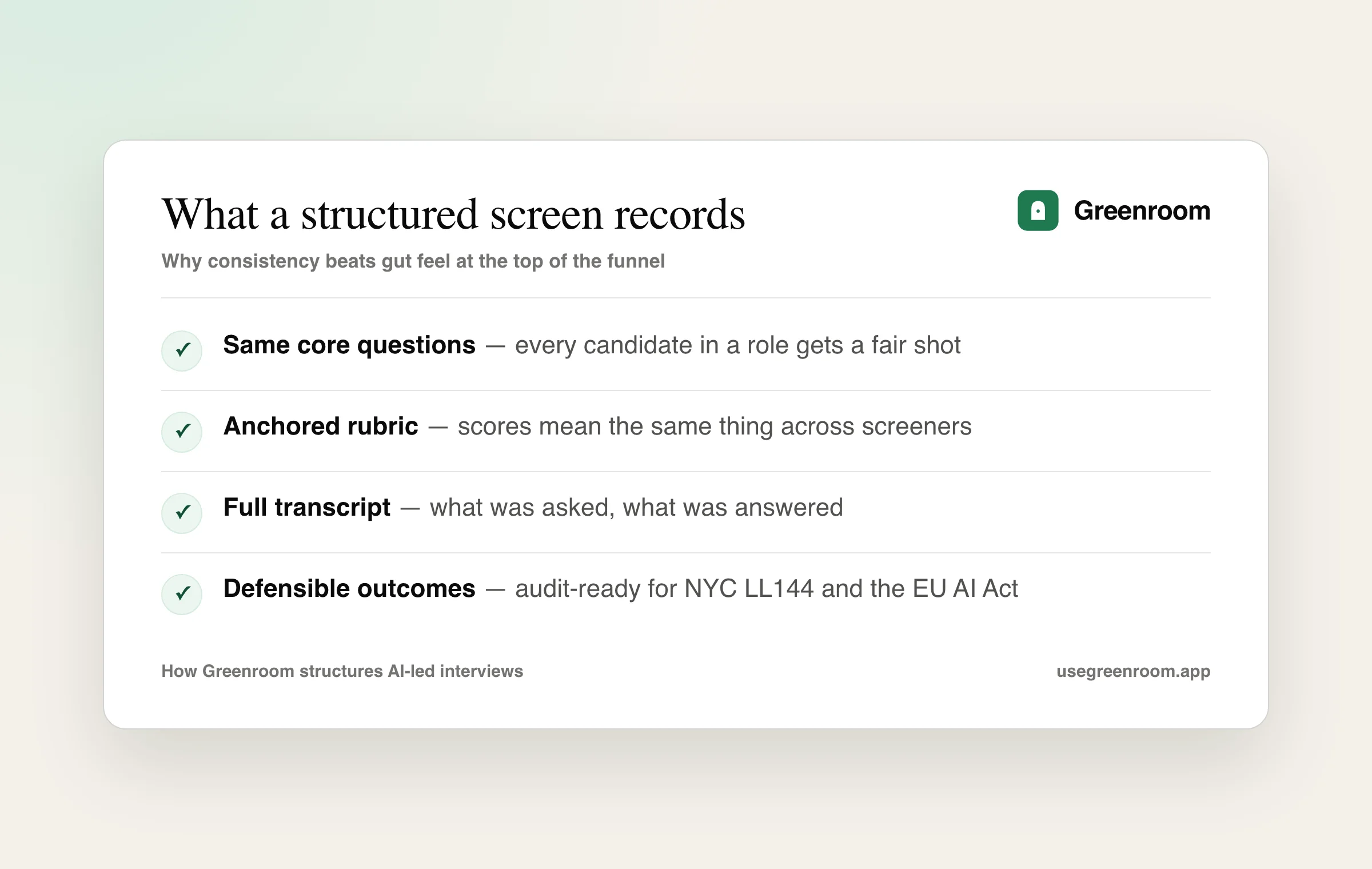
Structure is often misread as "rigid script." It isn't. A structured interview has four properties, none of which require robotic delivery:
- A fixed competency map. You decide in advance what the role actually requires, and every question maps to one of those competencies.
- The same core questions for every candidate in a given role, so scores are comparable.
- An anchored rubric — concrete descriptions of what a 2 vs. a 4 answer looks like — so "strong" means the same thing across screeners.
- A durable record of what was asked and how it was judged, captured at the moment, not reconstructed later.
Crucially, structure and conversation are not opposites. The best structured interviews still allow natural follow-ups — "why did you choose that?" — within a consistent frame. You get the warmth of a conversation and the rigor of a measurement.
What structured AI changes
A structured AI interview does not solve hiring by itself. What it does is enforce consistency at the top of the funnel: same competency map, same question ladder, same scoring frame, same transcript for review. The thing that historically made structure expensive — the discipline to run it identically on candidate #1 and candidate #80 at 6pm on a Friday — is exactly what software is good at.
That consistency raises the floor on fairness and makes later human review more defensible. And because the AI conducts the session by voice, it also captures the part a résumé can't show: how someone reasons out loud, recovers from a hard question, and explains a decision they actually made.
What it does not do
It's worth being honest about the limits, because over-claiming is how "AI interviewing" earned its skeptics:
- It doesn't make the final decision. It replaces the inconsistent first filter, not human judgment. Humans still decide — they just decide from comparable scores and full transcripts instead of half-remembered gut feel.
- It doesn't eliminate bias by magic. A rubric written carelessly can encode bias just like a person can. Structure makes bias visible and auditable, which is the precondition for fixing it — see our note on bias audit logs.
- It isn't a replacement for a work sample. For many roles the strongest signal still comes from doing the actual work. A structured screen is the filter before that, not a substitute for it.
The practical outcome
Hiring teams get cleaner inputs before onsite decisions. Candidates get a more legible process — the same questions, a clear rubric, and no dependence on which interviewer they happened to draw. And compliance teams get an audit trail instead of vague notes like "seemed sharp."
That audit trail is increasingly not optional. Both NYC Local Law 144 and the EU AI Act push hiring teams toward exactly the artifacts a structured screen produces by default: consistent questions, anchored scores, reviewable records. Structure turns a compliance burden into a by-product.
Structured AI is not useful because it is AI. It is useful because it removes avoidable randomness from screening — and randomness, at the top of the funnel, is the most expensive thing you can have. (We put a number on it in the hidden cost of a bad phone screen.)
Frequently asked questions
What is a structured AI interview?
An interview where an AI interviewer asks every candidate in a role the same calibrated core questions, scores answers against an anchored rubric, and records the full exchange — combining the consistency research favors with conversational follow-ups.
Are structured interviews really better than unstructured ones?
Decades of selection research say yes: structured interviews are among the best predictors of job performance, while unstructured chats barely beat chance. Structure removes the noise of who happened to interview you.
Does an AI interviewer replace human judgment?
No — it replaces the inconsistent first filter. Humans still make the decisions; they just make them from comparable scores, full transcripts and defensible records instead of half-remembered gut feel.
How does Greenroom keep AI-led screens fair?
Same core questions per role, rubric-anchored scoring, full transcripts, and audit-ready exports (relevant for NYC Local Law 144 and the EU AI Act). Consistency is the fairness mechanism.