She said yes immediately, the way you agree to a terms-and-conditions box. Yes, absolutely, no problem at all. The recruiter wrote it down. Six weeks later an offer arrived for a Pune office, a city she had never visited, starting in eighteen days, and she spent a weekend working out how to tell them that "yes, absolutely" had actually meant "please continue considering me."
"Are you willing to relocate?" is one of the few interview questions where the reflexive people-pleasing answer is genuinely dangerous, because unlike most interview claims, this one gets tested — with a joining date, a city, and a lease. It is also a question where a clear "no" costs you far less than most candidates fear, and a vague "maybe" costs far more. Here is what the question is actually checking and how to answer it in each of the four honest positions you might be in.
What the interviewer is really asking
Rarely just geography. Usually one of these:
- A logistics check. The role sits in a specific office and they need to know if the pipeline is wasted. This is the most common version and it is entirely practical.
- A commitment probe. Especially in India's service companies and in graduate programmes, where new hires are allocated to a base location and attrition after allocation is expensive. They are testing whether you will accept an allocation, not whether you love travelling.
- A flexibility signal. Some interviewers read willingness to relocate as a proxy for adaptability. This is a weak proxy, but it exists, which is why a bare "no" benefits from one sentence of reasoning attached.
- A negotiation opener. If relocation is expensive for them, your answer influences what they offer — a relocation allowance, temporary accommodation, or a later joining date.
Knowing which version you are facing changes the answer, and you can usually find out by asking one question back, which we will get to.
The four honest answers
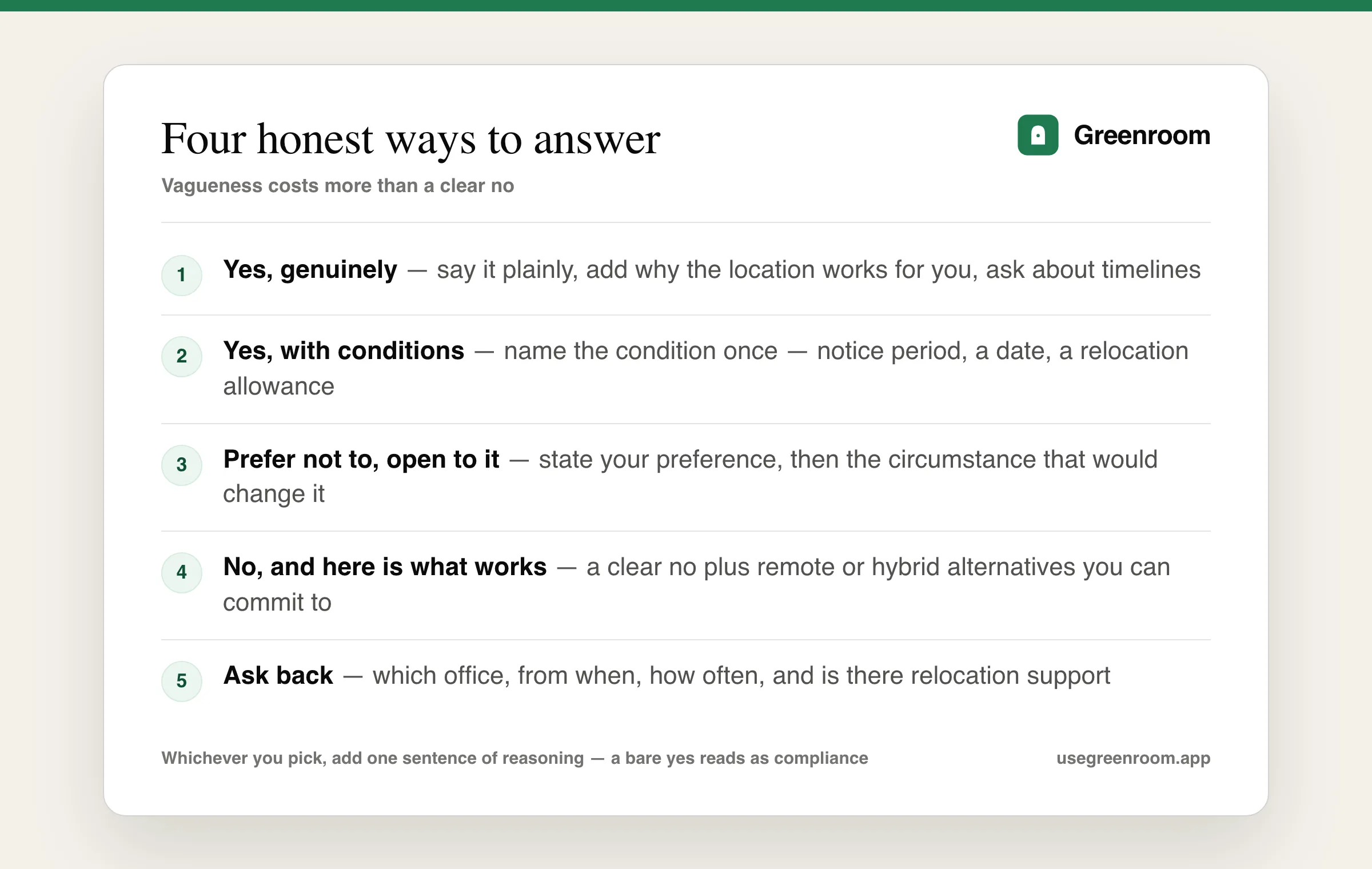
If the answer is a genuine yes. Say it plainly and add a reason, because a bare yes reads as compliance rather than intent. "Yes — I'm open to relocating, and Bengaluru in particular works well for me since most of my professional network is already there. Could you tell me which office this role is based in and when you would expect a start?" You have answered, given a reason, and asked the follow-up that gets you the real information.
If it is yes with conditions. Name the condition once, clearly, and do not apologise for it. "Yes, I'm willing to relocate. I have a sixty-day notice period, so realistically I could join in the first week of November — does that work with the timeline?" Or: "Yes, and I'd want to understand whether there's relocation support, since I'd be moving with family." Conditions stated once are professional. Conditions revealed gradually over three rounds are the thing that annoys recruiters.
If you would prefer not to but could be persuaded. This is the most common real position and the one people express worst. Give the preference first, then the circumstance. "My preference is to stay in Hyderabad, mostly because of family. That said, for the right role I'd consider relocating — particularly if there were an initial remote period or hybrid arrangement. What does the team currently do?" That is honest, specific, and leaves the door open without misrepresenting anything.
If the answer is no. Say it clearly and immediately offer what does work. "I'm not able to relocate — I have a family commitment here that is fixed for the next couple of years. I am set up for remote work and I'm happy to travel for onsite weeks if the team does those. Is that workable for this role?" A clean no plus a concrete alternative is respected. If the role genuinely requires the office, you have both saved four weeks, and honestly, that is a good outcome. Our remote job interview tips guide covers making the remote case credibly.
What to ask back
The question is an opening, and most candidates forget they are allowed to use it. Useful returns:
- "Which office is this role based in?" Surprisingly often the answer is "a few of them" or "we're flexible", which changes your whole answer.
- "From when would relocation be required?" A start date of "immediately" and "within six months" are different questions.
- "How often is the team expected in the office?" Three days a week and five days a week are different lives.
- "Is there relocation assistance?" Entirely normal to ask, and the answer tells you how much they want this filled.
- "Is the base location fixed, or allocated later?" Critical for Indian service-company graduate programmes, where allocation often happens after joining and after training.
Our questions to ask at the end of an interview guide covers how to place these without sounding like you are interviewing them.
The India-specific version
For TCS, Infosys, Wipro, Cognizant, Capgemini and similar mass-recruiting programmes, this question is close to a formality with a real consequence. Base locations are allocated by the company, sometimes only after training, and the expected answer for a graduate hire is essentially "yes, anywhere in India."
Answering no at that stage usually removes you from the programme, so the honest calculation is whether you want the offer on those terms. If you have a genuine constraint, say it — some companies do accommodate documented medical or family situations — but do not assume flexibility that has not been offered. Our campus recruitment process explained guide covers how allocation actually works.
For product companies and startups the question is far more negotiable, and hybrid arrangements are common enough that a preference is usually heard as a preference rather than a refusal.
Mistakes that cost offers
- Saying yes when you mean maybe. The bill arrives with the offer letter, and withdrawing at that point damages a relationship you may need again.
- A one-word no. Without a reason and an alternative, it reads as inflexibility rather than as a considered constraint.
- Negotiating relocation before there is an offer. Asking whether support exists is fine; negotiating the amount in round two is premature. Our salary negotiation guide covers timing.
- Over-explaining. Two sentences about family is respectful. Four minutes makes the interviewer uncomfortable and does not change the outcome.
- Changing your answer between rounds. Interviewers compare notes. If you said yes to the recruiter and hedge with the hiring manager, that is the thing they remember.
Where each prep option actually helps
- Glassdoor and AmbitionBox — genuinely useful for finding out where a company actually bases a given role, before you are asked.
- Your recruiter — the best source, and they will usually just tell you if you ask directly.
- ChatGPT — will draft you a polished paragraph. It cannot tell you whether you actually want to move to Pune, which is the part that decides the answer.
- Greenroom — the spoken layer. Ari, the AI interviewer asks HR-round questions like this one in a real spoken round and follows up on the vague version of your answer, which is exactly where this question goes wrong. Honest tradeoff: Ari does not know that company's office footprint — ask the recruiter.
Rehearse the version you actually mean
Write your one-sentence answer, your one sentence of reasoning, and your one question back. Say all three out loud until they come out in under twenty seconds without hedging. Then have someone push once — "and if the role were only available in Chennai?" — and answer that without changing your original position.
That push is the whole test. Our HR interview questions and answers guide covers the rest of the round this question lives in.
Closely related in 2026, as Indian IT tightened office rules: our office mandate questions in interviews guide covers the five-day question and how to negotiate it.
Frequently asked questions
How do you answer are you willing to relocate?
Answer in one clear sentence, add one sentence of reasoning, then ask a question back. For example: yes, you are open to relocating, Bengaluru works well because your professional network is there, and which office is this role based in and when would you be expected to start. The reasoning stops a yes from sounding like reflexive compliance, and the question back gets you the information you need before committing.
Is it OK to say no to relocating in an interview?
Yes, provided you say it clearly and immediately offer what does work. State the constraint briefly, then propose the alternative — remote work with travel for onsite weeks, or a hybrid arrangement — and ask whether that is workable for the role. A clean no with an alternative is respected, whereas a vague maybe that later becomes a no after an offer is issued damages the relationship far more.
What if you are willing to relocate but only under certain conditions?
Name the condition once, early and without apologising. Common legitimate conditions include a sixty or ninety day notice period, a specific earliest start date, needing to move with family, or wanting to know whether relocation assistance exists. Conditions stated once read as professional planning; conditions revealed gradually across three rounds are what recruiters find genuinely frustrating.
Should you ask about relocation assistance in an interview?
Asking whether relocation support exists is entirely normal and is best done when the question is first raised, because the answer also tells you how badly the company wants the role filled. Negotiating the specific amount is a different conversation and belongs after an offer is on the table rather than in an early round.
How should freshers answer the relocation question in Indian campus placements?
For large service-company graduate programmes such as TCS, Infosys, Wipro or Cognizant, base locations are allocated by the company and sometimes only after training, so the expected answer is effectively yes to anywhere in India. Answering no at that stage usually removes you from the programme, so treat it as a decision about whether you want the offer on those terms, and ask whether the base location is fixed or allocated later.
Does saying yes to relocation commit you legally?
A verbal yes in an interview is not a contract, but it sets the expectation the offer will be built on, and withdrawing after an offer is issued burns a relationship and sometimes a referral network you may need later. Treat it as a real commitment rather than a screening formality, and if your answer is conditional, say so before the offer stage rather than after.