The job ad said hybrid. The recruiter said hybrid. The hiring manager, in round three, said "hybrid, so three days, though our VP prefers four and most of the team is in five." He accepted, moved cities, and discovered in month two that "hybrid" had been doing an enormous amount of work in that sentence.
Return-to-office expectations in Indian IT have tightened noticeably over the past two years. Reporting on the major services firms describes TCS operating a five-day office expectation for many employees, with office presence linked to variable pay and promotion decisions, Wipro requiring roughly six hours a day across at least three days a week, and Infosys tightening its hybrid expectations to a similar shape. Meanwhile survey data consistently shows the opposite preference among employees — one widely-reported figure has 88% of Indian workers describing remote flexibility as important to staying with an employer — and research on rigid mandates associates them with meaningfully higher attrition.
You do not get to resolve that tension. You do have to answer a question about it in an interview, probably more than once. Here is how.
Why you are being asked
- A logistics check. The role is based somewhere and they need to know you will be there.
- An attrition check. This is the real one in 2026. Companies that tightened policy watched people leave, so they now screen for whether you will accept the policy or resent it in six months.
- A negotiation opener. If the policy is soft, your answer influences what they offer. If it is hard, your answer determines whether the conversation continues.
- Occasionally, a proxy for commitment. A weak proxy, but it exists — which is why a flat "no" benefits from a sentence of reasoning attached.
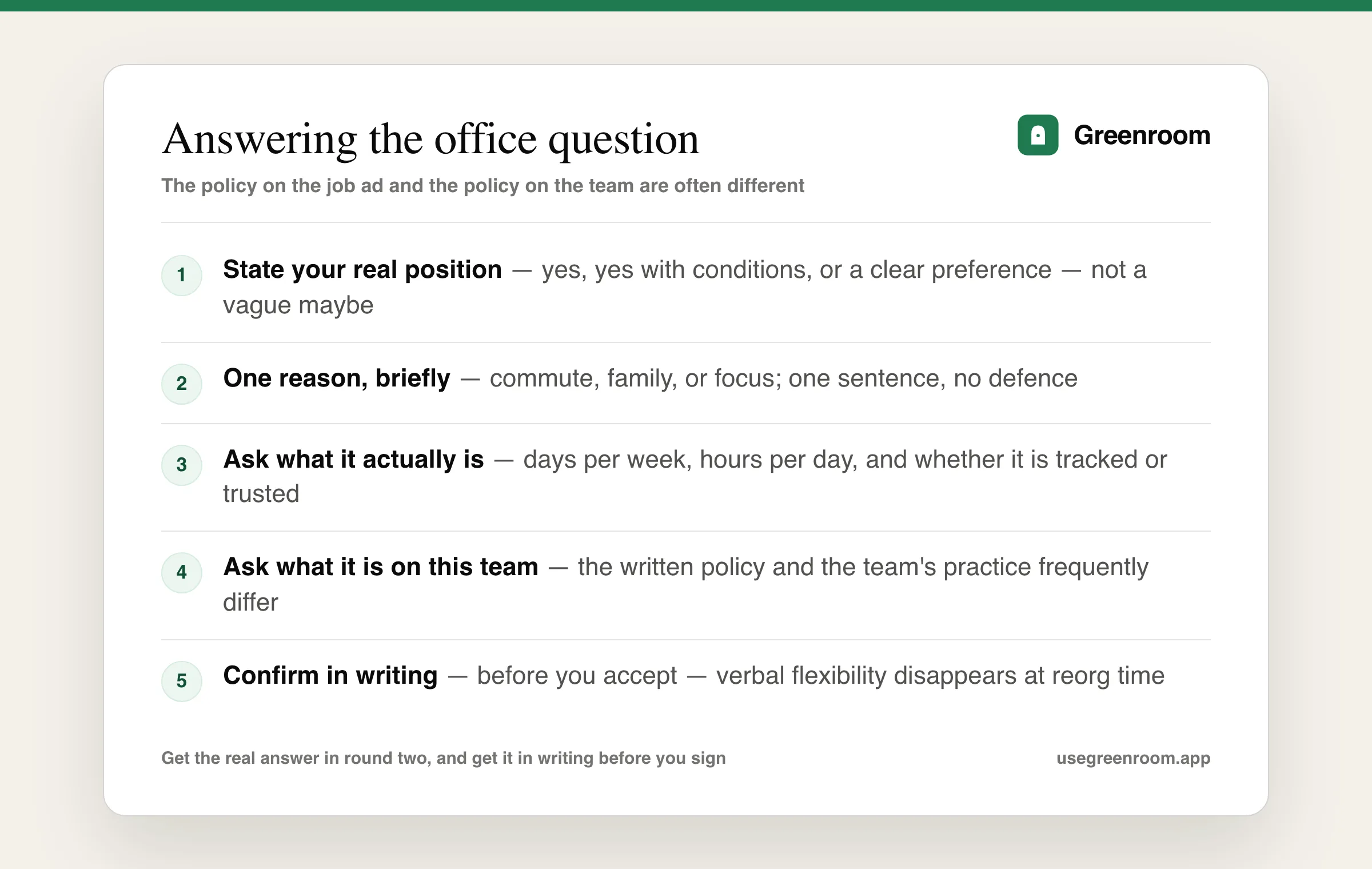
The four moves
One — state your real position. Not a vague maybe, which is the answer that costs the most later. There are only three honest positions and all three are acceptable:
- *Yes.* "I'm fine with five days in office — I actually prefer working from the office, and I'm already in Bengaluru."
- *Yes, with a condition.* "I can do five days. The one thing I'd flag is that I need to leave by 5:30 twice a week for a family commitment, which I'd manage by starting early."
- *A clear preference.* "My preference is three days, mostly because of a ninety-minute commute each way. I can do more when there's a reason — a launch, onboarding, a planning week. What does the team actually do?"
Two — one reason, briefly. Commute, family, focus, caregiving. One sentence. Four minutes of justification turns a preference into a problem.
Three — ask what the policy actually is. Specifically: how many days, how many hours, is attendance tracked, and is it tied to appraisal or variable pay. That last part is the question almost nobody asks and it is the one that has real money attached, given that at least one major firm is reported to link office presence to variable pay.
**Four — ask what it is *on this team*.** The written policy and the team's practice are frequently different in both directions. "What does your team actually do in a normal week?" gets you a much more honest answer than asking about company policy.
What to say when the answer is genuinely no
Sometimes the mandate is a dealbreaker — you have caregiving responsibilities, a health reason, or you simply will not move. Say so clearly and offer what does work:
"I'm not able to do five days in Hyderabad — I have a family commitment here that is fixed for the next two years. I can do a week in office per month, and I'm set up for fully remote work with overlapping hours. Is there a version of this role that works that way?"
That is honest, specific, and it lets everyone stop early if the answer is no. A clean no costs you far less than a vague yes that unravels after you have resigned elsewhere. Our remote job interview tips guide covers making the remote case credibly, and our are you willing to relocate guide covers the adjacent location question.
Negotiating it
Flexibility is negotiable more often than compensation bands are, and it is frequently easier for a hiring manager to approve.
- Negotiate after the offer, not in round two. In the early rounds you are establishing that you are workable; at offer stage you have leverage.
- Ask for something specific. "Three days, with Wednesdays fixed as the team day" is approvable. "More flexibility" is not.
- Trade explicitly. If they need five days, that is a legitimate input into your compensation expectation — a two-hour daily commute has a real cost. Saying so calmly is reasonable. Our salary negotiation for software engineers guide covers the framing.
- Get it in writing. This is the important one. Verbal flexibility granted by a manager evaporates at the next reorg, when that manager is gone and the policy is what the policy says. Ask for it in the offer letter or at minimum in an email from HR.
- Know it can change. Company-wide policy shifts override team-level arrangements, and 2026 has been a year of exactly that. Factor it into whether you would still want the job under the stricter version.
The questions worth asking them
- "How many days a week is the expectation, and is that a policy or a guideline?"
- "Is attendance tracked, and does it feed into appraisal or variable pay?"
- "What does this team actually do in a typical week?"
- "Has the policy changed in the last year, and is another change expected?"
- "Is there flexibility for a specific recurring commitment?"
The reaction to these questions is itself information. A recruiter who answers them plainly is telling you something good; one who deflects is also telling you something. Our red flags in a job interview guide covers reading those signals, and our questions to ask at the end of an interview guide covers where to place them.
What not to do
- Do not say yes to a policy you will resent. The attrition data is exactly why they are screening for this, and starting a job planning to leave is expensive for you too.
- Do not lead with the objection. Answer the question, then raise the constraint. Opening with a demand before you have been assessed rarely goes well.
- Do not argue about hybrid productivity research. You may well be right and it is not the conversation you are in.
- Do not accept "we're flexible" without a specific. It means nothing, and it is the phrase people quote back sadly in month three.
- Do not hide a hard constraint until the offer. Constraints stated once, early, read as planning. Constraints revealed after the offer read as a bait and switch.
How this changes your prep
There is a broader shift underneath this worth naming honestly. The same reporting that describes tightening office rules also describes India's largest IT firms cutting roles while the overall industry headcount grows — which means the market is not shrinking so much as rearranging, and candidates are competing on a narrower set of terms than in 2021.
Practically, that means fewer roles where you can dictate terms, and more where the flexibility conversation is a real negotiation you have to conduct well, out loud, on the spot. That is a rehearsable skill and almost nobody rehearses it — most people improvise it once, badly, in the round that matters. Ari, the AI interviewer runs HR-round questions like this one out loud, including the follow-up where the interviewer pushes on your vague answer, which is exactly where this question goes wrong.
Frequently asked questions
How do you answer the five-day office question in an interview?
State your real position in one sentence — yes, yes with a specific condition, or a clear preference — then give one brief reason, then ask two questions back: what the policy actually is in days and hours, and what this team does in a normal week. The vague maybe is the answer that costs the most later, because it defers a conflict to after you have already resigned from your current role.
What are the current return-to-office rules at Indian IT companies?
Reporting on the major services firms describes a general tightening: TCS operating a five-day office expectation for many employees with office presence linked to variable pay and promotion decisions, Wipro requiring around six hours a day across at least three days a week, and Infosys tightening hybrid expectations to a similar shape. Policies differ by grade, project and client, so treat published summaries as directional and ask the recruiter what applies to the specific role.
Can you negotiate hybrid or remote working in an offer?
Often yes, and it is frequently easier for a hiring manager to approve than a compensation increase. Negotiate at the offer stage rather than in an early round, ask for something specific such as three days with a fixed team day rather than general flexibility, and get the arrangement in writing in the offer letter or an HR email — because verbal flexibility granted by a manager tends to evaporate at the next reorganisation when the written policy is what remains.
What should you ask about a company's office policy in an interview?
Ask how many days a week are expected and whether that is policy or guideline, whether attendance is tracked and feeds into appraisal or variable pay, what this specific team does in a typical week, whether the policy has changed in the last year and whether another change is expected, and whether there is flexibility for a specific recurring commitment. How readily the recruiter answers is itself useful information.
Should you say no to an office mandate in an interview?
If it is genuinely a dealbreaker, yes — clearly and with an alternative attached, such as one week in office per month with fully remote working and overlapping hours. A clean no lets both sides stop early and costs far less than a vague yes that unravels after you have resigned elsewhere. What you should not do is accept a policy you expect to resent, since attrition after rigid mandates is precisely what employers are now screening for.
Does office attendance affect appraisal or pay in Indian IT?
At some firms it reportedly does — coverage of TCS in particular describes office presence being linked to variable pay and promotion decisions. Because this varies by company and by grade, it is worth asking directly whether attendance is tracked and whether it feeds into appraisal, since it is one of the few interview questions with money attached that almost no candidate thinks to ask.