You are sitting in the back row of your college auditorium at 9 a.m., half-asleep, while an HR manager clicks through a pre-placement talk deck that has the word "synergy" on three separate slides. Someone's phone rings — the ringtone is unmistakably a Bollywood item number — and forty heads swivel like it's a horror movie jump-scare. Nobody in that room, including you, actually knows what happens after this slide deck ends. Is there a test today? Tomorrow? Do you need to submit something? The placement coordinator's WhatsApp group has 240 unread messages and none of them answer the actual question.
This is the real starting point for most Indian students: not a lack of DSA practice, but a complete fog around what the campus recruitment process even is — how many stages there are, how long each one takes, and what gets you eliminated before you've said a single word to an interviewer. This guide is that map. Not what to study (we cover that in our full campus placement interview guide) — the actual campus hiring process, stage by stage, so you walk into placement season knowing exactly what's coming.
What the campus recruitment process actually looks like
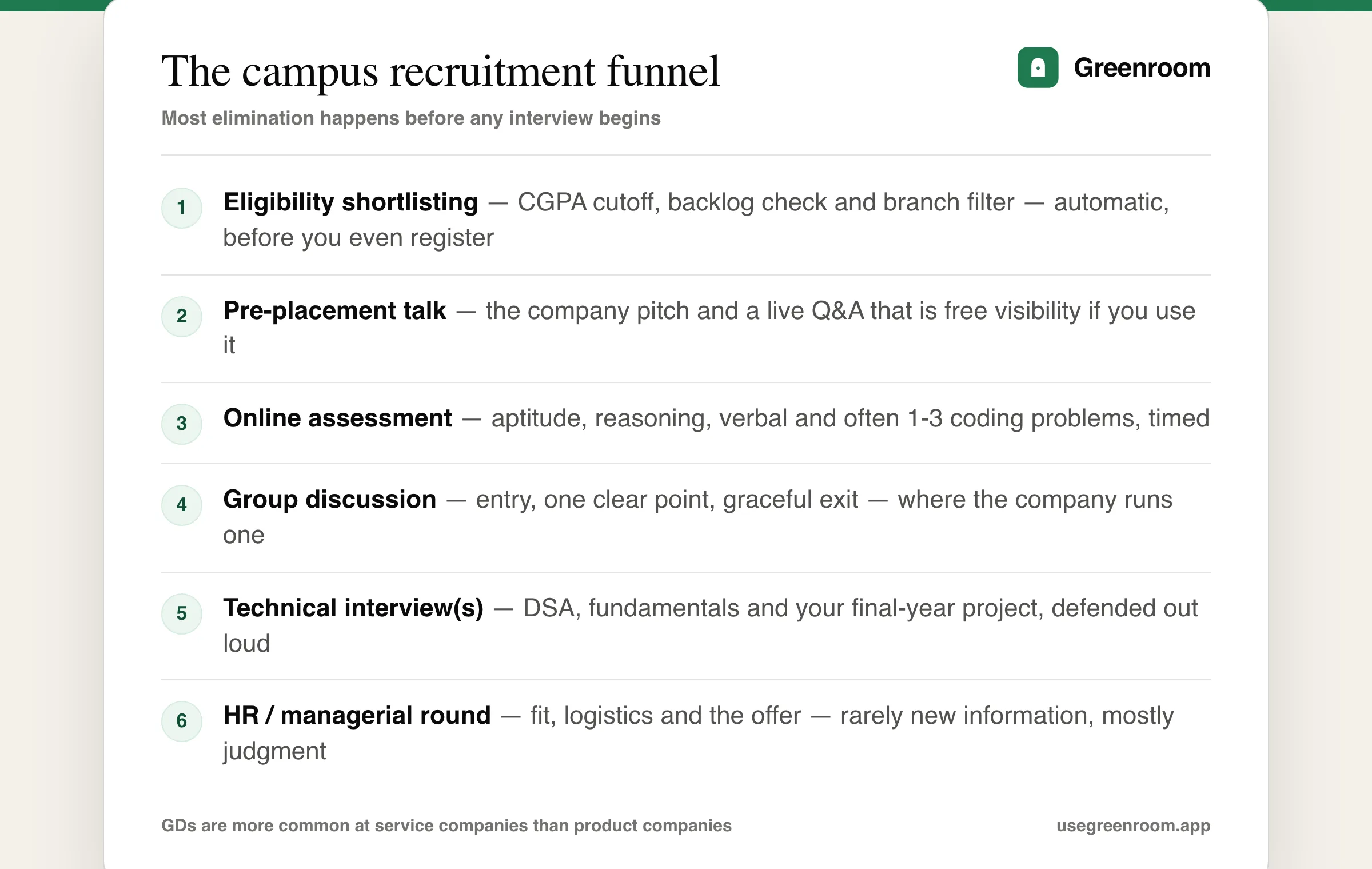
Strip away the company-specific variations and almost every campus selection process in India follows the same six-stage skeleton:
- Eligibility shortlisting — CGPA cutoff, backlog check, branch filter
- Pre-placement talk (PPT) — the company sells itself to you
- Online assessment (OA) — aptitude, reasoning, sometimes coding
- Group discussion (GD) — some companies, mostly for bulk-hiring service roles
- Technical interview(s) — one to three rounds
- HR / managerial round — culture fit, offer negotiation, logistics
Most drives eliminate 60–80% of registered students at the eligibility and OA stages alone — before any human has spoken to them. That's the part students underestimate most: the campus placement process is a funnel, and the top of the funnel is entirely mechanical.
Stage 1 — Eligibility shortlisting
Before your placement cell even announces a company is visiting, the company has already sent a JD with cutoffs: minimum CGPA (commonly 6.0–7.5 for product companies, 60% aggregate for service companies), maximum active backlogs (usually zero, sometimes one "standing" backlog allowed), and sometimes a branch restriction (CS/IT only, or "any branch" for service-company mass hiring).
Your placement cell filters the registered student list against these rules automatically. If you're borderline — say, exactly 6.0 CGPA when the cutoff is 6.0 — confirm with your placement office directly rather than assuming; rounding rules differ by college and by company.
Stage 2 — The pre-placement talk (PPT)
The PPT is the company's pitch: what they do, the role, the compensation band (sometimes vague, sometimes exact), and the process ahead. It's easy to treat this as a nap opportunity, but two things matter here:
- Companies do track attention. HR reps and alumni presenters notice who's asking questions and who's on their phone — this rarely eliminates anyone outright, but it's free, low-cost signal in a process starved for signal.
- The Q&A is a genuine opportunity. One sharp, specific question ("what does the onboarding project look like for new SDE-1s?") does more for your visibility than silence, and costs nothing.
Stage 3 — The online assessment (OA)
This is the biggest elimination round in the entire campus hiring process, and the one students prepare for least relative to how much it matters. (New to the jargon? Our OA full form in placement guide decodes the round from scratch.) A typical OA runs 60–90 minutes and covers some mix of:
- Quantitative aptitude — percentages, profit/loss, time-speed-distance, probability
- Logical reasoning — puzzles, seating arrangements, syllogisms, pattern completion
- Verbal ability — reading comprehension, grammar, sentence correction
- Coding — 1–3 problems, usually easy-to-medium, sometimes with partial-credit test cases
Service companies (TCS, Infosys, Wipro, Tech Mahindra, Cognizant) weight aptitude and verbal heavily, since they're filtering thousands of applicants for roles that don't require deep DSA. Product companies weight the coding section more, and expect cleaner code even on "easy" problems. Our aptitude test preparation guide breaks down a four-week plan for this stage specifically, and the DSA interview prep guide covers the coding side.
The mechanical trap students fall into: treating the OA like a school exam where you answer questions in order and leave blanks for hard ones. Untimed accuracy habits don't transfer to a 90-second-per-question sprint. Practice under an actual clock, not just working problems at your own pace.
Stage 4 — The group discussion (GD)
Not every company runs a GD — it's more common in service-company mass-hiring drives than in product-company loops — but where it exists, it's a genuine elimination round, not a formality. A moderator gives a topic (often current-affairs or abstract: "Is social media doing more harm than good?"), 8–10 candidates get 1–2 minutes to prepare, then 10–15 minutes of open discussion follow.
The single biggest mistake: staying silent for the first five minutes waiting for a "perfect" entry point, then never actually speaking. Evaluators are watching for whether you can enter a group conversation, make one clear point, and yield gracefully — not who talks the most. Our group discussion tips for placements guide covers the entry, hold, and exit mechanics in detail.
Stage 5 — Technical interview rounds
This is where the campus selection process shifts from mechanical filtering to actual human judgment, and it's usually 1–3 rounds:
- Round 1 — DSA problems (typically Easy-to-Medium, occasionally one Medium-Hard for top product companies), sometimes paired with basic CS fundamentals (OOP, DBMS, OS, networking) as quick-fire follow-ups.
- Round 2 (if applicable) — a deeper technical round: your final-year project explained in depth, more advanced DSA, or a light system-design conversation for stronger candidates.
- Round 3 (mostly product companies) — a bar-raiser or hiring-manager round mixing technical depth with behavioral judgment.
Interviewers in this stage are listening for how you think out loud, not just whether you reach the correct answer — a candidate who narrates their approach and handles a hint gracefully consistently beats a silent candidate who gets there eventually. This is also the stage almost nobody rehearses out loud before the real thing, which is a solvable gap (more on that below).
Stage 6 — The HR / managerial round
The final gate. Expect: "tell me about yourself," "why this company," relocation and shift-timing questions, and — increasingly at service companies — a spoken-English or communication check folded into this round (our Tech Mahindra interview guide documents exactly how that shows up there). This round rarely tests new information; it tests whether you're someone the company wants to actually work with for the next two years. Rehearsed-but-not-robotic answers to the standard questions (see our self-introduction guide for freshers) matter more here than in any other round.
How long does the whole process actually take?
This is the question placement WhatsApp groups argue about most, and the honest answer: it varies by drive structure.
- Single-day drive (common for service companies): eligibility → PPT → OA → interviews → HR, all compressed into one day, often 8–12 hours on campus. Results sometimes same evening, sometimes next morning.
- Multi-day drive (common for product companies): OA happens first (sometimes days or weeks before campus visit), shortlist announced, then a separate visit day for interviews — sometimes split across two visits if there are 3+ interview rounds.
- Off-campus / pooled drives: when a company doesn't visit your specific campus, the same stages happen, just coordinated through a shared portal or a nearby pooled-campus venue — see our off-campus placement strategy guide if this applies to you.
Across either structure, students who cleared everything up to the OA stage typically hear back on interview shortlist within 3–7 days, and a final offer decision within 24–72 hours of the last interview round for a same-day drive.
Where the standard prep advice breaks down
Placement-cell workshops and senior-shared PDFs are genuinely useful for stages 1–4 — eligibility rules, aptitude question banks, GD topics are all fairly static and well documented on forums, GeeksforGeeks-style question dumps, and your seniors' WhatsApp-forwarded notes. Where they consistently fall short is stages 5 and 6: nobody's PDF can rehearse you saying your answer out loud, under a clock, to someone who asks a follow-up you didn't expect.
That's a different skill from reading model answers, and it's the one most freshers skip entirely until the real interview. Greenroom runs spoken mock interviews mapped to this exact process — a technical round mock, an HR round mock, even a GD-style follow-up drill — so the first time you say your answers out loud isn't in front of the actual interviewer. It's free to start, and pairs well with a mock interview built specifically for freshers.
Campus CTCs are the most inflated version of this: our CTC vs in-hand salary in India guide covers what a ₹7 LPA campus offer actually pays monthly.
Frequently asked questions
How does the campus recruitment process work?
Most Indian campus drives follow six stages: eligibility shortlisting (CGPA and backlog filters), a pre-placement talk, an online assessment (aptitude, reasoning, sometimes coding), an optional group discussion, one to three technical interview rounds, and a final HR round. Elimination is heaviest at the eligibility and OA stages, before any interview happens.
What are the stages of campus placement?
In order: eligibility shortlisting, the pre-placement talk (PPT), the online assessment (OA), a group discussion where applicable, technical interview round(s), and the HR/managerial round. Not every company runs all six — GDs in particular are more common at service companies than product companies.
How long does the campus selection process take?
For single-day drives it can run start to finish in one day (8–12 hours on campus), with results often same evening or next morning. For product companies running multi-day drives, expect the OA days or weeks before the campus visit, an interview shortlist within 3–7 days of the OA, and a final offer decision within 24–72 hours of your last interview round.
What is the campus hiring process timeline for product companies vs service companies?
Service companies typically run compressed single-day drives with heavier aptitude/verbal weighting and sometimes a GD. Product companies more often split the OA and interview days across weeks, weight coding and technical depth more heavily, and run more interview rounds (2–3) before a final HR/managerial stage.
How can I prepare for the campus placement process as a fresher?
Prepare per stage, not generically: aptitude and reasoning drills for the OA, entry/exit mechanics for the GD if the company runs one, DSA fundamentals and a defensible project for the technical rounds, and rehearsed-but-natural answers for the HR round. The stages nearly everyone under-prepares are the spoken ones — technical and HR rounds — since reading answers and saying them out loud under mild pressure are genuinely different skills.
Do all companies follow the same campus recruitment process?
The six-stage skeleton (eligibility, PPT, OA, GD, technical interviews, HR) is close to universal in India, but the weighting shifts: service companies lean on aptitude, verbal ability, and GDs for bulk hiring; product companies lean on coding depth and add more technical interview rounds. Always check your placement cell's company-specific notice, since exact round counts vary by drive.