Every fresher asks some version of this, usually at 1am, usually after reading a thread that says software is over. And the honest answer is uncomfortable in both directions: the entry-level market genuinely got harder, and AI is not the whole reason, and there are still jobs. All three of those are true at once, which is why the confident takes in either direction are wrong.
This post tries to give you the version nobody selling a bootcamp or a doom thread will: what the reported data actually shows, what caused it, and what demonstrably still works if you are trying to get hired now.
What the data shows
Industry analyses through 2025 and 2026 consistently report the same direction, though specific figures vary by source and should be treated as directional rather than precise:
- Junior and new-graduate postings are down substantially from their 2022 peak — reported declines commonly in the range of a quarter or more.
- New graduates make up a shrinking share of Big Tech hires compared with the previous decade.
- Employment among the youngest developer cohort fell notably from its late-2022 peak, by more than the overall developer population.
- Meanwhile AI and ML specialist roles report a severe talent shortage, with large numbers of unfilled positions globally.
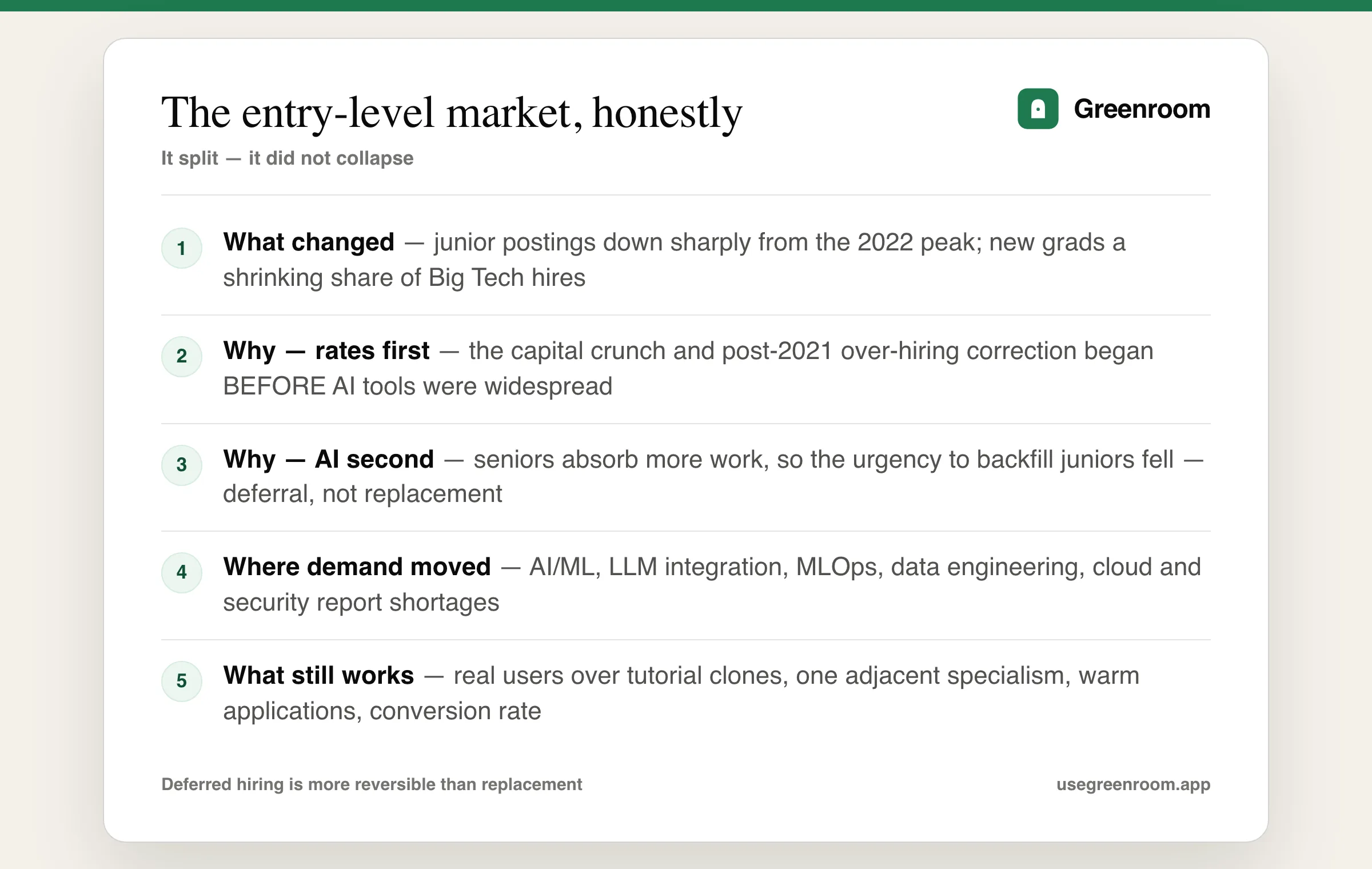
So the market did not shrink uniformly. It split. Generalist entry-level roles contracted; specialist and AI-adjacent roles are competing for people. That split, rather than a simple collapse, is the single most useful thing to understand here.
One genuine counter-signal worth holding onto: not every large employer read the situation the same way. IBM notably expanded entry-level hiring in 2026 on the reasoning that AI handles many junior tasks but still requires human oversight — which is a bet that juniors become more valuable as reviewers, not less.
Why it happened — and why AI is only part of it
This is where most commentary goes wrong, because attributing everything to AI is both scarier and less useful than the truth.
- The interest-rate shift came first. Cheap capital ended in 2023–24, venture funding tightened, and companies moved from growth-at-any-cost to profitability. Hiring freezes and layoffs followed — and this began before AI coding tools were widely adopted.
- Over-hiring in 2021–22 created a correction. Many companies hired ahead of demand during the boom and then spent two years absorbing it.
- Junior hires are an investment, not immediate output. A new graduate is net-negative for months. When budgets tighten, investments in future capacity are the first thing cut, regardless of AI.
- Then AI removed the pressure to hire. This is the real mechanism, and it is subtler than "AI replaced juniors": AI tools let existing senior engineers absorb more work, which reduced the urgency to backfill junior headcount. Not replacement — deferred hiring.
That last distinction matters for your planning. Deferred hiring is more reversible than replacement, and it depends on senior capacity staying sufficient — which is exactly the assumption IBM is betting against.
There is also a widely-noted structural worry: if the industry stops training juniors, it stops producing seniors, and the shortage arrives in five years. Companies know this. It is a real reason to expect the pendulum to move.
What this means for you, practically
Three consequences worth planning around rather than despairing about.
1. The bar moved, it did not disappear. "Can write CRUD" is no longer a differentiator, because that is the part AI does well. What still requires you: debugging something nobody understands, deciding what to build, judging whether generated code is actually correct, and owning a system in production. Those are the abilities that entry-level preparation should now target.
2. Volume applications work even worse than before. With fewer openings and more applicants, referrals and targeted applications have gone from advantageous to close to necessary. Fifteen warm applications genuinely outperform two hundred cold ones. Our off-campus placement strategy guide covers the mechanics for India.
3. Adjacent specialisation is the highest-leverage move. The roles reporting shortages are AI/ML engineering, LLM integration, MLOps, data engineering, cloud infrastructure and security. You do not need to become a researcher — being the graduate who has actually shipped a RAG application, or who understands deployment and monitoring, is a meaningfully different candidate from one with only a CRUD portfolio.
What actually works right now
- Build something that has users, however few. Ten real users and a story about what broke in production beats five tutorial clones. It demonstrates exactly the ownership that AI does not supply.
- Use AI tools well and be able to discuss it honestly. Pretending you do not use them reads as dishonest; saying you use them and always review the output, with an example of a bug you caught, reads as exactly the judgment employers now want. Interviewers increasingly ask about this directly.
- Go deep on one adjacent specialism — data engineering, cloud, security, or applied ML. Our AI engineer, data engineer and DevOps guides cover the interview surface for each.
- Fundamentals still get examined. Data structures, systems knowledge and SQL remain the interview currency, and they are more important now because they are how you evaluate generated code. Our DSA guide covers the syllabus.
- Target companies outside the obvious set. Non-tech companies with real engineering teams — banks, manufacturing, healthcare, government technology, GCCs in India — hire steadily and attract a fraction of the applications.
- Consider internships and contract roles as entry paths, including ones that convert. In a tight market the side door is often open when the front door is not.
And the practical one: get very good at interviewing, because with fewer openings each one matters more. The candidate who converts three of five interviews is in a completely different position from the one who converts one of ten, with identical technical ability. Our mock interview guide for freshers covers the practice loop.
What not to do
- Do not abandon software because of a thread. The people declaring the field dead are frequently either selling something or extrapolating from their own bad quarter.
- Do not skip fundamentals to chase prompt engineering. The durable roles need people who can evaluate output, which requires knowing the underlying material.
- Do not take the doom personally. A slow market is a market condition, not a verdict on you, and the difference matters for how long you keep going. Our staying motivated and doomscrolling guides cover this properly.
- Do not wait for it to improve before preparing. The recovery, when it comes, favours people who kept building.
The honest bottom line
If you want the summary in three sentences: the entry-level software market is materially harder than it was in 2021, and the cause is roughly a rate-driven correction plus AI reducing the urgency to hire juniors rather than AI replacing them. The demand did not vanish — it moved toward specialisms with reported shortages, and toward candidates who can demonstrate judgment rather than throughput. And the historical pattern for tech markets is cyclical, with the additional structural pressure that a generation of juniors not hired becomes a shortage of seniors later.
That is neither the doom answer nor the everything-is-fine answer, and it is the one that lets you plan.
Reddit, LinkedIn, ChatGPT — where each fits
- Actual labour-market data — treat any single statistic with suspicion, especially from sites selling interview products, and look for direction agreed across several sources rather than one dramatic number.
- Reddit and Blind — useful for market sentiment, terrible for calibration, because distress and outliers are both over-represented.
- LinkedIn — good for referrals and reconnecting; corrosive as a daily feed while job-hunting.
- Your college's recent alumni — the most accurate market signal you have access to, because they interviewed this cycle in your segment.
- Building and shipping — the highest-yield response to a hard market, and the only one entirely under your control.
- ChatGPT — genuinely useful for learning and for reviewing your code. It will not tell you your portfolio looks like everyone else's.
- Greenroom — the spoken layer. Ari, the AI interviewer, raises your conversion rate on the interviews you do get, which is the highest-leverage variable in a market with fewer openings. Fair tradeoff: it cannot create openings.
A plan for the next three months
- Month 1: fundamentals — data structures, SQL, systems — because they are how you evaluate generated code and they are still examined.
- Month 2: pick one adjacent specialism and build something real in it with actual users, however few.
- Month 3: conversion — mock interviews out loud until your hit rate moves, plus twenty warm, referred applications rather than two hundred cold ones.
- Throughout: use AI tools openly, review everything they produce, and collect one story about a bug you caught that they introduced.
Also useful: our how to get a job without experience guide, the fresher interview questions guide, and the GitHub portfolio guide for making projects count.
For the other side of the same shift, see our how to switch to an AI engineer role in India guide.
Frequently asked questions
Is AI replacing entry-level software engineering jobs?
Not straightforwardly. Reported data shows junior and new-graduate postings down substantially from their 2022 peak, but the causes are mixed. The interest-rate shift and post-2021 over-hiring correction came first, before AI coding tools were widely adopted. AI's actual role has been to let existing senior engineers absorb more work, which reduced the urgency to backfill junior roles — deferred hiring rather than direct replacement, which is more reversible.
Is software engineering still a good career in 2026?
Yes, with the important caveat that the entry-level market is materially harder than it was in 2021 and the demand has shifted rather than disappeared. Generalist junior roles contracted while AI and ML engineering, MLOps, data engineering, cloud infrastructure and security report significant shortages. The field also faces structural pressure to resume junior hiring, since a generation of juniors not trained becomes a shortage of senior engineers within a few years.
What skills should freshers learn to get hired in 2026?
Keep the fundamentals — data structures, systems knowledge and SQL — because they are still examined and because they are how you judge whether generated code is correct. Then go deep on one adjacent specialism reporting shortages, such as applied machine learning and LLM integration, data engineering, cloud infrastructure or security. Above all, build something with real users, since ownership and judgment are precisely what AI tooling does not supply.
Should you tell interviewers you use AI coding tools?
Yes. Pretending you do not use them reads as dishonest, since interviewers assume everyone does. The answer that lands is that you use them routinely and always review the output, supported by a concrete example of a bug or incorrect assumption you caught in generated code. That demonstrates exactly the evaluative judgment employers now say they are hiring juniors for, and interviewers increasingly ask about it directly.
How many jobs should you apply to in a tight market?
Fewer, better targeted. With fewer openings and more applicants, referrals and tailored applications have shifted from advantageous to close to necessary, and fifteen warm applications reliably outperform two hundred cold ones. Prioritise roles where you have a genuine angle — a referral, relevant domain experience, or an articulable interest — and look beyond the obvious employers to banks, healthcare, manufacturing, government technology and global capability centres.
Will entry-level tech hiring recover?
Historical tech hiring is cyclical, and there is a specific structural pressure toward recovery: if the industry stops training juniors it stops producing seniors, and that shortage arrives within a few years. Some large employers have already moved in that direction, with IBM notably expanding entry-level hiring in 2026 on the reasoning that AI handles many junior tasks but still requires human oversight. Nobody can date a recovery, so plan for the current market while continuing to build.