You've practiced the sentence in the mirror eleven times. "I took eight months off after my role was eliminated to..." — and every single time, it comes out fine in the mirror and comes out wrong on the call, because the mirror doesn't ask a follow-up question and Priya from HR does. You pause half a second too long. Your voice does the thing where it goes up at the end like a question. She writes something down. You have no idea what she wrote down, and now you're answering the next question while still thinking about what she wrote down.
Here's the thing almost nobody tells you about explaining a career gap in an interview: the gap itself is rarely the problem. A resume with a nine-month hole in it doesn't disqualify you before you open your mouth — LinkedIn's own workforce data has shown career breaks becoming steadily more common and less stigmatized as layoffs, caregiving demands and burnout recoveries touch a wider slice of the workforce every year. What actually costs candidates the round is the hesitation — the half-second pause, the over-apology, the three-minute answer to a question that needed thirty seconds.
What the interviewer is actually listening for
An interviewer asking about a gap on your resume is running a much narrower check than you think. They are not running a background check on your personal life. They're asking two things, in order: did you use the time (however that's defined for your situation — recovering, caregiving, upskilling, job-searching seriously), and are you ready now. That's the whole test. Everything else — the exact medical detail, the specific family situation, the blow-by-blow of a failed startup — is context you can choose to share or not, and most of it is genuinely none of their business.
The 30-second framework, in three beats
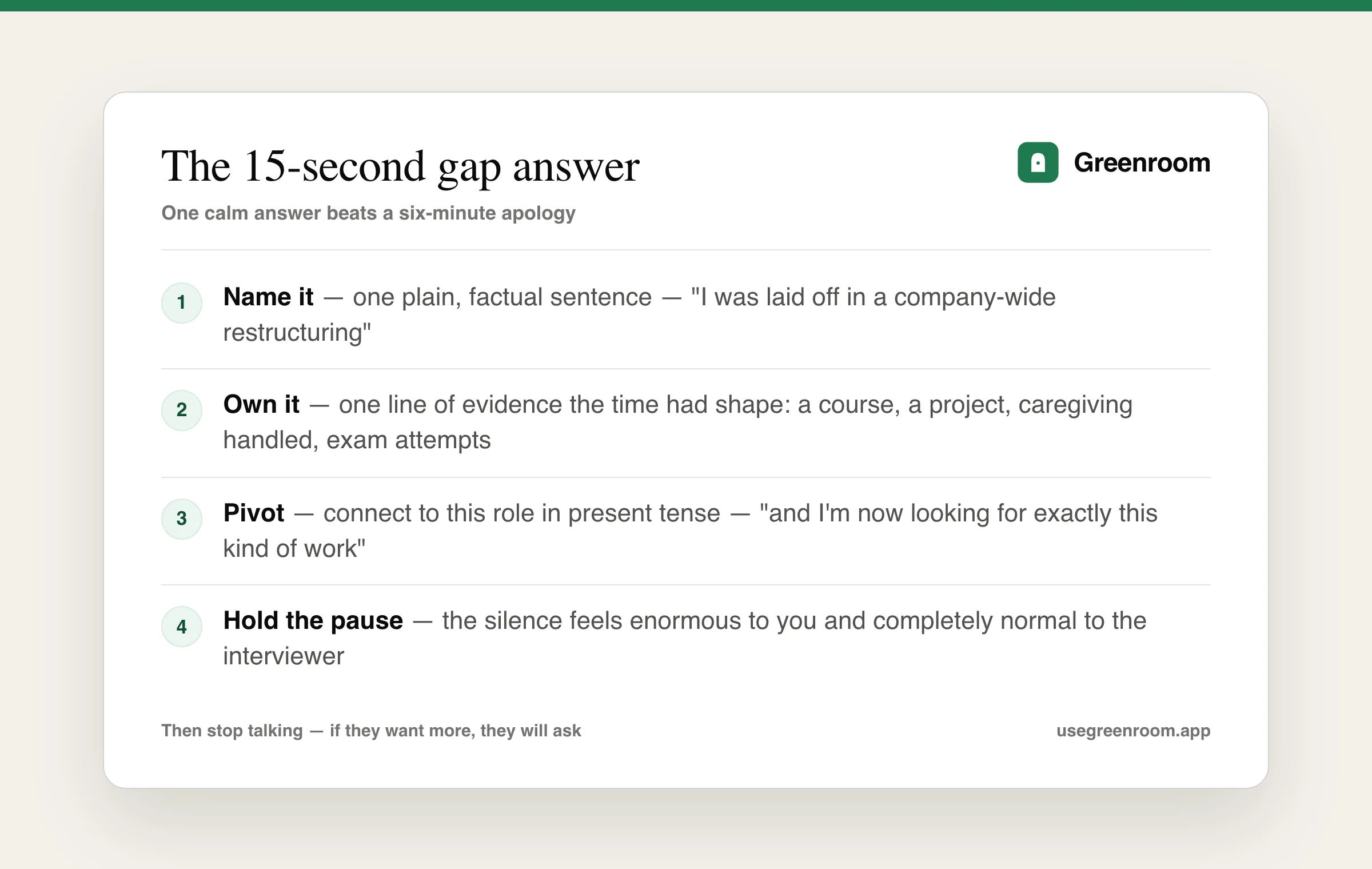
Every good gap answer, regardless of the reason, has the same three-beat shape. Say all three, in order, and then stop talking.
- What happened. One factual sentence. No preamble, no "so basically what happened was."
- What you did with it. The specific, verifiable thing — a certification, a caregiving responsibility you can name, a project, a documented recovery.
- Why you're ready now. The forward-looking line that closes the topic and hands the conversation back to the role.
That's it. Not five beats, not a chronological month-by-month account. Three.
Five worked examples, by reason
Laid off
"My team was cut in a company-wide restructuring in March — about 15% of the org, including the whole platform group. I spent the time interviewing seriously and shipping a couple of side projects I'd been putting off, including [name it]. I'm looking for a backend role where I can keep working close to payments infrastructure." Our what to do after a layoff guide covers the weeks before you get to this sentence.
Caregiving
"I stepped back for about a year to be the primary caregiver for a parent after surgery. I stayed current by [specific: a course, freelance work, an open-source contribution], and now that things are stable, I'm ready to commit fully to a full-time role again."
Health
"I took time away to deal with a health issue that's now fully resolved. I used part of that time to [specific, only if you're comfortable sharing — a certification, volunteer work, anything concrete]. I'm back at full capacity and looking for the right next role." You owe no medical detail beyond "resolved" — that word is doing the work, not a diagnosis.
Upskilling or a certification
"I took five months to go deep on [specific skill — cloud infrastructure, a language, a certification track] because I could see it was becoming table stakes for the roles I wanted. I finished [name the credential or project] and I'm now looking to apply it in a production environment."
A failed venture
"I spent fourteen months building a startup with two co-founders — we got to [a real, specific milestone: paying customers, a pilot, funding raised] before deciding to shut it down when [the real, brief reason: the market, the runway]. I learned more about shipping under real constraints in that year than in the three before it, and I'm looking to bring that back into a team." Evaluating a startup before joining covers the flip side of this same honesty.
Handling the awkward follow-up
Sometimes the three-beat answer isn't the end of it. "So what were you doing month to month?" is a legitimate follow-up, and it's usually curiosity or due diligence, not suspicion. Answer it the same way: factual, brief, then redirect. "Mostly [the honest specific], with a few months of harder searching mixed in — happy to go into [one specific thing] if useful, but I'm mainly excited to talk about [the role]." Most interviewers take the redirect. If they push further into territory you don't want to share (medical specifics, family details), a plain "that part's personal, but I'm fully able to start and focused on this role" is a complete, professional answer — you're allowed to hold a boundary in an interview.
Use your resume to pre-empt the question
A one-line note on your resume or LinkedIn — "Took time for a family health matter, 2025" or "Sabbatical: completed AWS certification, 2025" — often defuses the question before it's asked, and reads as more confident than silence followed by an explanation under pressure. It doesn't need detail; it needs to exist, so the reader isn't left guessing before you're even in the room.
How this compares to a generic "explain your resume gap" script
Most search results here hand you one universal script and tell you to fill in the blank — which is exactly why it sounds filled-in-the-blank when you say it out loud for the first time in a real interview. The gap between reading a framework and delivering it without a half-second stumble is entirely rehearsal, the same gap that separates a well-written resume bullet from a confident verbal answer. A generic LeetCode-adjacent question bank won't touch this at all; a friend's WhatsApp advice ("just be honest!") is true but not specific enough to survive a follow-up question live.
That's the narrow thing Greenroom is actually built for: Ari, the AI interviewer, asks the follow-up you're dreading — "so what were you doing month to month?" — and keeps asking until your answer stops sounding rehearsed and starts sounding calm, the same way it would on a real call. Honest tradeoff: it won't tell you what to disclose or how much detail is legally required from an employer — for that, your own judgment (or an actual employment consultant, for anything contractual) beats any AI. What it fixes is the hesitation, not the legal question.
Frequently asked questions
How do you explain a gap in your resume in an interview?
In three short beats: what happened, in one factual sentence; what you did with the time, one specific and verifiable thing; and why you're ready now, a forward-looking line that closes the topic. Say it in under 30 seconds and stop talking — the interview moves on faster than you expect.
What is the best answer for an employment gap?
There's no single script, because the honest answer depends on the actual reason. The structure that works for any reason is: state it plainly without apologizing, name one concrete thing you did during the gap, and connect it to why you're a stronger candidate today than before the gap started.
Should you bring up a career gap before the interviewer asks?
A one-line note on your resume or LinkedIn ("took time for a health recovery, 2025") often pre-empts the question entirely and reads as more confident than waiting to be asked. If it doesn't come up, you don't need to volunteer it — but have the 30-second version ready either way.
How do you explain unemployment due to a layoff in an interview?
State it as a business decision, not a personal one: the team or role was affected by a restructuring, briefly name the scale if it helps ("about 15% of the org"), and move straight to what you're looking for next. Don't badmouth the company and don't over-explain — most interviewers have seen a layoff before and won't dwell on it if you don't.
What if the interviewer keeps asking follow-up questions about the gap?
Answer the specific question factually and briefly, then redirect back to the role: "That's about it month to month — happy to talk more about [specific project from the gap] if useful, but I'm mainly excited about [the role]." Most interviewers are pattern-matching for evasiveness, not fishing for a longer story — a calm, complete answer usually ends the thread.
Does a career gap actually hurt your chances of getting hired?
Less than most candidates fear, and less than it did five years ago — layoffs, caregiving gaps and career pivots are common enough now that most interviewers have a colleague with one. What actually costs candidates the round is visible hesitation when the topic comes up, not the gap itself.