
The prompt is "design inventory management for Walmart." You have forty minutes, a whiteboard tool you have never used before, and a sudden vivid awareness that there are roughly ten thousand physical stores involved. This is the moment most candidates start naming technologies — Kafka, Redis, Cassandra — because listing things feels like progress. It is not, and the interviewer has watched twelve people do it this month.
Walmart Global Tech runs a FAANG-shaped loop, but the system design rounds carry a domain accent: retail, supply chain, inventory and pricing at genuine physical scale. Here are the Walmart Global Tech interview questions and how to actually approach them.
The Walmart Global Tech interview process
The shape below is consistent across reports, though the number of onsite rounds varies by level and team, and Walmart hires across several distinct orgs. Treat it as the pattern and confirm your specific loop with your recruiter — they will tell you if you ask.
Round 1 — online coding assessment
Typically two or three problems on a timed platform. Medium difficulty, standard data structures. This round is a filter rather than a differentiator: solve them cleanly and move on.
Round 2 — technical phone screen
One or two coding problems with a live interviewer, and narration matters here in a way it did not in the automated round. An optimal solution delivered in silence scores worse than a good solution explained as you build it.
Round 3 — the onsite loop
Coding, system design, and CS fundamentals, usually spread across three to five rounds. For senior levels the design round carries the most weight.
Round 4 — hiring manager and behavioural
Ownership, conflict and impact, often mapped to Walmart's stated values. Treated as a real scored round, not a closing formality.
Walmart coding questions, and what they are checking
Arrays, strings and hash maps
Sliding window, two pointers and interval merging are the recurring shapes. A representative prompt: given a list of store restock intervals, merge the overlapping ones. Sort by start, then walk the list extending the current interval when the next one starts before the current ends — O(n log n) dominated by the sort. State that complexity before you are asked; volunteering it reads as fluency.
Trees and graphs
BFS and DFS, usually dressed in a logistics costume — shortest path between distribution centres, dependency ordering for a fulfilment pipeline. If the prompt mentions "shortest" and the edges are unweighted, BFS is the answer and saying why (BFS explores by layer, so the first time you reach a node is via the fewest edges) is worth more than the code.
Dynamic programming
Appears, but less often than candidates fear. Knapsack-shaped problems fit the domain naturally — allocating limited shelf space or truck capacity for maximum value. If you see one, define the state out loud before writing anything. Half the DP failures in interviews are a wrong or unstated state definition, not a coding error.
Narrating while you code
Walmart's loop weighs communication explicitly. Say what you are considering, name the approach you are rejecting and why, then commit. Silence for four minutes followed by correct code is a weaker signal than a running commentary with one wrong turn in it, because the interviewer is trying to predict what you are like in a design review. Our guide on coding interview communication covers the mechanics.
Walmart system design: the retail accent
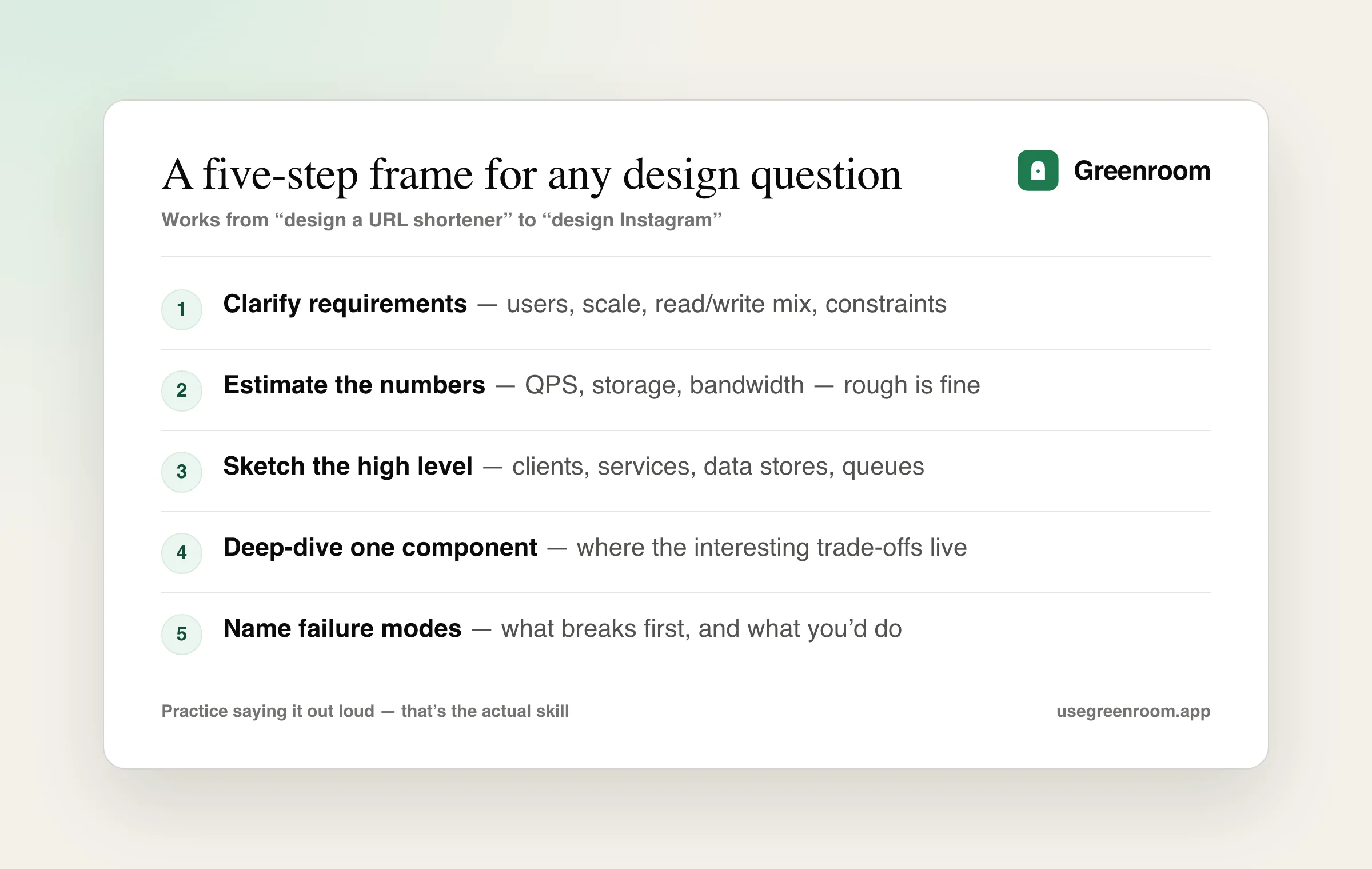
This is the round that distinguishes Walmart from a generic FAANG loop, and it is where domain thinking pays. Common prompts: design an inventory management system across stores and warehouses; design the order and checkout flow; design a pricing or promotions service; design order tracking and notifications.
Work the requirements before the architecture
Spend the first five minutes on scope and numbers. How many stores, how many SKUs per store, read-to-write ratio, and — the question that unlocks retail design — how stale is inventory allowed to be? A pricing service can tolerate seconds of staleness. Inventory at checkout cannot oversell the last unit. Naming that distinction unprompted is the strongest single move available in a Walmart design round.
Know where consistency actually matters
Most of a retail system is comfortably eventually consistent: product catalogue, search index, recommendations, analytics. A narrow slice is not: the decrement at checkout, payment capture, and reservation of the last item. The credible answer partitions the system by consistency requirement rather than applying one model everywhere. Expect a follow-up on how you prevent two customers buying the same final unit — reservations with a TTL, or an atomic conditional decrement, are both defensible.
Handle the physical-world constraint
Retail design has a wrinkle pure-software candidates miss: inventory is a physical count that drifts. Shrinkage, miscounts and returns mean the database and the shelf disagree. Acknowledging reconciliation — periodic cycle counts correcting the system of record — signals you have thought about the domain rather than pattern-matched a generic e-commerce diagram. Our system design guide covers the general structure.
The behavioural round
Ownership, conflict, failure and impact, in STAR form with numbers attached. "Improved performance" is not an answer; "cut p99 from 1.4s to 380ms by adding a covering index, which removed a nightly backlog" is. Prepare four stories and expect to reuse them across prompts — one shipped project, one conflict, one failure with what changed afterwards, one time you took on something outside your remit. Our behavioural questions guide has the structures.
How this compares to the other ways you could prepare
LeetCode covers the coding rounds properly and you should grind it; there is no substitute and no shortcut. It does nothing for the design round, which is a conversation rather than a problem with a correct answer.
System design videos and the well-known primers are genuinely good for vocabulary and reference architectures. Their limit is that watching someone else design a system builds recognition, not production — you will nod along at every decision and then find your own explanation arrives in fragments when it is your turn to talk for forty minutes.
Greenroom runs the design round out loud, and Ari asks the follow-up that the video cannot: you said you would cache the inventory count, so what happens when two stores read the cached value at the same time? The honest limit is that Ari does not know Walmart's internal architecture, and no preparation resource outside the company does. What it rehearses is the delivery — the part that is failing for most candidates who already know the material. Pair it with our FAANG preparation guide, data structures guide and Amazon backend guide, since the loops overlap heavily.
Frequently asked questions
What is the Walmart Global Tech interview process?
Walmart Global Tech runs a FAANG-style loop: an online coding assessment of two or three problems, a technical phone screen with a live interviewer, an onsite loop of three to five rounds covering coding, system design and CS fundamentals, and a hiring manager round on ownership and impact. The number of onsite rounds varies by level and team, so confirm your specific loop with your recruiter.
What system design questions does Walmart ask?
Prompts carry a retail accent: design an inventory management system across stores and warehouses, an order and checkout flow, a pricing or promotions service, or order tracking and notifications. Interviewers want scoped requirements, a data model, a scaling plan and explicit tradeoffs rather than a list of technologies.
What coding questions does Walmart Global Tech ask?
Standard data structures and algorithms: arrays, strings and hash maps using sliding window, two pointers and interval merging; trees and graphs with BFS and DFS, often framed as logistics or distribution problems; and some dynamic programming, frequently knapsack-shaped to fit shelf space or truck capacity. Narrating your approach as you code is weighted explicitly.
What makes the Walmart system design round different from other companies?
The domain. Retail systems force you to separate what can be eventually consistent, such as catalogue, search and recommendations, from the narrow slice that cannot, such as decrementing stock at checkout. There is also a physical-world constraint: inventory counts drift through shrinkage, miscounts and returns, so mentioning reconciliation through cycle counts signals real domain thinking.
Is Walmart Global Tech a FAANG-level interview?
The structure and coding bar are comparable to a large-tech loop, with the same emphasis on data structures, algorithms and system design. The distinguishing feature is the retail and supply-chain framing of the design round rather than a materially different difficulty level.
How should I prepare for a Walmart Global Tech interview?
Practise medium data-structure and algorithm problems while narrating aloud, since communication is scored. Rehearse retail-flavoured system design and build the habit of asking what data may be stale and what must be exact before designing. Prepare four STAR stories with quantified outcomes for the behavioural round.