The offer said ₹12,00,000. He told his family ₹1 lakh a month, because that is what twelve divided by twelve is, and everybody was pleased. The first salary credit was ₹68,400. He read the payslip four times looking for the error. There was no error. There was a variable component, an employer PF contribution, a gratuity line, an insurance premium and a tax deduction, and every one of them was disclosed in a document he had signed without reading.
CTC vs in-hand salary is the single most misunderstood thing about Indian job offers, and the confusion is almost entirely structural rather than dishonest. CTC means Cost To Company — everything the company spends on employing you in a year, including money that never passes through your hands. In-hand is what lands in your bank account after deductions. The gap is routinely 25 to 35 percent. Here is exactly where it goes, with a worked example, and the questions that stop the surprise.
What CTC actually includes
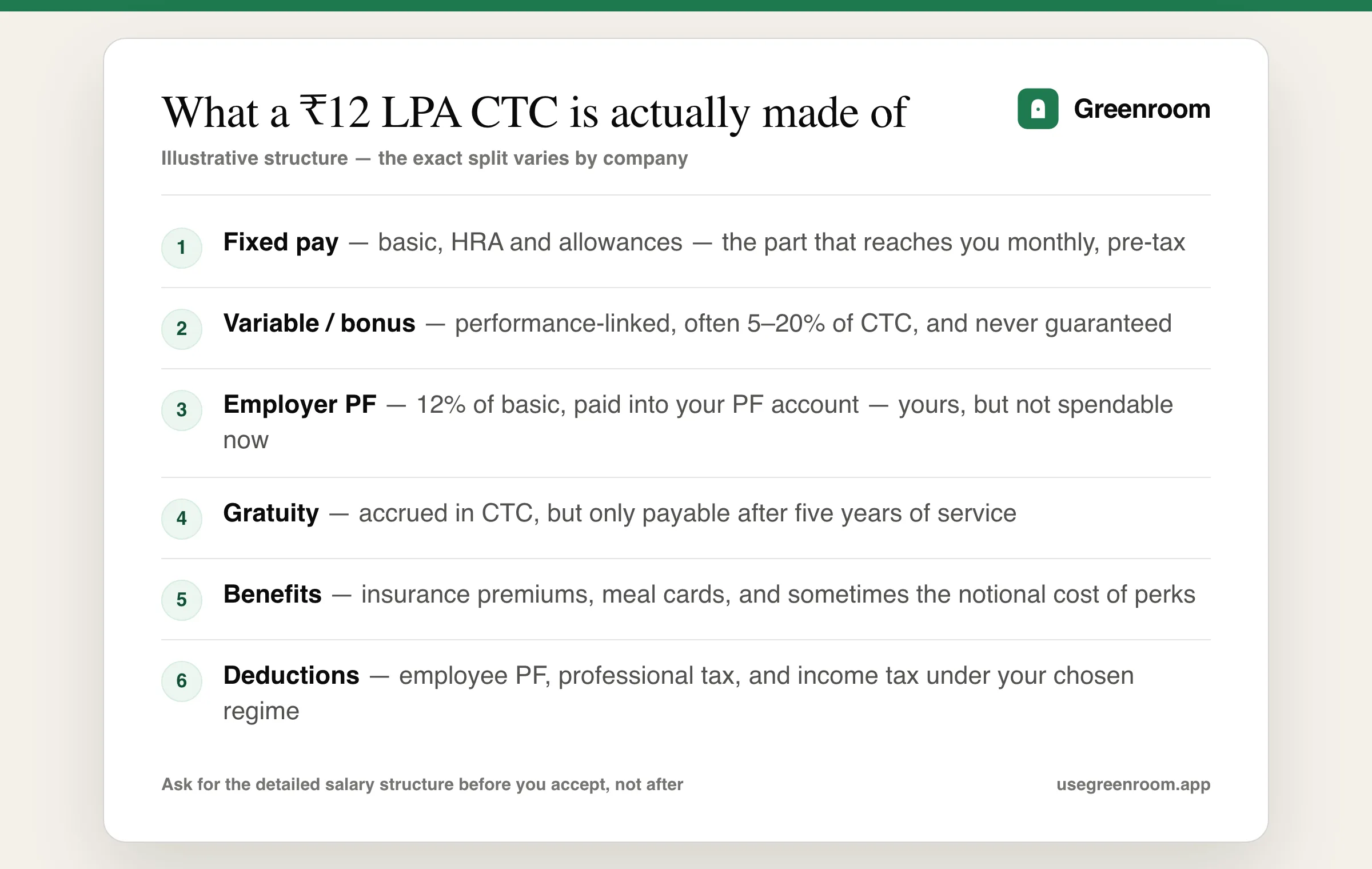
Fixed pay. Basic salary, House Rent Allowance, and various allowances. This is the part that becomes your monthly salary before tax, and it is the number that actually matters. Basic is usually 40-50% of fixed pay and drives your PF and gratuity calculations.
Variable pay or performance bonus. Typically 5-20% of CTC, paid quarterly or annually, and conditional on company and individual performance. It appears in your CTC at 100% and arrives at whatever percentage the year produced. Treat it as a possibility, not income.
Employer's provident fund contribution. 12% of basic salary, paid by the company into your PF account. This is genuinely your money, it earns interest, and you cannot spend it this month. It sits in CTC and not in your bank.
Gratuity. Accrued at roughly 4.81% of basic. Legally payable only after five years of continuous service, so for most people changing jobs at the three-year mark, this line in the CTC is money they will never receive from that employer.
Benefits and insurance. Health insurance premiums, life cover, meal cards, and sometimes the notional cost of transport or a laptop. Real value, zero liquidity.
Joining bonus and retention bonus. One-time, often with a clawback clause if you leave within a year or two. Read that clause specifically.
Sometimes ESOPs. Some companies quote a "total compensation" including stock. For unlisted companies this number is a guess about the future, and it is worth deciding privately what you value it at, which may be zero.
What gets deducted from what is left
- Employee provident fund — another 12% of basic, from your side.
- Professional tax — a small state-level deduction, a few hundred rupees a month in most states.
- Income tax (TDS) — deducted monthly based on your projected annual income and your chosen tax regime.
- Any voluntary deductions — additional PF, insurance top-ups, or a company loan.
A worked example: ₹12 LPA
Illustrative, because structures differ, but the shape is representative:
- CTC: ₹12,00,000
- Less variable pay at 10%: ₹1,20,000 → fixed CTC ₹10,80,000
- Less employer PF (12% of a ₹4,32,000 basic): ₹51,840
- Less gratuity accrual: ₹20,779
- Less insurance and benefits: ₹25,000
- Gross annual salary: roughly ₹9,82,000, or about ₹81,800 a month
- Less employee PF: ₹4,320 a month
- Less professional tax: ₹200 a month
- Less TDS: varies by regime and declarations, commonly ₹6,000-9,000 a month at this level
Monthly in-hand: roughly ₹68,000-72,000. Against a headline of ₹1,00,000. Nothing was hidden; it was all in the structure sheet.
The questions to ask before you accept
Ask these of the recruiter, in writing, before you sign. All are entirely normal:
- "Could you share the detailed salary structure or CTC breakup?" Most companies have a standard sheet and will send it. If they will not, that is information too.
- "What is the fixed versus variable split?" The single most important number after the headline.
- "Is the variable component guaranteed for the first year?" Some companies do guarantee year one; ask rather than assume.
- "What was the average variable payout for this team last year?" Rarely answered precisely, but the reaction tells you something.
- "Does the CTC include gratuity and employer PF?" Almost always yes, and confirming it forces the honest comparison.
- "Is there a joining bonus, and what is the clawback period?"
- "What is the notice period and is buyout allowed?" Our notice period negotiation in India guide covers this specifically.
Comparing two offers properly
Do not compare CTC to CTC. Compare fixed pay to fixed pay, then treat everything else as commentary.
An offer of ₹18 LPA with 30% variable and an offer of ₹15 LPA with 5% variable are ₹12.6 lakh and ₹14.25 lakh of fixed pay respectively. The smaller headline is the larger salary, and the person who compares headlines picks wrong.
Then adjust for the things that are real but not salary: insurance that actually covers your parents, a shorter notice period, a location that changes your rent by ₹15,000 a month, and stock you can honestly value. Our how to negotiate multiple offers guide covers running two processes at once.
How this changes what you say in the interview
When a recruiter asks for your expectation, answer in the same currency they will offer in — and be explicit about which.
Weak: "I'm looking for 18 lakhs." Strong: "Based on the role and my experience I'm looking at around ₹18 lakh fixed. I'm flexible on the overall structure — could you tell me the typical fixed-variable split for this level?" You have now anchored on the number that matters and asked the question that prevents the surprise.
If asked for your current CTC, give the accurate number and add the fixed component: "My current CTC is ₹12 lakh, of which ₹10.8 lakh is fixed." Inflating it is a bad idea in India specifically, because salary slips and Form 16 are routinely collected during background verification. Our background verification in India guide covers what actually gets checked, and our what are your salary expectations guide covers the wording.
Freshers and campus offers specifically
Campus CTCs are the most inflated version of this problem, because the components that never reach you are proportionally larger and the numbers are used competitively between colleges.
Watch for: a joining bonus counted inside CTC, a retention bonus payable at eighteen months, relocation assistance counted as compensation, a training-period stipend that is lower than the offered salary for the first three to six months, and a "performance bonus" for a role you have not started. A ₹7 LPA campus offer commonly means ₹40,000-45,000 in hand.
Ask the placement cell for the structure sheet, not the headline. Our campus recruitment process explained guide covers how these offers are constructed.
Where each option actually helps
- AmbitionBox and Glassdoor India — useful for ranges by company and level, though self-reported and skewed high.
- A take-home calculator — several free Indian salary calculators will do the arithmetic once you have the structure sheet. They are useless without it, which is why the structure sheet is the actual ask.
- Your offer letter's annexure — the real answer is usually already in your possession, in the annexure nobody reads.
- ChatGPT — perfectly capable of doing the tax arithmetic if you paste the structure. It cannot tell you what this company's variable actually paid out last year; the recruiter or a current employee can.
- Greenroom — not a calculator. Ari, the AI interviewer is for the conversation before the offer: practising the salary-expectation answer out loud, which is where most people give away ₹2 lakh in four seconds.
Frequently asked questions
What is the difference between CTC and in-hand salary?
CTC is Cost To Company — the total annual amount a company spends on employing you, including variable pay, the employer's provident fund contribution, gratuity accrual, insurance premiums and other benefits. In-hand salary is what actually reaches your bank account each month after employee PF, professional tax and income tax are deducted. For most Indian salaries the gap is 25 to 35 percent, and none of it is hidden — it is all in the salary structure annexure.
How much in-hand salary will I get for 12 LPA in India?
Typically around ₹68,000 to ₹72,000 per month, against a headline of ₹1,00,000. A representative breakdown removes roughly 10 percent variable pay, the employer PF contribution of 12 percent of basic, gratuity accrual of about 4.81 percent of basic and insurance costs to reach gross salary, then deducts employee PF, professional tax and monthly TDS. The exact figure depends on your basic-to-CTC ratio, your tax regime and your declared investments.
What percentage of CTC is in-hand salary in India?
As a rule of thumb, monthly in-hand is around 65 to 75 percent of CTC divided by twelve for salaries between roughly ₹6 and ₹25 LPA. Below about ₹7 LPA the income tax component shrinks and the ratio improves, while above ₹30 LPA it worsens because a larger share falls in higher tax slabs and variable components are usually a bigger proportion of the package.
Does CTC include PF and gratuity?
Almost always, yes. The employer's provident fund contribution of 12 percent of basic salary and the gratuity accrual of roughly 4.81 percent of basic are both counted inside CTC even though neither reaches your bank account this month. Gratuity is particularly worth noting because it is legally payable only after five years of continuous service, so anyone changing jobs earlier never receives that portion of their stated CTC from that employer.
How do you compare two job offers with different CTC?
Compare fixed pay to fixed pay rather than CTC to CTC, then treat everything else as commentary. An ₹18 LPA offer with 30 percent variable is ₹12.6 lakh fixed, while a ₹15 LPA offer with 5 percent variable is ₹14.25 lakh fixed — so the smaller headline is the larger salary. After that, adjust for insurance that genuinely covers your family, notice period length, location cost of living, and any stock you can honestly value.
Should you tell a recruiter your current CTC in India?
Give the accurate number and add the fixed component, for example that your CTC is ₹12 lakh of which ₹10.8 lakh is fixed. Inflating it is a poor idea in India specifically because salary slips and Form 16 are routinely collected during background verification, and a mismatch discovered at that stage can cost you the offer after you have already resigned.