Priya's Amazon phone screen started exactly the way she'd prepped for: "write a query that returns each customer's most recent order." She nailed it — ROW_NUMBER, partition, done. Then the interviewer, without changing tone, said "tell me about a time you took ownership of a problem outside your job description." Priya checked the meeting title to make sure she hadn't joined the behavioral round by mistake. She hadn't. At Amazon, there is no round without a behavioral round hiding inside it.
That's the single most misunderstood thing about Amazon data engineer interview questions: candidates prep SQL and pipelines (correctly), then get graded just as hard on Leadership Principles they never rehearsed out loud. I built Greenroom after freezing in exactly that kind of spoken, follow-up-heavy round — so this guide covers all four question types, the loop structure, and a prep plan that treats speaking as a skill, not an afterthought.
The Amazon data engineer interview process
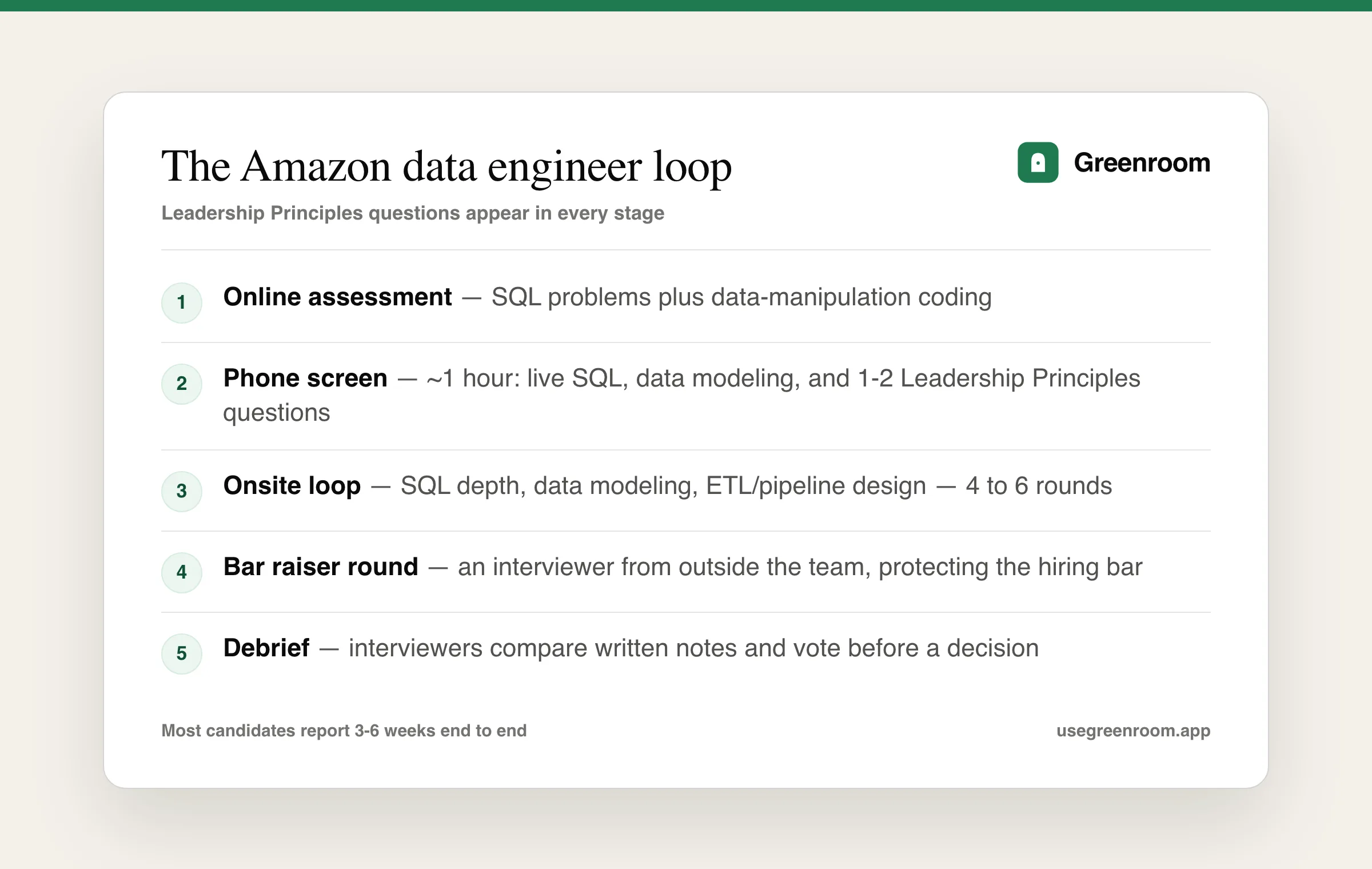
The Amazon data engineer interview process is one of the most consistent loops in tech, reported almost identically across regions and levels:
- Online assessment — SQL problems plus data-manipulation coding, occasionally work-style questions.
- Phone screen — ~1 hour with a data engineer: live SQL, a data-modeling discussion, and 1–2 Leadership Principles questions.
- Onsite loop — 4–6 rounds covering SQL depth, data modeling, ETL/pipeline design and coding, each round ending with behavioral questions.
- Bar raiser round — an interviewer from outside the team whose job is to protect the hiring bar company-wide; heavy on Leadership Principles.
- Debrief — interviewers compare written notes and vote before a decision.
Most candidates report 3–6 weeks end to end. The full round-by-round breakdown, with what each round screens for, lives on our Amazon Data Engineer interview prep page — this post goes deep on the questions themselves.
Amazon data engineer SQL interview questions
SQL is the gate. Amazon's DE loop leans on window functions harder than almost any other company's — if you can't reason about PARTITION BY out loud, the loop ends early. Real reported question shapes:
- Return each user's most recent record from an events table (dedup with ROW_NUMBER).
- Find users who logged in on 3 or more consecutive days (the classic streak problem).
- Compute month-over-month revenue growth per marketplace.
- Find the top 3 products by revenue in each category:
-- Top 3 products by revenue in each category
SELECT category, product_id, revenue
FROM (
  SELECT
    category,
    product_id,
    SUM(amount) AS revenue,
    DENSE_RANK() OVER (
      PARTITION BY category
      ORDER BY SUM(amount) DESC
    ) AS rnk
  FROM orders
  GROUP BY category, product_id
) ranked
WHERE rnk <= 3;
The follow-ups are where offers are won: why DENSE_RANK and not ROW_NUMBER? What happens to your query when two products tie? How does this behave on a billion-row table? Our SQL interview questions guide covers the window-function patterns these all build on.
Data modeling questions
Round two of most loops is a whiteboard (or verbal) modeling exercise, usually anchored to a realistic Amazon-scale domain:
- Design a data model for a ride-sharing app / an e-commerce returns flow. They want grain declared first, facts and dimensions second.
- When would you choose a star schema over a wide denormalized table?
- Explain SCD Type 1 vs Type 2 — and when Type 2 is worth the storage.
- How do you pick a partition key for a fact table queried by date AND by customer?
The trap is jumping to tables before declaring the grain. Interviewers consistently reward candidates who ask "what's one row in this fact table?" before drawing anything.
ETL and pipeline design questions
The design round is a data-flavored system design interview. Reported prompts:
- Design a pipeline that ingests 1B events/day with exactly-once semantics.
- Batch or streaming for a daily sales dashboard — defend the boring answer.
- A backfill needs to reprocess 90 days of data without corrupting downstream tables. Walk me through it.
- How do you handle late-arriving data in a partitioned warehouse?
- Redshift vs S3 + Athena for an analytics workload — trade-offs?
Structure beats vocabulary here: clarify volume and latency, propose ingestion → storage → transform → serve, then volunteer failure modes (idempotent retries, dead-letter queues, data-quality checks) before you're asked. The general framework is in our data engineer interview questions guide.
Leadership Principles: the round inside every round
Amazon interviewers are each assigned specific Leadership Principles to probe, in every round, technical or not. Expect ~2 per round:
- Tell me about a time you disagreed with your manager and were right. (Have Backbone; Disagree and Commit)
- Tell me about a data quality incident you owned end to end. (Ownership; Dive Deep)
- Describe a time you delivered with an unrealistic deadline. (Deliver Results; Bias for Action)
Answers must be STAR-shaped, specific, and metric-backed — "improved pipeline reliability" loses to "cut failed runs from 9/week to 1." The bar raiser will re-ask a story from a different angle to test whether it's real. Our Amazon Leadership Principles interview questions guide maps all 16 principles to reusable stories.
LeetCode, StrataScratch, GeeksforGeeks — where each fits
An honest map of the usual prep stack for this specific loop:
- LeetCode — mostly miscalibrated here; the DE loop's coding is SQL and Python data manipulation, not hard graph problems. Its SQL 50 list is the one genuinely useful slice.
- StrataScratch / DataLemur — the closest question shapes to real Amazon SQL screens; excellent for reps, silent on the spoken follow-ups.
- GeeksforGeeks interview experiences — useful anecdotes for calibrating recent loops; treat as anecdotes, not a syllabus.
- ChatGPT — good for generating practice prompts and reviewing a written STAR story; it won't interrupt your query walkthrough with "why not ROW_NUMBER?" the way a real interviewer will.
- Greenroom — the spoken layer. Ari, the AI interviewer, runs the SQL-reasoning, design and Leadership Principles rounds out loud with live follow-ups, and scores the structure and clarity the debrief actually votes on. It won't teach you warehousing from zero — pair it with the fundamentals above.
How to prepare for the Amazon data engineer interview
- Week 1: SQL depth — window functions, streaks, dedup, growth queries — explaining each query out loud, not just passing test cases.
- Week 2: data modeling — design three domains (rides, returns, subscriptions) declaring grain first; plus SCDs and partitioning trade-offs.
- Week 3: pipeline design — batch vs streaming, exactly-once, backfills, late data — talked through as full designs, not flashcards.
- Week 4: Leadership Principles — write 8–10 STAR stories with numbers, then rehearse them spoken until they survive a "tell me more about that decision" follow-up.
If you're running parallel FAANG processes, the loops rhyme but weight differently — our Google data engineer interview guide and Meta data engineer interview guide cover where each diverges, and the Microsoft data engineer interview guide, Uber data engineer interview guide and Apple data engineer interview guide cover the non-Amazon bar-raiser, streaming and privacy-first versions.
Frequently asked questions
What questions are asked in an Amazon data engineer interview?
Four types: advanced SQL (window functions, streaks, dedup), data modeling (star schema, SCDs, grain and partitioning), ETL/pipeline design (exactly-once ingestion, backfills, batch vs streaming), and Leadership Principles behavioral questions — which appear in every round, not just a dedicated one.
How many rounds are there in the Amazon data engineer interview?
Typically an online assessment, a ~1-hour phone screen, then an onsite loop of 4–6 rounds including a bar raiser round, followed by a debrief where interviewers vote. Most candidates report 3–6 weeks end to end.
Is the Amazon data engineer interview hard?
The technical bar is high but predictable — SQL and pipeline questions repeat in shape. What most candidates underestimate is that every round grades Leadership Principles answers as heavily as the technical answer, and unrehearsed STAR stories fail under bar-raiser follow-ups.
Does the Amazon data engineer interview include coding or just SQL?
Both, but SQL-first. Expect Python (or your language) for data manipulation — parsing, transformations, light algorithms — rather than LeetCode-hard problems. If prep time is scarce, window functions beat dynamic programming for this loop.
What is the bar raiser round in an Amazon data engineer interview?
A round run by a trained interviewer from outside the hiring team, with veto power, whose mandate is keeping the company-wide hiring bar high. It leans heavily on Leadership Principles and will re-probe stories you told earlier rounds from a new angle.
How do I prepare for the Amazon data engineer interview in one month?
Week 1 SQL window functions, week 2 data modeling with grain-first practice, week 3 pipeline design trade-offs, week 4 spoken STAR stories mapped to Leadership Principles — with at least one full spoken mock per round type before the real loop.
Sharpening the tooling behind these rounds? The PySpark interview questions guide covers the distributed-processing questions, the data modeling interview questions guide covers grain and star schemas, and the Airflow interview questions guide covers orchestration and backfills.