The night before her Netflix loop, a data engineer I'll call Meera did what felt responsible: six hours of medium-hard LeetCode and a YouTube video titled "CRACK any FAANG interview." Her first interviewer opened with: "Walk me through a pipeline you own — and tell me what you'd tear out of it if nobody was watching." Meera had rehearsed binary search on rotated arrays. Nobody at Netflix wanted her binary search. They wanted her opinions.
That's the thing to understand about Netflix data engineer interview questions: Netflix is the FAANG that interviews you like a senior peer, not a student. The loop assumes you've run production pipelines and asks you to defend real decisions out loud — which is exactly the muscle most prep never touches. I built Greenroom after freezing in a spoken round I knew the answers to, so this guide covers both what Netflix asks and how to say it.
The Netflix data engineer interview process in 2026
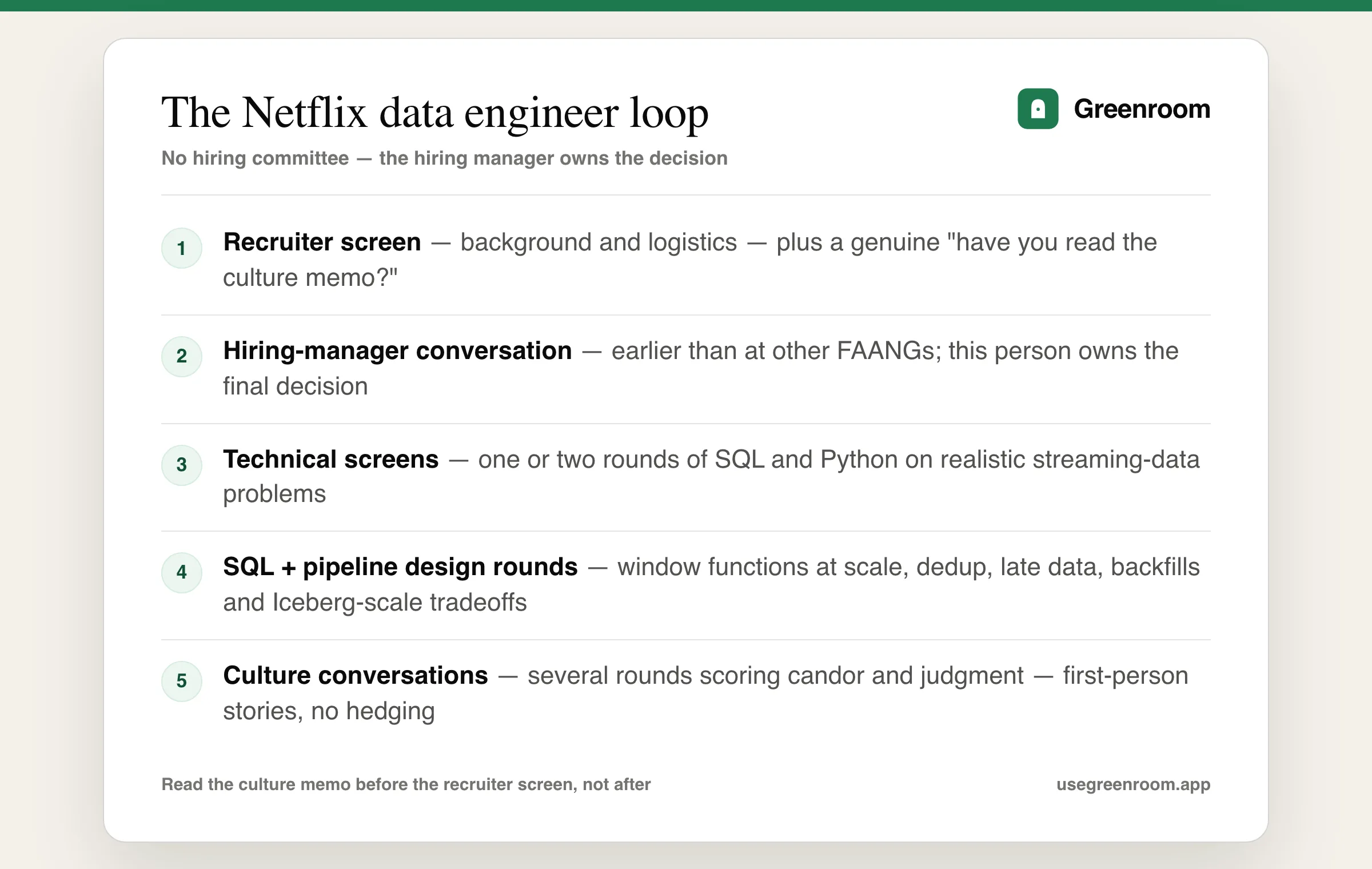
Netflix famously has no leveling ladder and (mostly) no new-grad pipeline — it hires experienced engineers and pays top of market. That shapes the whole Netflix data engineer interview process, which candidates consistently report as:
- Recruiter screen — background and logistics, plus a real question: "Have you read the culture memo?" (Read it. It's the only company where the required pre-reading is a philosophy document.)
- Hiring-manager conversation — earlier than at other FAANGs, and it matters: at Netflix the manager owns the hire, with no committee to appeal to.
- Technical screens — one or two rounds of SQL plus Python on realistic data problems.
- Virtual onsite — four to six rounds: SQL and coding depth, pipeline and data-architecture design, and multiple culture conversations, often including someone from a partner team.
Because one manager decides, every interviewer is effectively writing them a memo about how you think. Rambling, hedging, or reciting answers reads worse here than anywhere else — candor and clarity are the actual rubric.
Netflix data engineer SQL and coding interview questions
The Netflix data engineer SQL questions are framed on the data you'd actually touch: playback sessions, viewing hours, device events. The recurring shapes are window functions, deduplication and retention on very large fact tables:
Top titles by watch hours, per country.
The classic ranking-within-groups pattern — know why DENSE_RANK versus ROW_NUMBER matters when two titles tie:
-- top 3 titles by watch-hours per country, last 7 days
SELECT country, title_id, watch_hours
FROM (
  SELECT country, title_id,
         SUM(hours) AS watch_hours,
         DENSE_RANK() OVER (
           PARTITION BY country ORDER BY SUM(hours) DESC
         ) AS rk
  FROM playback_sessions
  WHERE play_date >= CURRENT_DATE - 7
  GROUP BY country, title_id
)
WHERE rk <= 3;
Then the follow-ups that decide the round: what this costs on a table with billions of rows, where you'd partition and cluster, and what breaks when a device retries and sends the same session twice. Our SQL interview questions guide drills the window-function family in depth.
Deduplicate a heartbeat stream.
Playback clients send heartbeat events every few seconds, and networks love duplicating them. The Python rounds live at this altitude — practical data wrangling, narrated clearly:
def dedupe_heartbeats(events):
    """Keep the latest heartbeat per (user, session)."""
    latest = {}
    for e in events:
        key = (e["user_id"], e["session_id"])
        if key not in latest or e["ts"] > latest[key]["ts"]:
            latest[key] = e
    return list(latest.values())
Mention the memory ceiling before you're asked — what happens when the stream doesn't fit in a dict, and how you'd do the same dedup in Spark. The Python interview questions guide covers the language layer underneath.
Pipeline design and data architecture questions at Netflix
This is the round Meera met her "what would you tear out" question in, and it's where Netflix goes deepest. The company's data platform runs on Spark, Flink, Kafka and Apache Iceberg — a table format Netflix itself created and open-sourced, which its engineers write about on the Netflix TechBlog. You don't need to have used their exact stack, but you need to reason at its scale:
- Design the playback-events pipeline — billions of events a day; name the freshness requirement first, then choose batch, streaming or both.
- Late and duplicate data — watermarks, reprocessing windows, and idempotent writes so a rerun never double-counts watch hours.
- Backfills — a bug corrupted a week of data; walk through recovery without taking the dashboards down.
- Modeling — grain first, facts and dimensions, and when a wide denormalized table is the honest answer for query cost.
There's no single right answer by design. What's scored is whether you state tradeoffs unprompted, change your mind gracefully when pushed, and disagree with the interviewer when you actually disagree — the culture memo calls it farming for dissent, and yes, they mean it in interviews too. The data engineer interview questions guide covers the ETL, warehousing and Spark fundamentals; the Netflix data engineer prep page has a compact round-by-round checklist.
The culture rounds: the memo, candor, and you
Every FAANG has behavioral rounds; Netflix has culture rounds, plural, and treats them as eliminatory. The questions look standard — a conflict, a failure, a decision you got wrong — but the scoring is distinctly Netflix: they want direct, first-person, unhedged answers. "We decided as a team" reads as camouflage; "I made the call, here's what I weighed, here's what I got wrong" reads as senior.
Read the culture memo the way you'd read a job description, because interviewers reference it. Expect questions shaped like: tell me about a time you disagreed and pushed back (there's a whole playbook in our disagreeing with your boss guide), a time you received blunt feedback, a decision you made without asking permission. Two-minute stories, real numbers, no adjectives doing the work of evidence.
LeetCode, DataLemur, the TechBlog — where each fits
An honest map of the prep stack for this specific loop:
- LeetCode — light duty here. Keep a daily easy-medium Python habit so syntax stays warm, but the Netflix DE loop is not an algorithms contest and DP grinding is misallocated hours.
- DataLemur and StrataScratch — the best written-SQL drills on realistic product data; excellent for window functions. Their limit: they can't push back on your reasoning, and Netflix rounds are mostly pushback.
- The Netflix TechBlog — genuinely the best company-specific prep that exists; read the data-platform posts and you'll speak the interviewers' vocabulary honestly.
- GeeksforGeeks and Blind interview experiences — useful anecdotes for calibration; treat as anecdotes, not a syllabus.
- ChatGPT — fine for generating pipeline-design prompts and critiquing written answers; it won't interrupt your answer with "why not streaming?" the way a Netflix interviewer will.
- Greenroom — the spoken layer. Ari, the AI interviewer, runs the round out loud, pushes follow-ups when your design answer hand-waves, and scores candor and structure — the things the hiring manager's memo is actually about. Fair tradeoff: Ari won't teach you Iceberg internals; pair it with the TechBlog.
How to prepare for the Netflix data engineer interview
- Week 1: SQL at scale — window functions, dedup, sessionization, then cost: partitioning and clustering reasoning, explained out loud.
- Week 2: Python data wrangling daily, plus three TechBlog data-platform posts — summarize each aloud in two minutes.
- Week 3: pipeline design — playback events, a backfill plan, a batch-to-streaming migration; answer each aloud twice, defending every tradeoff.
- Final week: the culture memo, your five stories in first person at two minutes each, and two full spoken mocks. Then the role-specific prep page the night before — not new material.
If other FAANG data loops are on your calendar, they rhyme but weight differently: the Google data engineer guide covers the hiring-committee version, the Amazon data engineer guide covers Leadership-Principles-in-every-round, the Meta data engineer guide covers the speed-and-breadth version, the Uber data engineer guide covers the streaming-marketplace version, and the general Netflix preparation guide covers the SWE track.
For the services side of the same platform, see our Netflix backend interview questions guide.
Frequently asked questions
What is the Netflix data engineer interview process?
Candidates consistently report: a recruiter screen, an early hiring-manager conversation, one or two technical screens mixing SQL and Python, then a virtual onsite of four to six rounds — SQL and coding, pipeline and data-architecture design, and several culture conversations, often including people from outside the team. Netflix interviews senior engineers as peers, so every round is a two-way discussion rather than a quiz.
Is the Netflix data engineer interview hard?
Yes, but not in the LeetCode sense. The technical bar assumes you have owned production pipelines — the questions probe scale, failure recovery and tradeoffs rather than puzzle tricks. The harder filter is the culture rounds: Netflix expects direct, candid, well-reasoned opinions delivered out loud, and vague or rehearsed-sounding answers stand out immediately.
Does Netflix hire junior or entry-level data engineers?
Rarely. Netflix has historically hired experienced engineers rather than running a large new-grad pipeline, and data engineering roles typically expect several years of production experience with distributed data systems. If you are early-career, target Amazon, Google or strong India product companies first — the Netflix loop assumes you have war stories to discuss.
What SQL questions does Netflix ask data engineers?
Reported questions are framed on realistic streaming data: top titles by watch hours per country using window functions, deduplicating playback heartbeat events, session and retention analysis, and joins across very large fact tables. Follow-ups push on cost and scale — partitioning, clustering, and what changes when the table has billions of rows.
What is the keeper test in a Netflix interview?
The keeper test is a management idea from the Netflix culture memo — managers ask themselves which employees they would fight to keep. It is not a question you are asked directly, but interviewers do check whether you have read the culture memo and whether your stories show candor, judgment and independent decision-making, the qualities the memo describes.
How long does the Netflix data engineer interview process take?
Most reported timelines run three to six weeks from recruiter contact to decision — faster than Google because there is no hiring committee; the hiring manager owns the decision. Scheduling the onsite is usually the longest gap, so use that window for structured spoken practice on pipeline-design prompts.