A recruiter I know showed me her LinkedIn inbox once. Two hundred and eleven unread. She was scrolling it in a lift, between interviews, on a phone, and each message showed roughly the first line and a half in the preview. Anything that opened with "Hi Ma'am, I hope this message finds you well, I am writing to express my interest" got exactly as far as "Hi Ma'am" before her thumb moved on.
That is the whole mechanism of how to message a recruiter on LinkedIn. They are not reading; they are triaging, in a preview pane, deciding one thing: *is this person relevant to something I am hiring for right now?* If line one does not answer that, line two does not exist.
The four-line message
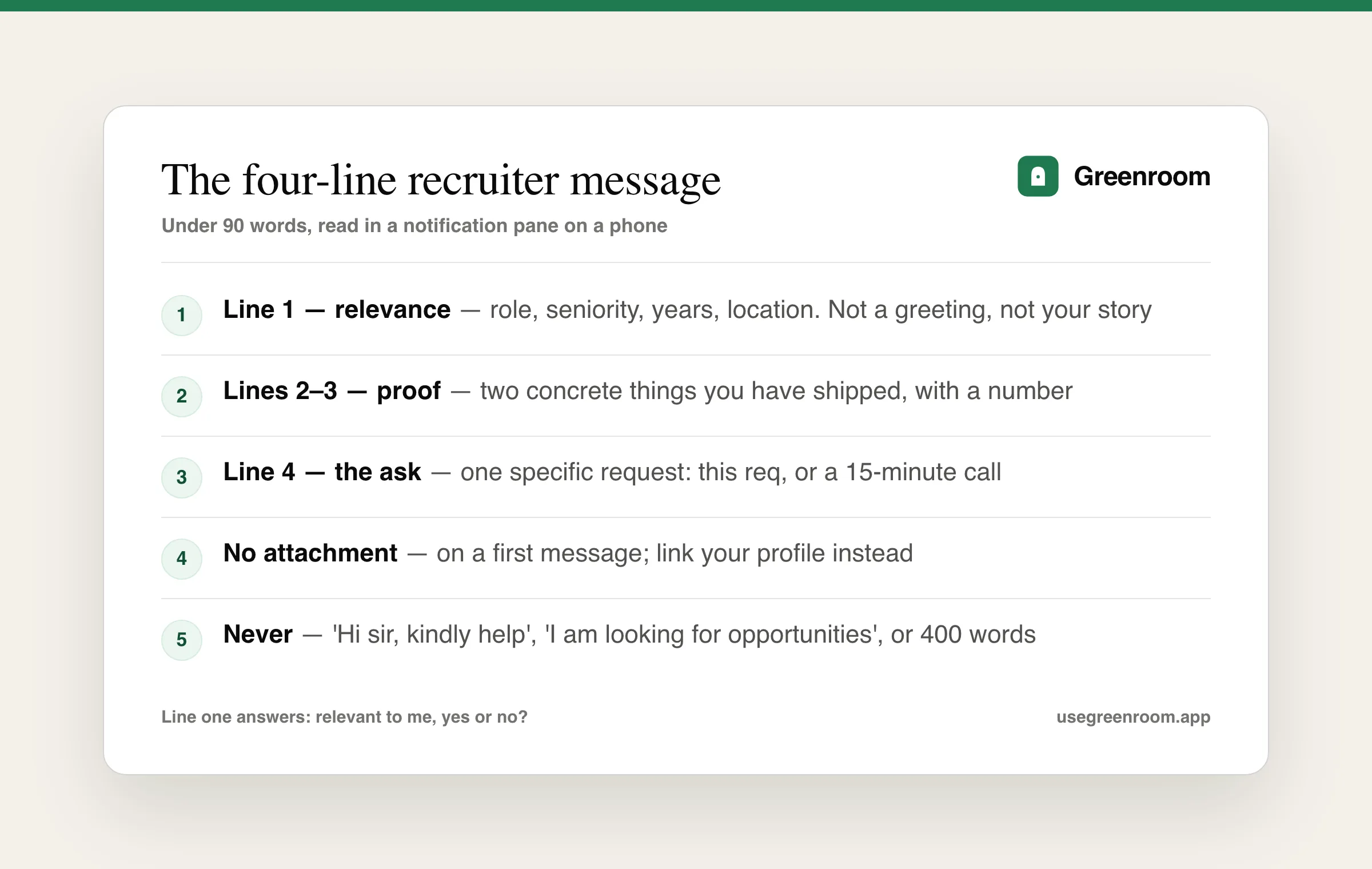
Line one — relevance, immediately. Role, seniority, years, location. No greeting beyond a name, no windup.
"Backend engineer, 4 years, Java/Spring, Bengaluru — saw you're hiring for the payments team."
That line does the entire triage job. She now knows whether to keep reading, which is the only decision being made.
Lines two and three — proof. Two concrete things, with a number in at least one. Not adjectives, not "passionate about scalable systems".
"Currently at [company], where I own the settlement service — took p99 from 900ms to 210ms and led the reconciliation rewrite."
Line four — one specific ask. Not "let me know if there are any opportunities". Ask for the thing you want.
"Is req #4821 still open, and would it be worth a quick call this week?"
That is it. Under ninety words. No attachment on a first message — LinkedIn previews handle them badly and it looks like a mass send. Your profile is the attachment.
Templates
Cold, about a specific role:
Hi Neha — backend engineer, 4 years, Java and Spring, based in Bengaluru.
I saw the Senior Backend Engineer opening on the payments team (req #4821). I currently own the settlement service at [company] — took p99 from 900ms to 210ms and led our reconciliation rewrite last year.
Is that role still open? Happy to send my resume or jump on a short call.
Thanks, Arun
Cold, no specific role — harder, keep it shorter:
Hi Neha — data engineer, 5 years, Spark and Airflow, Hyderabad.
Not applying to anything specific, but I follow your team's work and wanted to be on your radar. Most recently cut our daily batch pipeline from six hours to ninety minutes.
If anything opens up at that level, I'd be glad to hear about it.
Arun
Responding to a recruiter who contacted you — the highest-value message most people write badly:
Hi Neha — thanks for reaching out, and yes, interested.
Quick context: 4 years backend, currently on payments infrastructure, 60-day notice with buyout possible. I'd want to be around ₹32L fixed to move.
Could you share the JD and the team? Happy to talk this week — I'm free Tue/Thu after 6.
Arun
Notice this one answers the three questions the recruiter was going to ask anyway — expectations, notice period, availability — which compresses a week of back-and-forth into one message. Our what are your salary expectations guide covers the number and our CTC vs in-hand salary guide covers why to quote fixed.
Following up after silence — once, after five to seven days:
Hi Neha — following up on my note about req #4821. Still very interested; happy to send anything useful. If the role's filled or it's not a fit, no problem at all — just let me know either way.
Our how to follow up after no response guide covers the wider follow-up problem.
What kills these messages
- "Hi sir/ma'am, kindly help." Extremely common and it converts at close to zero. It signals a mass send and asks for a favour with nothing attached.
- "I am looking for opportunities." So are two hundred other people in that inbox this week. Name the role.
- The four-hundred-word life story. The preview shows a line and a half.
- A connection request with no note — invisible.
- An attachment on a first message. Reads as a template blast.
- Messaging five recruiters at the same company. They share notes and it looks like spraying.
- Following up every two days. One follow-up. Then leave it.
- Being relevant to nothing. If you are a frontend engineer messaging a recruiter who hires only for finance roles, no template rescues that. Check what they actually post about first.
Finding the right recruiter
- Search the company plus "recruiter" or "talent acquisition" on LinkedIn, then filter to the ones whose recent posts are about roles like yours.
- Check the job posting itself — many list the hiring recruiter, and some list the hiring manager, who is often the better target for a specific technical role.
- Agency versus in-house. Agency recruiters work across many companies and respond more readily; in-house recruiters have better information and more influence. Both are worth messaging, for different reasons.
- Prioritise recent activity. A recruiter who posted a role three days ago is in the inbox. One who last posted in March is not.
Make the profile back it up
The message gets them to click your profile, and the profile is where the decision actually happens. Minimum viable version:
- A headline that states the role, not a slogan. "Backend Engineer · Java, Spring, Distributed Systems" beats "Aspiring technologist | Lifelong learner".
- An About section with three concrete achievements, numbers included.
- Experience entries that say what you built, not what your team was responsible for.
- The keywords a recruiter actually searches — the technologies, in plain words, because their search does not infer.
- Open to work set privately if you are employed, which shows you to recruiters without showing your manager.
Our ATS resume tips for software engineers guide covers the same discipline applied to the resume they will ask for next.
Where each option actually helps
- LinkedIn itself — free, and the connection-request note is limited to a short character count, which is a useful forcing function for exactly the brevity described above.
- The job posting — the best source of the recruiter's name and the requisition ID that makes your message specific.
- ChatGPT — good for tightening a draft you wrote. Its failure mode is producing exactly the polished, generic, four-paragraph message that gets ignored, so cut whatever it gives you by half.
- A referral instead — usually stronger than a cold recruiter message when you have the option. Our how to ask for a referral guide covers it.
- Greenroom — not for the message; for the call it gets you. Ari, the AI interviewer runs the screen out loud so the first conversation is not the first time you have said any of it. Honest tradeoff: it cannot write your LinkedIn message, and it should not.
Outbound works better when inbound is also on: our LinkedIn profile tips for software engineers guide covers being found by search in the first place.
Frequently asked questions
How do you message a recruiter on LinkedIn?
Write four lines and keep it under ninety words. Line one establishes relevance immediately with role, seniority, years and location, because recruiters triage in a preview pane on a phone. Lines two and three give two concrete achievements with a number in at least one. Line four makes one specific ask, such as whether a particular requisition is still open. Do not attach anything to a first message — your profile is the attachment.
Why do recruiters ignore LinkedIn messages?
Because the first line failed to answer the only question they are asking, which is whether you are relevant to something they are hiring for right now. Openings such as I hope this message finds you well or I am looking for opportunities burn the only line they will read. Other common causes are a four-hundred-word message when the preview shows a line and a half, a connection request with no note, and attaching a file to a first message, which reads as a mass send.
What should you say when a recruiter contacts you first?
Answer the three questions they were going to ask anyway, in one message: your current focus and experience, your notice period including whether buyout is possible, and your compensation expectation as a fixed figure. Then ask for the job description and the team, and offer two specific times you are free. That compresses roughly a week of back-and-forth into a single reply and marks you out immediately.
Should you attach your resume when messaging a recruiter?
Not on a first message. LinkedIn previews attachments badly and a file on an opening message reads as a template blast sent to many people. Let your profile do that job, and offer to send the resume in your closing line. Once they reply, send it immediately and in the format they ask for.
How many times should you follow up with a recruiter?
Once, after five to seven days, and then stop. Keep the follow-up to two sentences, restate the specific role, and explicitly give them an easy way to close it out — saying that if the role is filled or it is not a fit, just letting you know is fine. Following up every two days is the fastest way to be muted.
How do you find the right recruiter to message?
Search the company name alongside recruiter or talent acquisition on LinkedIn, then filter to people whose recent posts are about roles like yours, because a recruiter who posted a relevant role three days ago is actively in their inbox. The job posting itself often names the recruiter or the hiring manager, and the hiring manager is frequently the better target for a specific technical role. Agency recruiters reply more readily while in-house recruiters have better information and more influence.