She had eleven slides, a colour-coded roadmap, and a genuinely good idea on slide nine. The room never saw slide nine. At minute nineteen of a twenty-minute slot she was on slide four, apologising, and speeding up — which is the presentation equivalent of running through an airport, and looks roughly as composed.
The feedback said "strong thinking, struggled to prioritise." She had prioritised beautifully in the plan. She just had not prioritised the deck.
That is the short version of why second interview presentation examples are more useful than presentation tips. Nobody needs to be told to rehearse. What people need is a shape: this brief, that many slides, this many minutes each, and the one section everybody leaves out. This guide gives five real brief shapes, the deck behind each, and the timing that keeps you inside the clock.
What the presentation round is actually testing
The invite makes it sound like an exam. It is not. A presentation round is the cheapest way a company can watch you do the actual job for twenty minutes: take an ambiguous problem, decide what matters, and explain it to people who will interrupt.
Three things are being scored, and only one of them is the content:
- Can you scope? You were given a vague brief on purpose. What you choose to leave out is the test.
- Can you be interrupted? Senior people will cut in on slide three. If that derails you, that is the finding.
- Would this be pleasant on a Tuesday? The room is imagining a planning meeting with you in it.
Slide craft is worth almost nothing here, which is a relief, because you have four days. Nobody has ever been rejected for a plain deck. People are rejected constantly for a deck that overruns, and for a deck that presents conclusions with no visible reasoning behind them.
Five second interview presentation examples
These are the five brief shapes that cover most presentation rounds. The wording differs; the underlying ask does not.
1. "Present your 30-60-90 day plan for this role"
The most common brief for managerial and senior individual-contributor roles. The trap is writing a plan that is all delivery — a list of things you will ship, from someone who has not yet met the team.
Anchor each phase to one deliverable and one relationship. Days 1-30: understand the system and the people, with a specific artefact at the end of it (a written summary of where the pain is). Days 31-60: one visible, low-risk improvement. Days 61-90: the first thing that would have been too dangerous to attempt in month one. Say out loud that the plan will change once you know more, because the alternative reads as someone who has already decided what is wrong with a team they have never met.
2. "Here's a problem we face — how would you tackle it?"
The case study. Almost everyone spends the deck proposing solutions. Spend the first third on how you would find out what is actually happening: what you would measure, what you would read, who you would talk to in the first week.
A candidate who says "I would want to see the funnel broken down by device before I trusted the drop-off number" has told the room more than three slides of proposals. The people watching already know the answer; they are checking whether you would have got there honestly or guessed correctly.
3. "What would you improve about our product?"
The teardown, and the one with a live tripwire in it: half of what looks broken from outside is a deliberate decision made under a constraint you cannot see.
Lead with what works and why, briefly and specifically, so the critique that follows is clearly informed rather than reflexive. Then pick two issues, not nine. For each, describe what you observed, what you think it costs, what you would try, and — this is the part that lands — what internal reason might exist for it being that way. Criticising a product in front of the people who built it is a tone exercise as much as an analysis one.
4. "Present a project you're proud of"
Pick the project with the best arc, not the biggest number: a real constraint, a decision that could have gone the other way, and a result you can describe honestly, including what you would do differently.
Four slides is plenty. Context, the decision and why it was hard, what happened, what you learned. The follow-up question is always some version of "what would you change" — so put your own answer to it on the last slide and pre-empt it. Our second interview questions guide covers the verbal versions of the same dig.
5. "Where should this team focus next year?"
The strategy brief, usually for lead and above. The failure mode is a wish list. The fix is to name your prioritisation rule before your priorities — "I would rank by revenue at risk, then by how reversible the decision is" — and then apply it visibly. A room can disagree with your ranking and still hire you for the rule.
How many slides, and how long each one gets
Work backwards from the slot, every time:
- 10-minute slot: about six slides, seven minutes of talking. A 10-minute interview presentation is one idea, not a survey.
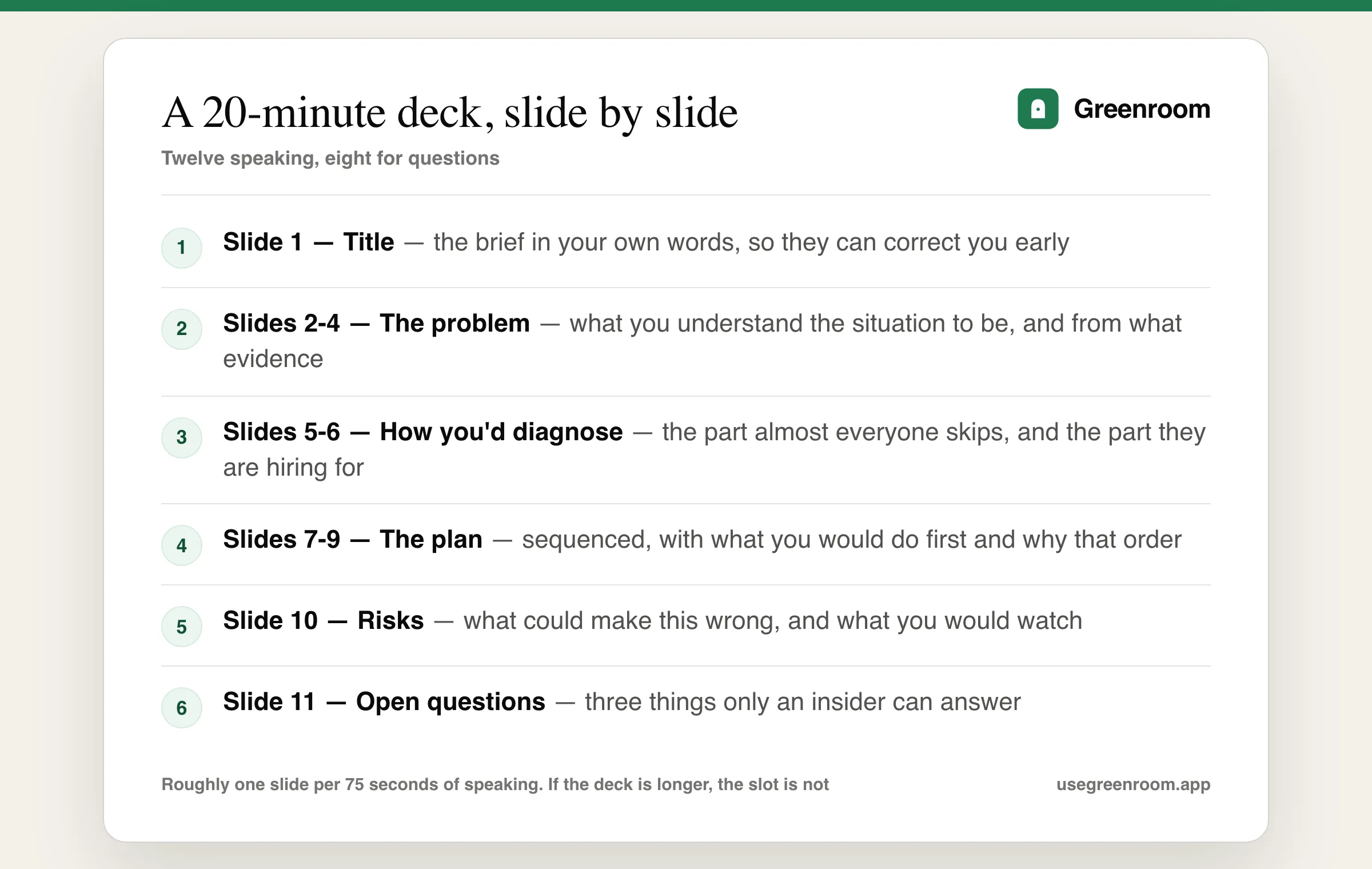
- 20-minute slot: about ten slides, twelve minutes talking, eight for questions.
- 30-minute slot: about fourteen slides, eighteen minutes talking. Above this length, build in a deliberate pause to check the room is still with you.
Two rules that survive every format. One idea per slide — if the slide needs two headlines, it is two slides. And your notes are not the slide: text-dense slides get read silently by the room, which means nobody is listening to you, which is the whole point of the round. If they ask for the deck afterwards, send a version with an appendix.
Check whether the deck is being shared in advance. If it is, the first two minutes of your slot should assume they have skimmed it and skip straight past the setup.
Preparing it in three evenings
Most people have about a week. Three focused evenings is enough.
Evening one — decide the answer. No slides. Write the argument as five sentences in a notes app. If the five sentences are not convincing, no amount of design will fix them.
Evening two — build the deck against the clock. Slide count from the slot length, one idea each, deliberately plain. Leave the title slide last.
Evening three — say it out loud, timed, twice. This is the only step that reliably changes the outcome and the one most consistently skipped, because reading a deck silently feels like rehearsing and takes a quarter of the time. It is not the same activity. Then prepare for the interruptions: write down the six questions you least want to be asked, and answer each in three sentences out loud. Our panel interview tips guide covers being questioned by several people at once, which is what the Q&A becomes.
Finish by preparing your own questions, since the round usually ends there — the questions to ask at the end of an interview list is sorted by who is in the room.
Where the usual advice comes up short
"Interview presentation tips" listicles. Tell a story, don't read your slides, make eye contact. All true, all known, none of it tells you how many slides to build for a twenty-minute slot or which section to cut when the brief is vague.
Slide template packs and Canva decks. They solve the problem you do not have. A visually polished deck that overruns loses to a plain one that finishes. Spend the time on the diagnosis slides instead.
Asking ChatGPT to write the deck. Genuinely useful for structuring an argument and for pressure-testing your prioritisation rule. What it cannot do is sit there while you talk for twelve minutes and tell you that you lost the room at minute four, because it is not in the room and it is not on a clock.
A friend on a video call. The best option available if you have one, and the honest limitation is that friends interrupt politely and let you run over. The interviewers will do neither.
Greenroom. Honest fit: Ari does not review slides, and this round is a slide-shaped round. What overlaps is the twelve minutes of talking and the Q&A that follows — Ari, the AI interviewer asks follow-ups in the middle of an answer and does not rescue you when you drift, which is the part of this round that actually goes wrong. Honest tradeoff: rehearsing the talk track is not the same as rehearsing the deck, and you still need one timed run at the real thing.
The one-line version
Take the slot length, halve it for questions, build roughly one slide per seventy-five seconds of what remains, spend a third of those slides on how you would diagnose the problem rather than on your conclusions, and rehearse it out loud with a timer at least twice — because the round is a working session, and the two things that lose it are running over and showing an answer with no visible reasoning behind it.
Frequently asked questions
What are some second interview presentation examples?
Five brief shapes cover most presentation rounds. A 30-60-90 day plan for the role, where each phase is anchored to one deliverable and one relationship. A case study on a problem the team actually faces, where the first third of the deck covers how you would diagnose it. A teardown of the company's product, kept to two issues rather than nine. A project you are proud of, chosen for the strength of its arc rather than its size. And a strategy brief on where the team should focus next, where you name your prioritisation rule before your priorities. The wording of the brief differs between companies, but the underlying ask is usually one of these.
How many slides should an interview presentation be?
Derive the slide count from the slot rather than choosing it first. A workable pace is about one slide per seventy-five seconds of speaking, and roughly half a slot should be reserved for questions. That puts a ten-minute slot at about six slides, a twenty-minute slot at about ten, and a thirty-minute slot at about fourteen. One idea per slide: if a slide needs two headlines it is really two slides. Running over time is the most common way a strong deck loses, so the count is a budget rather than a target.
What should I include in a 10-minute interview presentation?
One idea, presented properly, rather than a survey of everything you know. About six slides and seven minutes of speaking leaves three minutes for questions. Open by restating the brief in your own words so the room can correct you early, spend the middle on how you understand the problem and how you would verify that understanding, give a short sequenced plan, and close on two or three open questions that only an insider could answer. Cut background and credentials entirely — they have your CV, and at ten minutes every slide of setup is a slide of substance you will not reach.
What do you present in a second interview?
Whatever the brief asks for, which is usually a plan, a case study, a product critique or a past project. If the brief is vague, that is deliberate and the scoping is part of the test, so state your interpretation on the first slide and invite correction. Across all formats the section that most often decides the outcome is the one showing how you would find out what is actually happening — what you would measure, what you would read, who you would talk to — because interviewers are checking whether you would reach a good answer honestly rather than guess one correctly.
How do I prepare a presentation for an interview?
Three focused evenings is usually enough. First, write the argument as five sentences with no slides at all; if those five sentences are not convincing, design will not rescue them. Second, build the deck against the clock, with the slide count set by the slot length and one idea per slide. Third, say it out loud, timed, at least twice, and then write down the six questions you least want to be asked and answer each in three sentences aloud. Reading the deck silently feels like rehearsal and is not the same activity — it is the timed spoken run that changes the outcome.
What topics are good for an interview presentation when the brief is open?
When you are told to pick your own topic, choose something close to the role you are interviewing for and narrow enough to cover properly in the time. A specific problem you solved, a decision you had to make with incomplete information, or a focused view on where the field is heading all work. Avoid broad industry overviews, which are impossible to make specific, and avoid anything that requires the room to accept a lot of unfamiliar context before the interesting part begins. A good test is whether you can state the point of the presentation in one sentence before you build anything.