The office had a wall of plants, a demo that genuinely worked, and a founder who talked for forty minutes about the problem in a way that made him want to solve it too. He walked out already composing the message to his current manager.
Eleven months later the company did a "restructure" and he was one of nineteen people who found out on a Thursday morning that the runway had been eleven months when he joined, and that everyone above a certain level had known.
Nobody lied to him. He simply never asked, because asking felt presumptuous — and because everything he had been shown was, quite reasonably, the good part. The product, the founders and the office are all selected to impress. None of them predicts whether the job exists in eighteen months. The variables that do are boring, numeric, and mostly askable in a single conversation.
This is the question that comes before our ESOP vs salary guide: that one covers how to value the equity, and this one covers whether the company lives long enough for the equity to mean anything.
The seven questions
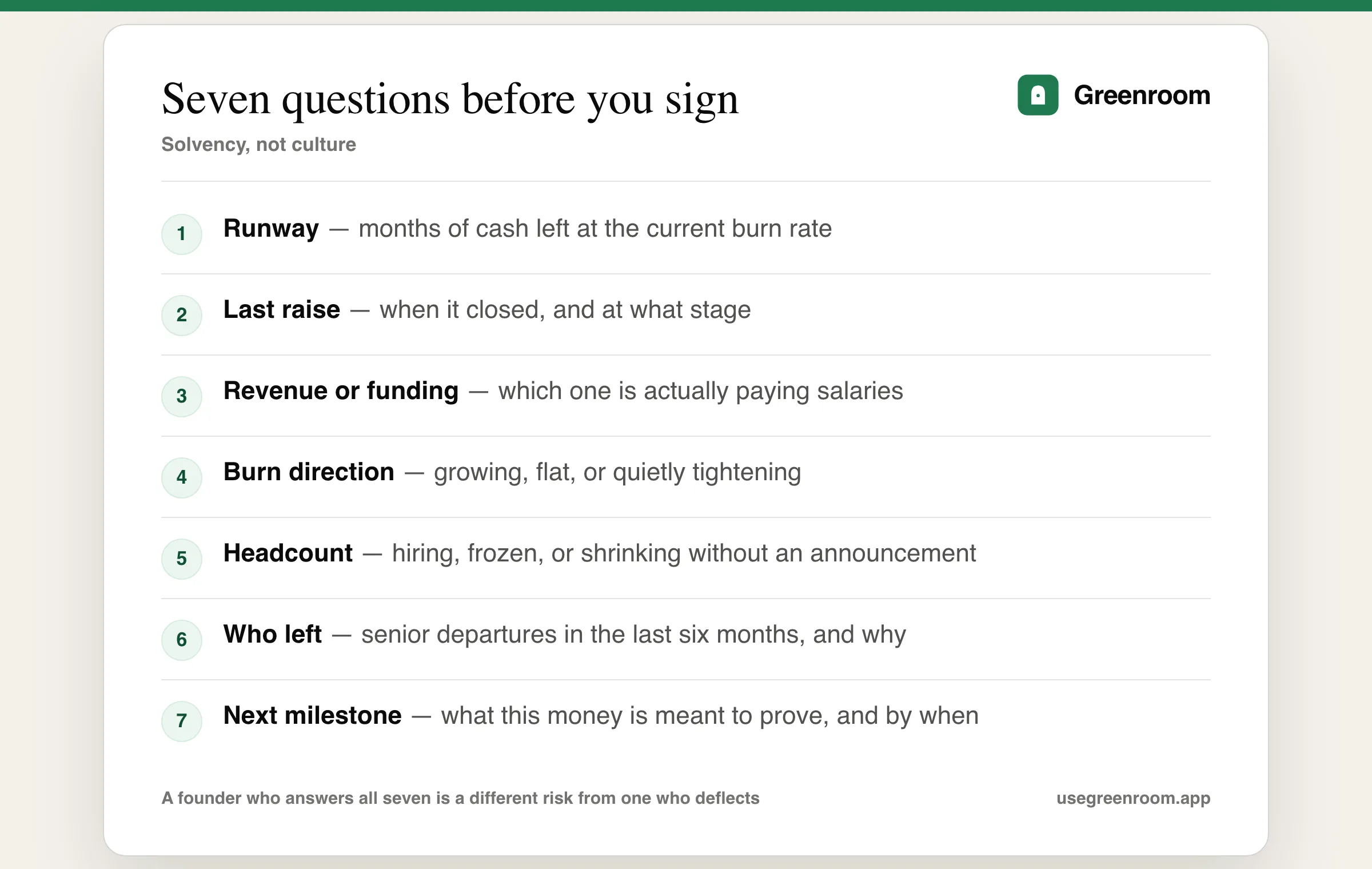
Ask these of a founder or hiring manager, ideally in the final conversation once they want you:
"How many months of runway are you working with at the current burn?" The single most informative question available. You are not asking for a bank statement; you are asking for a number they already track weekly.
"When did the last round close, and what stage was it?" Combined with the runway answer, this tells you where in the cycle you are joining. Joining shortly after a raise is a materially different risk from joining eighteen months after one.
"Are salaries currently paid out of revenue or out of the raise?" The politest version of the most important question. Companies with real revenue have a floor. Companies funded entirely by investment have a deadline.
"Is burn growing, flat, or coming down?" Direction matters more than the absolute number, and this one is genuinely hard to spin.
"What has headcount done over the last year, and what is planned?" Quiet shrinkage — people leaving and not being backfilled — is the most common early signal and the least announced.
"Who has left in the last six months, and why?" Senior departures cluster before trouble becomes public. You are listening for whether they can talk about it plainly.
"What is this money meant to prove, and by when?" Every funded startup has a next milestone that unlocks the following round. If nobody can name it, that is the answer.
How to ask without it landing badly
Timing and framing carry most of the weight:
- Ask late, in the final conversation, once an offer is close and they are selling to you.
- Ask the founder or hiring manager, not the recruiter, who often genuinely does not know.
- Frame it as commitment, not suspicion: *"I'm taking this seriously and I'd rather join with eyes open — can you talk me through runway and what the next milestone is?"*
- Ask about the milestone before the money. It is the same question in a form founders enjoy answering.
Our questions to ask at the end of an interview guide covers the broader set; these are the ones specific to an unprofitable company.
Reading the answers
Specific is good, even when the number is bad. "Fourteen months, and we need Series B by month ten, here's what has to be true" is a company that knows where it stands. That is a far better sign than a comfortable non-answer.
Deflection is data. "We're well capitalised" is not a number. One follow-up is fair. A second deflection has answered you.
Confidence is not information. Founders are professionally optimistic, and it is part of the job. Weigh what is checkable, not what is asserted.
Watch for a mismatch between the story and the behaviour. Aggressive hiring alongside vague runway answers, or a big vision with a hiring freeze, is worth asking about directly.
What you can check yourself
Before the conversation, an hour of work:
- Funding announcements — the date of the last round is usually public. In India, filings for private companies are also a matter of public record, though they lag considerably.
- Headcount trend on LinkedIn, which shows growth or decline over time and is harder to spin than a claim.
- Open roles. A company hiring across engineering, sales and support is behaving differently from one hiring two backend engineers.
- Recent news and layoff trackers, treated as directional rather than authoritative, since coverage of smaller companies is patchy.
- Ask a current employee, ideally one who is not on the hiring panel.
Stage changes what "risky" means
Pre-seed and seed. Assume it may not exist in two years. That can be entirely worth it for the ownership and the learning, and it should be a decision rather than a surprise.
Series A and B. The awkward middle — enough money to look stable, enough pressure to restructure quickly if metrics slip. Runway questions matter most here.
Late stage. More stable, and "startup" stops being an accurate word. Compensation is usually more structured, and the equity upside is smaller — our ESOP vs salary guide covers pricing that honestly.
The case for joining anyway
None of this argues against startups. The scope you get, the speed you learn, and the ownership you can hold are genuinely difficult to obtain elsewhere, and our service to product company switch guide covers why that move is often worth making.
The argument is only this: decide with the numbers rather than the demo. And if you join a company with short runway knowingly, protect yourself on the terms you control — more cash and less equity, a joining bonus rather than a promise, as our what to negotiate besides salary guide covers. Our offer revoked guide covers the scenario where it goes wrong before you even start.
Where the usual advice comes up short
"Questions to ask a startup" listicles. Almost entirely about culture, growth and mentorship. Useful, and they skip solvency completely.
Glassdoor and company reviews. Weak for small companies, where a handful of reviews are written by people with strong feelings in both directions.
"Follow the investors." A recognisable investor name means somebody did diligence at a point in time. It does not mean the company is funded now, and good investors write off companies routinely.
Your own excitement. The strongest signal in the room and the least reliable. If you find yourself avoiding the runway question because you do not want to hear the answer, that is worth noticing.
Greenroom. Honest fit: this is diligence, not interviewing, so Ari does not help you evaluate a company. The overlap is narrow and real — asking an uncomfortable question of someone senior, plainly, without hedging it into meaninglessness. Ari, the AI interviewer makes you say things out loud until they come out direct. Honest tradeoff: nothing rehearsable tells you whether the founder's answer was true.
The one-line version
In the final conversation, ask how many months of runway there are at current burn, when the last round closed, whether revenue or funding pays salaries, and what milestone this money has to reach — because the product and the founders were chosen to impress you, and the only thing that decides whether the job exists next year is arithmetic they already do every week.
Frequently asked questions
What should I ask a startup before accepting an offer?
Seven questions cover most of the risk: how many months of runway exist at the current burn rate, when the last funding round closed and at what stage, whether salaries are currently paid from revenue or from investment, whether burn is growing or coming down, what headcount has done over the past year, who has left in the last six months, and what milestone the current money is meant to reach. How readily these are answered is itself a substantial part of the signal.
Is it rude to ask a startup about runway?
It is normal, particularly from senior candidates, and founders often expect it. Runway is a number the leadership already tracks weekly, so asking is not requesting confidential financials so much as asking them to share a figure they discuss constantly. Timing helps: ask in the final conversation once an offer is close, direct the question to the founder or hiring manager rather than a recruiter, and frame it as taking the decision seriously rather than as suspicion.
How do I know if a startup is in trouble?
Common early signals include headcount shrinking quietly as people leave without being replaced, a cluster of senior departures within a short window, vague answers about runway alongside continued aggressive hiring, a long gap since the last funding round, and an inability to name the next milestone the company is working toward. None is conclusive alone, and a pattern of several is meaningful. Public funding announcements, LinkedIn headcount trends and the shape of open roles are all checkable before you ask anything.
What is a safe amount of runway for a startup?
There is no universal figure, and it depends heavily on stage, burn and whether meaningful revenue exists. What matters more than the number is whether the company can state it precisely and connect it to a plan — an answer such as a specific number of months alongside the milestone that must be reached before then indicates a team that knows where it stands. A confident non-answer like 'we're well capitalised' provides no information and, after a second deflection, has effectively answered the question.
Should I join a startup with short runway?
It can be a reasonable decision when made knowingly, since the scope, learning speed and ownership available at early-stage companies are genuinely hard to find elsewhere. The problem is discovering the situation afterwards rather than choosing it. If you do join with that knowledge, weight your negotiation toward what you control — more cash rather than more equity, a joining bonus rather than a future promise — and treat the equity as upside rather than as part of your compensation.
How can I research a startup's finances before an interview?
Funding announcements are usually public and give you the date and stage of the last round. LinkedIn shows headcount trends over time, which are harder to present selectively than a verbal claim. The pattern of open roles is informative, since a company hiring across several functions behaves differently from one making two targeted hires. In India, filings for private companies are also publicly available though they lag considerably. Speaking to a current employee who is not on the hiring panel is often the most useful source.