"I'd say I'm a perfectionist." The interviewer wrote nothing down. "I just really care about getting things right, sometimes to a fault." Still nothing. Then she asked what the last thing he had shipped late because of it was, and he did not have one, because he was not actually a perfectionist — he had read that answer somewhere in 2019 along with roughly everyone else in the room, the building, and the country.
Here is the reframe that fixes this question permanently: the interviewer is not collecting your weakness. They are checking whether you have a working relationship with it. That is why "perfectionist" fails — not because it is a cliché, but because it comes with no system attached. It is a claim about your character rather than evidence of your self-management.
So the weakness is the setup. What you built around it is the answer.
What is actually being assessed
- Self-awareness. Do you know something true and unflattering about how you work? Candidates who cannot produce one read as either unreflective or evasive, and both are worse than any weakness you could name.
- Correction. Far more important. Everyone has gaps; the question is whether you notice and adjust, or whether you have simply been carrying this one for six years.
- Honesty under mild discomfort. This is a small stress test. The polished non-answer signals that you handle uncomfortable questions by deflecting, which is exactly the thing they are trying to find out.
- Risk. Occasionally, genuinely: is this weakness disqualifying for this specific role? Which is the one real constraint on what you pick.
The three-part answer
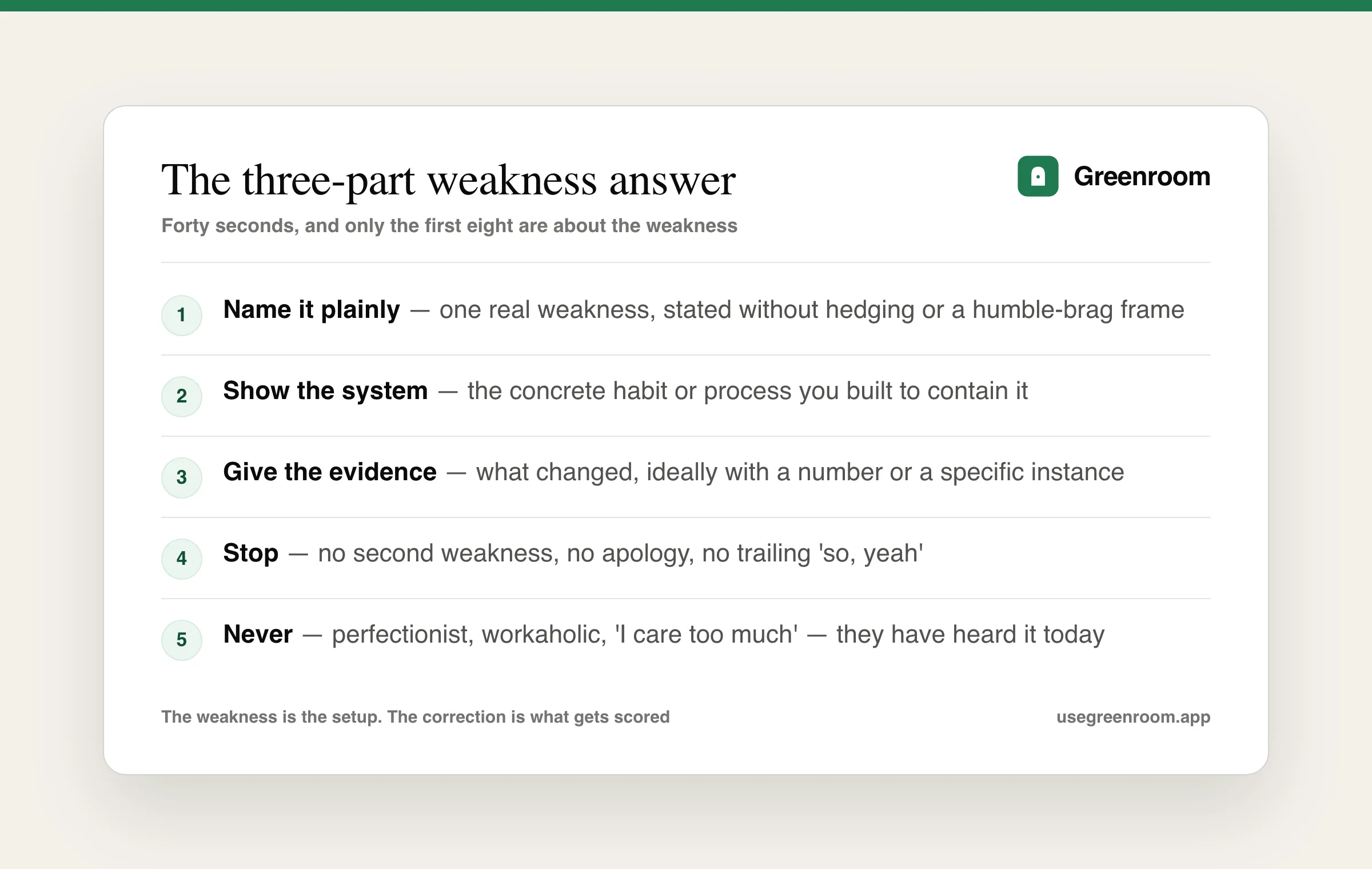
Part one: name it plainly, in one sentence. No hedging, no "some people might say", no framing device. "I'm not naturally good at asking for help early — I'll sit with a problem far longer than I should."
Part two: the system. This is the answer. Not "I'm working on it" — an actual mechanism, specific enough that it sounds like something you do rather than something you intend. "So I now have a hard rule: forty-five minutes stuck, and I post in the channel with what I've tried. I set a timer, because I don't trust myself to notice."
Part three: the evidence. What changed. "That came from a week I lost on a caching bug that someone else had already solved. Since I started doing it, the longest I've been blocked is about half a day."
Then stop. The whole thing is about forty seconds and only the first eight are about the weakness.
Eight weaknesses that work, with the system attached
Pick one that is true for you. The systems matter more than the weaknesses.
- Asking for help too late. System: a stuck-timer, and a rule about posting what you have tried.
- Saying yes to too much. System: never committing in the meeting; "let me check what I've got on and come back by end of day."
- Weak at public speaking or large-group communication. System: writing the first two sentences before any demo, and volunteering for the standup update deliberately.
- Impatient with process. System: asking why the process exists before arguing against it, having been wrong about that once.
- Going too deep too early. System: time-boxing exploration and writing the plan down before opening the editor.
- Poor at delegating (for seniors and managers). System: an explicit rule that anything you have done more than twice gets written up and handed over.
- Under-communicating progress. System: a Friday written update, whether or not anyone asked for one.
- A concrete skill gap — you are weak at frontend, or at SQL, or at system design. System: what you are actively doing about it, with the specific resource and cadence. This is the most underrated option because it is entirely fixable and totally credible.
Notice that none of these are disguised strengths, and none require you to be dramatic about a personal failing. Real, contained, corrected.
What never to say
- "I'm a perfectionist" / "I work too hard" / "I care too much." The interviewer heard this earlier today. It reads as evasion, which is worse than the honest answer would have been.
- A weakness that is the core of the job. Do not tell a customer-facing role you dislike talking to people, or a data role that you are careless with detail. This is the only real constraint.
- "I don't really have one." Reads as arrogance or as no self-reflection.
- Something personal and heavy. Anxiety, health, family circumstances. You are not obliged to disclose, and the interview is not the place. A work-shaped weakness is enough.
- A weakness with no correction. "I procrastinate a lot" and then silence is just a confession.
- Three weaknesses. One. Answering with a list reads as anxiety.
- A joke. "Kryptonite" is not a personality.
Handling the follow-ups
Two follow-ups are standard and both are easy if part two was real.
"Can you give me a specific example?" Have one ready — the incident that made you build the system. This is why the answer must be true; a manufactured weakness has no origin story and the pause gives it away.
"How do you know it's working?" The evidence from part three, extended. "My manager mentioned in my last review that I'd got much better at flagging blockers early" is ideal, and a specific instance works fine too.
A third, rarer version: "What else?" Some interviewers push for a second one to see whether the first was rehearsed. Have a second, weaker one loosely ready — you do not need the full three-part treatment for it, just honesty and one sentence about what you do about it.
Our tell me about a time you failed guide covers the heavier sibling of this question, and our how do you handle criticism guide covers the one that usually follows it.
The fresher version
With no work experience, use coursework, projects or team situations — and lean harder on the correction, because that is what you actually have.
"I used to start coding before I understood the full problem — on our final-year project I rewrote a whole module because I'd misread the requirement. Now I write down what I'm building in three bullet points and check it with whoever asked, before I start. It cost me two days once and it hasn't cost me a day since."
That is a completely serviceable answer and it beats a rehearsed corporate one from someone with the same amount of experience. Our fresher interview questions and answers guide covers the surrounding round.
Where each option actually helps
- Your last performance review — the single best source, because someone already told you the truth and wrote it down.
- A colleague you trust — ask what you are annoying to work with about. Mildly unpleasant, extremely effective.
- ChatGPT — will produce a polished, safe, entirely generic weakness answer. It is the wrong tool for this specific question, because the whole thing turns on the answer being true and having an origin story only you have.
- Greenroom — the spoken layer. Ari, the AI interviewer asks this one in the flat HR-round register and then asks for the specific example, which is exactly where the borrowed answer stops. Honest tradeoff: Ari cannot tell you what your actual weakness is — your last review can.
Our greatest weakness interview answer guide covers more example answers, and our HR interview questions and answers guide covers the rest of the round this lives in.
Frequently asked questions
How do you answer what is your biggest weakness?
Use three parts and about forty seconds. Name one real weakness plainly without hedging, describe the concrete system you built to contain it — a specific habit or rule, not an intention to improve — and give the evidence that it works, ideally with a specific instance. The weakness itself is only the setup; the mechanism you built around it is the part that actually gets scored.
What are good weaknesses to say in an interview?
Ones that are true, contained by a system, and not central to the job. Common workable answers include asking for help too late, saying yes to too much, under-communicating progress, going too deep too early, weak public speaking, poor delegation for senior roles, and a concrete skill gap such as being weak at SQL or system design. That last option is underrated because it is entirely fixable and completely credible when paired with what you are actively doing about it.
Why is saying you are a perfectionist a bad answer?
Not because it is a cliché, but because it comes with no system attached — it is a claim about your character rather than evidence that you manage yourself. Interviewers hear it constantly and read it as evasion, which is worse than any honest weakness would have been. The tell is the follow-up: someone who is genuinely a perfectionist can name the last thing they shipped late because of it, and someone reciting the answer cannot.
What weaknesses should you never mention in an interview?
Anything central to the role — do not tell a customer-facing team you dislike talking to people, or a data role that you are careless with detail. Also avoid disguised strengths such as working too hard, claiming you have no weaknesses, personal or health matters you are not obliged to disclose, a weakness with no correction attached, listing three of them, or making a joke of it.
What follow-up questions come after the weakness question?
Two are standard. Can you give a specific example, which is why the weakness must be true — a manufactured one has no origin story and the pause gives it away. And how do you know it is working, answered with the evidence from your third part, such as a manager noting the improvement in a review. Some interviewers also ask what else, to test whether the first answer was rehearsed, so have a second weaker one loosely ready.
How should a fresher answer the weakness question?
Use coursework, projects or team situations, and lean harder on the correction because that is what you actually have. For example, admitting you used to start coding before fully understanding the problem, describing the specific project where that cost you two days, and explaining that you now write the requirement in three bullet points and confirm it before starting. A true, specific answer of that shape beats a polished corporate one from a candidate with the same experience.