A candidate I'll call Sanjana prepped for her Groww interview the way she'd heard Zerodha's loop worked — light on algorithms, heavy on take-home judgment calls. She walked in and got two back-to-back DSA rounds with genuinely hard graph and dynamic-programming problems, the kind she'd expect at a large product company, not a "chill fintech." Groww and Zerodha compete in the same investing space, and candidates often lump their interview philosophies together. They shouldn't — Groww's loop runs a lot closer to a standard, DSA-heavy product-company interview.
That's the real shape of Groww interview questions: don't assume Indian fintech interviews are uniformly light on algorithms just because one well-known competitor is. Groww runs a genuine DSA gate, a machine-coding or low-level design round, and a system design round focused on reliability for real investment and order data — closer in shape to Flipkart or Swiggy's loop than to Zerodha's. I built Greenroom after freezing in exactly this kind of interview, where an assumption about "what this company's loop is like" turns out to be wrong. This guide covers the real Groww interview process, the questions that come up, and why comparing it to Zerodha's loop can mislead you.
The Groww interview process
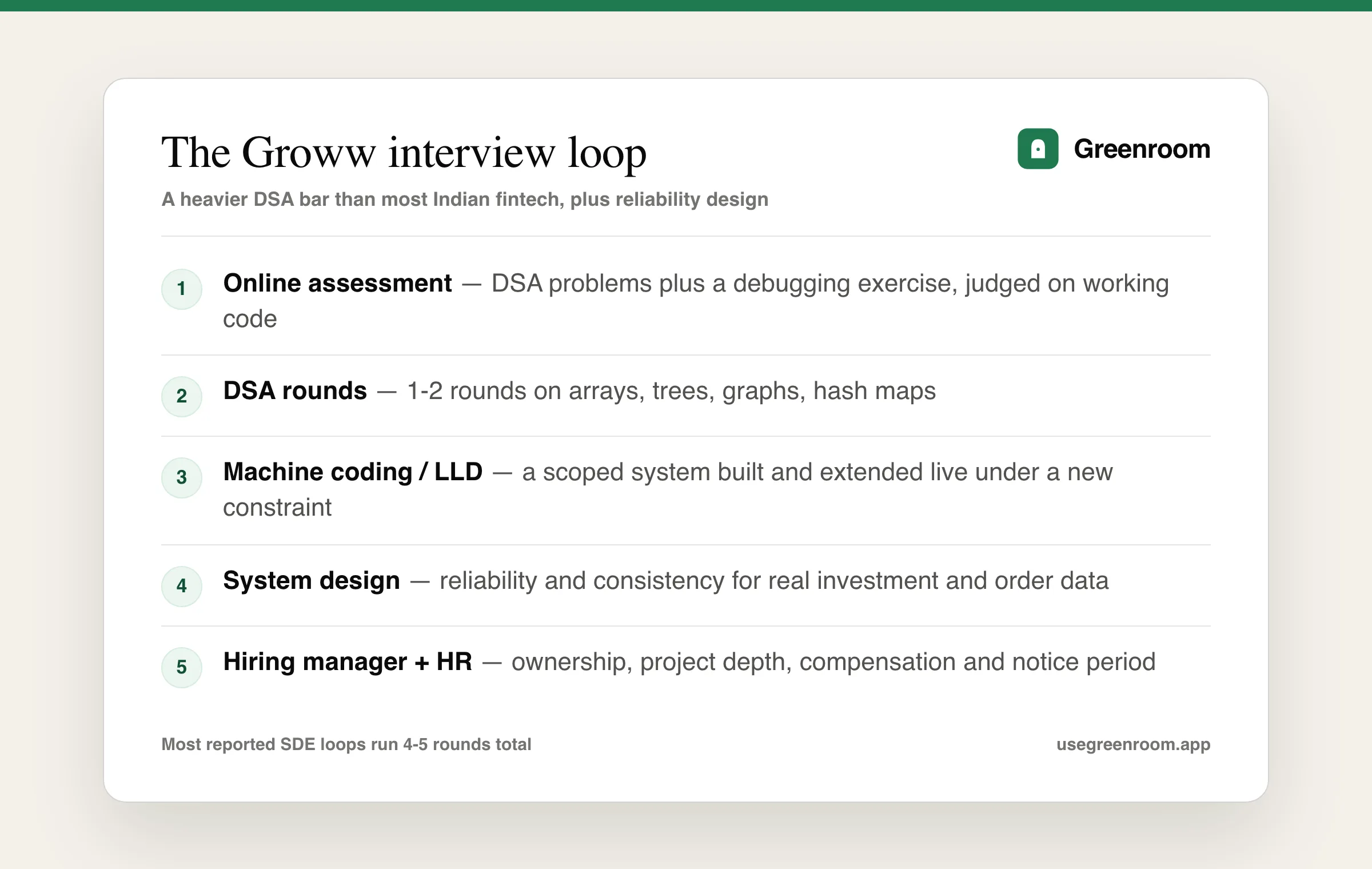
Candidates consistently report a loop shaped like this:
- Online assessment — DSA problems plus a debugging exercise, judged on working code.
- 1–2 DSA rounds — arrays, trees, graphs, hash maps, at a genuinely competitive-programming-adjacent difficulty.
- Machine coding / low-level design round — a scoped system built and extended live under a new constraint.
- System design round — reliability and consistency for real investment, order and portfolio data.
- Hiring manager + HR — ownership, project depth, compensation and notice period.
Most reported loops run 4–5 rounds total. The detail that surprises candidates coming in with a "fintech interviews are lighter" assumption: Groww's DSA rounds are reported as harder, on average, than several well-known product companies' — this isn't a loop to under-prepare algorithms for.
DSA and coding questions
Expect genuinely difficult data structure and algorithm problems, not a token gate round:
- Given a stream of events, return the top-K most frequent items in a sliding window.
- Find the shortest path in a weighted graph with negative edges allowed — when does Dijkstra break, and what do you reach for instead?
- Design a data structure that supports insert, delete, and getRandom in O(1).
- Solve a dynamic programming problem involving overlapping subproblems (e.g., a variant of longest increasing subsequence or edit distance).
The machine-coding / low-level design round
A scoped system, built and then extended live when the interviewer adds a new requirement mid-round:
- Design an order-matching engine that processes buy/sell orders and updates positions correctly.
- Build an in-memory rate limiter that protects a trading API during high-volume windows.
- Design a portfolio-tracking system that stays consistent as new transactions come in.
Interviewers grade extensibility and correctness under a live-changing spec — can your class hierarchy absorb "now also support partial order fills" without a rewrite.
System design questions
Groww's system design questions lean toward correctness and reliability for real financial data, similar in spirit to other fintech companies but focused on investment-specific data:
- Design a system that reconciles a user's portfolio value in real time as market prices change.
- How would you design an order-processing pipeline that can never silently lose or duplicate a trade?
- Walk through how you'd design a notification system that alerts a user to a price movement within seconds, at scale.
- Design a system that handles a partial failure when syncing data from an exchange or market-data provider.
Work these through the standard skeleton — clarify requirements, propose a data model, pick a consistency and retry strategy, close with failure modes — with a specific eye toward what happens when market data or an exchange feed is delayed or briefly unavailable.
Behavioral and hiring-manager questions
- Tell me about a time you debugged a production incident under pressure.
- Walk me through a technical decision you made that you'd reverse if you could.
- Describe a project where you had to push back on a requirement — what happened?
Our behavioral interview questions and answers guide covers structuring these with STAR without sounding rehearsed.
LeetCode, GeeksforGeeks, ChatGPT — where each fits
- LeetCode — genuinely useful and necessary here, more so than at some other Indian fintech companies — Groww's DSA rounds reward real practice at a competitive-programming-adjacent level.
- GeeksforGeeks interview experiences — useful for calibrating what past candidates were asked; treat as anecdotes, not a syllabus, since accuracy and recency vary post to post.
- A system design course — necessary for the reliability round; focus on financial-data consistency and reconciliation patterns specifically.
- ChatGPT — solid for generating practice LLD prompts and sanity-checking a written design; it won't push you the way a real interviewer defending a genuine trading-system design will.
- Greenroom — the spoken layer. Ari, the AI interviewer, runs a mock coding-into-design round out loud and pushes reliability follow-ups the way a real Groww interviewer would, scoring clarity and structure in your answers.
How to prepare for the Groww interview
- Week 1–2: core DSA at real depth — arrays, trees, graphs, dynamic programming — practiced as if for a large product company, not a lighter fintech screen.
- Week 3: low-level design — pick three prompts (order-matching engine, rate limiter, portfolio tracker) and design the classes out loud, twice each.
- Week 4: system design for financial-data reliability — reconciliation, real-time price updates, exchange-feed failure handling — worked through out loud.
- Final week: one spoken mock chaining a hard DSA problem into a design question, since that's the actual shape of Groww's loop, not a lighter judgment-based conversation.
If Groww is one of several Indian fintech companies you're targeting, don't assume the loops are interchangeable — our Zerodha interview questions guide covers a notably lighter DSA bar with heavier judgment-based screening, and our Razorpay interview questions guide covers a payments-infrastructure loop with a heavy idempotency-and-consistency lens. The general system design interview guide covers the framework all three assume.
For the server-side loop in detail, see our Groww backend interview questions guide, covering market data fan-out, order management and the market-open spike.
Frequently asked questions
What questions does Groww ask in a technical interview?
Expect genuinely difficult DSA problems (graphs, dynamic programming, hash maps), a machine-coding or low-level design round building a scoped system like an order-matching engine, system design questions focused on reliability for real investment and portfolio data, and behavioral questions about production incidents and ownership.
How many rounds are in the Groww interview process?
Typically an online assessment (DSA plus debugging), 1–2 DSA rounds, a machine-coding/low-level design round, a system design round, and a hiring manager/HR round — 4–5 rounds total in most reported cases.
Is Groww's interview as light on DSA as Zerodha's?
No — this is a common and costly assumption. Despite competing in the same investing space, Groww's reported DSA rounds are genuinely difficult, closer to a standard large-product-company bar, while Zerodha has been public about de-emphasizing algorithmic puzzles in favor of take-home, judgment-based screening.
What does Groww actually screen for in interviews?
A genuine DSA bar (arrays, graphs, dynamic programming), clean and extensible low-level design under a live-changing spec, and system design reasoning specifically about reliability and consistency for real investment, order and portfolio data.
How hard is the Groww interview?
It's a consistently high bar with real algorithmic difficulty — the part that catches people off guard isn't a single hard round, it's underestimating the DSA bar because of assumptions carried over from a different fintech company's publicly-known interview philosophy.
How is Groww's interview different from other Indian fintech companies?
Zerodha runs a notably lighter DSA bar with take-home, judgment-based screening; Razorpay and CRED weigh idempotency, consistency and (for CRED) design taste heavily. Groww's loop is closer to a standard DSA-plus-LLD-plus-system-design shape, with the system design round focused on investment-data reliability specifically.