A candidate I'll call Aditya spent three weeks grinding LeetCode hards before his Zerodha interview, the same way he'd prepped for every other product-company loop that year. The actual interview opened with a small, real bug in a real (anonymized) piece of Zerodha's own code, and a question: "what would you actually do here, and why." No graph traversal. No DP table. Just a working engineer's judgment, examined closely. Three weeks of grinding hadn't been wasted, exactly — but it wasn't what got tested either.
That's the real shape of Zerodha interview questions: India's largest stockbroker runs one of the smallest engineering teams relative to its user base in Indian tech, and it hires accordingly — for judgment, ownership, and the ability to reason about a real system, not for competitive-programming speed. I built Greenroom after freezing in exactly this kind of interview, where the questions rarely look like the ones you rehearsed. This guide covers the real Zerodha interview process, what it actually screens for, and how it differs from the DSA-heavy loops most candidates over-prepare for.
The Zerodha interview process
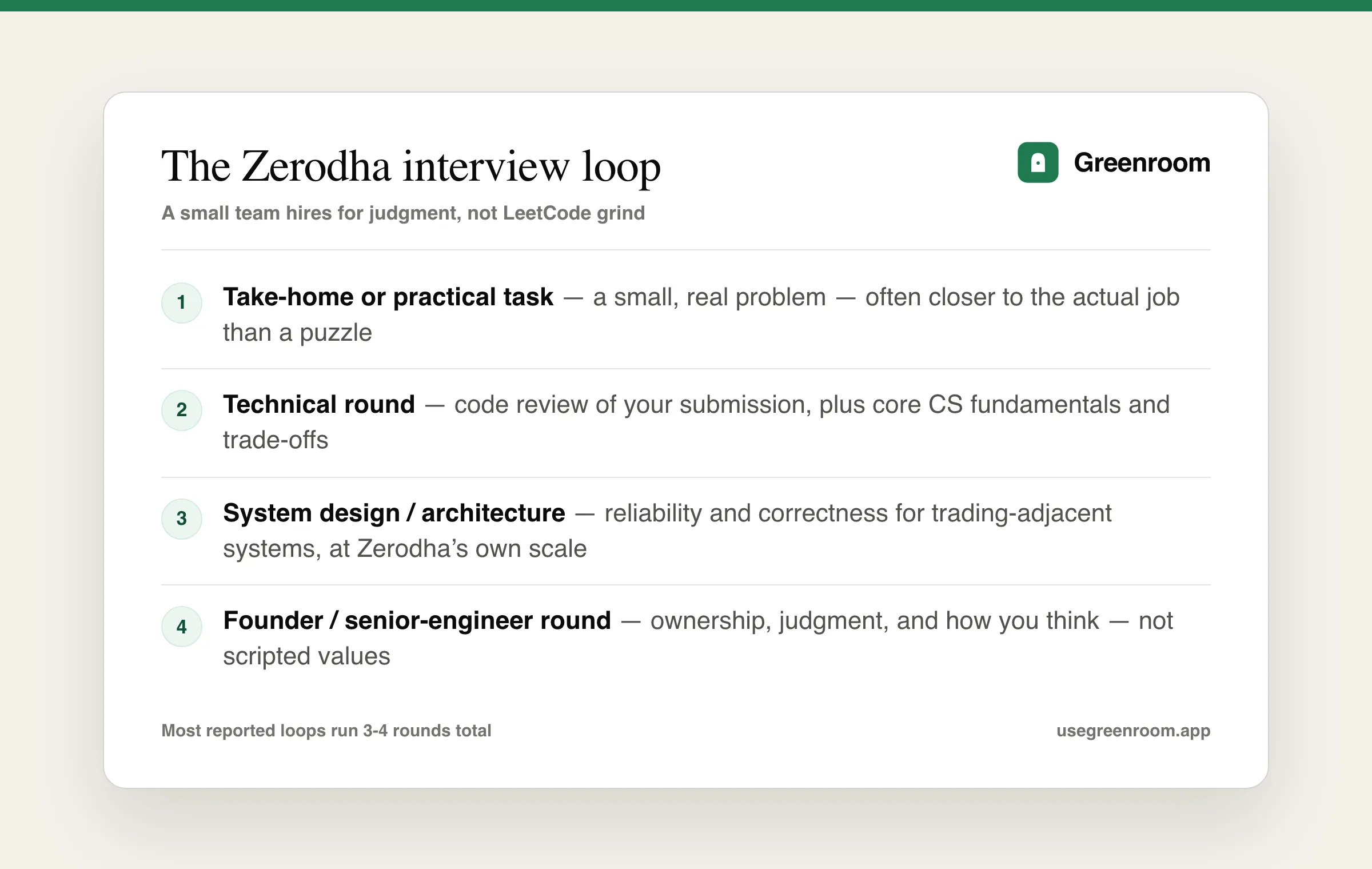
Reported experiences describe a leaner, less scripted loop than most product companies:
- A take-home or practical task — a small, real-shaped problem, often closer to actual engineering work than an algorithmic puzzle.
- Technical round — a review of your submission plus core CS fundamentals, focused on the trade-offs behind your choices.
- System design / architecture round — reliability and correctness questions, scaled to Zerodha's own systems rather than a generic FAANG-style prompt.
- Founder or senior-engineer round — judgment, ownership, and how you think out loud, not a scripted values checklist.
Most reported loops run 3–4 rounds total. The detail that surprises candidates coming from a pure-DSA background: there often isn't a dedicated LeetCode-style coding round at all — the take-home and the conversation around it carry more weight than any single algorithm would.
Why the DSA bar is lighter — and what replaces it
Zerodha has talked publicly about being skeptical of interview processes optimized for memorized algorithm patterns rather than real engineering ability, and its loop reflects that. This doesn't mean coding ability doesn't matter — it means it's tested differently:
- A working, real-shaped problem (a small feature, a bug, a data-processing task) instead of an abstract algorithmic puzzle.
- Deep follow-ups on your own code — why this data structure, what breaks at 10x scale, what you'd change with more time.
- A bias toward simple, correct, maintainable solutions over clever ones — the opposite instinct LeetCode training optimizes for.
What Zerodha actually screens for
Reported interviews consistently probe a few specific things, more than any fixed syllabus:
- Ownership — "tell me about something you built end-to-end and were responsible for, not just a feature you shipped."
- Correctness under constraints — reliability, data integrity, and what happens when something goes wrong, given Zerodha's exposure to real financial data.
- Simplicity of design — can you justify why your solution is the right amount of complex, not more.
- Communication — explaining a technical decision clearly to someone who wasn't in your head while you made it.
System design and architecture questions
Zerodha's system design questions are grounded in the actual constraints of a brokerage handling real trades and real money, not abstract "design Twitter" prompts:
- How would you design a system that has to stay correct even if it's temporarily slower during market hours?
- Walk through how you'd design a data pipeline that can't silently drop or duplicate a trade record.
- Design a rate-limited API that protects a downstream system without blocking legitimate high-frequency usage.
Work these the same way you'd work any system design prompt — clarify constraints, propose a data model, talk through failure modes — but lean harder into correctness-first reasoning than raw scale, since that's the lens Zerodha's own systems are built with.
LeetCode, GeeksforGeeks, ChatGPT — where each fits
An honest map of the usual prep stack, since Zerodha's loop makes most of them less useful than usual:
- LeetCode — genuinely less relevant here than at almost any other well-known Indian tech company; useful only as general problem-solving fitness, not as direct prep.
- GeeksforGeeks interview experiences — thin for Zerodha specifically, since the loop is less standardized round-to-round than a large company's — treat any single report as one data point, not a pattern.
- A systems/reliability mindset, built from real projects — the closest thing to "the syllabus" here; go deep on 1–2 real systems you've built rather than wide on interview patterns.
- ChatGPT — useful for stress-testing your own design reasoning and finding holes in a take-home submission before you send it.
- Greenroom — the spoken layer. Ari, the AI interviewer, runs a mock round that pushes "why this, not that" follow-ups on a real project you describe, which is closer to what a Zerodha interviewer actually does than a rehearsed algorithm answer would be.
How to prepare for the Zerodha interview
- Week 1: pick your best 1–2 real projects and rebuild your ability to explain every design decision in them, including the ones you'd change now.
- Week 2: practice take-home-style problems under a time box — a small, real feature, built simply and correctly, not cleverly.
- Week 3: system design focused on correctness-under-constraint scenarios (data integrity, rate limiting, graceful degradation) rather than pure scale.
- Final week: one spoken mock walking through a real project's trade-offs out loud, since that's closer to Zerodha's actual round than a coding-puzzle rehearsal.
If you're deciding between fintech companies with very different interview philosophies, the contrast is useful — our Razorpay interview questions guide covers a heavier DSA-plus-idempotency loop, and our CRED interview questions guide covers a design-taste bar-raiser round that Zerodha's loop doesn't really have an equivalent of, our Groww interview questions guide covers a direct competitor in the same investing space whose DSA bar is, surprisingly, much heavier than Zerodha's, and our CoinDCX interview questions guide covers a related trading loop where the market never closes, raising the correctness bar even higher. The general system design interview guide still covers the underlying framework.
Comparing broking loops? Our Groww backend interview questions guide covers a very similar problem space round by round.
Frequently asked questions
What questions does Zerodha ask in a technical interview?
Expect a take-home or practical, real-shaped problem rather than a pure DSA round, deep follow-up questions on your own submitted code and its trade-offs, system design questions focused on correctness and reliability for financial data, and conversational questions about ownership and judgment from a founder or senior engineer.
How many rounds are in the Zerodha interview process?
Typically a take-home or practical task, a technical round reviewing that submission plus fundamentals, a system design/architecture round, and a founder or senior-engineer round — 3–4 rounds total in most reported cases, fewer and less standardized than a typical large-company loop.
Does Zerodha ask LeetCode-style DSA questions?
Rarely as a dedicated round. Zerodha has been public about preferring real, working-shaped problems over algorithmic puzzles, so a take-home task or a small real bug is more likely than a classic LeetCode-pattern question — though core data structure and complexity reasoning still comes up as a follow-up.
What does Zerodha actually screen for in interviews?
Ownership of real systems, correctness and reliability under constraint (given its exposure to financial data), a bias toward simple and maintainable design over clever solutions, and clear communication of technical trade-offs — more than raw algorithmic speed.
How hard is the Zerodha interview?
It's a high bar, but a different one than FAANG-style loops — the difficulty isn't algorithmic complexity, it's demonstrating real engineering judgment under close, informal questioning from people who've actually built the systems you're being asked about.
How is Zerodha's interview different from other Indian tech companies?
Most well-known Indian tech companies (Swiggy, Zomato, Razorpay) run DSA-plus-machine-coding-plus-system-design loops closer to a FAANG shape. Zerodha's loop is leaner and less standardized, replacing a dedicated algorithmic coding round with a real, take-home-style problem and deep conversational follow-ups on your own reasoning.