Three weeks of Yoodli. You've been disciplined about it — recording yourself answering interview questions every evening, watching the playback, attacking the feedback. Your filler-word count has dropped from 18 per session to 4. Your words-per-minute sits in the ideal 140–160 range. Your eye contact score is green. You feel, genuinely, like a more polished communicator. You walk into the real technical interview feeling ready.
The interviewer says: "Walk me through the most complex system you've ever designed."
Your delivery is flawless. Your pace is measured. Not a single "um" escapes. And about ninety seconds in, you realize something horrible: you have nothing left to say. Because Yoodli never asked you a technical question. It never probed your data model. It never followed up with "and what happens to your service when the database goes down?" It measured how you spoke. It had no opinion whatsoever on what you were saying.
This is the Greenroom vs Yoodli question in one scene. Both tools involve speaking into a microphone and getting AI feedback. But they are solving entirely different problems — and mixing them up is how you end up with perfect delivery and an empty answer. This post breaks down what each tool actually does, where each one genuinely wins, and how to decide which one to open the night before your interview.
What Yoodli actually is
Yoodli is an AI speech and communication coach. You record yourself speaking — on any topic, to any prompt — and the platform analyzes the recording. The output: filler-word count and type, speaking pace in words per minute, eye contact score (via webcam), a talk/listen ratio for conversational modes, conciseness metrics, and a word-by-word transcript with annotations. It's a mirror for your speaking habits, and it's a remarkably good one.
The use cases Yoodli is explicitly built for: sales pitches, executive presentations, leadership communication, and professional development coaching. Interview preparation appears on the list too — but with an important asterisk. Yoodli can give you speech prompts to respond to. It will tell you whether your answer was concise. It will not tell you whether your answer was correct, or whether it would have satisfied a real interviewer, or what the obvious follow-up question was and how you would have handled it.
Yoodli's free tier is generous for solo speech practice. Paid plans lean toward enterprise and team use — sales coaching managers, communication trainers, and L&D teams tracking rep delivery across many pitches. It's a well-funded, well-designed product that does exactly what it says. The issue for job-seekers is that what it says is "speech coach," not "interview simulator."
The gap Yoodli can’t fill
Here's the thing about interview performance: it has two axes. The first is delivery — pace, filler words, eye contact, vocal confidence, conciseness. Yoodli trains this axis with genuine excellence. The second is substance — what you actually say, whether your system design holds together, whether your behavioral story has a real result, whether your technical explanation is accurate and defensible. Yoodli has no model of the second axis whatsoever.
That gap shows up in four concrete ways that matter for job-seekers specifically:
- No adaptive follow-up questions. Yoodli gives you a prompt; you respond; it scores your delivery. It does not then ask "and why did you pick Postgres over Cassandra?" or "what was your specific contribution to that outcome?" The follow-up question is exactly where real interviewers separate the candidate who memorized an answer from the one who actually understands it.
- No technical substance layer. It doesn't know your tech stack, your projects, your target role, or what a strong answer to "design a rate limiter" looks like. It cannot distinguish a well-structured system design response from a beautifully paced word salad.
- No interview scoring rubric. Real interviews are evaluated on signal clarity, depth, handling of ambiguity, and technical accuracy. Yoodli scores your delivery. A 9/10 delivery score on a factually thin answer is still a failing interview.
- No behavioral depth probing. STAR stories need specificity and a real result. "I led the team and things improved" is not a STAR story, but Yoodli will never tell you that — it will only notice if you said "like" too many times while telling it.
None of this is a criticism of Yoodli's engineering. It's a criticism of using a speech tool to solve an interview problem. The Yoodli interview prep use case is real but limited: it makes you sound more confident saying things you already know how to say. It can't teach you what to say, or test whether you actually know it.
What Greenroom does differently
Greenroom is a voice-based AI mock interview platform. The AI interviewer, Ari, conducts live spoken sessions — not playback analysis of your monologue, but an actual back-and-forth. You answer; Ari listens; Ari responds with a follow-up question based on what you just said. That's the fundamental architectural difference.
When you start a Greenroom session, you set your target role (senior backend engineer, data analyst, product manager) and seniority level. Connect your GitHub and Ari pulls your actual repositories — so instead of a generic "tell me about a complex system," you might hear "your repo shows you built a job queue with BullMQ. Walk me through why you chose that over a database-backed queue." The question is about your work, which is exactly what the real interviewer will ask.
During the session, the adaptive follow-up is the core mechanism. Give a vague answer — "I improved the system's performance significantly" — and Ari probes: "By how much, and what was the specific bottleneck you identified?" Give a strong answer and Ari pushes into tradeoffs. Give a weak STAR story and Ari asks for the result you left out. This is the rep that matters: not the monologue, but the moment after the monologue when a real interviewer asks the question your answer left open.
After the session you get a structured feedback report: an overall score on a 1–10 scale, plus specifics on structure, pace, filler word count, and which answers were vague, well-supported, or missing key elements. The full anatomy of that report is explained in how AI interview feedback actually works. Then — and this is the part that actually creates improvement — you fix one thing and run the session again immediately. No scheduling, no social cost, no waiting for a stranger to be available at 11pm.
Pricing: free tier for initial sessions, Pro at $10/month, Premium at $20/month internationally. India-specific options: ₹149 7-Day Confidence Pass (3 mock sessions, one-time purchase), ₹499/month, ₹999/month.
Greenroom vs Yoodli: head to head
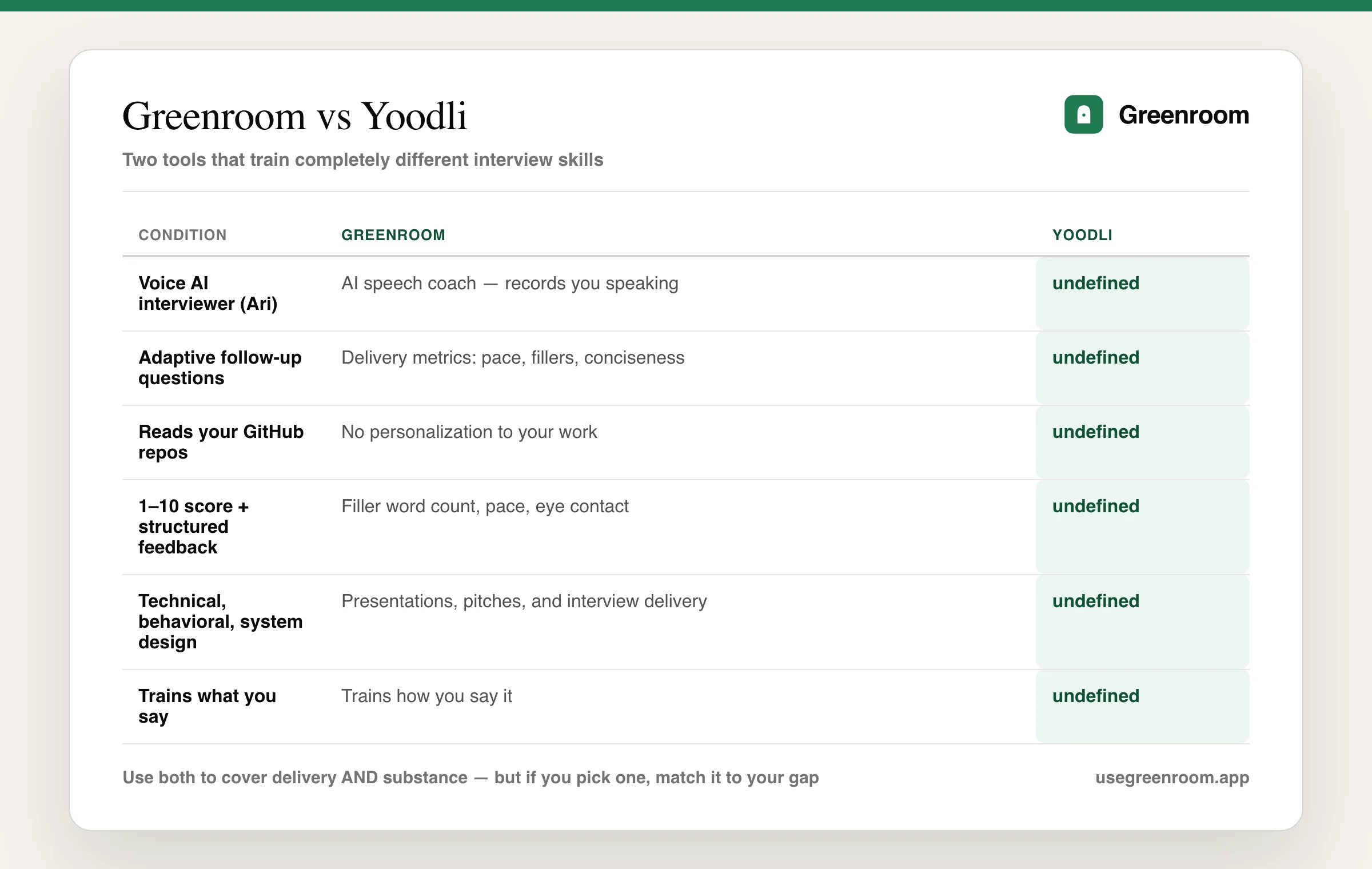
Here's the comparison on the dimensions that actually decide which tool to open before a specific interview.
What it actually trains
Yoodli trains speech delivery: pace, filler words, eye contact on camera, conciseness, and talk/listen ratio. These are real skills that affect interview performance. Greenroom trains interview performance: content depth, answer structure, handling of follow-up questions, and scoring against the rubric a real interviewer uses. You can excel on one axis and completely fail on the other.
Adaptive follow-up questions
Yoodli: no. You speak to a prompt; it scores your delivery. Greenroom: yes, based specifically on what you just said. This single difference is what separates speech practice from interview practice. A real interviewer doesn't wait for you to finish your monologue and then tell you your pace was good — they ask the question your answer invited, and that's where your actual preparation gets tested.
Technical interview coverage
Yoodli has no model of technical content. It cannot evaluate a system design answer, a database schema decision, or an explanation of concurrency tradeoffs. Greenroom covers technical communication, system design, behavioral, and HR rounds with role-specific questions and GitHub integration. If your interview has a technical component — which most software engineering interviews do — Yoodli is essentially neutral on the content that decides the outcome.
Delivery metrics
Yoodli's strength is clear here: pace analytics, filler-word tracking by type, word-by-word transcript annotation, eye contact scoring, and conciseness metrics are all significantly more granular than Greenroom's delivery layer. Greenroom gives you filler count and pace, which is useful; Yoodli gives you a full delivery audit, which is richer. If eliminating a specific speech habit is your goal, Yoodli's tooling is better for that narrow job.
Behavioral interview depth
Yoodli will score whether your behavioral answer was concise. Greenroom will probe whether it was specific — "what was your individual contribution?" and "what was the measurable outcome?" Those are the follow-up questions that separate a real STAR story from a vague one. The behavioral round is where Greenroom's probing earns its keep most clearly.
Cost and target audience
Yoodli's paid plans are priced toward enterprise communication coaching — sales teams, L&D departments, managers running communication programs. Greenroom's paid plans are priced toward individual job-seekers: $10–$20/month internationally, ₹149–₹999 for India. Both have free tiers. The cost difference reflects who the primary customer is — Yoodli's is the org buying for their team; Greenroom's is the candidate prepping for Friday's interview.
When to use Yoodli (it genuinely wins here)
To be honest about Yoodli: it wins the specific job it was built for, and it's not close.
- Presentation polish. Conference talks, board updates, investor pitches, sales demos — nobody will follow up with an adaptive question about your data model. They'll judge your pace, clarity, and whether you radiated confidence or nerved your way through. Yoodli is purpose-built for this.
- Sales and executive communication. Yoodli's enterprise pricing exists because sales teams genuinely use it to track rep delivery across pitches. If your goal is professional communication excellence — not interview prep — Yoodli is built for your problem.
- Eliminating a specific delivery habit. If you know you say "like" constantly, or you rush when nervous, or your sentences trail off, Yoodli's word-by-word analytics isolate exactly where in a recording the habit clusters. The granularity is excellent for targeting a single problem.
- Warm-up before a Greenroom session. Speaking on camera for ten minutes before your mock interview to loosen up, using Yoodli to confirm your baseline delivery looks clean, is a genuinely smart use of both tools in sequence.
- Non-interview professional communication. Leadership, pitching for funding, giving feedback to reports, presenting quarterly results — all of these benefit from the delivery analytics Yoodli provides, and none of them require an adaptive follow-up AI.
If the above list describes your actual goal, use Yoodli for it and ignore the rest of this article. It's a genuinely good tool for those use cases.
When Greenroom is the right tool
If your goal is specifically getting a job offer, Greenroom is built for that outcome. These are the situations where it's the clear choice:
- Technical interviews. System design questions, architecture decisions, code explanation, handling "why did you pick X over Y" — Yoodli has no model of any of this. Greenroom trains you for the conversation that actually decides whether you pass a technical screen.
- Behavioral interviews. STAR stories need specificity, a real result, and the ability to hold up under "what was your specific contribution?" Greenroom's adaptive follow-ups are exactly what test this. Yoodli won't catch a behavioral answer that sounds smooth but says nothing.
- High-frequency reps before a specific interview. The night before an interview, you need to say your answers out loud, get an honest score, and fix whatever broke — immediately, without scheduling anyone. That is exactly what Greenroom enables and what a delivery-measurement tool cannot.
- GitHub-connected project explanation. If your repos are your evidence of engineering ability, you want the practice interviewer to have actually read them. Greenroom's GitHub integration makes the questions specific in a way no generic speech prompt can.
- Measuring interview performance improvement. Greenroom's 1–10 score gives you a consistent rubric across sessions. Going from 5.8 to 7.4 over a week of focused prep tells you something real about your readiness. Yoodli's metrics tell you your delivery improved; Greenroom's score tells you your interview performance improved — those are different claims.
The strongest prep stack: use both
Here's the insight most candidates miss: Greenroom and Yoodli are not competing for the same job. They train the two separate axes of interview performance. Used together in the right sequence, they cover both halves of what gets you the offer.
Think of it this way. Interview performance lives on two axes. The substance axis: what you say, whether your system design makes sense, whether your behavioral story has a real outcome, whether you handle the follow-up or fall apart. The delivery axis: how you say it, whether you sound confident, whether the pace is readable, whether the filler words undermine an otherwise strong answer. Most candidates train one and neglect the other. The over-polished candidate has perfect delivery and no content — our cold-open scenario. The under-polished candidate knows the content cold but sounds uncertain even when they're right. Real interviewers notice both.
The strongest stack:
- Step 1 — Substance first with Greenroom. Run multiple sessions across the question types you'll actually face. Get the content of your answers right — structure, specificity, handling of follow-ups — before you worry about delivery. A polished delivery on a thin answer is still a thin answer.
- Step 2 — Layer in Yoodli for delivery. Once you know what to say, use Yoodli to audit the delivery. Track filler words, confirm your pace is holding under pressure, check your eye contact on camera. Fix one delivery habit at a time — don't try to rebuild your communication style in a week.
- Step 3 — Combined final check. The week before the real interview, run a full Greenroom session as if it's live. Review the structured report. Then record one Yoodli session on the same answers purely to confirm delivery is clean. If both look good, you've covered both axes and you're as ready as preparation makes you.
The best tools for practising interview speaking covers this stack in more detail, and the best AI interview coach guide compares the full landscape of tools in this space — including other options beyond Yoodli and Greenroom worth knowing about.
For the head-to-head with peer mock interviews instead of speech coaching, the Greenroom vs Pramp comparison covers a completely different tradeoff: human social pressure vs on-demand AI reps. Both comparisons are worth reading if you're building a serious prep plan.
A tale of two prep weeks
Meet Priya and Arjun, both interviewing the same Thursday, both starting to prep the previous Saturday.
Priya's week: She's heard Yoodli is great for interview prep. She spends the week recording herself answering common interview questions — "tell me about yourself," "walk me through a project" — and fixing her delivery based on the feedback. By Wednesday, her filler count is at 3, her pace is smooth, and she sounds genuinely polished. Thursday's interview opens with "walk me through your most complex system design." She sounds excellent for the first two minutes. Then the interviewer asks "how does your service handle the case where the message queue fills up?" She's never been asked a follow-up question in three weeks of practice. She doesn't have an answer ready. The silence lasts nine seconds, which feels, to everyone in the room, like considerably longer.
Arjun's week: He starts with a diagnostic Greenroom session on Saturday. The report comes back with three things: vague system design answers with no tradeoff discussion, a behavioral story missing a measurable result, and a pace issue under technical pressure. Sunday he drills system design follow-ups — not monologues, actual back-and-forth with Ari probing his architecture choices. Monday he rebuilds his project story around its real outcome. Tuesday he does a Greenroom session specifically at his target seniority; the score goes from 5.9 to 7.1. Wednesday he does one Yoodli session to confirm his delivery hasn't fallen apart during all the content work. Thursday he walks in. The "how does your service handle queue overflow?" question arrives. He answers it, because Ari asked him something structurally identical on Sunday.
The moral is not that Yoodli is bad — Priya's delivery was genuinely better for using it. The moral is that interview performance is graded on both axes simultaneously, and a week spent only on delivery is a week where substance goes unpractised.
The “AI speech coach for interviews” category, honestly assessed
Yoodli is not alone in the delivery-coaching-for-interviews positioning. There's a broad category of tools that help you sound better — and the honest truth is that most of them share Yoodli's structural limitation: they measure the output without evaluating the content.
Generic ChatGPT prompting also falls into this trap. You can prompt it to "ask me interview questions," and it will. But it won't probe your vague system design answer with the precision of a real interviewer, it won't score you on a rubric, and it won't give you a consistent assessment session-over-session. It's closer to Yoodli than to Greenroom in practical utility — useful for generating content to practise, limited for actually simulating the interview experience.
The real alternative to Greenroom for interview simulation is a human mock interview — a friend, a peer via Pramp, or a paid expert via interviewing.io. That comparison is covered in AI mock vs a real engineer mock. The short version: a real senior engineer's judgment is still the gold standard for high-fidelity calibration; the AI advantage is unlimited reps at zero scheduling cost, which is what actually builds fluency.
The category of tools marketed as "AI speech coach for interviews" is real and growing. Evaluate them on this question: does it ask you a question, listen to your answer, and ask a follow-up question based on what you actually said? If yes, it's an interview simulator — useful for interview prep. If no, it's a delivery coach — useful for delivery, not for rehearsing the substance of an interview.
How a Yoodli session actually works
It helps to understand the mechanics, because the gap lives in the details. You open Yoodli and choose a mode: free practice (speak on any topic), a specific prompt (they provide a question, you answer), or one of their structured coaching tracks. You speak. The platform transcribes the audio in real time and, once you're done, generates the delivery analytics: filler words identified by type (you can see exactly where each "um" landed in the transcript), pace across the recording (did it slow down or speed up under pressure?), eye contact score if you're using webcam, and a conciseness rating.
The feedback is immediate and visual — you can scrub the timeline to the 1:23 mark where three consecutive fillers appeared and replay that moment. That's genuinely useful for identifying where a specific habit clusters. You save the session, compare it to your previous ones, track the trend line. It's the Duolingo streak model applied to communication coaching, and it works for building the habit of practicing delivery.
What doesn't happen: Yoodli doesn't read your answer and decide what question comes next. It doesn't score the content of what you said. It doesn't tell you "your system design was missing a discussion of consistency vs availability tradeoffs." When the session ends, you know how you sounded. You don't know whether what you said would have gotten you the offer.
How a Greenroom session actually works
The loop is built differently from the ground up. You open Greenroom, set your role and seniority, optionally connect GitHub. Ari opens with a question out loud — you hear a voice, not a text prompt. You answer out loud, the way you would in the real interview. Ari listens and then responds — not with the next pre-scripted question on a list, but with whatever follow-up your answer invited. Hedge without specifics and the follow-up is a probe. Give a crisp answer with real numbers and the follow-up escalates difficulty.
The session runs for the number of questions you set — enough to cover a realistic interview round. When it ends, you get the structured report: overall score (1–10), filler count, pace, and written feedback on which answers were strong, which were vague, which were missing elements a real interviewer would expect. You read the one thing that hurt your score most. You redo the session targeting that one thing. You check whether the score moved. That tight, private, instantly-repeatable loop is the mechanism that actually turns a shaky answer into a fluent one — and it's structurally unavailable when your "practice" is a delivery-measurement tool with no model of what your answer should contain.
Frequently asked questions
Is Yoodli good for interview preparation?
Yoodli is genuinely good at improving delivery — filler word reduction, pacing, eye contact, and conciseness. For interview substance — handling technical questions, adaptive follow-ups, and STAR structure scoring — it has significant gaps. It is best used alongside a purpose-built mock interview tool like Greenroom rather than as a replacement for one.
What is the difference between Yoodli and Greenroom?
Yoodli is a speech and delivery coach: you speak, it measures how you spoke — pace, filler words, eye contact, conciseness. Greenroom is an AI mock interviewer: it asks you interview questions out loud, listens to your answers, asks adaptive follow-up questions based on what you said, and scores your performance against an interview rubric. One trains delivery; the other trains interview performance.
Does Yoodli ask follow-up interview questions?
No. Yoodli provides speech prompts you can respond to, but it does not ask adaptive follow-up questions based on your answers the way a real interviewer or Greenroom does. The follow-up question — why did you choose that approach, what was the bottleneck — is precisely what differentiates interview practice from speech practice, and Yoodli does not include it.
Can Yoodli replace mock interview practice?
Not for technical or behavioral interview prep. Yoodli replaces delivery coaching — a communication trainer, a Toastmasters session, a manager giving you presentation feedback. It does not replace the experience of answering real interview questions, handling follow-up probes under pressure, or being scored on the substance of what you said. For interview preparation specifically, you need a tool that conducts interviews, not one that only measures your speaking.
Which is better for technical interview prep: Yoodli or Greenroom?
Greenroom, clearly. Technical interviews are evaluated on whether you understand the problem, can design a coherent solution, and can defend your choices under follow-up probing. Yoodli has no model of technical interview content — it cannot distinguish a strong system design answer from a weak one. Greenroom is built specifically for this and can read your GitHub repos to ask project-specific questions.
Should I use both Yoodli and Greenroom?
Yes — they complement each other well. Use Greenroom first to get your interview substance right: content depth, answer structure, handling of follow-up questions, and technical accuracy. Then layer in Yoodli to polish the delivery on top: eliminate filler words, normalize pace, improve eye contact on camera. The sequence matters — fix what you say before you polish how you say it. A perfectly paced answer with no real content still loses the interview.