The retry looked harmless. The payment request timed out, the client retried, and the interviewer asked what the customer's bank statement now said. The candidate worked it out in real time, out loud, and arrived somewhere unpleasant: the first request had probably succeeded before the timeout, so the customer had just been charged twice for a pair of shoes. In most interviews that is a good discussion. At Stripe it is the entire job.
Stripe backend interview questions are unusual in a specific and mostly welcome way: the loop is practical rather than theatrical. You work in a real repository, with a real editor, running real tests, on problems that resemble actual work — consume this API, fix this bug, design this endpoint. There is far less whiteboard algorithm theatre than at other companies of comparable prestige, and considerably more emphasis on correctness under failure, because the product moves money. I built Greenroom after freezing in an interview I had prepared for, so this guide covers each round and how to talk through it.
The Stripe backend engineer interview process
- Recruiter screen — background and level. Ask which track: product engineering, infrastructure, or payments-domain teams.
- Practical coding screen — roughly an hour in a real editor with tests, usually extending existing code rather than writing from scratch.
- Integration round — consume a real or mock API and make something work end to end, handling pagination, errors and rate limits.
- Debugging round — a repository you have never seen with a bug in it. Find it, fix it, explain it.
- API and system design — idempotency, webhooks, versioning and correctness over money.
- Behavioral round — collaboration, ownership, and how you handle an incident you caused.
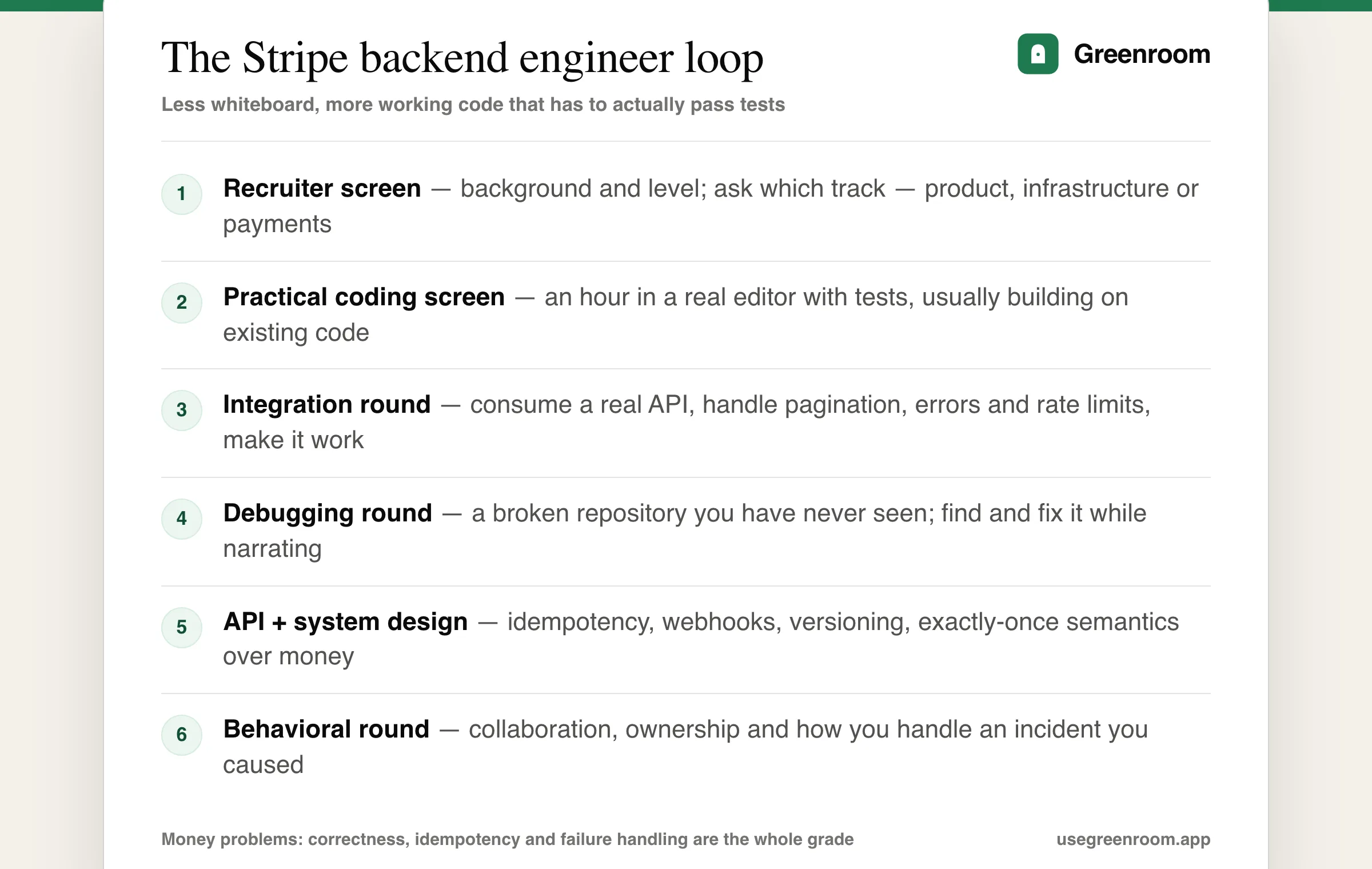
Not every loop contains all six, and the order varies. Our backend developer interview questions guide covers the role-general bank.
The practical coding rounds
Bring a working development environment and the ability to use your own editor competently. This is closer to a pair-programming session than an exam.
What is graded: does it work, does it handle the edge cases, are the tests meaningful, is the code readable, and did you talk while you worked. Elegance matters far less than at algorithm-first companies; correctness matters far more.
Practical habits that score:
- Read the existing code before writing any. Candidates who start typing immediately consistently do worse.
- Run the tests early and let failures guide you rather than reasoning in your head.
- Handle the error path. Money code that ignores the failure branch is the fastest way to lose this round.
- Ask about the requirement you are unsure of rather than guessing. It is treated as a strength.
- Commit little and often if the format allows it, and say why.
You will still see some algorithmic work, but it is usually in service of a realistic task — parsing, aggregating, reconciling two lists of transactions. Our DSA coding interview preparation guide covers the baseline.
The integration round
You are given API documentation and asked to build something against it. The grading is about how you deal with the messy parts:
- Pagination. Cursor-based, and what happens if the underlying data changes between pages.
- Rate limits. Backoff with jitter, and why a naive fixed retry makes a rate-limit problem worse.
- Error taxonomy. Which errors are retryable, which are permanent, and how you tell the difference from a status code.
- Timeouts. Set them explicitly. A missing client timeout is a real production outage cause and interviewers here know it.
- Reading the docs carefully. Half the round is whether you actually read the documentation you were given.
The debugging round
An unfamiliar repository with a planted bug. What is being graded is your method, not your speed.
Say your process out loud: reproduce it first, read the failing test, form a hypothesis, narrow with a bisect or a log or a breakpoint, confirm, fix, then add a test that would have caught it. Candidates who start changing code before reproducing the problem lose this round even when they eventually fix it.
Two things that raise the score: noticing a second, unrelated problem and flagging it without going down that rabbit hole, and saying what you would do to prevent the class of bug rather than only this instance.
API design and correctness over money
This is the round most specific to Stripe, and the vocabulary matters.
- Idempotency. The central concept. A client sends an idempotency key, the server stores the result against that key, and a retry returns the stored result rather than performing the action twice. Be able to describe where the key is stored, how long it lives, what happens if two requests with the same key arrive concurrently, and what happens if the first request is still in flight.
- Exactly-once is a lie; idempotent at-least-once is the truth. Saying this correctly is a strong signal.
- Webhooks. Delivery guarantees, retries with backoff, signature verification, ordering that you cannot rely on, and why the consumer must be idempotent too.
- API versioning. How you change a response shape without breaking integrations that will never be updated. Stripe's own approach to versioning is public and worth reading.
- Money representation. Integer minor units, never floats, plus currency and rounding rules. Getting this wrong in an interview about payments is memorable for the wrong reasons.
- Consistency and reconciliation. What happens when your ledger and the bank disagree, and how you detect it before the customer does.
- Auditability. Immutable records, and why you append rather than update.
Our REST API interview questions and API security interview questions guides cover the adjacent material, and the Stripe backend engineer prep page has a round-by-round checklist.
# idempotent charge: the single most Stripe-shaped piece of code there is
def charge(key, amount, currency):
    existing = store.get(key)
    if existing and existing.status == "succeeded":
        return existing.result                 # replay, do not charge again
    if existing and existing.status == "in_flight":
        raise Conflict("request with this key is still processing")

    store.put(key, status="in_flight")         # claim the key before doing work
    try:
        result = processor.charge(amount, currency)
        store.put(key, status="succeeded", result=result)
        return result
    except Exception:
        store.put(key, status="failed")        # a failed key may be safely retried
        raise
Then volunteer the race: "two concurrent requests with the same key both read empty — so the claim needs to be a conditional write, not a read followed by a write." That is the follow-up they were going to ask.
Where each prep option actually helps
- Stripe's own API documentation — genuinely the best preparation available. Their pages on idempotent requests, webhooks and versioning are the answer key for the design round.
- Your own editor — set it up properly and practise in it. Fumbling with tooling on the day costs real minutes.
- A real open-source repository — practise finding and fixing a bug in code you did not write, out loud, on a timer.
- Designing Data-Intensive Applications — for the consistency and reconciliation vocabulary.
- ChatGPT — genuinely useful for generating a broken repository to practise on, and for reviewing your error handling. It will not ask what the customer's bank statement says.
- Greenroom — the spoken layer. Ari, the AI interviewer runs the design and behavioral rounds out loud and pushes on the failure cases. Honest tradeoff: Ari will not run your test suite, so pair it with real coding practice.
How to prepare for the Stripe backend interview
- Week 1 — build something small against a real public API, handling pagination, rate limits, timeouts and error classes properly.
- Week 2 — idempotency, webhooks and versioning until you can explain each in ninety seconds, including the concurrency race in the idempotency key.
- Week 3 — debug three unfamiliar open-source repositories out loud, on a timer, narrating your method.
- Final week — design a payments API and a webhook delivery system out loud, two full spoken mocks, and the role-specific prep page the night before.
Comparing loops? The Razorpay backend engineer guide covers very similar payments problems in the Indian market, and the Meta backend engineer guide covers a much more whiteboard-driven process.
Frequently asked questions
What is the Stripe backend engineer interview process?
Stripe's loop is unusually practical. Candidates report a recruiter screen, a practical coding screen of about an hour in a real editor with tests, an integration round building against real API documentation, a debugging round in an unfamiliar repository, an API and system design round centred on idempotency and correctness, and a behavioral round. Not every loop includes all six and the order varies, but there is far less whiteboard algorithm work than at comparable companies.
What is an idempotency key and how do you implement one?
An idempotency key is a client-supplied identifier that lets a server safely deduplicate retried requests. The server stores the outcome against the key, so a retry returns the stored result rather than performing the action twice. A complete answer covers where the key is stored and for how long, claiming the key with a conditional write so two concurrent requests cannot both proceed, what a caller sees when a request with the same key is still in flight, and why a failed attempt should leave the key retryable.
How should you approach Stripe's debugging round?
Narrate a method rather than guessing. Reproduce the problem first, read the failing test, form an explicit hypothesis, narrow it down with a bisect, a log or a breakpoint, confirm the cause, fix it, and then add a test that would have caught it. Changing code before reproducing the issue loses the round even if you eventually fix it, and flagging a second unrelated problem without chasing it raises the score.
What API design questions does Stripe ask?
The round centres on correctness over money: idempotent request handling, webhook delivery with retries, signature verification and unreliable ordering, API versioning that does not break integrations which will never be updated, representing money as integer minor units with currency and rounding rules rather than floats, reconciliation when your ledger and the bank disagree, and immutable append-only records for auditability.
Does Stripe ask LeetCode questions?
Much less than most companies at its level. Algorithmic work usually appears in service of a realistic task such as parsing, aggregating or reconciling two lists of transactions, inside a real editor with tests. You still need solid fundamentals, but optimising exclusively for whiteboard puzzles prepares you poorly for a loop that mostly rewards working, well-tested, readable code and clear narration.
How should you prepare for a Stripe interview?
Set up your own editor properly and practise in it, because fumbling with tooling costs real minutes. Build something small against a real public API handling pagination, rate limits, timeouts and error classes; read Stripe's public documentation on idempotent requests, webhooks and versioning, which is effectively the answer key for the design round; and practise debugging unfamiliar open-source repositories out loud on a timer.