PayPal handles money at massive scale, so its interviews care about correctness, reliability, and system design as much as raw coding. Expect standard data-structure and algorithm rounds plus a design round that often has a payments flavor. Here's how to prepare.
The PayPal interview process
- Recruiter screen — background and logistics.
- Technical screen — one or two coding problems.
- On-site loop — coding rounds, a system design round, and a behavioral round.
PayPal coding questions
- Arrays, strings, hash maps — two-pointer, sliding window, intervals.
- Trees and graphs — BFS/DFS, traversals.
- Dynamic programming and recursion — moderate difficulty.
- Clear narration and edge-case handling expected.
PayPal system design
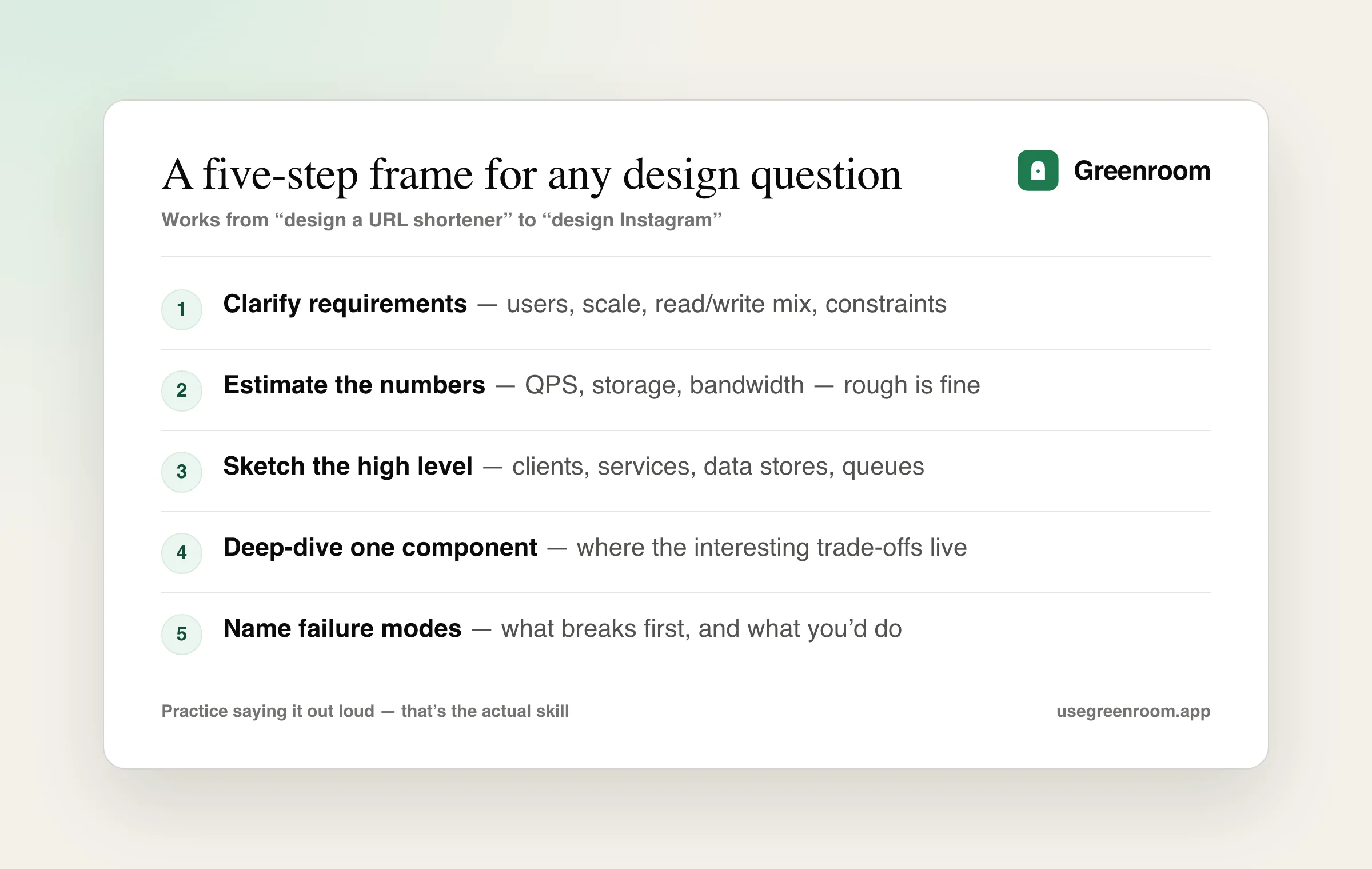
Expect payments-flavored design: design a payment processing system, a transaction ledger, a fraud detection pipeline, or a notification service. They want consistency, reliability, idempotency, and a clear discussion of trade-offs — money systems can't lose data. See our system design guide and backend guide.
PayPal behavioral
Expect ownership, conflict, and impact questions. Answer in STAR and quantify results.
How to prepare
System design is a spoken skill. Practise talking through payments-style designs and trade-offs out loud. Greenroom runs spoken interviews that push on your design reasoning with live follow-ups. Pair it with our backend and system design guides.
Frequently asked questions
What is the PayPal interview process?
PayPal's process includes a recruiter screen, a technical screen with one or two coding problems, and an on-site loop of coding rounds, a system design round (often payments-flavored), and a behavioral round. Because PayPal moves money, correctness, reliability and design reasoning carry significant weight throughout.
What system design questions does PayPal ask?
PayPal favors payments-flavored design prompts like designing a payment processing system, a transaction ledger, a fraud detection pipeline or a notification service. Interviewers want strong consistency, reliability and idempotency, plus clear trade-off discussion, since money systems can't lose data or double-charge under retries.
What coding questions does PayPal ask?
PayPal asks standard data-structure and algorithm problems: arrays, strings and hash maps (two-pointer, sliding window, intervals), trees and graphs (BFS/DFS, traversals), and moderate dynamic programming and recursion. Clear narration and careful edge-case handling are expected, reflecting PayPal's emphasis on correctness.
How should I prepare for a PayPal interview?
Practise data-structure and algorithm problems with careful edge-case handling, and prioritize payments-style system design — reasoning about consistency, idempotency and failure modes. Rehearse talking through designs and trade-offs out loud with a voice-based mock interview, since the design round is verbal and central to PayPal's loop.