Picture the scene: a backend engineer, three years of experience, has built and rebuilt a caching layer twice in production. The interviewer asks, almost gently, "can you walk me through how you'd design a rate limiter?" — a question this engineer could draw on a napkin at 2am, half asleep, for a friend. Instead, what happens is: nothing. A pause that starts reasonable and turns excruciating. The engineer's own brain, the same brain that designed the actual system, returns a 404. Not "I don't know" — worse, a complete, silent mind freeze, the kind where you can feel the answer somewhere just out of reach, like a word on the tip of your tongue, except the word is an entire system design.
This is one of the most common, most misunderstood failure modes in interviewing, and almost everyone who's experienced it draws the wrong conclusion from it: "I clearly didn't know it well enough." That conclusion is usually false, and believing it makes the problem worse, because the actual fix isn't "study more" — it's "rehearse retrieval under the exact conditions where it tends to fail." This post is about why mind freeze during interviews happens at a mechanical level, and the specific prevention plan — not the in-the-moment recovery script, which is its own post — that closes the gap before the freeze ever starts.
What mind freeze actually is, mechanically
Mind freeze isn't memory loss. The information you need is still in your brain — you'll often recall it perfectly forty seconds after the interview ends, in the parking lot, which is the single most diagnostic fact about this whole phenomenon. If the knowledge had genuinely been missing, it wouldn't suddenly reappear once the stakes dropped to zero. What actually fails is retrieval: the live, real-time process of locating and pulling a specific memory out from under acute stress, on a clock, while being watched.
Cognitive psychologists distinguish between storage (whether information exists in memory at all) and retrieval (whether you can access it on demand). You can have something perfectly stored and still fail to retrieve it — that's the entire tip-of-the-tongue phenomenon, and it's well documented outside interviews too: a student who studied hard blanking on an exam answer they clearly knew the night before, an actor forgetting a line they've performed forty times, a presenter losing their place mid-slide despite having rehearsed the deck. Stress doesn't delete the memory. It narrows the retrieval path — under the Yerkes-Dodson framework that's been studied in performance psychology for over a century, moderate arousal improves performance, but past a certain threshold, additional stress actively degrades it, particularly for tasks that require flexible, on-demand recall rather than a fixed, automatic motor skill.
There's a second mechanism stacking on top of the first: cortisol, the primary stress hormone, has a well-documented suppressive effect on hippocampal function — the hippocampus being central to forming and retrieving episodic and declarative memories. In the acute moment of "I am being evaluated and the silence is getting long," your cortisol spikes, your hippocampus's retrieval efficiency drops, and the path to the answer you absolutely have gets temporarily harder to find — not erased, just harder to find, under exactly the conditions where you need it fastest.
Why "just know the material better" doesn't fix it
This is the instinctive response almost every candidate has after a freeze, and it's almost always the wrong lever to pull, for a specific reason: the engineer in the opening example already knew the material better than almost anyone interviewing them would. Studying more adds to storage. It does very little for retrieval under stress specifically, because passive studying — reading, re-reading notes, watching another system design video — never actually exercises the retrieval-under-pressure pathway. You can have a vault stacked floor to ceiling with gold and still fail to open it fast enough if you've only ever practiced opening it in a quiet room with no one watching and no clock running.
This is the same blind spot covered in why do I freeze in interviews — the cause is retrieval under pressure, not a gap in what you know — but this post goes one layer further into the prevention mechanism specifically: what closes that gap is retrieval practice, sometimes called the testing effect, a well-replicated finding in learning science that actively recalling information (without looking at notes) under conditions resembling the real test strengthens retrieval far more than passively re-exposing yourself to the same information. The skill you're missing isn't "knowing rate limiters." It's "retrieving the rate-limiter explanation, out loud, in real time, while someone is listening and the clock is running, without the safety net of your notes in front of you."
The diagnostic comparison: rehearsed vs. under-rehearsed retrieval
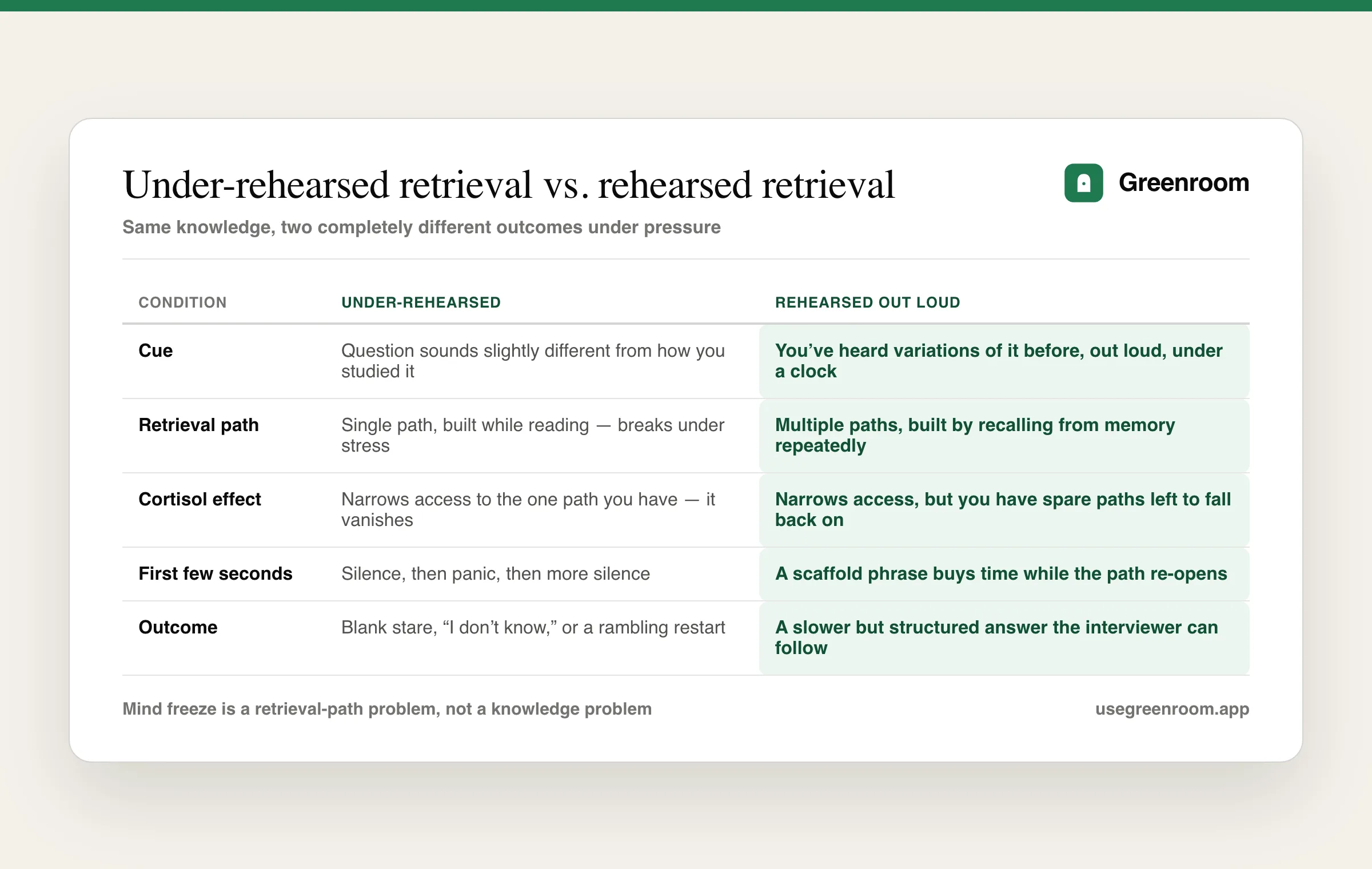
Look at the gap row by row. Cue recognition — if you studied a concept by reading about it once, the live interview question almost never arrives phrased exactly the way you studied it, and that mismatch alone can stall retrieval before stress even compounds it. Retrieval path — passive study builds exactly one path to an answer, built while reading calmly; active, repeated recall under pressure builds several redundant paths, so if one is blocked under stress, another is still open. Cortisol effect — this is the part people miss: cortisol narrows your access regardless of how well-rehearsed you are. The difference isn't that rehearsed candidates don't feel stress — they do. The difference is they have spare retrieval paths left over after the narrowing, and under-rehearsed candidates don't. First few seconds — rehearsed candidates have a scaffold phrase ready to buy time while the path reopens; under-rehearsed candidates have only silence, which itself adds more stress, compounding the freeze. Outcome — a slower, structured answer versus a blank stare or a rambling restart that the interviewer has to mentally redirect.
This is the whole prevention strategy in one row-by-row comparison: you can't lower cortisol to zero in a real interview, and you shouldn't try — moderate stress sharpens focus. What you can do is make sure you have more than one retrieval path to your important answers, built the only way retrieval paths actually get built: by retrieving them, out loud, repeatedly, under conditions that resemble the real thing.
The prevention plan: building redundant retrieval paths
1. Active recall, not re-reading, for your core stories and explanations
For every story or explanation you expect to need — your top 5–6 STAR stories, your 3–4 "explain a system you built" answers, your go-to system-design frameworks — stop re-reading your notes about them. Instead, close the notes, and try to recall and say the whole thing out loud from memory. Notice exactly where you stumble; that stumble point is precisely where your retrieval path is weak, and it's far more useful diagnostic information than "I read it again and it felt familiar." Repeat across days, not just once — spaced retrieval practice (recalling something again after a day or two, not immediately) builds a sturdier path than cramming the same recall five times in one sitting.
2. Rehearse under time pressure, not in your own time
A huge share of "I know it but I blanked" cases trace back to having only ever practiced an answer at your own unhurried pace. Add a visible timer when you rehearse — even a phone stopwatch propped against your monitor — so the retrieval skill you're building includes "find this answer while a clock is running," because that's the actual condition you'll be tested under. This is the same principle behind practicing like you play: if the real event has a condition (a clock, an audience, no pausing), your rehearsal needs that condition too, or you're training a different skill than the one you'll be tested on.
3. Rehearse out loud, to another person or a mock interviewer
Recalling something silently in your head and producing it verbally, live, to another human, are measurably different skills — verbal production under social evaluation adds its own retrieval load on top of pure recall. If your only rehearsal has been silent or written, you've never actually trained the skill the interview tests. This is the single biggest gap GeeksforGeeks-style question dumps and a friend's WhatsApp-forwarded prep PDF leave open: they're excellent for storage (learning the material) and close to useless for retrieval-under-pressure rehearsal, because reading a list of answers silently never once puts you in the position of producing one live.
4. Practice variations of the same question, not just one fixed phrasing
Because cue mismatch is part of what stalls retrieval, rehearse the same underlying answer triggered by several different phrasings of the question — "design a rate limiter," "how would you stop one user from overwhelming an API," "what would you build to protect a shared resource from abuse." Each phrasing builds a slightly different retrieval path to the same core knowledge, so a live interviewer's unexpected phrasing is less likely to be the thing that stalls you.
5. Build one scaffold phrase per major topic, in advance
Even with strong rehearsal, the first few seconds of a hard question are exactly when residual stress is highest. A pre-built scaffold phrase — "there are a few approaches here, let me start with the constraints" or "let me think through this the way I would on the job" — buys two to three seconds of socially normal silence while your retrieval path actually opens, instead of dead air that compounds the panic. This is the prevention-side complement to the in-the-moment recovery moves in recover from blanking in interview — the scaffold phrase is what you reach for before a full freeze sets in, not after.
Comparing this to how most people actually try to fix it
The default response to a freeze is almost always "study the topic harder," which, as covered above, mostly strengthens storage rather than retrieval, and storage was rarely the actual gap. The second most common response is generic confidence advice — "believe in yourself," "you've got this" — which doesn't address the mechanism at all; cortisol narrows retrieval whether or not you believe in yourself, and confidence built on hope rather than rehearsed retrieval tends to evaporate the moment the freeze actually happens, because nothing concrete backs it up. A friend running you through questions casually over coffee is genuinely useful and better than nothing, but it rarely recreates real evaluative pressure — there's no clock, no unfamiliar interviewer, no real stakes, so the retrieval pathway being trained is gentler than the one you'll need.
ChatGPT can be a decent tool for generating practice questions and even giving you feedback on a written answer, but it can't replicate the specific stress of a live, spoken, evaluated exchange with follow-up questions you can't predict — and follow-ups are exactly where untrained retrieval paths get exposed, because a follow-up forces you off your one rehearsed path and into genuine live retrieval. Greenroom is built specifically to close that gap: a spoken mock interview with a live AI interviewer, asking real follow-ups, on a clock, with feedback afterward on exactly where your retrieval stalled — which is the only kind of practice that actually trains the skill mind freeze prevention requires, rather than the skill of reading calmly.
What to do if you freeze anyway
Even with full preparation, you may still freeze occasionally — preparation lowers the odds substantially but doesn't take them to zero, and that's a normal, not a failed, outcome. If it happens, the in-the-moment plan is different from prevention, and it's covered in full in what to do when you blank mid-interview: use a scaffold phrase, take a physical reset (a physiological sigh works well here too, since the same cortisol spike driving the freeze is also driving a racing heart), and rebuild from whatever fragment you can retrieve rather than waiting for the whole answer to arrive at once. Prevention and recovery are two different skills, worth practicing separately, and worth having both ready.
Frequently asked questions
Why do I freeze in interviews even when I know the material?
Because mind freeze is a retrieval failure under acute stress, not a knowledge failure — cortisol narrows your access to memories you genuinely have stored, which is why the answer often surfaces perfectly a few minutes after the interview ends, once the stress has dropped. The fix is building multiple rehearsed retrieval paths to your key answers, not memorizing more content.
What's the difference between mind freeze prevention and recovering from a blank?
Prevention is the rehearsal work done before the interview — active recall, practicing under time pressure, out loud, with question variations — that reduces how often a freeze happens at all. Recovery is the in-the-moment script for when a freeze happens anyway: a scaffold phrase, a physical reset, and rebuilding the answer from a fragment. Both matter; prevention lowers the odds, recovery handles the cases prevention doesn't catch.
Does studying harder prevent mind freeze?
Not on its own. Studying — reading, re-reading, watching tutorials — builds storage (whether you have the knowledge), but mind freeze is a retrieval problem (whether you can access it live, under stress, on a clock). The fix is active, spoken retrieval practice under realistic conditions, not more passive study time on material you may already know well.
How many times do I need to rehearse an answer before mind freeze stops happening?
There's no universal number, but spaced retrieval practice — recalling the answer from memory, out loud, on separate days rather than cramming it repeatedly in one sitting — builds a sturdier retrieval path with fewer total reps than cramming does. Most candidates notice a real difference after rehearsing their core answers out loud, under a timer, across three to five separate sessions.
Can mock interviews actually prevent mind freeze, or do I need a therapist?
Mock interviews address situational performance freezing by rehearsing retrieval under realistic, evaluative pressure — which is exactly the mechanism behind most interview-specific mind freeze. If the freezing generalizes well beyond interviews — frequent panic, avoidance of any evaluative situation, persistent physical symptoms — that pattern is worth discussing with a doctor or therapist, since it may reflect something broader than interview-specific retrieval stress.
Is mind freeze the same thing as imposter syndrome?
They're related but distinct. Imposter syndrome is a belief — feeling like a fraud despite evidence of competence — while mind freeze is a real-time physiological and cognitive event where stress blocks retrieval of knowledge you do have. Imposter syndrome can make freezing more likely (because anticipating failure raises baseline anxiety), but you can have one without the other.