She had bought the course. Sixty-two hours of video, a PDF question bank, a Discord community, and a certificate. Nine weeks later she failed a phone screen for the same reason she had failed one before buying it: she knew the answer, said it badly, ran out of time, and never mentioned the number that would have made it land. Nothing in sixty-two hours of video had ever required her to open her mouth.
The question people search is "is interview prep worth paying for?" and I am going to give you the answer that is bad for my business first: mostly, no. We sell interview practice. We also have a free tier, and I would rather you use the free version well than buy something that does not fix your problem — including from us.
Here is the honest version of the decision.
What is actually being sold
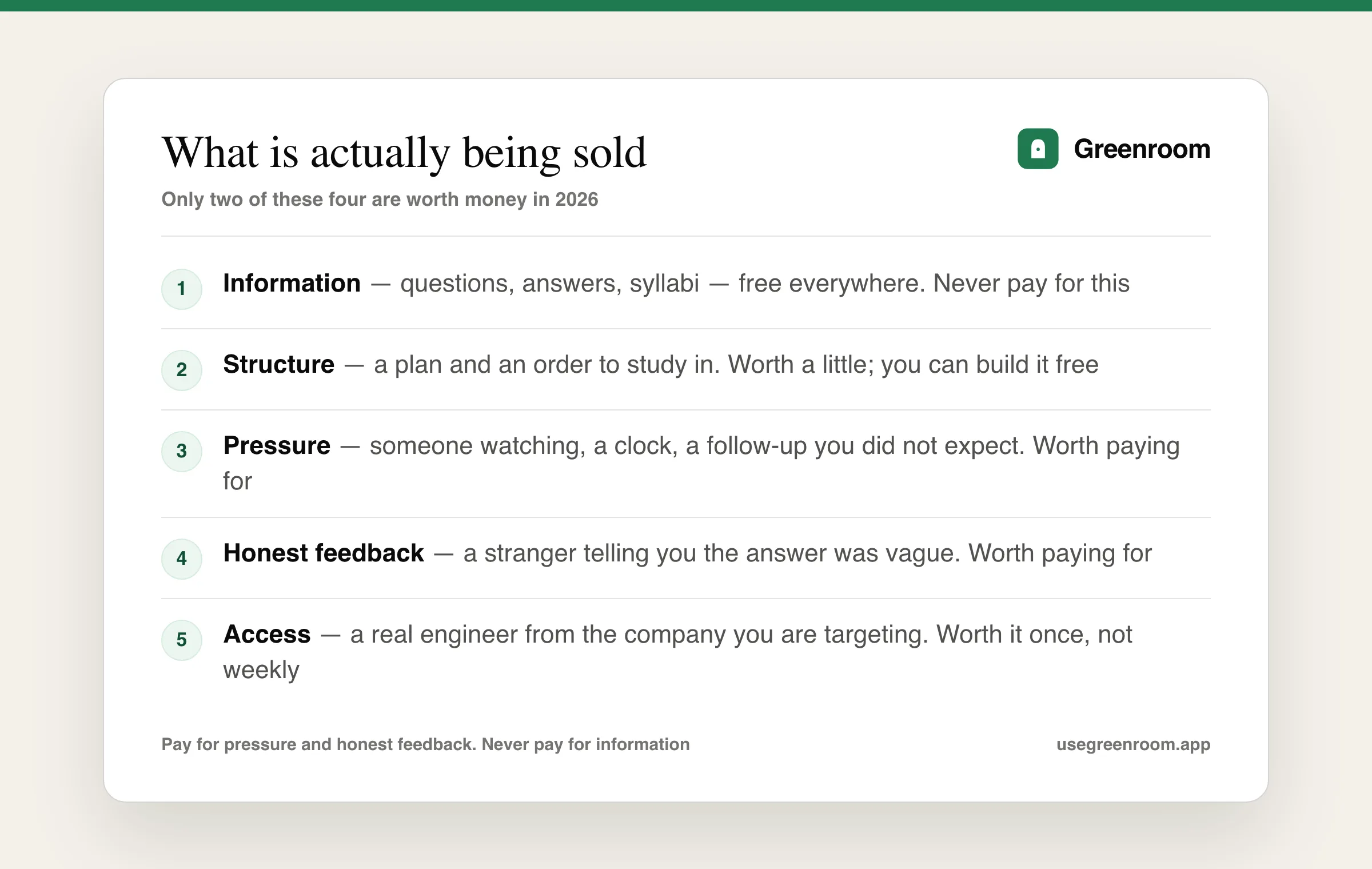
Almost everything in this market is one of four things, and only two of them are worth money.
Information — never pay for this. Questions, answers, syllabi, "the 300 questions asked at Amazon". In 2026 this is free, abundant, and often better free: GeeksforGeeks, the official docs, YouTube, LeetCode's free tier, and a language model that will generate a question bank from a job description in nine seconds. A course whose core value is a curated list of things you could have Googled is selling you organisation, at a markup.
Structure — worth a little, buildable for nothing. A plan, an order, a schedule. This has genuine value if you are drowning, and it is also the thing you can construct in an afternoon from any decent free roadmap. Paying for structure is reasonable if it is cheap and if you would genuinely not build it yourself.
Pressure — worth paying for. Someone watching. A clock. A follow-up question you did not prepare for. Silence when you finish an answer badly. This is the thing that cannot be read, cannot be watched, and does not happen at your desk alone, and it is the single largest gap between people who know the material and people who pass.
Honest feedback — worth paying for. A stranger telling you that your answer was vague, that you said "we" eleven times, that you never gave a number. Friends will not do this. Your own recording will not tell you why. This is genuinely scarce and it is the other thing worth money.
There is a fifth thing, sold rarely and worth a lot in one specific case: access — a real engineer who interviews at the company you are targeting. Worth it once for calibration. Not worth it weekly.
The three situations where paying is genuinely worth it
One: you have a specific, expensive interview soon. A FAANG onsite, a final round after eight weeks of process, a job that changes your salary band. The maths here is not close — a few thousand rupees against a compensation difference measured in lakhs is a rounding error, and calibration from someone who has seen that loop is worth real money. This is the case where I would spend the most.
Two: you have failed repeatedly and do not know why. You are clearing screens and dying in round three, or getting to onsites and never converting. That is a diagnosis problem, and diagnosis is exactly what you cannot do for yourself — you cannot hear your own vagueness. One honest external assessment is worth more than another month of study, because more study of the wrong thing is what got you here.
Three: you will not do it otherwise. Unglamorous and true. If paying is what makes you show up — because you booked a slot, because someone is waiting, because it cost you something — then you are buying commitment, and commitment is a real product. Be honest with yourself about whether this is you.
When it is not worth it
- You have not exhausted the free tier of anything. If you have not finished a free roadmap or done a single free mock, buying is procrastination with a receipt.
- You are buying information. Covered above. Never.
- Your actual gap is that you do not know the material. No mock interview fixes not knowing how a hash map works. Study first, then buy pressure. Getting this order wrong is the most common waste of money in this market.
- You are three months out with no interviews booked. Buy later, closer, when it is sharper and cheaper in relative terms.
- It is a subscription you will forget. Prep is bursty. Annual subscriptions to prep tools are, for most people, a donation.
- You are buying it to feel like you are doing something. The purchase is a mood, not a method. This is the one worth being genuinely honest with yourself about.
How to tell before you pay
Five questions. If a product cannot answer them clearly, that is the answer.
- Will I have to speak out loud? If not, it is information. Free alternatives exist.
- Will something ask me an unexpected follow-up? The follow-up is where the value lives. A fixed list of questions is a PDF with a login.
- Will I get specific feedback, or a score? "7/10 on communication" is not feedback. "You used 'we' throughout an answer about your own work" is.
- Can I try it before paying? Any prep product that will not let you experience the core loop free is asking you to buy on faith in a market with a lot of noise.
- What does it explicitly not do? A seller who cannot name their own limitation is either inexperienced or not being straight with you.
The honest comparison, including us
- Free question banks (GeeksforGeeks, LeetCode free, YouTube, official docs). Cover the information layer completely. Start here always. Their gap: no pressure, no feedback.
- LeetCode Premium. Genuinely useful if you are grinding company-tagged problems at volume, and only then. Our LeetCode Premium alternatives guide covers the cheaper routes.
- A friend doing mocks. Free and underrated. Their gap: friends rescue you, and they rarely ask the second follow-up. Our how to practise mock interviews alone guide covers doing this without one.
- Human expert mocks (interviewing.io, Pramp for peers, individual coaches). The best calibration available and the most expensive. Worth it once or twice near a big loop, not as a habit. Our AI mock vs a real engineer mock guide covers the tradeoff properly.
- ChatGPT. Free, endlessly patient, and generates questions well. Its structural gap is that it lets you type, which trains reading rather than speaking — and it will not notice when you have gone quiet.
- Greenroom. We sell the pressure layer: Ari, the AI interviewer runs the round out loud, asks the follow-up you did not plan for, and scores structure and specificity. Free to start, so you can test the loop before deciding. Honest limitations, since I just demanded them of everyone else: Ari will not teach you a topic you have never studied, will not review your code line by line, and cannot tell you a specific company's internal rubric. If your gap is knowledge rather than delivery, we are the wrong purchase and you should go and study.
What to do instead, if the answer is no
- Do one free mock this week. Not next week. The information about your gaps is the point.
- Record yourself answering five questions and watch it back. Free, brutal, effective.
- Ask one person in the role you want for thirty minutes. Most say yes and it costs nothing.
- Apply to three companies you do not care about and use the interviews as calibration. This is the most underrated free resource in the entire market.
- Finish one free roadmap before buying anything at all.
Our how many mock interviews before the real one guide gives a number by scenario, and our best mock interview websites in India guide compares the options including the free ones.
Frequently asked questions
Is paid interview preparation worth the money?
Usually not, because most of what is sold is information — question banks, syllabi and curated lists — and information is free and abundant in 2026. What is genuinely scarce, and therefore worth paying for, is pressure and honest feedback: someone watching, a clock running, an unexpected follow-up, and a stranger willing to tell you your answer was vague. If what you are buying can be read rather than spoken, you are paying for organisation.
When should you pay for interview prep?
Three situations justify it. When you have a specific expensive interview soon, such as a FAANG onsite, where a few thousand rupees against a compensation difference in lakhs is a rounding error. When you have failed repeatedly and cannot diagnose why, because you cannot hear your own vagueness and more study of the wrong thing is what got you there. And when paying is genuinely what makes you show up, in which case you are buying commitment, which is a real product.
When is paid interview prep a waste of money?
When you have not exhausted the free tier of anything, when you are buying information you could search for, when your actual gap is not knowing the material — no mock interview fixes not knowing how a hash map works — when you are three months out with no interviews booked, when it is a subscription you will forget because preparation is bursty, and when the purchase is really about feeling productive rather than fixing a diagnosed problem.
How do you judge an interview prep product before buying?
Ask five questions. Will I have to speak out loud, because if not it is information. Will something ask me an unexpected follow-up, since a fixed list of questions is a PDF with a login. Will I get specific feedback rather than a score, because seven out of ten for communication is not feedback. Can I try the core loop before paying. And what does it explicitly not do — a seller who cannot name their own limitation is not being straight with you.
Are free interview prep resources enough?
For the information layer, entirely — free question banks, official documentation, YouTube and a language model cover it better than most paid courses. What free resources do not provide is pressure and honest external feedback, which is the gap that decides most interviews. A workable free approach is recording yourself answering five questions and watching it back, asking one person in your target role for thirty minutes, and using interviews at companies you do not care about as calibration.
Should you pay for a human mock interview or use an AI one?
A human expert mock gives the best calibration available, particularly someone who interviews at your target company, and it is worth doing once or twice near an important loop rather than as a weekly habit because of cost. An AI mock is worth it for repetition — the spoken reps and unexpected follow-ups you need weekly and cannot get from a friend who reassures you. The two solve different problems, and using the expensive one for calibration and the cheap one for volume is the sensible split.