"So, are you planning on having kids anytime soon?" The interviewer asked it warmly, conversationally, like it was a normal follow-up to "tell me about yourself" — and for a half-second the candidate just sat there doing the mental math of is this actually happening, did I imagine that, do I answer the question or the subtext, while the interviewer waited with the easy patience of someone who has asked this exact question fifty times and never once been told no. That half-second of stunned silence is the most common reaction to an illegal interview question, and it's also the worst possible state to answer from — so this post exists to make sure that half-second never has to happen blind.
Most candidates have a vague sense that some questions are off-limits, without knowing exactly which ones, why, or what to actually say when one lands in real time. Here's the specific list, the reasoning, and scripts that redirect cleanly without turning the room hostile.
What's actually off-limits (and why)
In the US, the EEOC and a patchwork of state laws (several states now have salary-history bans, for example) restrict questions tied to protected characteristics — not because the topics are inherently sinister, but because answers to them can be used, consciously or not, to discriminate. In India, the Constitution's Article 15 and various labour and equal-opportunity provisions cover similar ground, though enforcement and norms vary more by company than by statute. The common categories, across most jurisdictions:
- Age — "How old are you?" / "What year did you graduate?" used to infer age.
- Marital and family status — "Are you married?" / "Do you have kids, or plan to?"
- Pregnancy — any version of this, direct or implied ("any major life events coming up?").
- Religion — "What holidays do you celebrate?" used as a proxy.
- National origin / citizenship beyond work authorization — "Where are you really from?" vs. the legitimate "are you authorized to work here?"
- Disability or health status — beyond "can you perform the essential functions of this role, with or without accommodation?"
- Salary history — banned outright in a growing number of US states and cities specifically to break the cycle of underpaid candidates staying underpaid.
The legitimate version of several of these exists right next to the illegal one — "are you legally authorized to work in this country" is fine; "where are you really from" is not. The line is whether the question is necessary to assess job fitness, or whether it's fishing for a protected characteristic under a friendlier wrapper.
Why interviewers ask anyway
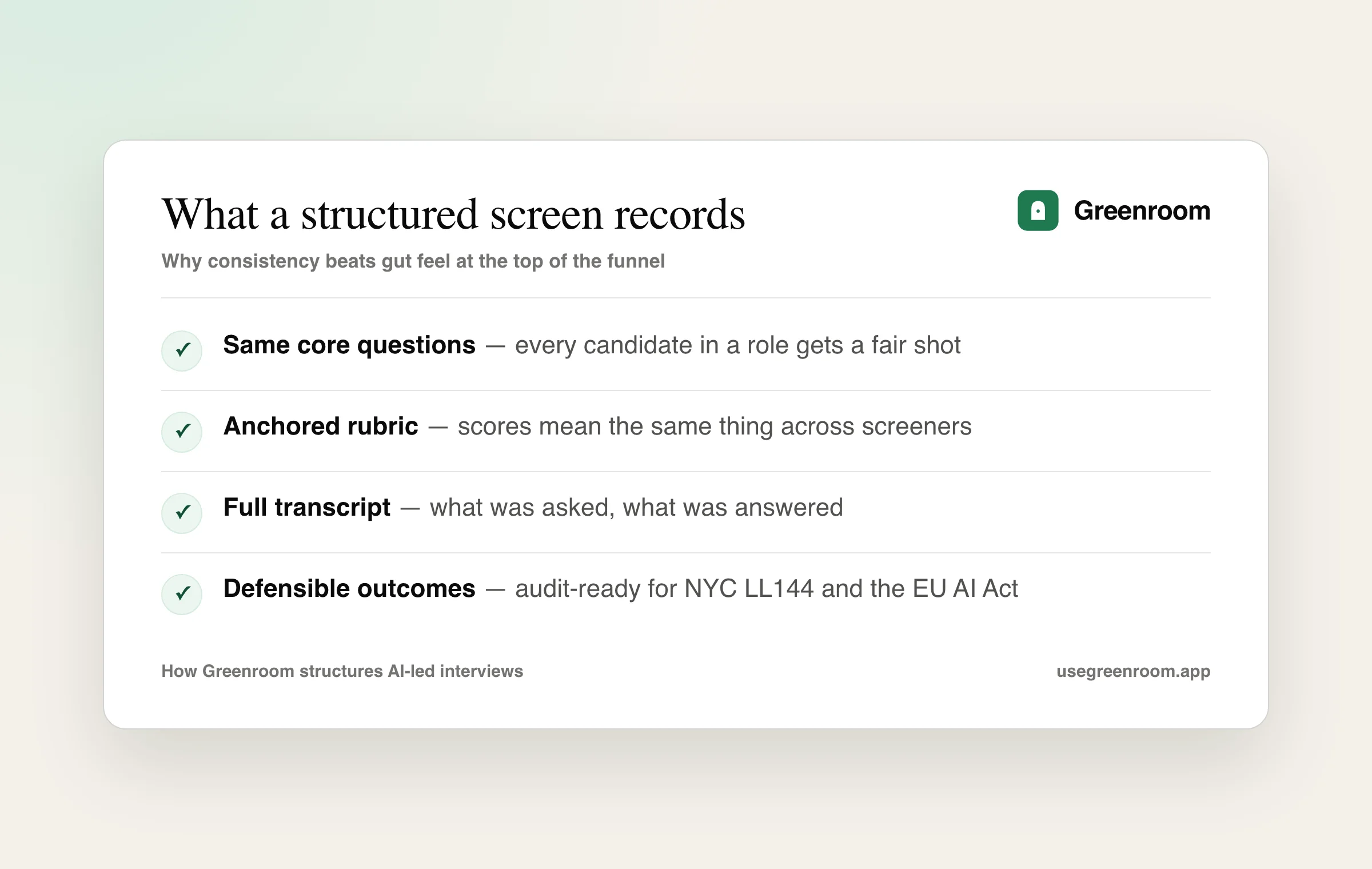
Most of the time it isn't malice — it's an untrained interviewer making small talk that wanders somewhere it shouldn't, especially in unstructured, conversational interviews where there's no script keeping things on-rubric. This is one of the strongest practical arguments for structured interviews: when every candidate gets the same role-relevant questions in the same order, there's much less room for a question to drift into "so, tell me about your personal life" territory in the first place. It's also why companies under regulatory scrutiny — see our note on NYC's Local Law 144 bias audits — are increasingly moving toward documented, structured formats: it's not just fairer, it's auditable.
How to redirect, without sounding combative
You're allowed to just answer if you want to — plenty of people do, and that's a personal call, not a mistake. But if you'd rather not, the goal is to redirect to the legitimate underlying concern without accusing anyone of anything, because the interviewer is very often not the same person who'll be your manager, and burning the relationship over an awkward question rarely serves you. A few scripts that work in practice:
- On family/marital status: "I want to make sure I can give you a clear picture of my availability and commitment to the role — I'm fully able to meet the schedule and travel requirements you've described."
- On age/graduation year: "I have [X years] of experience directly relevant to this role — happy to walk through the specifics."
- On salary history: "I'd rather focus on the value I'd bring to this role — what's the budgeted range for this position?" (In jurisdictions with a salary-history ban, you can also simply and calmly note that you understand the question isn't permitted there — see our salary expectations and salary negotiation guides for the fuller script.)
- On pregnancy/health/disability: "I'm able to perform all the core responsibilities you've outlined for this role."
Notice the pattern: each redirect answers the legitimate business question (can you do the job, are you available, what would you cost) without supplying the protected-characteristic information the question was actually fishing for.
When it's a pattern, not a slip
One awkward question from one nervous interviewer is very different from a panel where every interviewer probes the same protected topic, or a recruiter who pushes back when you redirect. If you notice a pattern — not a single slip but a repeated, insistent line of questioning, especially paired with other discomfort — that's worth weighing as a genuine signal about the company, not just an interview-technique footnote. See our companion piece on red flags during a job interview for how to weigh that against the rest of the loop.
This isn't the kind of thing a question dump prepares you for
Generic interview-prep content — a list of "100 common questions," a friend's old prep PDF, a ChatGPT session generating answers to expected questions — assumes every question in the room will be a fair one. None of it rehearses the specific, slightly destabilizing experience of having an illegal question land on you in real time and needing to redirect calmly, in your own voice, without a script in front of you. That's a delivery skill, not a knowledge gap, and it only gets built by practicing the redirect out loud under some amount of real-time pressure — which is exactly what a spoken mock interview is for.
Frequently asked questions
What are examples of illegal interview questions?
Common categories include questions about age or graduation year used to infer age, marital or family status, pregnancy or plans to have children, religion, national origin or citizenship beyond legitimate work-authorization checks, disability or health status beyond ability to perform essential job functions, and (in a growing number of US states/cities) salary history. The common thread is that the question fishes for a protected characteristic rather than job fitness.
Do I have to answer an illegal interview question?
No. You can decline and redirect to the legitimate underlying concern (availability, qualifications, salary expectations, ability to perform the role) without directly answering the protected-characteristic question. You can also choose to answer if you're comfortable doing so — that's a personal judgment call, not a rule.
How do I redirect an illegal interview question without sounding rude?
Answer the legitimate business concern behind the question instead of the question itself, calmly and without accusation — for example, responding to a question about family plans with a statement about your availability and commitment to the role's schedule. This addresses what the interviewer actually needs to know without supplying protected information, and keeps the conversation collaborative rather than confrontational.
Why do interviewers ask illegal questions if they're not allowed to?
Usually it's an untrained interviewer making conversational small talk that drifts off-script, especially in unstructured interviews with no fixed question set. Structured interview formats, where every candidate gets the same role-relevant questions in a fixed order, significantly reduce how often this happens because there's less room for a question to wander.
Is one awkward question during an interview a red flag about the company?
Not necessarily — a single slip from one interviewer is common and often unintentional. A repeated, insistent pattern across multiple interviewers, or pushback when you redirect, is a stronger signal worth weighing seriously when you evaluate the company, alongside other signals covered in our guide to interview red flags.