He had printed four copies of his resume, a plastic folder, and a pen he did not need. The interview went well. Nobody looked at the folder.
Six weeks later, three days before a joining date he had already told his parents about, HR emailed asking for the relieving letter from a startup that had shut down in 2023, and for payslips from a job where he had been paid partly in cash. The joining date moved by five weeks. The folder had been the easy part.
That gap is the whole point of this guide. The documents required for an interview are almost nothing — the list that actually costs people time arrives later, when an offer is already signed and the leverage has moved. What follows is the stage map: what to carry on the day, what HR asks for after selection, what background verification wants, and what to do when one of them does not exist.
A caveat worth stating up front, because most checklists skip it: requirements vary by company, by role, by state, and by whether you are a campus or a lateral hire. The invite email and the offer email are the real checklist. Everything below is the pattern most Indian employers follow, not a rule any single one is bound by.
Stage one: interview day
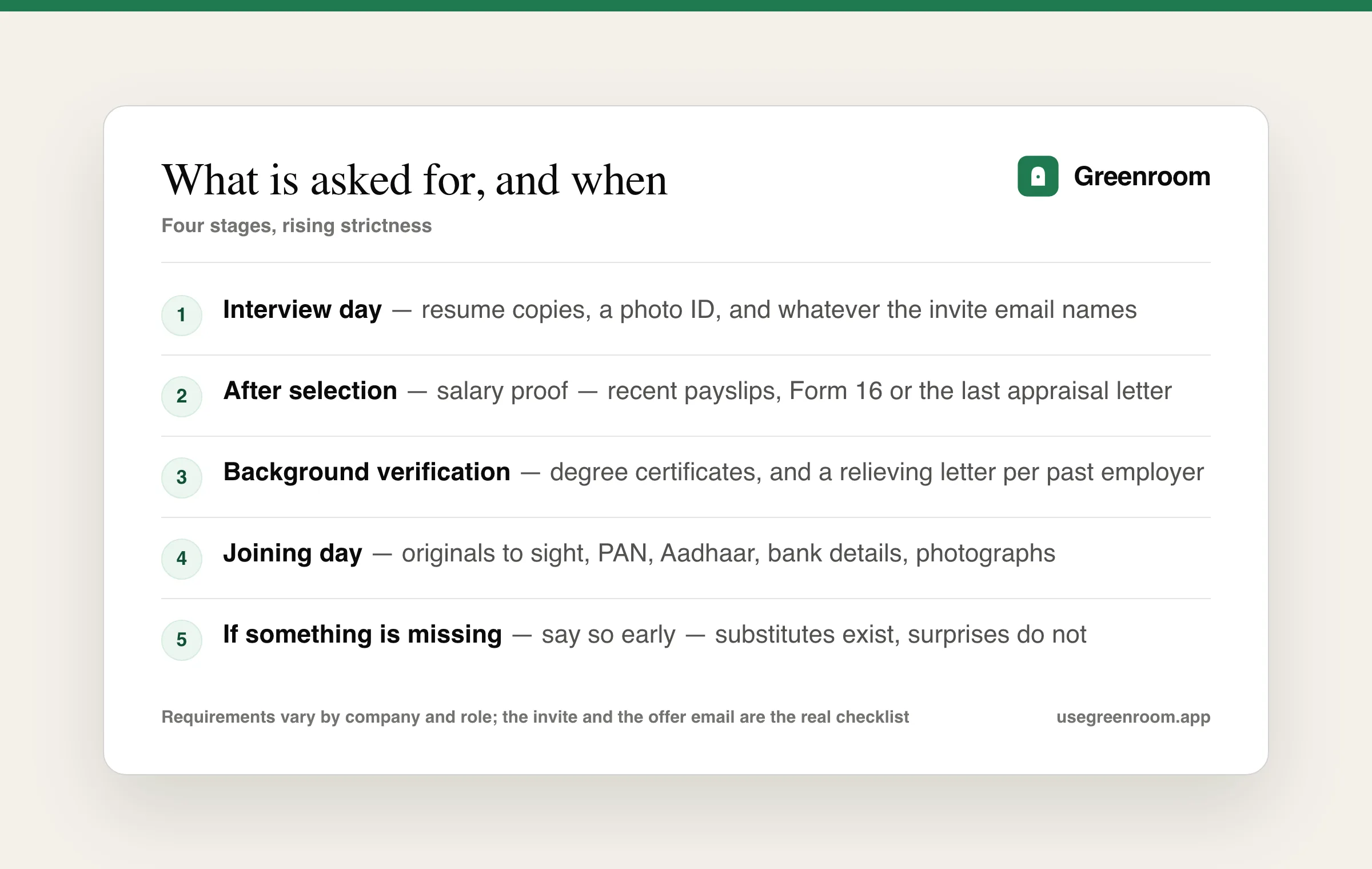
Short list, and it has barely changed in a decade:
- Two or three printed copies of your resume, matching the version you submitted. Not an improved version — a different resume in the room is a conversation you do not want.
- One photo ID, usually Aadhaar or a PAN card. For an office-building interview this is often for the security desk rather than for HR.
- Whatever the invite email names. If it asks for something specific, that is the actual requirement and it overrides every checklist online, including this one.
- A folder, because a rolled-up resume is a small, avoidable signal.
That is genuinely it for most interviews. Some walk-in and campus drives ask for more — passport photographs, mark sheets on the day — and our walk-in interview tips guide covers that format, where the queue and the volume change what you carry.
Stage two: after you are selected
Once a role is verbally confirmed, most Indian companies ask for salary proof before the offer letter is finalised, because the number they offer is often anchored to what you earn now.
- Recent payslips, usually the last three months.
- Form 16 or the most recent appraisal letter, sometimes in place of payslips, sometimes as well.
- Your current offer or increment letter, where the payslip alone does not show the full structure.
Two things worth knowing. First, providing salary proof is common practice, not a legal obligation — some candidates decline and negotiate on market rate, with mixed results depending on how badly they are wanted. Second, this is precisely why the components of your current package matter, and our CTC vs in-hand salary guide covers what is actually being compared.
If you are a fresher, this stage largely does not apply. What replaces it is academic proof, which moves straight into the next stage.
Stage three: background verification, where it actually goes wrong
This is the expensive stage, and it runs after you have accepted and often after you have resigned. Expect a third-party agency rather than the company itself.
Education. Degree certificate and consolidated mark sheets, sometimes verified directly with the university, which is slow and outside anyone's control.
Employment. A relieving letter from each employer in the period being checked, plus an experience letter where the relieving letter does not state dates and designation. This is the single most common point of failure, and our relieving letter guide covers how to get one and what to do when a company refuses or no longer exists.
Identity and address. Aadhaar, PAN, and sometimes a utility bill or rental agreement for the address on file.
Gaps. Any period not covered by education or employment will be asked about, and a written explanation is normal rather than a red flag.
Verification typically takes one to three weeks and frequently takes longer, and the delay is usually the agency waiting on someone else's HR — our background verification delay guide covers what to do while it sits. Bond and service-agreement documents can surface here too, which the training bond guide handles properly.
Stage four: joining day
By now the paperwork is administrative:
- Originals of everything already submitted, for sighting rather than surrender. A company that wants to retain your original degree certificate is doing something you should ask about in writing first.
- PAN and Aadhaar, plus a cancelled cheque or bank statement for salary credit.
- Passport photographs — keep six spare, it is always more than expected.
- PF and UAN details from your previous employer, so the account transfers rather than being opened again.
- Medical or insurance forms, where the employer runs a check.
What to do when a document does not exist
This is the part checklists leave out, and it is the only part that is genuinely hard.
No relieving letter, because the company shut down. Common and generally survivable. Offer alternatives: the resignation email and its acceptance, the final payslip, Form 16 for that year, the PF passbook showing contributions, bank statements showing salary credits. Two or three of those together usually satisfy an agency.
No relieving letter, because you left badly. Say so before verification starts rather than after. Agencies find the gap regardless, and a candidate who flagged it is a different case from one who appeared to conceal it.
Salary partly in cash. Show what is documented and state the rest plainly. An inflated claim that payslips do not support is the version that costs the offer.
Mark sheets lost. Universities issue duplicates, and it takes weeks — start on the day you accept, not on the day HR asks.
Something genuinely uncertain — a bond, a dispute, a gap you would rather not explain. Get advice specific to your situation; a blog post is not that, and the stakes here are higher than the stakes in the interview.
The honest summary: disclose early and substitute. Almost every missing-document problem is survivable when it is raised in week one and difficult when it surfaces in week six.
Where the usual advice comes up short
Naukri and Indeed checklists. Accurate and undated, presented as one flat list, with no separation between what the security desk wants and what a verification agency wants. The flat list is why people over-prepare for the interview and under-prepare for the offer.
Your placement cell's WhatsApp PDF. Usually right for campus drives and often wrong for lateral hires, where salary proof and relieving letters appear and mark sheets mostly stop mattering. Our campus placement interview guide covers the campus version specifically.
The company's own HR email. The most reliable source available, and the one people skim. Read it twice; where it disagrees with any guide, it wins.
Asking ChatGPT. Fine for the general pattern, and it cannot tell you what your employer's agency will accept in place of a letter that does not exist. That answer comes from the recruiter, and it is worth asking directly.
Greenroom. Honest fit: this is paperwork, and Ari does not help with paperwork. The narrow overlap is real, though — explaining a gap, a short stint or a missing letter out loud, without over-apologising, is the same skill the interview tests, and Ari, the AI interviewer will follow up on a vague answer rather than let it pass. Honest tradeoff: nothing you rehearse produces a document you do not have.
The one-line version
Carry a photo ID, printed resumes and whatever the invite email names, then spend the same evening collecting the things nobody has asked for yet — payslips, mark sheets, and a relieving letter from every employer — because the documents that move a joining date are requested six weeks later, by an agency, from companies you no longer work for.
Frequently asked questions
What documents are required for an interview in India?
For the interview itself the list is short: two or three printed copies of the resume you actually submitted, one photo ID such as Aadhaar or a PAN card, and anything specifically named in the invite email, which overrides any general checklist. Walk-in drives and campus drives sometimes ask for more on the day, such as passport photographs or mark sheets. The longer document list — salary proof, education certificates and relieving letters — is requested after selection rather than at the interview, so it is worth assembling in parallel while you are still interviewing.
What documents should I carry for a walk-in interview?
Carry more than you would to a scheduled interview, because walk-ins compress several stages into one day. Multiple resume copies, a photo ID, passport photographs, and your education certificates or mark sheets if the advertisement mentions them. Where the drive is for an immediate requirement, recent payslips are sometimes asked for on the spot. The job advertisement is the authority here, and when it lists documents that list is the requirement rather than a suggestion.
What documents are needed for background verification?
Typically three categories. Education, meaning degree certificates and consolidated mark sheets, sometimes verified directly with the university. Employment, meaning a relieving letter from each employer in the period under check, plus an experience letter where the relieving letter does not state dates and designation. And identity, meaning Aadhaar, PAN and sometimes proof of address. Any period not covered by study or work will also be queried, and a written explanation of a gap is routine rather than damaging.
What if I don't have a relieving letter?
It is a common situation and usually survivable, particularly when the previous company has shut down. Offer documentary substitutes instead: the resignation email and its acceptance, the final payslip, Form 16 for that year, a PF passbook showing contributions, or bank statements showing salary credits. Two or three together will often satisfy a verification agency. The decisive factor is timing — raise it in the first week of the process rather than letting it surface during verification, because a disclosed gap is treated very differently from one that appears to have been concealed.
Do I have to give payslips before getting an offer?
Most Indian employers ask for recent payslips, Form 16 or an appraisal letter after selecting you, because offers are frequently anchored to current salary. It is common practice rather than a legal obligation, and some candidates decline and ask to be evaluated on market rate instead, with results that depend heavily on how much the employer wants them. What does not work is claiming a figure the documents will not support, since the payslips are usually seen before the offer letter is issued.
What documents are required on the first day of joining?
Originals of what was already submitted, for sighting rather than for the company to keep — a request to retain your original degree certificate is worth querying in writing before you hand it over. Beyond that, PAN and Aadhaar, a cancelled cheque or bank statement for salary credit, several passport photographs, your PF and UAN details from the previous employer so the account transfers rather than being reopened, and any medical or insurance forms the employer uses. The joining email normally lists this precisely, and it is the version to follow.