A candidate I'll call Sneha spent six weeks grinding LeetCode mediums for her Barclays Pune interview. Graphs, DP, the works. The interviewer opened with: "What's the difference between DELETE, TRUNCATE and DROP?" Then: "Walk me through the database schema of your final-year project." Then, gently: "Which Barclays value do you connect with most?" Sneha knew binary lifting. She did not know Barclays had values. She'd prepared brilliantly — for a completely different movie.
That's the thing to understand about Barclays interview questions: the bank's technology centres in Pune and Chennai hire thousands of engineers, and the loop is broad, not deep. The coding bar is moderate; the differentiators are SQL written live, database and OS fundamentals explained out loud, an honest grilling on your projects, and a values round most candidates don't know exists. I built Greenroom after freezing in an interview I'd "prepared" for in exactly this lopsided way — all algorithms, no answers for the questions actually asked. This guide covers the real Barclays interview process for freshers and laterals: the online assessment, the technical rounds, the values round, and a prep plan that matches the actual weightings.
The Barclays interview process
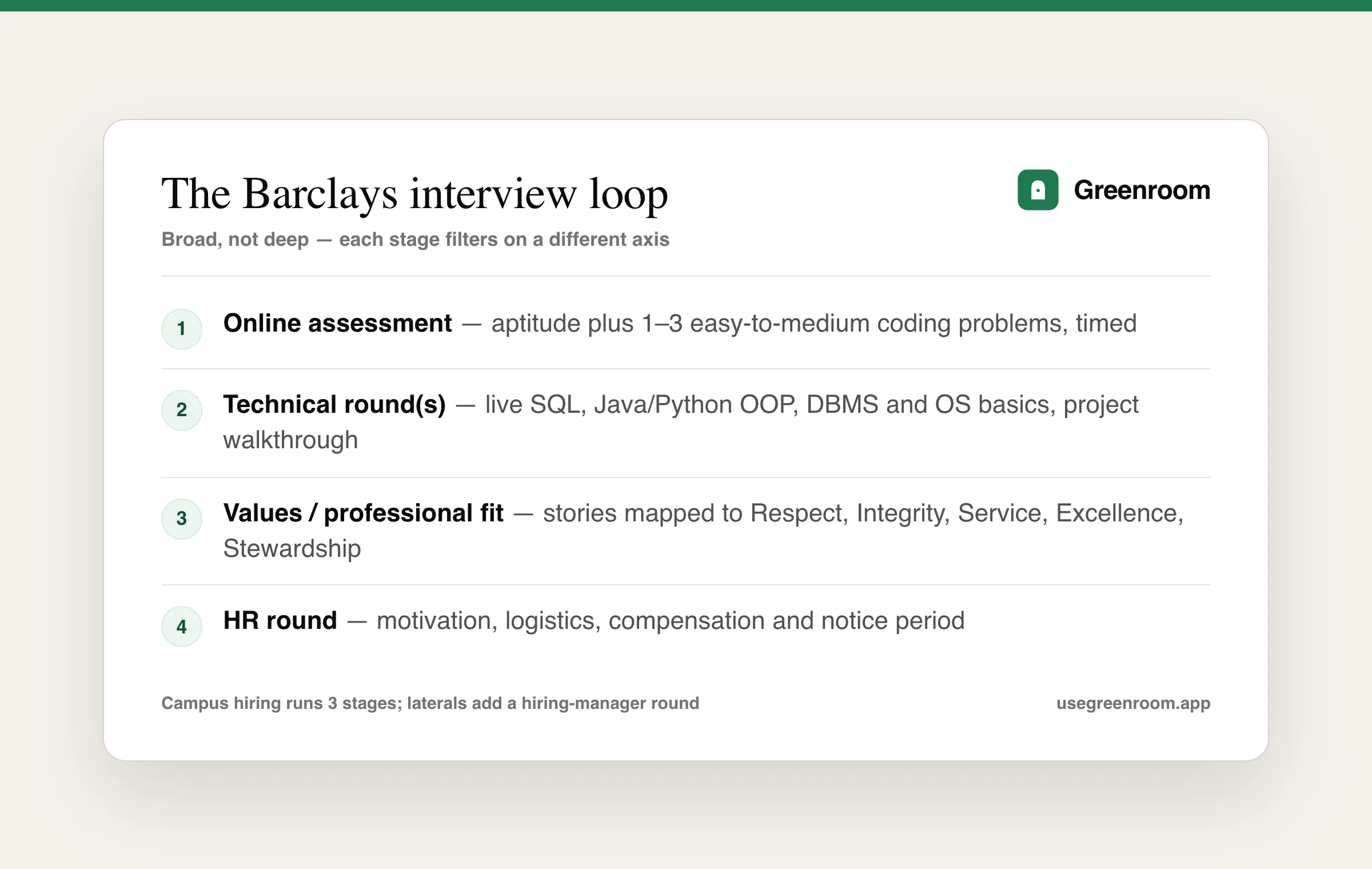
For campus and graduate technology roles (the analyst intake most Indian freshers enter through), candidates consistently report three stages after the application:
- Online assessment — logical and quantitative aptitude plus one to three coding problems, easy-to-medium difficulty.
- Technical interview (one or two rounds) — Java/Python fundamentals, SQL queries written live, DBMS and OS basics, and a long walkthrough of your projects.
- Professional-fit / HR round — behavioral questions mapped to Barclays' published values, plus motivation and logistics.
Lateral hiring follows the same skeleton with a hiring-manager discussion added, and a system-design conversation for senior roles. The pattern across every stage: breadth beats depth. Nobody fails Barclays on a hard algorithm; people fail it on a JOIN they couldn't write, a project they couldn't defend, or a values question they'd never considered. Barclays' own early-careers site describes the values-based assessment openly — it's the most ignored piece of free syllabus in banking interviews.
The online assessment
The Barclays online assessment is the widest filter, and candidates report a consistent shape:
- Aptitude — logical reasoning and quantitative questions under time pressure; nothing exotic, but the clock is real.
- Coding — one to three problems on arrays, strings and hash maps, occasionally a simple DP problem. Easy-to-medium; partial marks for passing test cases are common, so a clean brute force beats a broken optimal solution.
If you've done a season of campus OAs this will feel familiar — our aptitude test preparation guide covers the reasoning section, and the coding section sits well below the bar of the product-company OAs covered in our DSA preparation guide.
Technical interview questions
This is where Sneha's movie went off-script. The technical rounds are a fundamentals tour, and SQL is the star — this is a bank; the data layer is the job. Recurring questions, per candidate reports across Glassdoor and GeeksforGeeks experiences:
- SQL, written live: second-highest salary, department-wise top earners, duplicate detection, the difference between
WHEREandHAVING, and JOIN types with a worked example. - DELETE vs TRUNCATE vs DROP — and which ones can be rolled back.
- Java/Python OOP: the four pillars with real examples, abstract class vs interface,
HashMapinternals, exception handling,Stringimmutability. - DBMS and OS basics: ACID properties, normalization to 3NF, indexing, deadlocks, processes vs threads.
- Your projects: schema design, why you chose your stack, what breaks under load, what you'd redo.
The classic SQL question, answered the way the interviewer hopes:
-- Second-highest salary: the answer everyone gives
SELECT MAX(salary) FROM employees
WHERE salary < (SELECT MAX(salary) FROM employees);

-- The follow-up they actually care about: window functions
SELECT name, salary
FROM (
  SELECT name, salary,
         DENSE_RANK() OVER (ORDER BY salary DESC) AS rnk
  FROM employees
) ranked
WHERE rnk = 2;
The values and behavioral round
Barclays publicly anchors hiring to five values — Respect, Integrity, Service, Excellence and Stewardship — and the professional-fit round asks you to evidence them with real stories, not recite them:
- Tell me about a time you helped a teammate at cost to yourself. (Respect / Service)
- Tell me about a mistake you owned up to before anyone noticed. (Integrity)
- Tell me about something you improved that nobody asked you to. (Excellence / Stewardship)
- Why banking technology, and why Barclays specifically?
Interviewers here will sometimes ask outright which value your story maps to — which instantly separates candidates who looked the values up from candidates hearing them for the first time. Prepare five short stories, one per value, structured the way our HR interview questions guide lays out. This round is spoken, not written, and rambling is the main failure mode.
LeetCode, GeeksforGeeks, ChatGPT — where each fits
An honest map of the usual prep stack against this particular loop:
- LeetCode — worth a few weeks of easies and mediums for the OA; past that, you're over-investing in the least differentiating stage. Sneha's error, quantified.
- GeeksforGeeks interview experiences — genuinely useful for Barclays, since the loop is stable year to year; read five recent experiences and the question distribution above will jump out at you. Anecdotes, not a syllabus.
- SQL practice platforms — the highest-ROI hours in the whole prep; you need to write queries cold, not recognize them.
- ChatGPT — good for generating "explain ACID to me like an interviewer" drills and mock values questions; it won't notice you rambling for three minutes or ask the follow-up a bored human would.
- Greenroom — the spoken layer. Ari, the AI interviewer, runs voice mocks on fundamentals and behavioral questions with real follow-ups, and grades how clearly you structure answers — which is most of what the Barclays technical and values rounds are actually scoring. It won't replace SQL reps; pair it with them.
How to prepare for the Barclays interview
- Week 1: SQL until it's reflex. Joins, GROUP BY/HAVING, subqueries, window functions — write thirty queries by hand, no autocomplete.
- Week 2: fundamentals out loud. OOP pillars, ACID, normalization, indexing, deadlocks, processes vs threads — explain each in under ninety seconds, spoken, because that's the format they're graded in.
- Week 3: projects and values. Rehearse your project walkthrough including the schema and the "what breaks at scale" answer; write one short story per Barclays value.
- Final week: OA drills plus one full spoken mock covering a SQL question, a fundamentals chain, and two values questions back to back. If you're interviewing across banks, the loops rhyme — our JPMorgan interview questions guide and Goldman Sachs interview questions guide map the neighbouring territory.
Frequently asked questions
What questions are asked in a Barclays interview?
For technology roles, expect Java or Python fundamentals (OOP, collections, exception handling), SQL queries written live (joins, GROUP BY, second-highest salary, window functions), DBMS and OS basics, a deep walkthrough of your projects, and behavioral questions mapped to Barclays' values — Respect, Integrity, Service, Excellence and Stewardship.
How many rounds are there in the Barclays interview process?
Campus and graduate hiring typically runs three stages after the application: an online assessment (aptitude plus coding), one or two technical interviews, and a professional-fit or HR round covering values and motivation. Lateral hiring adds a hiring-manager discussion and sometimes a system-design conversation for senior roles.
What is the Barclays online assessment like?
Candidates report a mix of logical and quantitative aptitude questions plus one to three coding problems of easy-to-medium difficulty — arrays, strings, hash maps, and occasionally a simple dynamic-programming problem. Clean, working code matters more than an optimal solution, and partial marks for passing test cases are common.
Is the Barclays interview difficult for freshers?
It's moderate — the coding bar is below a FAANG or top-product-company loop, but the interview is broader than most freshers expect: SQL written live, DBMS and OS fundamentals explained out loud, and a genuine grilling on your final-year project. Candidates who only prepared DSA get caught by the breadth, not the depth.
What are the Barclays values asked about in interviews?
Barclays publicly anchors its hiring to five values — Respect, Integrity, Service, Excellence and Stewardship. The behavioral round asks you to evidence them with real stories: a time you helped a teammate, a time you owned a mistake, a time you improved something nobody asked you to. Generic answers stand out badly here because interviewers ask which value your story maps to.
Does Barclays ask DSA and coding questions?
Yes, but at a moderate bar — easy-to-medium array, string and hash-map problems in the online assessment, and sometimes a live problem in the technical round. The differentiators are usually SQL fluency, database fundamentals, and how clearly you explain your projects, not hard algorithmic tricks.