---
title: Zepto Data Engineer Interview Questions (2026 Guide)
description: Real Zepto data engineer interview questions — dark-store inventory, 10-minute delivery SLAs, demand forecasting data and streaming — with answers and a prep plan.
url: https://usegreenroom.app/blog/zepto-data-engineer-interview-questions
last_updated: 2026-07-31
---
← Back to blog
India · Zepto
# Zepto data engineer interview questions and process
July 31, 2026 · 12 min read
"What's our on-time delivery rate?" the interviewer asked. The candidate wrote a tidy query: orders delivered within ten minutes, divided by orders delivered. "Good. Now — a customer orders, waits nine minutes, cancels, and the rider was 30 seconds away. Where is that order in your numerator?" It was nowhere. It was also, obviously, the most interesting order in the dataset.
Zepto data engineer interview questions live in that gap between a metric that computes and a metric that is true. Quick commerce runs on ten-minute promises, dark-store inventory that is wrong the moment it is written, and demand that spikes when it rains — so the data questions are unusually operational. This guide covers the loop, the SQL, the pipeline design and the follow-ups.
## The Zepto data engineer interview process in 2026
Zepto hires data engineers into the core data platform, supply chain and inventory, and growth/marketplace analytics, mostly in Bengaluru and Mumbai. The reported Zepto data engineer interview process:
- Recruiter screen — background, notice period, and which team. Worth asking: supply chain skews modeling and batch, growth skews experimentation, platform skews streaming.
- SQL round — operational metrics over orders, riders and inventory. Window functions and sessionization show up constantly.
- Python / coding round — practical data wrangling, occasionally light DSA in an online assessment.
- Pipeline and data modeling round — real-time inventory, late events, and how you model a store's stock over time.
- Hiring manager + culture — speed, ownership, and a number you got wrong. Zepto interviews are known for probing appetite for pace.
The consistent thread: everything is time-bounded. A ten-minute SLA means a pipeline that is thirty minutes stale is not a slow pipeline, it is a wrong one.
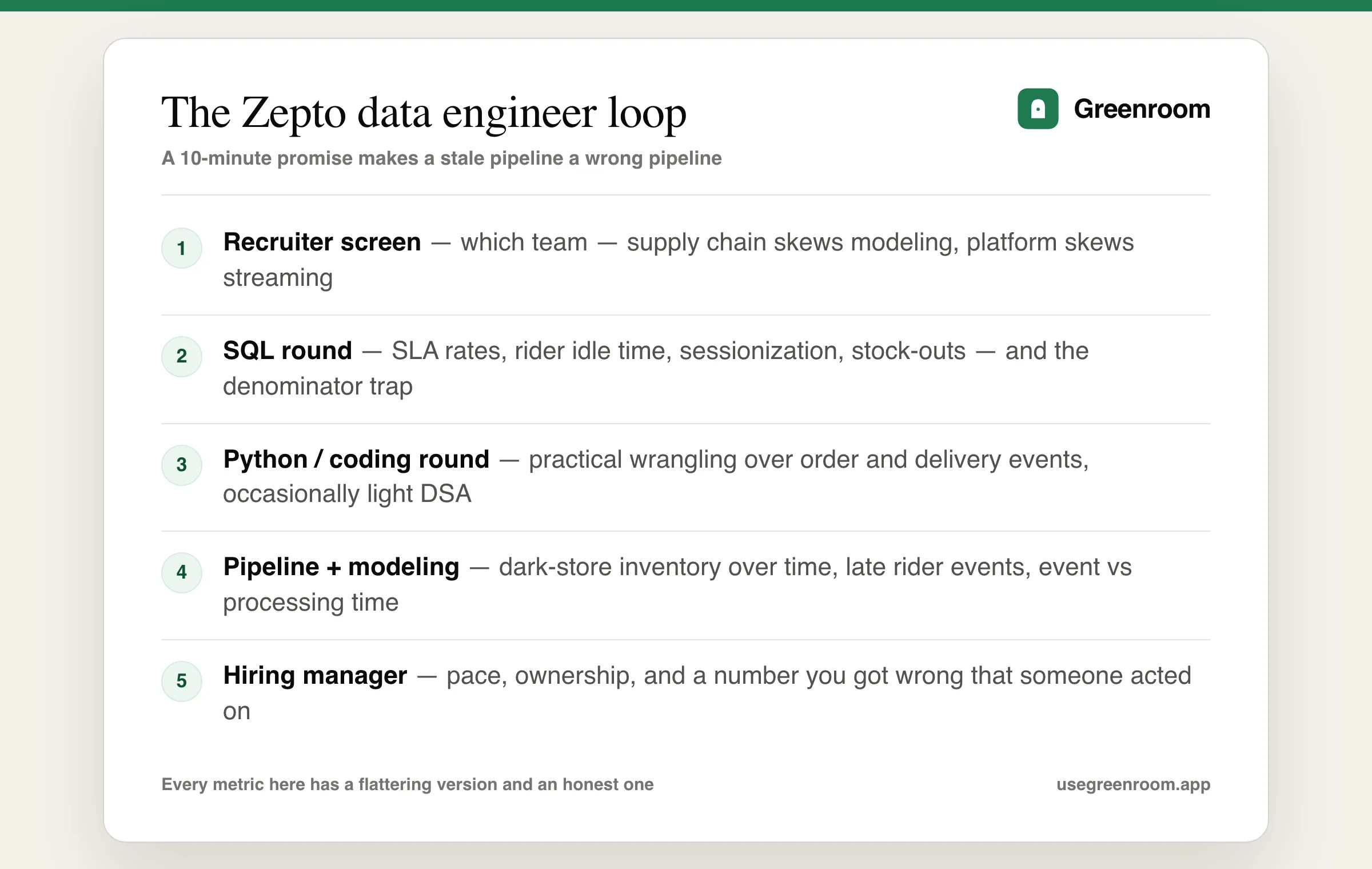
The Zepto data engineer loop: five rounds, with time-bounded operational metrics running through all of them.
## Zepto SQL interview questions
The Zepto SQL interview questions are framed on quick-commerce data: orders, dark stores, SKUs, riders, delivery events. The delivery-SLA question from the intro is close to universal:
```
-- On-time rate by store, counting cancellations honestly
SELECT s.store_id,
COUNT(*) AS orders_placed,
COUNT(*) FILTER (WHERE o.status = 'delivered'
AND o.delivered_at - o.placed_at <= INTERVAL '10 minutes') AS on_time,
COUNT(*) FILTER (WHERE o.status = 'cancelled') AS cancelled,
ROUND(100.0 * COUNT(*) FILTER (WHERE o.status = 'delivered'
AND o.delivered_at - o.placed_at <= INTERVAL '10 minutes')
/ NULLIF(COUNT(*), 0), 2) AS on_time_pct_of_placed
FROM orders o
JOIN stores s ON s.store_id = o.store_id
WHERE o.placed_at >= DATE_TRUNC('day', NOW() - INTERVAL '7 days')
GROUP BY s.store_id
ORDER BY on_time_pct_of_placed;
```
The point is the denominator, and saying so before writing is the strongest opening: on-time as a share of delivered orders flatters you, because a store that cancels everything it cannot deliver scores 100%. On-time as a share of placed orders is the honest metric. Volunteering that distinction is exactly what the round is testing.
Other reliable shapes: rider utilisation and idle time (gaps-and-islands over shift events), sessionization of app browsing before an order, cohort retention by first-order week, basket analysis for items frequently bought together, and stock-out detection — periods where a SKU showed zero available inventory at a store. Our SQL interview questions guide covers the window-function family.
## Modeling inventory: the question that separates candidates
The signature Zepto modeling question is some version of: how would you model inventory for a dark store so we can answer "what was in stock at 7pm last Tuesday?"
A current-state table cannot answer it — it has been overwritten. The expected answer involves keeping the events, not just the state:
- An append-only stock movement fact — one row per event (received, picked, sold, damaged, adjusted, returned), with store, SKU, quantity delta and timestamp. This is the source of truth.
- A current-stock projection derived from it, for the app's read path, kept fresh by streaming.
- A periodic snapshot fact — stock level per store per SKU per hour — because reconstructing 7pm last Tuesday by replaying millions of movements is too slow for analytics.
- Grain stated explicitly for each of the three. Interviewers ask.
Then the reality follow-up: physical stock and system stock disagree, constantly. Items get damaged, mis-picked, or stolen. So the model needs a cycle-count/audit event type and a variance metric, and the honest answer says that inventory data is an estimate that decays until the next count. Candidates who treat system stock as ground truth get pushed hard on it. The data modeling interview questions guide covers snapshot facts and grain in depth.
## Real-time pipelines and late events
Quick commerce is a streaming problem, so expect design questions on freshness. Reported prompts: build a real-time availability feed so the app never shows an out-of-stock item; build a live dashboard of orders per minute per store; detect a store that is falling behind its SLA within minutes, not hours.
The concepts to have ready:
- Event time vs processing time. A rider's phone loses signal in a basement and the delivery event arrives eight minutes late. Windowing on processing time silently misattributes it to the wrong minute.
- Watermarks and allowed lateness. How long you wait before closing a window, and what you do with what arrives afterwards — drop, or emit a correction.
- Idempotent, restatable writes. At-least-once delivery means duplicates; a MERGE on event ID rather than an append.
- The lambda-ish reality. A fast streaming path for the app and operations, plus a batch path that recomputes the day correctly overnight. Say why both exist rather than pretending streaming alone is enough.
- What breaks under a spike. Rain, a cricket final, a flash sale. Backpressure, partition skew on a hot store, and consumer lag.
Our Kafka interview questions guide covers the streaming layer and the PySpark interview questions guide covers the processing engine and the skew questions that come with a hot store key.
## The hiring manager round: pace and wrong numbers
Zepto's culture round is candid about speed, and you should be candid back. Expect: a time you shipped something fast and it broke; how you decide what to cut when the deadline will not move; a number you got wrong that someone made a decision on.
For the last one, the structure that works is specific and unglamorous: what the number was, how you found out, what you did in the first hour, and the check you added so it could not recur silently. "A timezone bug put 40 minutes of orders in the wrong day, ops caught it before I did, I backfilled six days and added a freshness-plus-row-count alert" is a hire signal. Our tell me about a time you failed guide has the structure.
## StrataScratch, DDIA, ChatGPT — where each fits
- StrataScratch and DataLemur — the best written practice for the SQL round, especially window functions and funnel logic. Their limit: they mark a query right or wrong, and this round is decided by the spoken argument about the denominator.
- Designing Data-Intensive Applications — the chapters on stream processing, event time and delivery guarantees are the theory under every pipeline answer above.
- The Data Warehouse Toolkit — the periodic snapshot fact pattern that answers the inventory question is straight out of Kimball.
- LeetCode — light duty. Keep a small habit for the occasional online assessment; the loop is not an algorithms contest.
- Any quick-commerce product itself — genuinely useful. Order something, watch the status transitions, and notice how many distinct events the app exposes. That is your data model.
- ChatGPT — fine for generating modeling prompts and critiquing a written design. It will not ask where the nine-minute cancellation went.
- Greenroom — the spoken layer. Ari, the AI interviewer, runs the round out loud and pushes the definition follow-up when your metric skips its own denominator. Fair tradeoff: Ari will not teach you Flink internals.
> The core truth: Zepto hires data engineers who argue about definitions before they argue about tools. Every metric in quick commerce has a flattering version and an honest one, and the interview is largely about which one you reach for unprompted.
## How to prepare for the Zepto data engineer interview
- Week 1: SQL on operational shapes — SLA rates, sessionization, gaps-and-islands, cohorts, stock-outs. Write each, then re-explain aloud in ninety seconds, always stating the denominator first.
- Week 2: practical Python on event data — flatten, dedupe, collapse to latest state — each ending with "and here's where this breaks at scale."
- Week 3: modeling and streaming. Design the inventory model aloud, then the real-time availability feed, then say what happens when it rains.
- Final week: five behavioral stories in first person including one wrong number, and two full spoken mocks with definition pushback.
Interviewing across Indian consumer tech? The general Zepto interview questions guide covers the company-wide loop, the Swiggy data engineer guide covers the closest comparable loop, and the PhonePe backend engineer guide and Meesho frontend engineer guide cover other Indian consumer-tech interviews.
## Frequently asked questions
### What is the Zepto data engineer interview process?
Candidates report a recruiter screen, a SQL round covering operational metrics over orders, riders and inventory, a Python or coding round focused on practical data wrangling, a pipeline and data modeling round covering real-time inventory and late events, and a hiring manager round on pace, ownership and a number you got wrong. Some loops add a short online assessment.
### What SQL questions does Zepto ask data engineers?
Reported questions cover on-time delivery rate against a ten-minute SLA, rider utilisation and idle time using gaps-and-islands logic, sessionization of browsing before an order, cohort retention by first-order week, basket analysis for items bought together, and stock-out detection where a SKU showed zero inventory at a store. Follow-ups probe your denominators, particularly how cancellations are counted.
### How do you model dark-store inventory in a data engineering interview?
Keep the events rather than only the current state. Use an append-only stock movement fact with one row per event such as received, picked, sold, damaged or adjusted, a current-stock projection derived from it for the app read path, and an hourly periodic snapshot fact so historical questions can be answered without replaying millions of movements. Also include cycle-count events, because physical and system stock constantly disagree.
### What real-time or streaming questions does Zepto ask?
Reported prompts include building a real-time availability feed so the app never shows an out-of-stock item, a live orders-per-minute dashboard by store, and detecting a store falling behind its SLA within minutes. Strong answers distinguish event time from processing time, explain watermarks and allowed lateness for delayed rider events, use idempotent restatable writes, and describe what breaks during a demand spike.
### Does Zepto ask DSA questions to data engineers?
Only lightly. Some loops include a short online assessment with basic data structures and algorithms problems, but the interview rounds themselves focus on SQL, practical Python data wrangling, pipeline design and data modeling. Preparing operational SQL and streaming concepts is a far better use of time than grinding algorithm problems for this particular role.
### Is the Zepto data engineer interview hard?
The technical bar is standard for a well-funded consumer-tech company — analyst-level SQL, practical Python, and mainstream streaming concepts. The difficulty is that every metric question has a hidden definitional trap, particularly around cancellations, late events and stock accuracy, and the hiring manager round probes genuine appetite for working at pace. Candidates who only prepare syntax find the follow-ups harder than the queries.
Zepto's rounds are decided by the definition you state before the query. Greenroom runs mock data engineering interviews out loud with Ari — metric and denominator pushback included — and scores structure, clarity and depth. Free to start. Curious how it works? See how AI mock interviews work.