The brief arrived on a Thursday: redesign their onboarding flow, produce annotated screens, and include a short strategy note. No time limit given, no payment mentioned, and a line at the end saying the team was "excited to see what you come up with". She spent eleven hours on it across a weekend. She did not get the job. Four months later a version of her flow, recognisably hers, was live on their product.
Work trials and job simulations are spreading, and for a defensible reason: as AI-assisted applications made resumes cheap to produce, employers moved assessment towards things that are expensive to fake. Reporting in 2026 puts the share of employers using some form of skills assessment above 80%, and describes extended assessments in some industries growing into multi-day trials where candidates build real artefacts or shadow a team for a shift.
Most of this is legitimate and some of it is genuinely better than a whiteboard. A minority of it is unpaid labour with an interview attached. Here is how to tell the difference, and how to do well at the legitimate version.
What these formats actually are
- A job simulation or work sample. A scoped, realistic task — debug this repository, review this pull request, respond to this support ticket, analyse this dataset. Usually one to four hours, usually with fabricated data. This is the good version and it correlates with job performance better than most interview formats.
- A take-home assignment. The familiar version, done alone on your own time. Our take-home assignment interview tips guide covers it in depth.
- A live pair session. You work with an engineer on a real-ish problem for an hour or two. Increasingly common and, honestly, one of the fairest formats there is.
- A paid work trial. A day to a week, on real work, paid, usually at the end of a process. Common at startups and reasonable when genuinely paid.
- An unpaid multi-day trial on real deliverables. The problem case.
How to do well in a simulation
The single most important thing: these formats grade your process, not just your output. Almost every well-designed simulation is deliberately larger than the time allows, or deliberately ambiguous, precisely to see what you prioritise.
- Ask clarifying questions before starting, in writing, even for an async task. Candidates who send two sharp questions are consistently rated higher than candidates who guess silently.
- State your assumptions in the submission. "I assumed the dataset is complete and that latency matters more than cost; if that is wrong, the second design is better." This converts a wrong guess into demonstrated judgment.
- Time-box hard and say so. "I spent three hours as suggested. With more time I would have added X and Y." That sentence protects you against being compared to someone who spent fifteen hours.
- Prioritise visibly. Do the important parts and explicitly list what you deliberately skipped. Scope judgment is often the actual thing being tested.
- Include a short README. What you built, how to run it, what you would do next. For technical roles this is frequently the highest-scoring artefact in the whole submission.
- Do not gold-plate. A polished half-solution with clear reasoning beats a sprawling complete one with none.
- Prepare to walk through it live. Most simulations are followed by a review conversation, and that conversation carries more weight than the artefact. This is the part candidates under-prepare — our machine coding round guide covers the same dynamic for build-it rounds.
When it stops being an interview
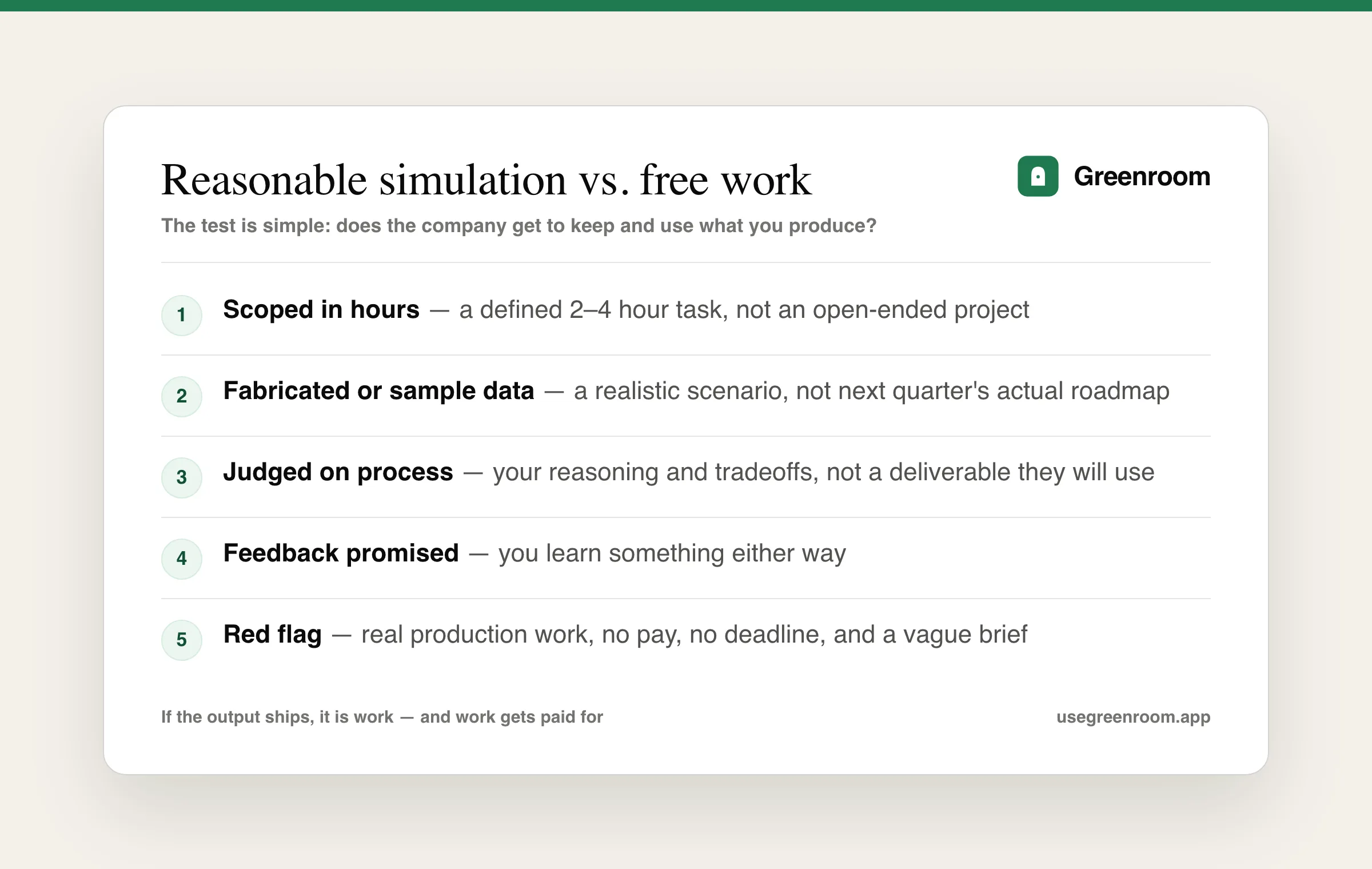
The line is not the format or even the length. It is this: does the company get to keep and use what you produce?
Signals that it has crossed over:
- The task is real production work rather than a scenario — an actual client, an actual open ticket, an actual campaign going out.
- There is no time limit, and the brief is open-ended enough to absorb unlimited effort.
- It is unpaid and lasts more than about four hours.
- You are asked to work with real internal data, systems or customers.
- The deliverable is something they could ship as-is.
- It arrives very early in the process, before anyone has invested time in you.
- They will not answer a direct question about what happens to the output.
On the legal position: it varies by jurisdiction and is worth knowing rather than guessing. In the United States, the Fair Labor Standards Act broadly requires that anyone performing real work that benefits an employer be paid at least minimum wage, including during a trial. India's framework is less prescriptive about pre-employment trials, which in practice means the norm is set by what candidates accept — so declining unreasonable requests is genuinely how the norm moves.
How to ask about payment without sounding difficult
This is the part people avoid, and the phrasing is easier than it feels.
For a long task: *"Happy to do this. Given the scope, is this a paid exercise, or should I time-box it to a few hours and show my approach rather than a complete build?"*
That single sentence is doing three things — agreeing enthusiastically, flagging the scope, and offering an alternative. It is very hard to take badly, and the answer tells you a lot. A company that responds with either payment or a smaller scope is a good sign. A company that responds badly to a polite scoping question has told you something useful about what working there is like.
For a multi-day trial: *"For a trial of that length, is it a paid engagement? I want to make sure I can commit properly to it."*
If they say no and will not scope it down, you can decline: *"I'd love to keep going, but I'm not able to commit several unpaid days. I'm happy to do a shorter exercise, or to walk through comparable work I've already done."* Offering existing work is often accepted and costs you nothing.
Why this is happening, and what it means for your prep
The honest case for these formats is strong. Traditional interviews measure interview performance; a well-designed work sample measures something closer to the job, and the research on work samples as a predictor is genuinely favourable. As AI made polished applications and rehearsed answers cheaper, employers were always going to move towards things that are harder to fake — which is the same shift behind the rise of deeper live follow-ups, covered in our proxy interviews and the deepfake crackdown guide, and behind resumes losing signal, covered in will recruiters know you used AI on your resume.
Practically, three things follow for how you prepare:
- Build one thing you can show. A deployed project with a README does double duty — it strengthens your application and it is the artefact you offer when you decline an unreasonable trial.
- Practise explaining work you have already done. The review conversation after a simulation is worth more than the submission, and it is a spoken skill. Our how to explain your project in an interview guide covers it.
- Practise scoping out loud. "Here is what I would do in three hours and here is what I would leave" is the sentence these formats reward, and it is rehearsable — which is what Ari, the AI interviewer is for.
Where each option actually helps
- The recruiter — ask directly what the exercise involves, how long it should take, and whether it is paid. All three are normal questions.
- Your existing portfolio — the single best defence against an unreasonable trial, because it lets you offer a genuine alternative.
- Glassdoor and AmbitionBox reviews — candidates frequently describe a company's assessment process, including whether it is unreasonable.
- ChatGPT — fine for scaffolding a submission, with the same caveat as everywhere else: you will be asked to walk through it, so understand every line.
- Greenroom — the spoken layer, for the review conversation that follows the exercise, which is where these processes are actually decided. Honest tradeoff: it cannot do the exercise for you, and should not.
Our red flags in a job interview guide covers the wider set of signals worth weighing before you invest a weekend in anyone's hiring process.
Frequently asked questions
What is a work trial or job simulation in hiring?
A job simulation is a scoped, realistic task — debugging a repository, reviewing a pull request, analysing a dataset — usually one to four hours and usually with fabricated data, designed to measure something closer to the actual job than a traditional interview does. A work trial is longer, typically a day to a week on real work, and should be paid. Both have spread as AI-assisted applications made resumes cheaper to produce and less useful as a filter.
How do you do well in a job simulation?
Treat it as a test of process rather than output, because most are deliberately larger or more ambiguous than the time allows. Ask clarifying questions in writing before starting, state your assumptions explicitly in the submission, time-box hard and say what you would have added with more time, prioritise visibly and list what you deliberately skipped, and include a short README covering what you built and what comes next. Then prepare to walk through it live, because that review conversation usually carries more weight than the artefact.
Should work trials be paid?
A scoped exercise of a few hours on fabricated data is reasonably treated as part of the interview. A multi-day trial producing real work the company keeps and uses should be paid. In the United States the Fair Labor Standards Act broadly requires that anyone performing real work benefiting an employer be paid at least minimum wage, including during a trial. India's framework is less prescriptive about pre-employment trials, which in practice means the norm is set by what candidates are willing to accept.
How do you ask whether a work trial is paid without sounding difficult?
Agree enthusiastically, flag the scope, and offer an alternative in one sentence — for example, saying you are happy to do it and asking whether it is a paid exercise or whether you should time-box it to a few hours and show your approach rather than a complete build. That is very hard to take badly, and the response is informative: a company that offers payment or reduces scope is a good sign, and one that reacts badly to a polite scoping question has told you something useful.
When does a work trial become free labour?
The test is whether the company keeps and uses what you produce. Warning signs are a task that is real production work rather than a scenario, no stated time limit with an open-ended brief, more than about four hours unpaid, access to real internal data or customers, a deliverable they could ship as-is, the request arriving very early before anyone has invested in you, and unwillingness to answer directly what happens to the output.
Why are companies using work trials instead of interviews?
Because the signals they previously relied on became cheap. With AI-assisted applications flooding pipelines and rehearsed answers widely available, employers moved assessment towards formats that are expensive to fake, and well-designed work samples predict job performance better than most traditional interview formats. The same pressure explains the shift towards deeper live follow-ups and the declining weight placed on resumes.