The bullet said "architected a distributed caching layer, reducing p99 latency by 43%". The interviewer asked which caching strategy, and he said cache-aside, correctly. She asked what happened on a cache miss during peak, and he paused. She asked where the 43% came from — which dashboard, measured over what window — and the honest answer was that he had no idea, because a language model had written the sentence and he had approved it in about four seconds.
The question people actually search is "will recruiters know you used AI on your resume?" and the answer is more interesting than yes or no. Most of them are not checking. According to research circulating in 2026, only a small minority of hiring teams — around 14% in one survey — run dedicated AI-detection software on applications. The overwhelming majority detect it a different way: by asking you about it.
Why this became a problem in 2026
The volume numbers explain the whole situation. Greenhouse's March 2026 benchmark reported roughly a 157.7% increase in applications per hire since 2022. Ashby's 2026 analysis of more than 109 million applications described applications per hire roughly tripling between 2021 and 2024 and staying above 300 per hire through 2025. Vendor research puts the share of applications containing AI-generated content very high — one figure quoted widely is around 78% — though that particular number comes from a detection vendor and should be treated with suspicion.
The direction, though, is not really disputed: it became trivially easy to produce a polished, keyword-matched application, so everybody did, so the resume stopped being a filter. When a signal gets cheap, employers stop trusting it and move the assessment somewhere the cost is still real. That somewhere is the interview.
What employers actually do instead of detection
- Interview probing. The most common method by a distance. They pick a line and ask three questions about it.
- Practical tasks and work samples. Assessments and increasingly work trials, because a work sample is expensive to fake.
- Depth questions on your own claims. Not gotchas — just one level below what the bullet says.
- Live follow-ups. Structured or unstructured, the second and third question is where an unlived claim comes apart.
- Background verification for dates, designation and salary, which is a separate check with separate consequences. Our background verification in India guide covers it.
Note what is missing: almost nobody is running your PDF through a classifier and rejecting you for a detection score. Those tools are unreliable and employers know it.
So is it fine to use AI on your resume?
Yes — with a boundary that actually matters, and it is not the one people expect.
Using AI to write is fine. Rephrasing a bullet, tightening a summary, fixing structure, adapting a resume to a job description. It is a writing tool and treating it as forbidden is unrealistic in 2026.
Using AI to invent is not. A claim you did not do, a number you did not measure, a technology you have not touched. That is not an AI problem — it is the same lie it always was, now easier to produce and, crucially, easier to produce *convincingly*, which is exactly why the interview probe has become the standard response.
The failure mode in between is the interesting one, and it catches honest people: AI-inflated truth. You did the work, but the model wrote "architected" where you contributed, "43%" where you remember "quite a bit", "led" where you participated. Each individual upgrade felt harmless. Together they produce a resume describing a slightly more senior engineer than you, and that engineer is the one being interviewed.
The three-question test
Run this on every line before the resume goes anywhere.
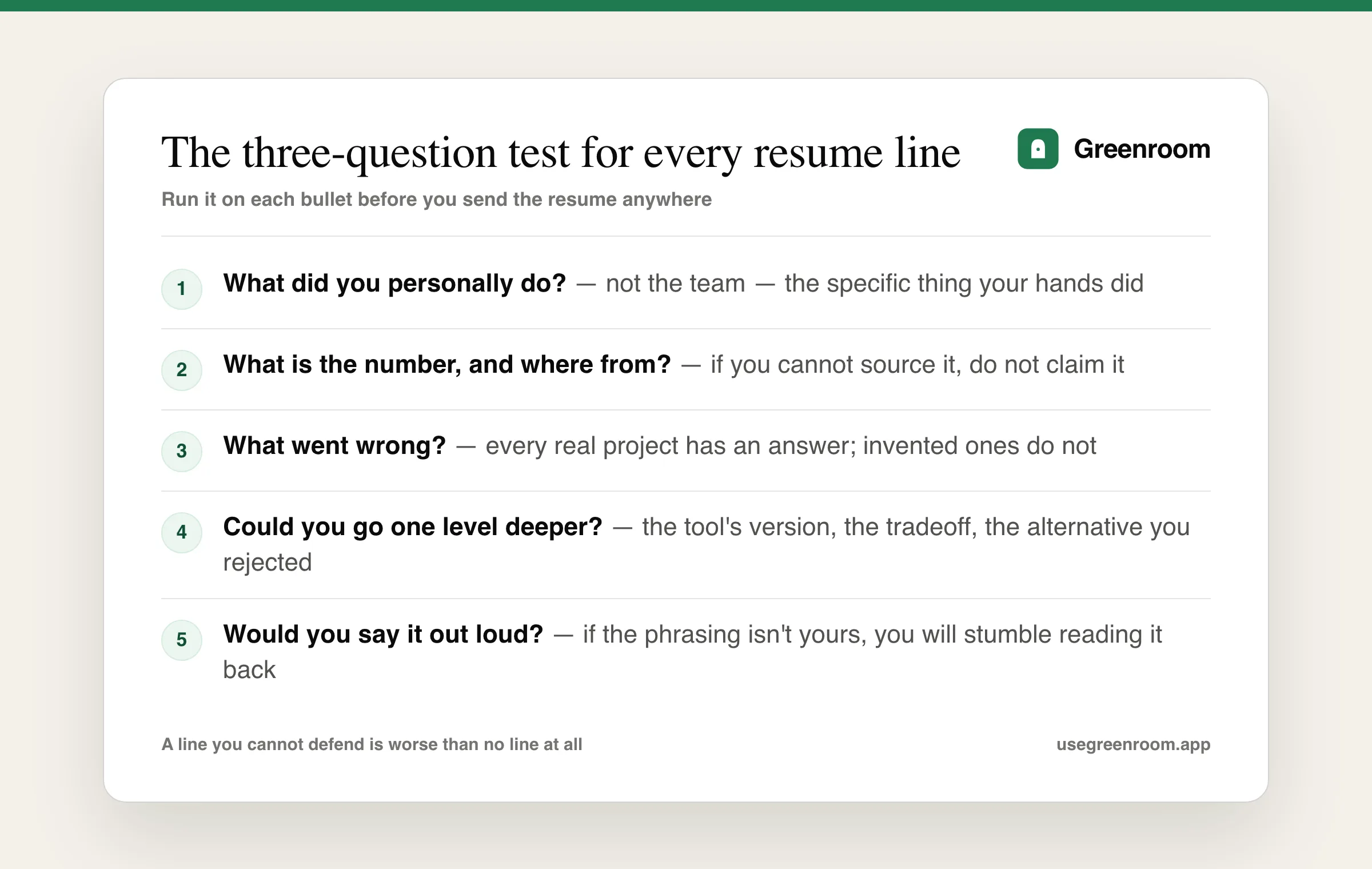
One: what did you personally do? Not the team. The specific thing your hands did. If the honest version is "I was on the team that did this", the bullet needs rewording — "contributed the X component of" is both true and still good.
Two: what is the number, and where did it come from? Which dashboard, measured over what window, before and after what change. If you cannot source it, delete it. An unsourced number is a trap you built for yourself, because "where did that figure come from?" is a completely standard question.
Three: what went wrong? Every real project has an answer. If a bullet has no failure attached to it in your memory, that is a signal you did not live it as deeply as the wording suggests.
Then two supporting checks. Could you go one level deeper — the library version, the tradeoff you accepted, the alternative you rejected and why? And would you say it out loud in those words? If the phrasing is not yours, you will hesitate reading it back, and interviewers notice hesitation about your own resume more than almost anything else.
How to use AI on your resume well
- Write the raw truth first, badly. Dump what you actually did in plain language with real numbers, then use the model to tighten it. Starting from a generated draft is what produces claims you never made.
- Give it your material, not the job description. Prompting with the job description produces a resume optimised to look like the job rather than like you, which is exactly what fails in round one.
- Ban the inflating verbs unless they are literally accurate. Architected, spearheaded, led, owned, drove. Each one is a claim about your scope that an interviewer will test.
- Keep every number sourced. Write the source in a private note next to each one so you can answer instantly.
- Read the final version aloud. Anything that makes you wince or hesitate is a line that will do the same in the interview.
- Keep your voice. A resume that reads exactly like everyone else's is a real cost when a recruiter is scanning three hundred of them. Slightly specific and slightly human beats polished and generic.
Our ATS resume tips for software engineers guide covers the formatting layer, and our resume for freshers with no experience guide covers building the content from a thinner base.
Preparing to defend it
This is the part almost nobody does, and it is now the highest-leverage hour in a job search.
- Print your resume and mark every claim — verbs, numbers, technologies. Typically twenty to thirty defensible claims.
- For each, prepare thirty seconds: what you did, why, and one thing you would do differently.
- Pick the three you are weakest on and either strengthen your recall or remove the line. Removing a line you cannot defend is a genuine improvement, not a loss.
- Rehearse the deepest project out loud, with a failure in it. Our how to explain your project in an interview guide covers the structure and our how to talk about GitHub projects guide covers the code version.
- Have someone push twice on each claim, because one follow-up is survivable by anyone; the second is where invented material fails.
That last point is the whole reason Ari, the AI interviewer exists in the shape it does — a spoken round where the next question is generated from what you just said about your own work. To be straightforward about our position: we think AI is a perfectly good writing assistant and a poor substitute for having done the thing, and the gap between those two is precisely what the interview now measures.
Where each option actually helps
- Your own notes, commits and dashboards — the source of the numbers. Ten minutes of digging beats any rewrite.
- ChatGPT or Claude — genuinely good at tightening prose you wrote. The risk is starting from a generated draft, which produces claims you then have to live up to.
- A friend reading your resume back to you — surprisingly effective at finding lines that do not sound like you.
- AI-detection tools — do not bother. Employers largely are not using them and the outputs are unreliable in both directions.
- Greenroom — the spoken layer. Ari asks about the things on your resume and then asks again, which is the exact failure mode described above. Honest tradeoff: it cannot make a claim true; it can only tell you which ones you cannot yet defend.
Frequently asked questions
Can recruiters tell if you used AI to write your resume?
Most are not trying to detect it technically — research circulating in 2026 suggests only around 14% of hiring teams use dedicated AI-detection software, and those tools are unreliable in both directions. Instead, employers detect it in the interview by picking a line from your resume and asking two or three questions about it, using practical tasks and work samples, and checking whether you can defend your own claims one level deeper than the bullet states.
Is it OK to use AI to write your resume?
Using AI to write is fine — rephrasing bullets, tightening a summary, fixing structure, adapting to a role. Using AI to invent is not, and that is the same problem it always was, just easier to produce convincingly. The failure mode that catches honest people is in between: AI-inflated truth, where the model writes architected instead of contributed, or a specific percentage where you only remember that things improved, producing a resume describing a slightly more senior engineer than you.
How do you know if a resume claim is defensible?
Run three questions on every line. What did you personally do, as distinct from what the team did. What is the number and where exactly did it come from, meaning which dashboard and measured over what window — if you cannot source it, delete it. And what went wrong, because every real project has an answer and a bullet with no failure attached is usually one you did not live as deeply as the wording implies.
Why has the resume stopped being a filter?
Because volume exploded once polished applications became cheap to produce. Greenhouse's March 2026 benchmark reported roughly a 157.7% increase in applications per hire since 2022, and Ashby's analysis of over 109 million applications described applications per hire roughly tripling between 2021 and 2024. When a signal becomes cheap, employers stop trusting it and move assessment to where faking is still expensive — which is the interview, work samples and depth questions.
What words should you avoid on an AI-assisted resume?
Avoid scope-inflating verbs unless they are literally accurate — architected, spearheaded, led, owned, drove — because each is a claim about your seniority that an interviewer will test with a follow-up. Also avoid any number you cannot immediately source. A useful final check is reading the resume aloud: anything that makes you hesitate or wince is a line that will produce the same hesitation in the room, and interviewers notice hesitation about your own resume more than almost anything.
How do you prepare to defend your resume in an interview?
Print it and mark every claim — verbs, numbers and technologies — which usually yields twenty to thirty defensible statements. Prepare thirty seconds on each covering what you did, why, and one thing you would change. Identify the three you are weakest on and either strengthen your recall or remove them, since deleting an indefensible line is an improvement rather than a loss. Then rehearse out loud with someone pushing twice on each claim, because the second follow-up is where unlived material comes apart.