---
title: Tiger Analytics Interview Questions (2026 Guide)
description: Real Tiger Analytics interview questions — SQL, Python, the machine learning round, the business case and HR — with worked answers and a four-week prep plan.
url: https://usegreenroom.app/blog/tiger-analytics-interview-questions
last_updated: 2026-07-30
---
← Back to blog
India · Tiger Analytics
# Tiger Analytics interview questions and process
July 30, 2026 · 11 min read
The SQL was clean. The candidate wrote a beautiful window function, explained the partition, handled the tie. Then the interviewer said: "Great. This dashboard goes to a CPG client's sales director tomorrow morning. She's going to ask why the North region number changed from last week. What do you say?" Silence. Long enough for both of them to hear a fan spin up somewhere.
That is the shape of Tiger Analytics interview questions: a technical round that quietly becomes a client conversation. Tiger is an AI and analytics consultancy delivering to enterprise clients, so every round tests whether you can defend a number to somebody who did not write it. I built Greenroom after freezing in an interview I had prepared properly for — so this guide walks the Tiger loop round by round with what to actually say.
## The Tiger Analytics interview process in 2026
Tiger Analytics hires across data science, data engineering, data analyst, ML engineer and consulting tracks, with large India presence in Chennai, Bengaluru and Hyderabad and a remote-friendly model. The reported Tiger Analytics interview process:
- Recruiter screen — background, notice period, track and level calibration. Worth asking which domain: CPG, retail, insurance and healthcare each colour the case questions.
- Online assessment or take-home — not universal, but common: SQL and Python problems, occasionally a small dataset exercise.
- Technical round 1 — SQL and Python live, with the interviewer talking through the problem with you rather than watching silently.
- Technical round 2 — machine learning or data engineering depending on track, plus a deep dive on your résumé projects.
- Business case / client round — an open problem from a real-ish client context: what would you build, what data do you need, how do you measure it.
- Hiring manager and HR — why consulting, client handling, and a time you had to deliver bad news.
The loop is friendlier in tone than a FAANG onsite and no less rigorous. Interviewers are usually practising consultants, and they ask the questions that actually bite them on projects.
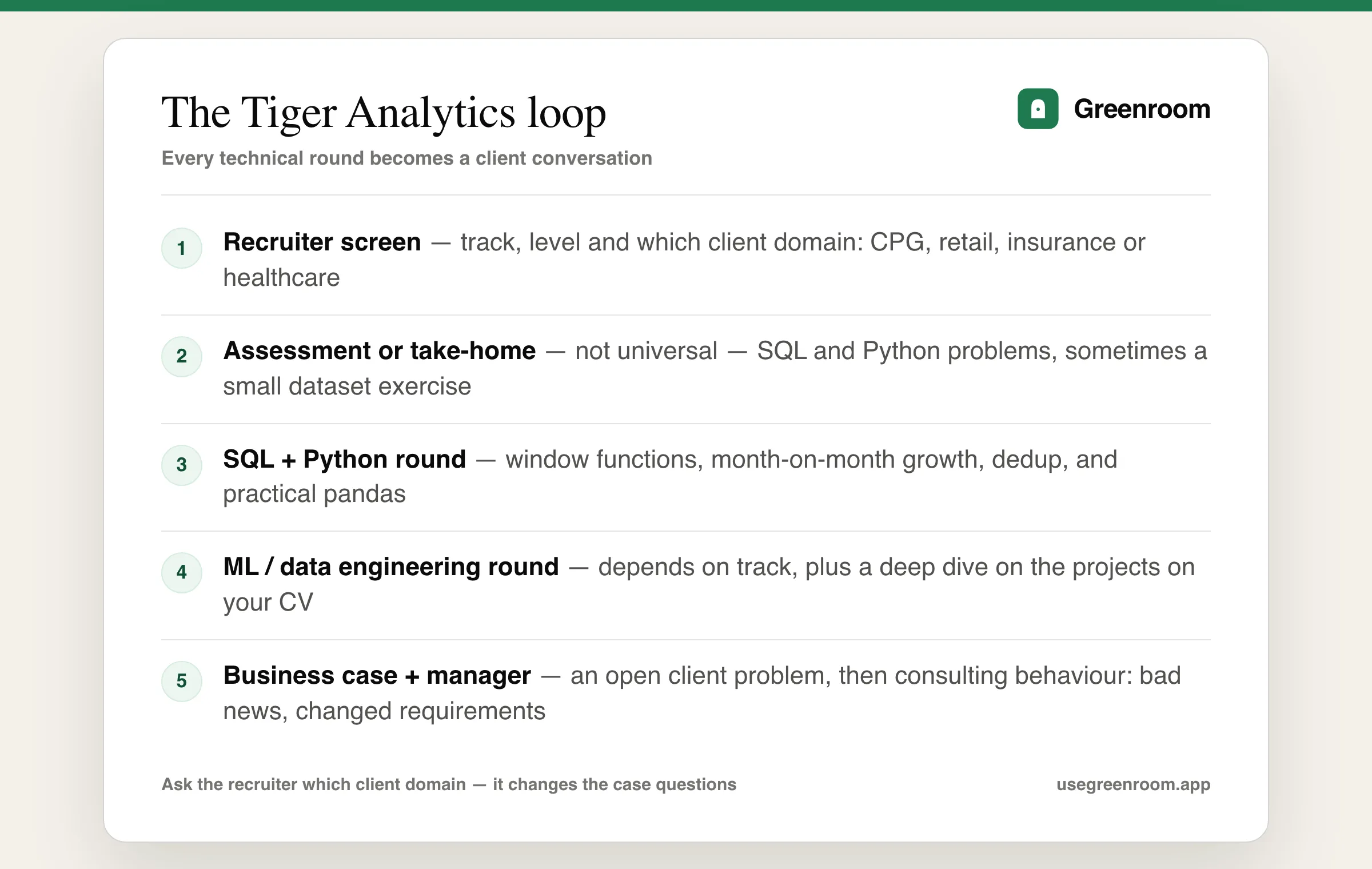
The Tiger Analytics loop: technical depth first, then a business case that decides most offers.
## Tiger Analytics SQL interview questions
SQL is the round everyone gets, regardless of track. The Tiger Analytics SQL interview questions concentrate on window functions, self-joins, and business-shaped aggregations over sales and customer data. A representative one — month-on-month growth by region, which shows up in some form in a majority of reported loops:
```
WITH monthly AS (
SELECT region,
DATE_TRUNC('month', order_date) AS mth,
SUM(net_revenue) AS revenue
FROM orders
WHERE status = 'completed'
GROUP BY region, DATE_TRUNC('month', order_date)
)
SELECT region, mth, revenue,
LAG(revenue) OVER (PARTITION BY region ORDER BY mth) AS prev_revenue,
ROUND(100.0 * (revenue - LAG(revenue) OVER (PARTITION BY region ORDER BY mth))
/ NULLIF(LAG(revenue) OVER (PARTITION BY region ORDER BY mth), 0), 2) AS mom_pct
FROM monthly
ORDER BY region, mth;
```
The follow-ups are the round. What happens to a region with no orders in a month — does it show as a gap or a zero, and which does the client expect? Is status = 'completed' the right filter, or should cancelled-then-reordered be handled? Do returns get netted in the same month or the month of the original order? Volunteering that last one unprompted is the answer to the story at the top of this page: the North number changed because a return posted late. Our SQL interview questions guide covers the window-function family in depth.
Other reliable shapes: nth highest salary, running totals, customers who bought A but not B, deduplication with ROW_NUMBER, and gaps-and-islands for consecutive-day streaks.
## Tiger Analytics Python and data engineering questions
The Tiger Analytics Python interview questions are practical: pandas merges and group-bys, handling missing and duplicate data, reshaping, plus a couple of language fundamentals (mutable default arguments, list vs generator, why a shallow copy bit you once). For data engineering tracks the round shifts to Spark, PySpark transformations, partitioning, orchestration with Airflow, and cloud specifics on AWS, Azure or GCP depending on the client account you are being staffed to.
Two questions come up so often they are worth rehearsing: how you would handle a pandas job that no longer fits in memory (chunking, dtype reduction, pushing the aggregation into SQL, moving to Spark — in that order, and say why you would try the cheap options first), and how you would design an incremental load rather than a full refresh. The data engineer interview questions guide and the Python interview questions guide cover the surrounding material.
## Tiger Analytics machine learning and business case questions
For data science tracks, the ML round pairs textbook fundamentals with a client-shaped case. Frequently reported:
- Explain the bias-variance tradeoff using a model you actually built.
- Your churn model has high accuracy but the retention team says it is useless. What went wrong? (Imbalance, precision-recall, and the cost of a false negative.)
- How do you decide which features to keep, and how do you avoid target leakage?
- Linear regression assumptions — and what you do when they are violated in real client data.
- How do you explain a model to a client who wants a rule they can write on a slide?
- Design a demand forecasting / market mix modelling / customer segmentation solution for a CPG client.
Market mix modelling and pricing/promotion analytics come up more at Tiger than at most firms because of its CPG and retail client base — knowing roughly what MMM is for (attributing sales to marketing spend across channels, with adstock and diminishing returns) is worth an afternoon of reading even if you have never built one.
The business case is graded on the chain, not the model: what decision the client is making, what the target and horizon are, what data exists and what is missing, the naive baseline you would beat first, a metric tied to money rather than a leaderboard, and how you would monitor it after deployment. Our data scientist interview questions guide and ML engineer interview questions guide go deeper, and the how to explain your project guide covers the résumé deep-dive that always follows.
## The consulting round: client handling and bad news
Tiger's hiring managers ask consulting questions, not culture-fit filler. The two that recur: a time you delivered bad news to a stakeholder, and a time a client changed the requirement halfway through.
The strong answer is unglamorous and specific. For bad news: what the finding was, that you took it to them early rather than at the deadline, what you brought alongside it (an option, not just a problem), and what happened. For changed requirements: that you confirmed the change in writing, restated the impact on timeline in plain terms, and did not quietly absorb it into your weekend. Consultancies are checking whether you will protect the project and yourself. Our tell me about a time you failed guide has the structure.
## StrataScratch, Kaggle, ChatGPT — where each fits
- StrataScratch and DataLemur — the closest practice to Tiger's SQL round, especially the window-function and business-metric problems. They mark right or wrong; Tiger's round is decided by the spoken follow-up.
- Kaggle — good for modelling craft, weak preparation for a round about choosing the target and the metric, both of which Kaggle hands you for free.
- GeeksforGeeks and AmbitionBox interview experiences — useful for what gets asked and typical round order. Treat reported salary and process details as approximate and dated.
- Cloud provider documentation — for data engineering tracks, the official AWS, Azure or GCP docs on the specific services in the JD are better preparation than a course, and cheaper.
- ChatGPT — solid for generating case prompts and critiquing a written design. It will not ask why the North region number moved and then wait through your silence.
- Greenroom — the spoken layer. Ari, the AI interviewer, runs SQL, ML and case rounds out loud, pushes the client follow-up your written practice never asks, and scores structure and clarity. Fair tradeoff: Ari will not review your Spark code line by line.
> The core truth: Tiger hires analysts who can defend a number to someone who did not write the query. Every technical round has a client question hiding one follow-up away — rehearse the answer out loud, because reading it does not build the reflex.
## How to prepare for the Tiger Analytics interview
- Week 1: SQL daily on business shapes — window functions, month-on-month growth, cohorts, dedup, gaps-and-islands. Write each, then re-explain it in ninety seconds without looking.
- Week 2: pandas and, if relevant, PySpark. Every exercise ends with the sentence "and here's where this breaks at client scale."
- Week 3: ML fundamentals plus one end-to-end case a day, spoken: decision, target, data, baseline, metric, deployment, monitoring. Read up on market mix modelling if you are interviewing for a CPG account.
- Final week: rewrite your project story, prepare five consulting behavioral answers in first person, and run two full spoken mocks where someone interrupts you with client questions.
Interviewing across the Indian analytics circuit? The ZS Associates interview questions guide, the Fractal Analytics interview questions guide and the Mu Sigma interview questions guide cover the closest alternatives, and the Publicis Sapient interview questions guide covers the engineering-heavy end of the same market.
## Frequently asked questions
### What is the Tiger Analytics interview process?
Candidates report a recruiter screen, sometimes an online assessment or take-home with SQL and Python, a live technical round on SQL and Python, a second technical round covering machine learning or data engineering plus a deep dive on your résumé projects, a business case or client round, and a hiring manager and HR conversation. The number of rounds varies by track and seniority.
### What SQL questions does Tiger Analytics ask?
The most reported SQL questions involve window functions for month-on-month growth and running totals, nth highest salary, customers who bought one product but not another, deduplication with ROW_NUMBER, self-joins for period comparison, and gaps-and-islands problems for consecutive-day streaks. Follow-ups probe business definitions, such as whether returns are netted in the original month or the month they post.
### Is the Tiger Analytics interview difficult?
The technical bar is solid but standard for analytics consulting — window functions, practical pandas, textbook machine learning. The difficulty is that every technical answer is followed by a client-facing question about what the number means and how you would defend it to a stakeholder. Candidates who prepare only in writing find that follow-up much harder than the query itself.
### What machine learning questions does Tiger Analytics ask?
Common ML questions include explaining the bias-variance tradeoff with a model you built, why a high-accuracy churn model can be useless to a retention team, feature selection and avoiding target leakage, linear regression assumptions and what to do when real client data violates them, and designing an end-to-end demand forecasting, market mix modelling or customer segmentation solution for a CPG or retail client.
### Does Tiger Analytics give a take-home assignment?
Some tracks and drives include a take-home or online assessment with SQL and Python problems, and occasionally a small dataset exercise, but it is not universal. If you receive one, treat the write-up as the graded artefact: state your assumptions, show the baseline you compared against, and explain what you would do with more time. A clear short answer beats an unexplained complex one.
### What should I ask a Tiger Analytics recruiter before the interview?
Ask which track and level you are being considered for, which client domain the role is staffed to — CPG, retail, insurance and healthcare shape the case questions differently — whether the technical round leans machine learning or data engineering, and whether there is a take-home. That one call changes what you spend the next two weeks preparing.
Tiger's rounds turn into client conversations one follow-up in. Greenroom runs mock analytics and case interviews out loud with Ari — stakeholder pushback included — and scores structure, clarity and depth. Free to start. Curious how it works? See how AI mock interviews work.