Picture this: you've just explained, beautifully, how you'd design a caching layer. Textbook. Confident. The Tesla interviewer nods, then asks, "cool — have you actually built and shipped this, or read about it?" There's a pause that feels like it lasts a fiscal quarter. This is, unfortunately, the most Tesla question there is, and it has nothing to do with cars.
Tesla's engineering interviews carry a reputation for being unusually blunt about one thing: have you actually built the thing you're describing, with your own hands, under a deadline that didn't move for you. Whether you're interviewing for Autopilot/AI software, vehicle firmware, the Energy/Powerwall side, or manufacturing/Gigafactory systems, the loop tests the same underlying trait — first-principles thinking applied to a real, physical-world constraint, not abstract trivia. This guide covers the Tesla interview questions that actually come up across software, firmware, and systems roles, with real answers and the reasoning behind what each one is actually probing.
The Tesla interview process
Tesla's process is famously fast-moving and varies a fair amount by team, but for engineering roles it typically looks like:
- Recruiter screen (20–30 min) — role scope, location/relocation, motivation, comp expectations.
- Hiring manager screen (30–45 min) — a deeper conversation on your background and why this specific team, often with one or two technical questions woven in.
- Technical interview(s) (45–60 min each, 1–3 rounds) — live coding, systems/firmware design depending on the role, and detailed questions about projects on your resume.
- On-site or virtual loop — for many roles this compresses into a single intense day: coding, a design/architecture round, and a round focused entirely on past projects — "walk me through the hardest bug you've ever fixed."
- Final/team-fit round — sometimes with a director or VP, especially for roles closer to vehicle safety-critical systems.
Tesla's loops move fast — candidates often go from first screen to offer in under two weeks for roles the team urgently needs filled, which also means there's less hand-holding between rounds than at a typical FAANG company. Show up ready for each round to stand alone.
Tesla coding interview questions
Coding rounds lean toward practical, build-something problems over abstract algorithmic puzzles, though classic data structures still show up, especially for new-grad and early-career loops:
- Arrays, strings, hash maps — standard two-pointer/sliding-window problems, but often phrased as a real scenario ("parse this sensor log and find the anomaly") rather than an abstract LeetCode prompt.
- Systems-adjacent coding — implement a basic state machine, a simple scheduler, or a rate limiter — relevant to firmware and embedded roles where Tesla expects you to be comfortable close to hardware.
- Debugging exercises — given a snippet with a subtle bug (a race condition, an off-by-one, a memory issue in C/C++), find and fix it live, narrating your reasoning.
- Object-oriented or systems design at small scale — design a class hierarchy for, say, a vehicle's charging state, with edge cases like "what happens if the charger disconnects mid-session."
A representative one for firmware/embedded-leaning roles: "Implement a simple finite state machine for a vehicle charging port — states: idle, plugged-in, charging, fault — and handle the transition when a fault is detected mid-charge."
typedef enum { IDLE, PLUGGED_IN, CHARGING, FAULT } ChargeState;

ChargeState transition(ChargeState current, ChargeEvent event) {
  switch (current) {
    case IDLE:
      return (event == PLUG_IN) ? PLUGGED_IN : IDLE;
    case PLUGGED_IN:
      if (event == START_CHARGE) return CHARGING;
      if (event == UNPLUG) return IDLE;
      return PLUGGED_IN;
    case CHARGING:
      if (event == FAULT_DETECTED) return FAULT;
      if (event == CHARGE_COMPLETE || event == UNPLUG) return IDLE;
      return CHARGING;
    case FAULT:
      // Fault state only clears on an explicit reset, never an unplug alone —
      // a real safety requirement, not an implementation detail.
      return (event == RESET) ? IDLE : FAULT;
    default:
      return IDLE;
  }
}
The interesting follow-up Tesla interviewers tend to ask here isn't about the code itself — it's "what happens if the fault sensor itself fails, and you never get a FAULT_DETECTED event at all?" That's the real test: do you default to a safe state under sensor failure, or does your state machine just sit there charging indefinitely because nothing told it to stop? Naming a watchdog timer or a heartbeat check as a mitigation is the kind of answer that lands.
Tesla systems/architecture questions
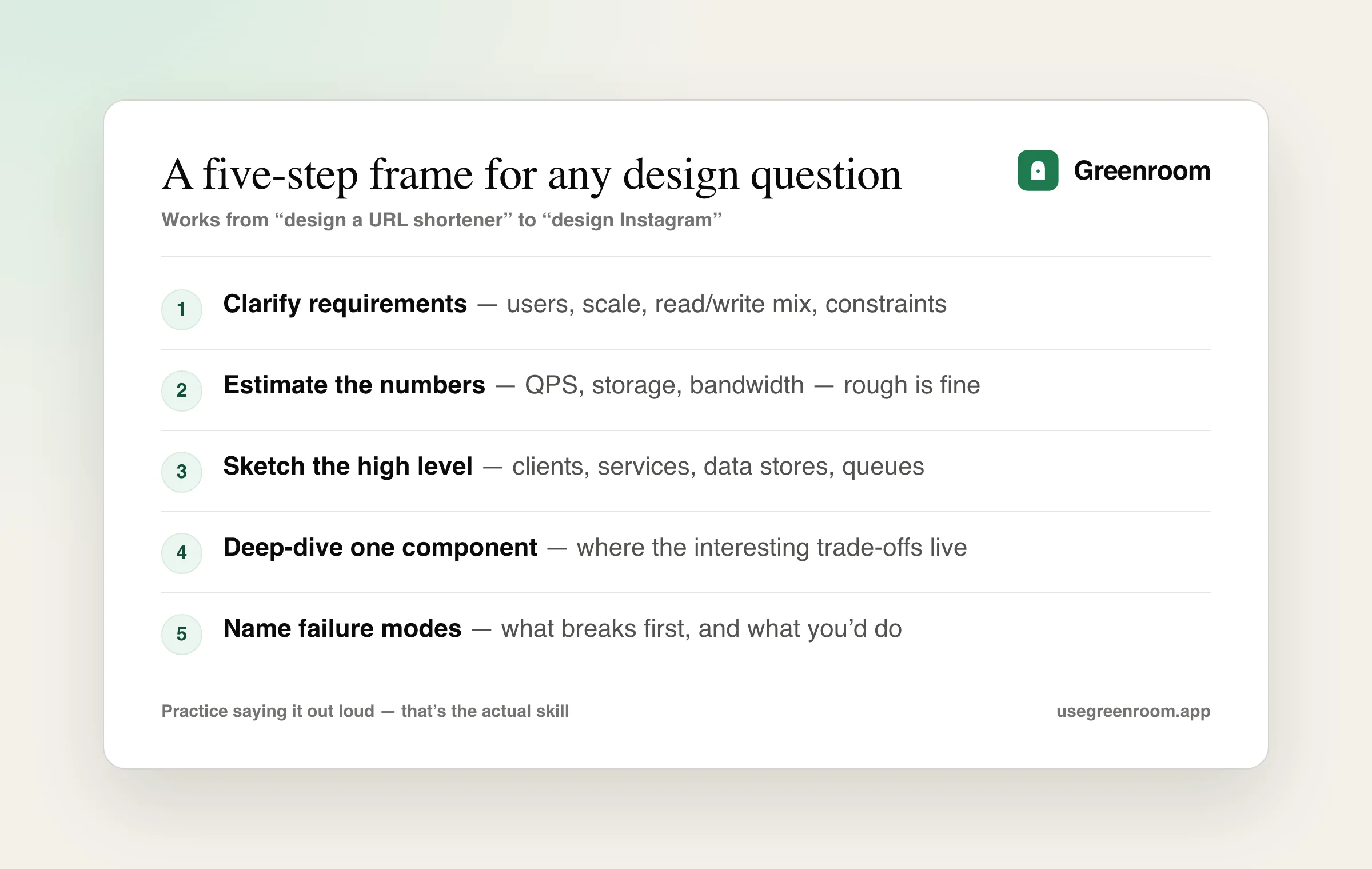
For senior software and firmware roles, expect design questions grounded in real-world physical constraints rather than pure web-scale system design:
- "Design a logging/telemetry system for a fleet of vehicles" — handling intermittent connectivity (a car isn't always online), bandwidth constraints, and prioritizing which data to upload first when bandwidth is scarce.
- "Design an over-the-air (OTA) update system" — safety is the headline constraint: how do you guarantee a failed update never bricks a car, including power loss mid-flash (this is where A/B partitioning and rollback come up).
- "Design a rate-limited command queue for a vehicle's onboard systems" — given limited CPU/bandwidth on an embedded controller, how do you prioritize safety-critical commands over convenience features.
Worked example — "design an OTA update system for a vehicle fleet":
- Constraints first. Cars aren't always connected, have limited bandwidth, and an update going wrong is not "annoying," it's potentially dangerous. Name this up front — it reframes the whole design.
- A/B (dual) partitioning. Write the new firmware to an inactive partition while the active one keeps running; only switch over after the new image verifies (checksum/signature), so a corrupted download never overwrites the only working copy.
- Power-loss safety. If power cuts mid-flash, the bootloader must fall back to the last-known-good partition automatically — explicitly naming this is the single highest-signal moment in this question.
- Staged rollout. Push to a small percentage of the fleet first, watch for crash/fault telemetry, then expand — exactly the kind of caution a hardware company needs that a pure SaaS company might skip.
- Bandwidth/connectivity. Resume interrupted downloads rather than restarting; prioritize critical safety patches over feature updates when bandwidth is scarce.
- Rollback path. A user or a fleet-ops team needs the ability to force a rollback to the previous known-good version if a problem surfaces after the update completes.
The pattern across all of these: Tesla's design rounds reward candidates who treat physical-world failure (power loss, no connectivity, sensor failure) as the default case to design for, not an edge case to mention in passing at the end.
Tesla behavioral interview questions
Tesla's behavioral round is less about textbook STAR polish and more about evidence of speed, ownership, and a track record of solving something hard yourself, often phrased bluntly:
- "Tell me about the hardest technical problem you've personally solved — not your team, you."
- "Describe a time you had to make a call with incomplete information and a deadline that wasn't moving."
- "Tell me about a project that failed, and what you did differently after."
- "Why Tesla, specifically, and not a comparable role somewhere with a calmer pace?"
Answer in STAR, but lean harder than usual on the Action section — Tesla interviewers want concrete detail (what you actually wrote, debugged, or decided), and will follow up if your answer stays abstract. The "why Tesla" question deserves a genuine answer grounded in the mission or the specific technical problem, not a generic "I love EVs" — interviewers hear that one constantly and it doesn't move anyone.
Tesla vs. other prep approaches
A LeetCode grind alone under-prepares you for Tesla's debugging-heavy and systems-design rounds, which lean on practical, hands-on reasoning more than algorithmic cleverness — useful, but only half the picture. A GeeksforGeeks-style question dump or a friend's shared PDF will tell you Tesla "asks about OTA updates" without ever forcing you to defend your A/B-partitioning answer when someone asks "what if the power cuts exactly mid-flash" — and that follow-up is precisely where Tesla loops separate candidates. Reading ChatGPT's answer to "design an OTA system" is a reasonable first pass, but it's still silent, recognition-only practice; the interview itself is a live, verbal, adversarial-ish conversation where the value is in producing the answer under mild pressure, not recognizing a good one on a screen.
Greenroom runs spoken mock interviews that push exactly on this — asking the "what if the sensor fails" or "what if the connection drops mid-update" follow-ups a real Tesla interviewer would ask, and giving feedback on whether your answer held up, not just whether the first sentence sounded right. Pair that with real LeetCode practice for the coding rounds and you've covered both halves of the loop.
How to prepare for a Tesla interview
- Practice debugging exercises, not just fresh-problem coding — Tesla loops frequently hand you broken code and ask you to find the bug live, which rewards methodical narration over speed.
- Build a "failure modes first" habit for any design question: power loss, no connectivity, sensor failure, race condition — name the failure before you're asked, and propose the mitigation in the same breath.
- Prepare a real "hardest problem I solved" story with specific, technical detail you can go three follow-ups deep on — vague answers get probed hard here.
- Have a genuine, specific "why Tesla" tied to the team or mission, not a generic EV-enthusiasm line.
- Practice the systems/architecture round out loud, ideally with realistic follow-ups on failure modes, since that's the actual skill being tested — see our system design guide for the general framework, then layer Tesla's physical-world constraints on top.
Frequently asked questions
What is the Tesla software engineer interview process?
Tesla's process typically includes a recruiter screen, a hiring manager screen, one to three technical interviews covering live coding and systems/firmware design, and an on-site or virtual loop that often compresses into a single intense day. Tesla's loops move quickly, sometimes from first screen to offer in under two weeks, with less hand-holding between rounds than a typical FAANG process.
What coding questions does Tesla ask?
Tesla's coding rounds favor practical, build-something problems over abstract algorithm puzzles: array/string/hash-map problems often phrased as real scenarios, systems-adjacent coding like state machines or schedulers for firmware roles, live debugging exercises with a planted bug, and small-scale object-oriented design with real edge cases.
What system design questions does Tesla ask?
Tesla's design questions are grounded in physical-world constraints rather than pure web-scale design: designing a telemetry system for a fleet with intermittent connectivity, designing an over-the-air (OTA) update system with power-loss safety and rollback, or designing a rate-limited command queue for an embedded controller that must prioritize safety-critical commands.
What behavioral questions does Tesla ask?
Tesla's behavioral round focuses on speed, ownership, and concrete evidence of solving something hard yourself — for example, "tell me about the hardest technical problem you've personally solved" or "describe a time you made a call with incomplete information and a deadline that wasn't moving." Interviewers push for specific, technical detail rather than abstract answers.
How is Tesla's interview different from a typical software company's interview?
Tesla's interviews place heavier weight on hands-on debugging and physical-world failure modes (power loss, connectivity drops, sensor failure) than a typical SaaS or web company, reflecting that Tesla's software runs inside a physical vehicle or factory system where failure has real-world consequences, not just a service outage.
How should I prepare for a Tesla interview?
Practice debugging exercises in addition to fresh coding problems, build a habit of naming failure modes (power loss, connectivity, sensor failure) before being asked, prepare a detailed "hardest problem I solved" story you can go several follow-ups deep on, and have a genuine, specific reason for wanting to join Tesla's particular team or mission rather than a generic answer.