She had been there eleven months when she noticed. The offer letter said *"probation: six months"*, and it was March, and nobody had ever said the word "confirmed" to her. Not in her review, not in an email, not anywhere.
She asked her manager, who said "oh, you're definitely confirmed, you've been doing great." Which was kind, and not an answer, because he did not actually know. HR eventually found that her confirmation had never been processed — a manager had changed teams during month five and the form had simply not been filled in. She had been on probation for eleven months without anyone intending it.
Everything written about probation is performance advice: prove yourself, be proactive, ship something early. That advice is real, and it is a different article, our first 90 days in a new job guide covers it properly.
This is about the part nobody explains. Probation is not a test you pass by working hard. It is an employment status with different rules attached, and it ends because somebody performs an administrative act, not because six months elapsed. Which is exactly why it lapses quietly.
What the status actually changes
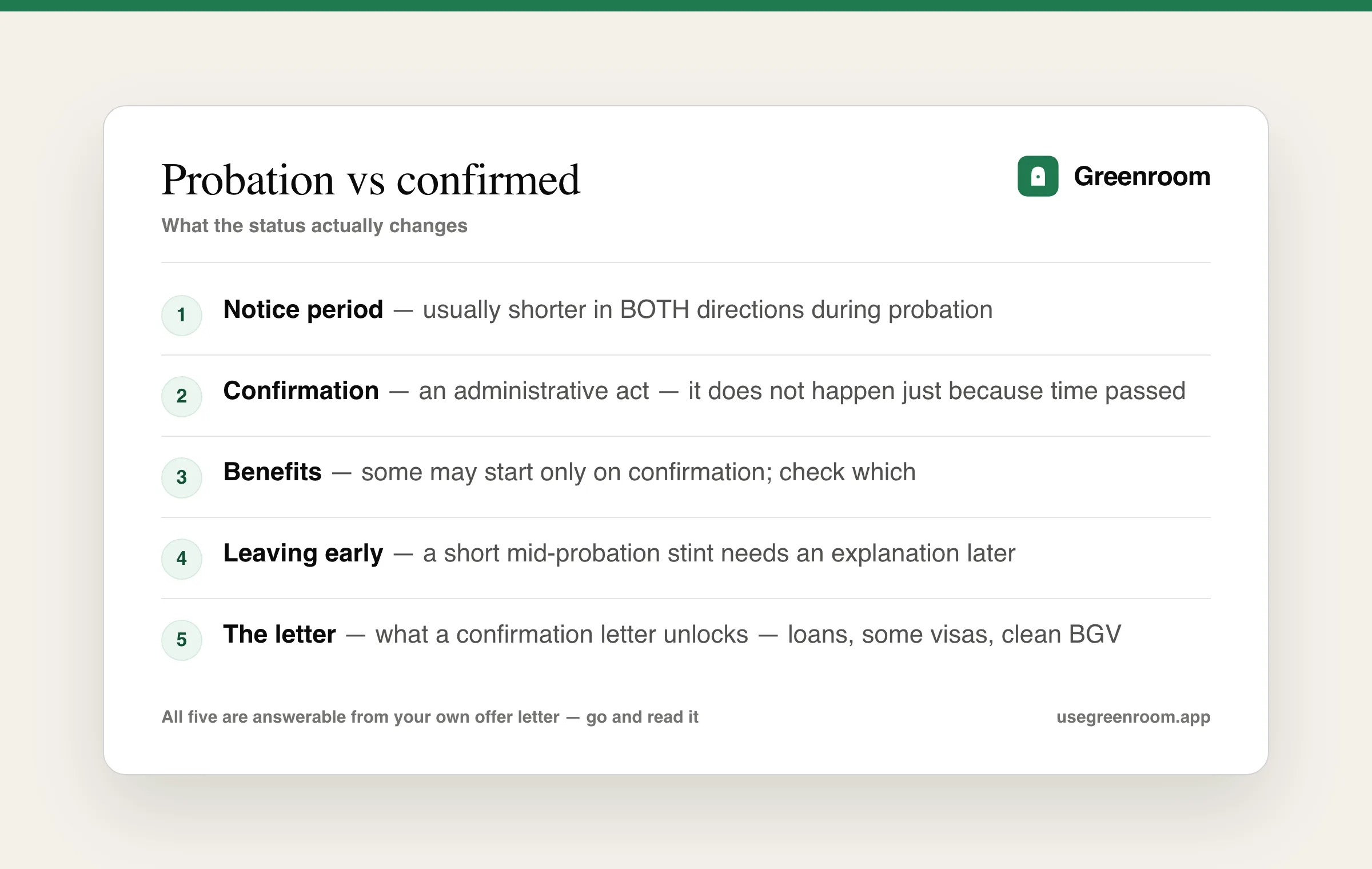
The notice period, usually in both directions. This is the most consequential difference and the one people are most surprised by. Many Indian offer letters set a short notice during probation (15 days, 30 days, sometimes less) rising to 60 or 90 days on confirmation. That cuts both ways: it is easier for you to leave, and easier for the company to end it. Our notice period negotiation guide covers the confirmed-employee version.
Confirmation is an act, not a date. Somewhere there is a form, a letter, or an HR workflow. If nobody runs it, you stay on probation indefinitely, and in most cases nobody is monitoring this on your behalf.
Some benefits may not have started. Depending on the employer, certain allowances, insurance tiers, leave accrual or bonus eligibility begin only on confirmation. Worth knowing which rather than assuming.
Extension is a real outcome, and it is not always a verdict on you — restructures, a manager change or a delayed review cycle produce extensions that have nothing to do with performance. It can also be a genuine signal. The difference is knowable, and you have to ask.
A confirmation letter is a document you will want later. It is commonly requested for loan and credit applications, sometimes for visa processes, and it makes your employment history unambiguous during your next employer's verification, which our background verification in India guide covers.
What to do, and when
On joining. Read the offer letter properly and note four things: the probation length, the notice period during probation, the notice period after confirmation, and any benefit that starts on confirmation. Five minutes, once. Our after accepting an offer, before joining guide covers the rest of that reading.
Two weeks before the probation end date. Email your manager, copying HR, in one plain sentence: *"My probation period ends on [date], could you confirm the process and timeline for confirmation?"* This is a completely normal question. Asking it makes you the person who tracks their own paperwork, not a nuisance.
When it is confirmed. Get the letter. Not a verbal "yes you're confirmed" — the document, saved somewhere you will find it in three years.
If the date passes silently. Follow up once, politely, in writing. Silence is far more often administrative than sinister, and a written trail is what gets it unstuck.
If your probation is extended
Ask three questions, in this order:
- "Is this about my performance, or about process?" Both are common. You need to know which.
- "What specifically would need to change for confirmation?" If it is performance, you want it concrete and measurable. Vague answers are themselves informative.
- "What is the new date?" An extension without an end date is not an extension; it is an open question, and it is fair to ask for a date in writing.
If the answers are specific and reasonable, treat it as a plan and work it. If they are vague across two conversations, that is a signal worth acting on — quietly, while still employed.
Leaving during probation
Sometimes the job is simply wrong, and going early is the right call. Two practical notes:
The short notice cuts your way too. Leaving during probation is usually procedurally easier than leaving after confirmation, and our how to resign professionally guide applies — collect your relieving and experience letters regardless of how short the stint was. A short stint with documents is a manageable story; a short stint with none is a problem at your next employer's verification.
You will be asked about it. A three-month stint is conspicuous on a resume. The workable answer is brief, factual and free of blame: the role turned out to differ materially from what was described, you decided early rather than wasting a year, and here is what you are looking for now. Our how to explain job hopping guide covers the pattern version of this conversation.
If they end it during probation
It happens, and shorter notice applies to the company as well. What is worth doing calmly:
- Ask for the reason in writing, and ask what the exit will be recorded as.
- Ask about notice pay and whatever the policy provides.
- Collect your documents: relieving letter, experience letter, payslips, full and final settlement. This matters more in India than most people expect.
- Do not sign anything you have not read on the day, particularly if a sum is involved. If it is significant, take advice before signing.
Terms vary considerably by contract, employer and state, and none of this is legal advice — your offer letter and HR policy are the documents that govern your situation.
Where the usual advice comes up short
"Just work hard and you'll be confirmed." True and insufficient. Confirmation is administrative; performance does not fill in the form.
"Don't ask, it looks insecure." Backwards. Asking about a process defined in your own offer letter reads as organised. The people who never ask are the ones still unconfirmed at month eleven.
Forum threads on probation rules. Useful for how specific employers behave. No substitute for your own offer letter, which is the only document that binds anyone.
Your manager's reassurance. Well-meant and frequently uninformed, managers often do not know the state of an HR workflow. Take the warmth, and still ask HR for the letter.
Greenroom. The connection is narrow and worth being honest about: probation matters at interview time mainly when you left during one and have to explain a short stint without sounding defensive or bitter. Ari, the AI interviewer, asks why you left and then asks again, which is the answer worth rehearsing. Honest tradeoff: Ari cannot read your offer letter, and the offer letter is where every real answer in this article lives.
The one-line version
Read your offer letter for the probation length and both notice periods, email your manager and HR two weeks before the end date asking about the confirmation process, insist on the letter rather than a verbal yes, and if it is extended ask whether it is performance or process and get a new date in writing — because confirmation is a form somebody has to fill in, and nobody is tracking it for you.
Frequently asked questions
What is a probation period in India?
It is an initial phase of employment, commonly three to six months, during which different terms apply — most importantly a notice period that is usually shorter in both directions, and sometimes benefits or allowances that begin only on confirmation. Exact terms are contractual and vary by employer, state and role, so your offer letter and the company's HR policy are the documents that actually govern your situation rather than any general rule.
Is confirmation after probation automatic?
Usually not. Confirmation is an administrative act (a form, a letter or an HR workflow that somebody has to complete) rather than something that happens because time has elapsed. It is common for confirmations to be delayed or missed entirely when a manager changes teams or a review cycle slips, and in most companies nobody is monitoring it on your behalf. This is why employees sometimes discover they have been on probation well past their stated end date.
What should I do if my probation period ends and nobody says anything?
Follow up in writing, politely and once. A single sentence to your manager copying HR —that your probation ended on a particular date and could they confirm the process and timeline— is a completely normal question, and asking it reads as organised rather than insecure. Silence is far more often an administrative oversight than a signal, and a written trail is usually what gets the paperwork unstuck. When it is processed, ask for the confirmation letter rather than accepting a verbal yes.
What does it mean if my probation is extended?
It can mean either a performance concern or a purely procedural delay such as a restructure, a manager change or a slipped review cycle, and the two are not distinguishable from the outside. Ask directly whether the extension relates to your performance or to process, ask what specifically would need to change for confirmation, and ask for the new end date in writing. Concrete answers give you a plan to work; repeated vagueness across two conversations is itself a signal worth acting on.
Can I resign during my probation period?
Yes, and it is usually procedurally simpler than resigning after confirmation because the notice period during probation is generally shorter. Collect your relieving letter, experience letter, payslips and full and final settlement regardless of how brief the stint was, since those documents carry substantial weight during your next employer's background verification in India. A short stint with proper documentation is a manageable story; one without documents tends to become a problem later.
Why does a confirmation letter matter?
It is the document that proves your employment status changed, and it is commonly requested for loan and credit applications, sometimes for visa processes, and it makes your employment history unambiguous when a future employer runs background verification. A verbal assurance from a manager creates no record. Ask for the letter when confirmation is processed and keep it somewhere you will still be able to find it several years later.