---
title: Notice Period Negotiation in India: A Practical Guide
description: How to negotiate your notice period in India — buyout rules, what HR can and cannot enforce, scripts for both employers, and what to do if you are held back.
url: https://usegreenroom.app/blog/notice-period-negotiation-india
last_updated: 2026-07-31
---
← Back to blog
India · Careers
# How to negotiate your notice period in India
July 31, 2026 · 12 min read
The offer letter said 30 days. His current company's HR said 90, non-negotiable, and mentioned the word "policy" four times in one call. Somewhere between those two numbers was a job he actually wanted, and a manager at the new company politely asking, for the third time, whether he had a confirmed date yet.
If you work in Indian IT you will have this exact problem at least once, and almost nobody is taught how to handle it. Notice period negotiation in India is a real skill with a real playbook — and the outcome depends far more on how early and how calmly you handle it than on what the policy document says. This guide covers what is actually enforceable, how buyouts work, what to say to both sides, and what to do when you are stuck.
## Why Indian notice periods are so long
The 60-to-90-day notice period in India is largely a staffing-model artefact. Large service companies (TCS, Infosys, Wipro, Cognizant, Accenture, Capgemini) bill clients for named resources, so replacing someone means finding, onboarding and getting a replacement billable — a process that takes months. Product companies and startups typically run 30 to 60 days, because they are not backfilling a contract line item.
That difference matters strategically: a 90-day notice is usually a commercial constraint dressed as a policy, which is exactly why it is more negotiable than HR implies. Nobody in the process is emotionally invested in day 90 specifically; they are invested in not leaving a project uncovered.
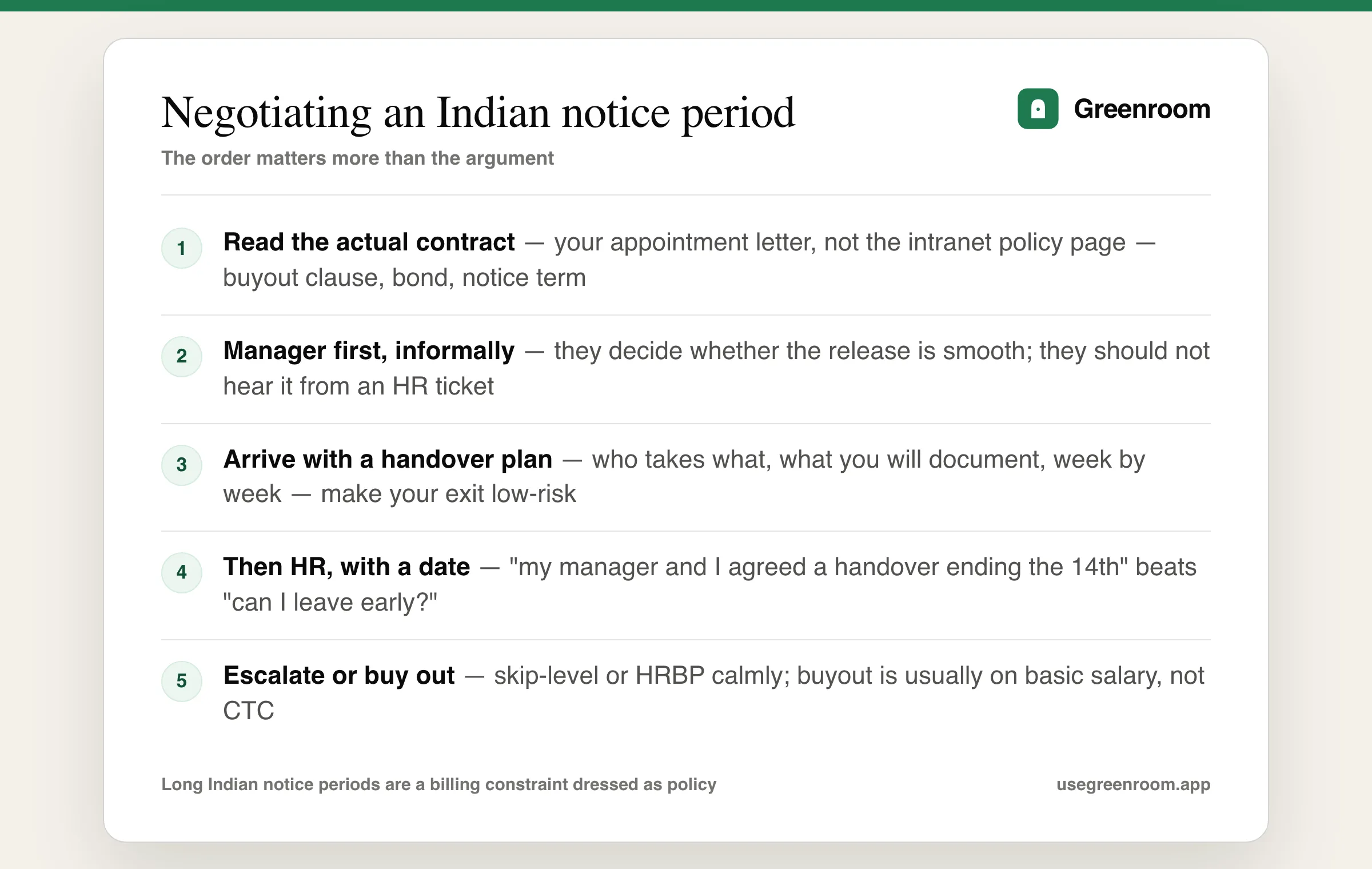
The order matters more than the argument: manager first, HR second, and always with a plan attached.
## What your contract actually says, and what is enforceable
Before any conversation, read your appointment letter — not the intranet policy page, the signed document. Look specifically for the notice period clause, whether a buyout is explicitly permitted and at what rate, and whether there is a training-bond or service-agreement clause.
The general position in India, stated carefully because employment law varies by state and by whether you are covered under Shops & Establishments or Standing Orders:
- Notice periods are a contractual term, and the usual remedy for breaking one is financial — the employer recovers salary in lieu of notice. It is a civil contract matter, not a criminal one.
- Withholding your relieving letter or Full & Final settlement as leverage is common practice and is disputed territory; employees have successfully challenged it, but that is a slow route you probably do not want during a job switch.
- Nobody can force you to physically attend work — but absconding is genuinely damaging, because it forfeits your relieving letter and F&F, and Indian background verification will surface it.
- Bonds and training agreements are enforceable only to the extent they represent a reasonable, genuine cost — but testing that costs time and legal fees. Read yours before you sign anything, not when you resign.
This is general information rather than legal advice; if a bond or a large recovery amount is involved, a one-hour consultation with an employment lawyer is money well spent.
## The buyout: how it actually works
A notice period buyout means paying your current employer for the days you will not serve, so you can leave earlier. Practical realities:
- It is usually calculated on basic salary, not CTC — which makes it far cheaper than people fear. Confirm the formula in writing before agreeing to anything.
- It is not a right unless your contract says so. Many companies allow it at management discretion; some service companies refuse it outright for billable roles.
- Ask the new employer to cover it. This is completely normal, especially if they want you sooner. Many companies have a budget line for it — but you must ask before you sign, because it is much harder afterwards.
- Get it in writing on both sides. A verbal "we'll sort it out" from either HR team is worth nothing during F&F.
If the new employer will not pay it and you can afford it, weigh the cost against the risk of the offer lapsing. A month of basic salary is often cheaper than losing the role.
## The sequence that actually works
Most people get this wrong by starting with HR. The order matters:
- 1. Manager first, informally. Your manager decides whether the release is smooth or obstructed, and they hear it better from you than from an HR ticket. Frame it as a transition problem you want to solve together, not a demand.
- 2. Arrive with a transition plan, not a request. Name who can take each responsibility, what documentation you will write, and what you will hand over in which week. This single move changes the conversation more than any argument about policy.
- 3. Offer something real. Availability for questions after leaving, weekend knowledge-transfer sessions, finishing a specific release. Make early release feel low-risk to the person approving it.
- 4. Then HR, with a specific date and manager support. "My manager and I have agreed a handover plan ending on the 14th" is a very different conversation from "can I leave early?"
- 5. Escalate calmly if blocked. Skip-level manager or the HR business partner, never a public channel or an angry email. Everything you write may be read by people you have not met.
Throughout, stay unfailingly professional. The Indian tech market is smaller than it looks, and your current manager may end up as a reference, a colleague, or an interviewer. Our reason for job change guide covers how to talk about the exit afterwards.
## What to say to the new employer
Handle this side proactively; silence is what kills offers. The rules:
- Disclose the real notice period during interviews, not after the offer. Recruiters plan around it, and a surprise at offer stage damages trust badly.
- Give a realistic date with a best case — "my contract says 90 days; I'm negotiating for 45 and I'll confirm within two weeks." Never promise a date you do not control.
- Ask about buyout support before signing. Also ask whether the joining date is flexible, because many companies would rather wait than lose the candidate.
- Update them proactively, every week or two, even when nothing has changed. Candidates who go quiet get replaced; candidates who send a two-line update get waited for.
One thing to avoid entirely: accepting an offer while planning to abscond from your current employer. Indian background verification checks employment history and relieving documents, and an unexplained exit can cost you the new job after you have already left the old one.
## When you are genuinely stuck
If the release is refused outright and the offer is time-bound, your realistic options are:
- Ask the new employer to wait. The most underused option. Good companies frequently will, particularly for senior roles.
- Serve the full period and negotiate the joining date instead. Not a failure — a delayed start with a signed offer beats a lost offer.
- Use pending leave. Some employers allow accrued leave to offset part of the notice; many do not. Ask explicitly rather than assuming.
- Pay the buyout yourself if the numbers work and the role is worth it.
- Formal escalation — a polite written request to HR leadership documenting your handover completion. Written records matter if this becomes a dispute.
What to avoid: absconding, threatening legal action early (it hardens positions immediately), or badmouthing either employer to the other. Also avoid accepting a counter-offer purely to escape the notice problem — that solves a logistics issue by making a career decision, and the underlying reason you wanted to leave rarely changes.
## Career forums, LinkedIn advice, ChatGPT — where each fits
- Your own appointment letter — the only document that actually governs your situation, and the one most people never reread.
- Company-specific employee forums and AmbitionBox — useful for whether a particular employer typically allows buyouts. Treat specifics as dated and unverified.
- LinkedIn advice posts — heavy on confidence, light on contract detail, and frequently written by people describing a market that has changed.
- An employment lawyer — genuinely worth an hour if a bond, a large recovery amount or a withheld relieving letter is involved.
- Your new employer's recruiter — an underused ally. They negotiate joining dates constantly and know what their company will flex on.
- ChatGPT — fine for drafting a resignation email or a handover plan. It will not rehearse the actual conversation where your manager says "we can't release you" and you have to respond calmly in real time.
- Greenroom — the spoken layer. Ari, the AI interviewer, runs the difficult conversations out loud — including the notice-period question in interviews — so you have said the words before it counts. Fair tradeoff: Ari cannot read your contract.
> The core truth: notice period outcomes are decided by whether you make your exit low-risk for the person approving it. A handover plan and an early, calm conversation beat every argument about what the policy technically permits.
## A four-week plan for a clean exit
- Before you resign: reread your appointment letter, calculate the buyout on basic salary, and confirm in writing what the new employer will support.
- Week 1: tell your manager in person with a written handover plan attached. Ask directly for the date you want, and name what you will complete.
- Week 2: formal resignation to HR referencing your manager's agreement. Start documenting genuinely — a real handover is your strongest leverage.
- Weeks 3–4: execute the handover visibly, confirm the release date in writing, and follow up on relieving letter and F&F timelines before your last day, not after.
Also useful: our salary negotiation guide covers the offer conversation this follows, the multiple offers guide covers competing timelines, and the service to product company switch guide covers the transition many of these moves represent.
## Frequently asked questions
### Can I negotiate my notice period in India?
Yes, and it is far more common than policy documents suggest. Long Indian notice periods are largely a staffing and billing constraint rather than a legal requirement, so approval usually depends on whether your exit leaves a project uncovered. The most effective approach is to speak to your manager before HR, bring a concrete handover plan naming who takes each responsibility, and request a specific date rather than asking generally to leave early.
### How does a notice period buyout work in India?
A buyout means paying your employer for the days you will not serve so you can leave earlier. It is usually calculated on basic salary rather than total CTC, which makes it cheaper than most people expect. It is not automatically a right — many companies allow it at management discretion and some refuse it for billable roles. Confirm the formula in writing, and ask your new employer to cover it before you sign the offer.
### What happens if I do not serve my notice period in India?
Leaving without serving notice or agreeing a buyout is a contractual breach, and the usual consequence is financial recovery plus the employer withholding your relieving letter and full and final settlement. It is a civil matter rather than a criminal one, but the practical damage is significant because Indian background verification checks employment history and relieving documents, and an unexplained exit can cost you the new job.
### Can my employer refuse to release me early?
Yes, if your contract specifies the notice period and does not guarantee a buyout, the employer can insist you serve it. Your realistic options are to ask your new employer to wait, which good companies frequently do, negotiate a later joining date, use accrued leave to offset part of the notice if your employer permits it, or pay a buyout if one is offered. Escalating politely to a skip-level manager or HR business partner sometimes helps.
### Should I tell a new employer my real notice period?
Yes, and during interviews rather than after the offer. Recruiters plan hiring timelines around notice periods, and a surprise at offer stage damages trust badly. Give the contractual figure along with a realistic best case, such as saying the contract specifies 90 days while you are negotiating for 45 and will confirm within two weeks. Then send short proactive updates every week or two, because candidates who go quiet get replaced.
### Is a training bond enforceable in India?
Bonds and service agreements are generally enforceable only to the extent they represent a reasonable and genuine cost actually incurred by the employer, such as documented training expenses, rather than an arbitrary penalty. However, testing that position takes time and legal fees, which is rarely practical mid-switch. Read any bond clause carefully before signing employment, and if a large recovery amount is involved, consult an employment lawyer.
The notice-period question comes up in interviews too, and hesitating on it reads badly. Greenroom runs mock interviews out loud with Ari, including the awkward logistics questions, and scores clarity and confidence. Free to start. Curious how it works? See how AI mock interviews work.