
Six months ago you were calibrating torque specs, grading essays, or reconciling a ledger. Now you're on a Zoom call, a stranger with a half-visible bookshelf asks you to "walk through the time complexity of this loop," and your brain produces exactly one thought: I have never once said the words time complexity out loud in my life. You smile. You say something about "it depends on the input size," which is technically true and also what you say when you have no idea what you're talking about. The interviewer nods, types something, and you spend the rest of the call wondering what they wrote.
This is the specific, recognizable moment almost every career switcher into tech hits — bootcamp grad, self-taught developer, mechanical engineer, teacher, financial analyst, it doesn't matter which door you came in through. The panic isn't that you don't know the material. It's that you don't know which parts of the unwritten interview script you're supposed to already have memorized, because nobody handed you the syllabus everyone else got in college.
This guide is that syllabus. Below are the interview questions for career switchers into tech that actually come up — the CS-fundamentals gap question, the "why did you switch" question, the "what have you built" question — with real answers, and an honest read on how much your background actually matters versus how much it doesn't.
The questions career switchers actually get asked
Company-specific loops vary, but five questions show up across almost every non-traditional-background interview, in some phrasing or another. Recognizing the shape of the question matters more than memorizing a script, because interviewers rephrase constantly and a memorized answer falls apart the second they ask a follow-up.
"You don't have a CS degree — walk me through your fundamentals."
This is rarely a trick question. It's a direct probe for a specific gap: Big-O notation, data structures, how memory and recursion actually work, basic algorithmic thinking. A CS grad got four years of forced repetition on this; you got however many months your bootcamp or self-study plan gave it. The interviewer isn't asking to shame you — they're asking because they genuinely don't know your baseline, and unlike a CS grad, they can't assume it.
The answer that works: don't apologize for the gap, name what you've done to close it. "I didn't get this in a degree program, so I built it deliberately — I worked through [specific resource], and here's a data-structure decision I actually made in a project, and why." Concrete beats comprehensive. One real example where you chose a hash map over a list because of lookup time tells them more than reciting Big-O definitions for six data structures.
"Why are you switching to software engineering?"
This is the single most-asked question in a career-switch interview, and it's the one candidates most reliably fumble — usually by treating it as a confession instead of evidence. Interviewers ask it because the answer predicts two things they actually care about: whether you'll stay motivated through a hard first 18 months, and whether this was an impulsive pivot or a considered decision.
A weak answer apologizes for the old career ("I just didn't like accounting anymore"). A strong answer connects the old career to the new one as a continuous thread, not a rupture — see the worked examples below.
"What have you built, and why does it matter without an internship on your resume?"
Traditional candidates lean on internship logos. You don't have that lever, so the interviewer shifts the entire weight of "can this person actually build things" onto your projects. That's not a disadvantage in disguise — it's a real, if narrower, path: a portfolio that shows real decisions beats a resume line that shows you showed up somewhere for a summer.
"How do you know you'll actually be good at this?"
A blunter version of the same question, usually from a hiring manager rather than a recruiter. They're testing self-awareness, not certainty — nobody expects a confident yes. The strongest answers name a specific moment of struggle-then-breakthrough from your transition, because it's the only evidence you have that predicts how you'll behave the next time something is hard.
A live fundamentals check — explained from zero, not from memory.
Expect at least one round where you're asked to explain something — recursion, a hash map, REST versus RPC — as if the interviewer is checking whether you understand it, not whether you memorized the Wikipedia definition. This is actually the round where switchers can outperform CS grads: someone who learned recursion four years ago in a lecture hall often explains it worse than someone who wrestled with it against a real bug last month.
Reframing your background as an asset, not an apology
The instinct under pressure is to lead with the apology: "I know I don't have a traditional background, but…" Delete that sentence. Every time you say it, you're doing the interviewer's filtering work for them, for free, before they've even asked a question.
Here's the reframe, worked through for three different starting points:
Mechanical engineer → software engineer. "I spent four years debugging why a physical system didn't behave the way the spec said it should — usually the answer was in the data, not the theory. Software gave me the same kind of problem with a faster feedback loop, so I taught myself [language], and the first project I shipped was [specific thing] because it let me apply the same root-cause-first instinct I already had." This tells the interviewer you already have the underlying skill — systematic debugging — and software was the vehicle you chose for it, not a random escape hatch.
Teacher → software engineer. "Explaining a concept to 30 people with 30 different starting points, every day, for years, is the same skill as writing code someone else has to read and maintain later. I got into programming because I wanted to build the tools I wished I'd had in the classroom, and the first thing I built was [specific project]." Teachers underrate this constantly — communication and empathy for "someone who doesn't already know what you know" is a genuinely scarce engineering skill, and you already have it.
Finance/accounting → software engineer. "I spent three years automating parts of my own job in Excel and VBA before I realized the automating was the part I actually liked. That's what pulled me toward software — not that I hated finance, but that I liked building the system more than running it." This is one of the strongest switch stories available, because it's evidence-based: you didn't decide to switch in the abstract, you noticed a real preference from real behavior.
The pattern in all three: name the transferable skill explicitly, then point at one concrete project as proof, in that order. Reframing your non-tech background isn't about hiding where you came from — it's about stating, out loud, exactly why that background is relevant instead of hoping the interviewer connects the dots themselves. They usually won't; you have to draw the line for them.
What to emphasize without an internship to point to
Without an internship, the project discussion carries the entire weight your resume can't. That means the depth of how you talk about a project matters more for you than for almost any other candidate profile. A few specific things to get right:
- Pick one project you can defend for 15 minutes, not five you can describe for two. Interviewers follow up. A project you built once and haven't touched since falls apart under the third "why" — see our guide on how to explain a project in an interview for the structure that survives follow-ups.
- Talk about the decision you'd change, not just the one you made. "If I rebuilt this today I'd use a queue instead of polling, because I learned about backpressure the hard way" reads as more senior than a flawless-sounding walkthrough — it shows you've kept learning past the point of "it worked."
- Deploy it, even badly. A live URL, however unglamorous the hosting, beats a repo that only runs on your laptop. It proves you can ship, which is a different (and often rarer) skill than writing code that works in isolation.
- Know your GitHub history cold. Interviewers who ask about your projects increasingly open the repo mid-call. Commit messages, README quality, and whether the tests actually run are all part of the impression — our GitHub projects in interviews guide covers what they're actually looking for when they click in.
- If your resume has zero traditional experience, structure matters more, not less. See resume for freshers with no experience for how to lead with projects instead of an empty work-history section that just advertises the gap.
How much does a bootcamp or self-taught background actually count against you?
Here's the honest, hedged answer, because anyone who tells you a confident single number is guessing: it varies enormously by company, and there's no reliable industry-wide figure to quote. A handful of things are true broadly, though:
Large, traditional employers with rigid degree requirements in their applicant tracking system will sometimes filter you out before a human ever reads your application — that's a real structural obstacle, and the practical fix is a referral or a direct application through a channel that skips the automated filter, not a better resume. Smaller product companies and startups running skills-first hiring loops care far more about what you can build live, in the interview, than about the credential on your resume. Several large tech employers have publicly said they don't require a CS degree for many software roles — treat specific claims like that as directional, since hiring bars shift by team and by year even inside the same company.
Stack Overflow's annual developer survey has repeatedly found that a large share of professional developers learned to code primarily outside a formal CS degree — the exact percentage moves year to year and depends on survey methodology, so don't quote it as a precise figure, but the direction is consistent: non-traditional paths into this industry are common, not fringe.

Where the degree matters most is at the resume-screen stage of large, conservative employers. Where it matters least is once you're in the room — a strong live technical round and a well-defended project close most of the gap that a missing degree line opened. Our skills-based hiring in India piece goes deeper on how that filter has shifted from a credential check to a proof-you-must-build check across the market generally, not just for career switchers specifically.
If your switch is narrower — say, from a general SDE role into AI engineering, or from an Indian service company into a product company — the fundamentals overlap heavily with this guide, but the specific loop differs; see switching to an AI engineer role in India and switching from a service company to a product company for those narrower paths.
How career switchers actually prepare — and where each method breaks
Most switchers default to one of three prep methods, and each has a real blind spot for this specific situation:
A pure LeetCode grind builds pattern recognition for coding rounds but does nothing for the "why did you switch" question, the fundamentals-explained-from-zero round, or the project defense — all of which are just as decisive for a switcher and none of which LeetCode touches.
A friend's WhatsApp PDF of "common interview questions" is free and better than nothing, but it's a list of questions with no practice actually answering them out loud, under a follow-up, with someone listening for whether your explanation holds together.
Typing your answer into ChatGPT and reading the response back teaches you what a good answer looks like on a page. It does not teach you to say it, live, when a stranger asks a follow-up you didn't script for — and the "why did you switch" question in particular collapses fast under a real follow-up if you've only ever written it down, not said it.
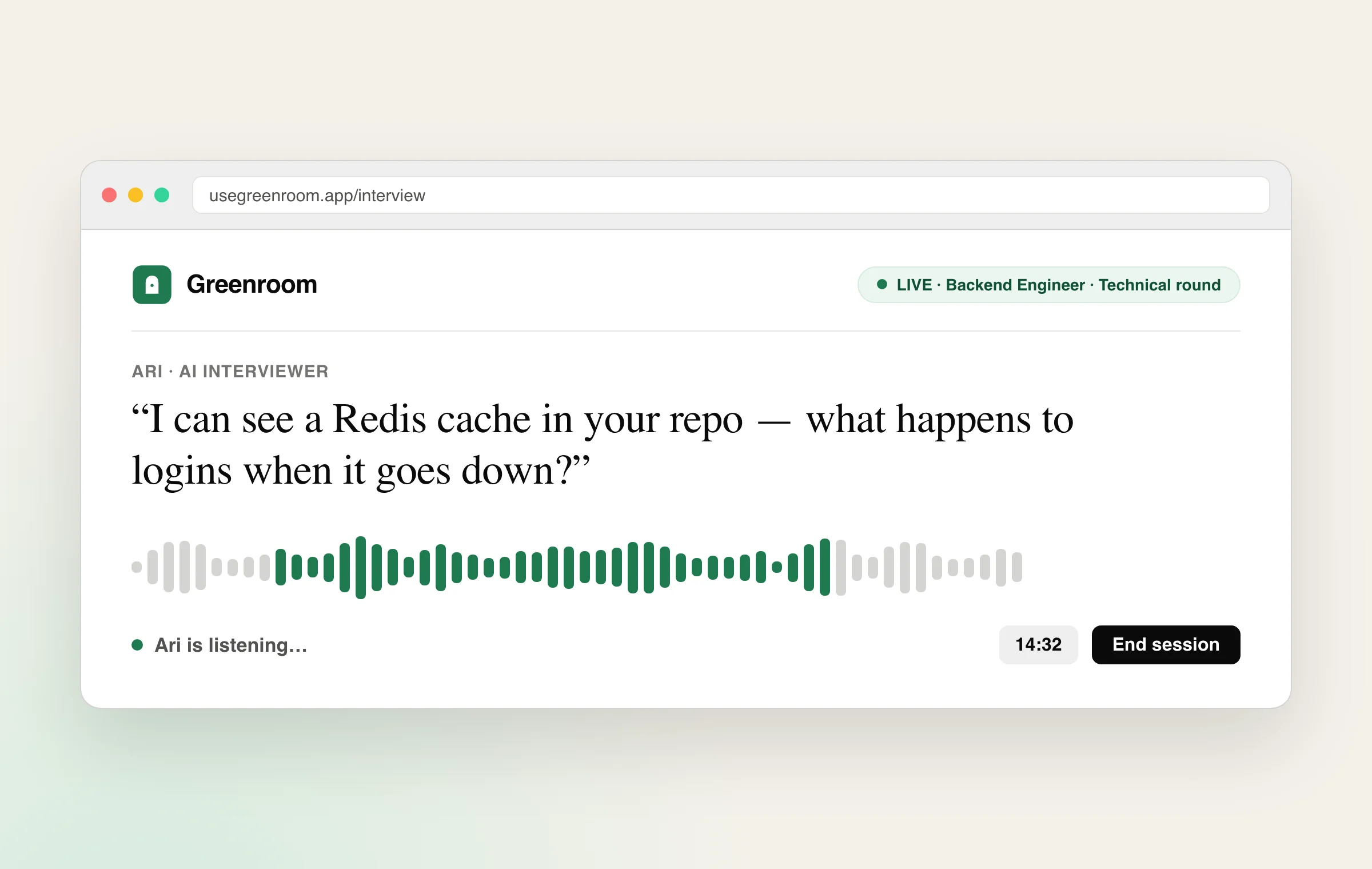
Greenroom runs spoken mock interviews that ask the actual questions above — the fundamentals check, the "why the switch," the project deep-dive — and follows up the way a real interviewer would, then gives you feedback on how clearly you explained yourself, not just whether the content was technically right. It's not a replacement for building real projects or actually knowing your fundamentals; it's the layer that makes sure the story you've built lands out loud, under pressure, the one time it counts.
Frequently asked questions
What interview questions do career switchers into tech get asked?
The most common are: an explanation of your CS fundamentals gap and how you've closed it, "why are you switching to software engineering," what you've built without an internship to point to, how you know you'll actually be good at this, and a live round where you explain a core concept (recursion, a hash map, REST) from first principles rather than from memory.
How do I explain a CS fundamentals gap in an interview?
Don't apologize for it — name what you've done to close it and back it with one concrete example. Say what resource or method you used, then walk through a real decision from a project where you applied that fundamental (like choosing a hash map for lookup speed), rather than reciting definitions for several data structures in a row.
Do bootcamp grads and self-taught developers get treated the same as CS grads in interviews?
It varies a lot by company, and there's no reliable single figure to quote. Large employers with rigid degree filters in their applicant tracking systems can screen you out before a human reads your application; smaller product companies and skills-first hiring loops weight a strong live technical round and a well-defended project far more heavily than the credential itself. The gap matters most at the resume-screen stage and least once you're actually in the interview room.
How do I answer "why are you switching careers" in a tech interview?
Connect your old career to the new one as a continuous thread, not a rupture — name the transferable skill explicitly (debugging instinct, communication, an automation habit you noticed you loved) and back it with one concrete project, in that order. Avoid leading with an apology for the old career; interviewers are listening for evidence of a considered decision, not a confession.
What should I emphasize in a portfolio if I don't have internship experience?
Depth over breadth — one project you can defend for 15 minutes beats five you can only describe for two. Talk about what you'd change if you rebuilt it, deploy it even if the hosting is unglamorous, and know your GitHub commit history and README well enough to survive an interviewer clicking into the repo mid-call.
Is it harder to get a tech job as a career switcher in 2026?
It's a different filter, not necessarily a harder one. The obstacle shifts from "do you have the credential" to "can you prove the skill live" — which removes one barrier (the degree requirement) and adds another (you have to demonstrate, not just claim, your fundamentals). Companies running skills-first hiring loops have moved this direction generally, not only for career switchers.