Spider-Man: Brand New Day landed in cinemas today, which means a fresh wave of people are about to be reminded of the least discussed thing about Peter Parker: the webs are not the impressive part. The impressive part is that he is a science student with a full second job, chronic sleep debt, and he still knows the material.
Nobody gets bitten by a radioactive spider. But almost every reader of this blog has Parker's actual problem — too much to learn and nowhere near enough time, because coursework, a full-time job, a commute or family responsibilities are eating the week. This is a system for studying under exactly that constraint, and the techniques are boring, evidence-backed, and they work.
The Parker problem, stated honestly
Most study advice assumes an empty calendar. "Do two hours of DSA daily" is useless to someone finishing work at 9pm or writing a final-year project at the same time as sitting placement drives.
So the real constraint is not motivation. It is that you have perhaps 45 to 90 usable minutes a day, they are low-energy minutes, and they are interrupted. Everything below is chosen because it survives that constraint — which is also why the highest-status advice (long deep-work blocks, building elaborate projects, reading whole textbooks) is the first thing to cut.
Stop rereading. Start retrieving.
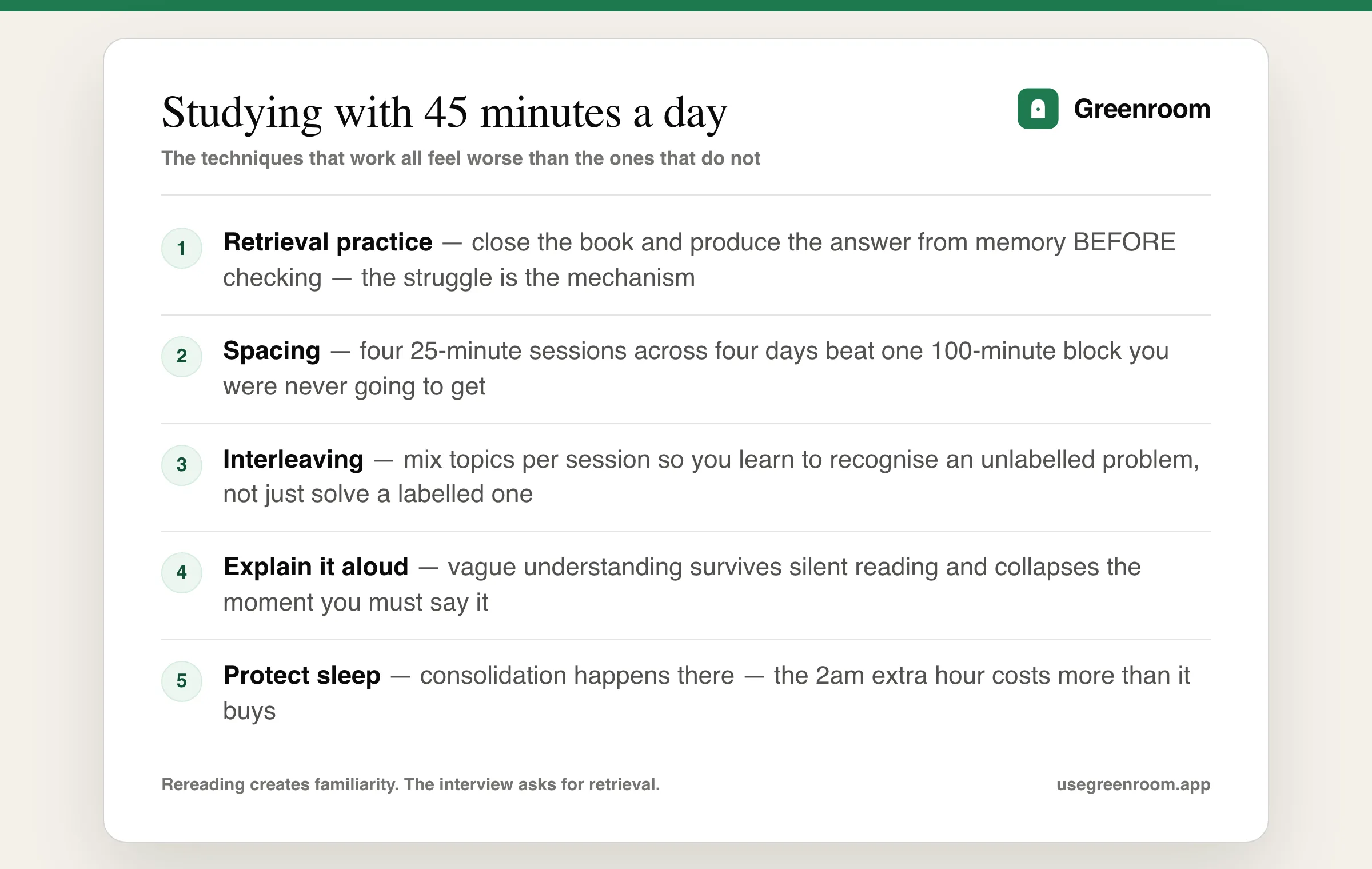
The single highest-return change: close the material and try to produce the answer from memory before you check. This is retrieval practice, and the research behind it is unusually consistent — testing yourself on material produces far more durable learning than reviewing it, even though reviewing feels more productive.
That feeling is the trap. Rereading creates fluency — the page looks familiar, so your brain reports "I know this." Familiarity is not retrieval. The interview asks you to retrieve.
In practice:
- Read a concept once, close it, and explain it aloud. If you stall, you have found the gap — that is the point, not a failure.
- Turn every topic into a question, not a heading. "Indexes" is a heading. "Why does an index not help this query?" is retrievable.
- Attempt before you learn. Try the problem for five minutes before reading the solution. The struggle is what makes the solution stick, even when you fail to solve it.
- Use blank-page recall. At the end of a session, write everything you remember about the topic with nothing in front of you. Then check. The holes are your next session.
Our Make It Stick summary for interview prep covers the underlying research in more depth, and the Feynman technique guide covers the explain-it-simply method this builds on.
Space it out, because your week is already fragmented
The good news about having no long blocks: spacing beats cramming anyway. Four 25-minute sessions across four days produce better retention than one 100-minute session, and you were never going to get the 100 minutes.
The practical version, which needs no app:
- Revisit new material the next day, then three days later, then a week later. Each successful recall pushes the next review further out.
- Keep a "got it wrong" list — one page, add anything you failed to recall, review only that list on low-energy days. This is the highest-value fifteen minutes in your week.
- Let it feel harder. Spaced review feels worse than massed review because you have partially forgotten. That partial forgetting is the mechanism, not a sign the method is failing.
If you want tooling, spaced-repetition software like Anki automates the scheduling. If you do not, an index card and a date written in the corner does the same job.
Interleave, so you learn to recognise the problem
Most people study in blocks: all arrays Monday, all trees Tuesday. It feels organised and it produces a specific weakness — you get good at solving problems when you already know what kind they are. The interview does not tell you.
Interleaving means mixing problem types within a session. It feels worse and performs better, because you are training the skill you actually need: looking at an unlabelled problem and identifying what it is. Practically, mix three or four topics in a session rather than one, and revisit older topics deliberately instead of only moving forward.
The same logic applies to interview prep as a whole. Alternate a coding problem, a behavioural answer and a system design sketch rather than spending three weeks purely on DSA — because the real loop interleaves them and your preparation should rehearse the switching.
Say it out loud — the step almost everyone skips
Here is the Parker detail worth stealing: he is constantly explaining things — to Ned, to himself, to whoever is unfortunate enough to be in the lab. Explaining is retrieval with a quality check attached, because vague understanding survives silent reading and collapses the moment you have to say it in sentences.
This matters more for interviews than for exams, because an interview is not a test of what you know, it is a test of what you can say while someone watches. Those are different skills, and preparing only the first is the most common preparation mistake there is.
So: explain concepts aloud, in plain language, without notes. Record yourself occasionally and listen back — you will hear the hedging, the "basically", the sentence that trails off, all of which are invisible when you rehearse in your head. Our how to think out loud in interviews guide covers the mechanics.
Protect sleep, because Parker demonstrably does not
The film franchise is very clear that Peter Parker is exhausted, and it is consistently portrayed as a problem rather than a flex. Take the hint.
Sleep is when memory consolidates. Studying at 2am to bank an extra hour, at the cost of the sleep that would have made the previous four hours stick, is a net loss — and it is the most common self-inflicted wound in placement season. The same goes for the night before an interview: reviewing new material is worse than useless, because you arrive tired and the new material is not consolidated anyway. Reread your own one-page summary and go to bed.
Two related points, unglamorous and real: cramming produces short-lived recall that fades fast, which is precisely wrong for an interview loop spread over three weeks; and interviewing tired is a measurable disadvantage in exactly the skills you are being scored on — clarity, composure, working memory.
YouTube, question dumps, ChatGPT — where each fits
- Video courses and YouTube — good for first exposure to a concept, and dangerous as a primary method, because watching produces strong familiarity and weak retrieval. Watch once, then close it and explain it.
- Question dumps (GeeksforGeeks-style) — useful for coverage of what gets asked. The structural flaw is that they hand you the question and the answer simultaneously, which removes the retrieval attempt that does the learning.
- Anki or paper cards — the right tool for spacing, and either works. The app is not the method.
- A study partner — genuinely valuable, because explaining to a human exposes vagueness instantly. The failure mode is a partner who is too polite to say "I didn't follow that."
- ChatGPT — very good at generating practice questions and checking a written explanation. Its limit is that it accepts your first answer and reads your intent charitably, which is the opposite of an interviewer.
- Greenroom — the spoken layer. Ari, the AI interviewer, makes you retrieve out loud under mild pressure and pushes when an explanation is vague, which is retrieval practice in the exact format the interview uses. Fair tradeoff: Ari will not teach you the syllabus — pair it with the reading.
A 45-minute daily template
- 0–5 min: blank-page recall of yesterday's topic. No notes. Check afterwards and add misses to the "got it wrong" list.
- 5–25 min: one new problem or concept, attempted before reading any solution.
- 25–35 min: two older problems from different topics — this is your interleaving.
- 35–45 min: explain the day's main concept aloud, in plain language, as if to a friend who does not know it.
- Weekly: one full spoken mock, and a review pass over the "got it wrong" list only.
Also useful: our interview preparation guide covers the wider plan, the how long to prepare guide covers realistic timelines, and the aptitude preparation guide covers the placement paper this often runs alongside.
Frequently asked questions
How do you study effectively when you have very little time?
Prioritise retrieval over review. Close the material and try to produce the answer from memory before checking, because testing yourself produces far more durable learning than rereading even though rereading feels more productive. Space short sessions across days rather than attempting long blocks, mix several topics per session, explain concepts aloud, and keep a single list of everything you failed to recall to review on low-energy days.
Why is rereading notes a bad study method?
Rereading creates fluency rather than knowledge — the page becomes familiar, so your brain reports that you know the material when you have only recognised it. Recognition and recall are different abilities, and interviews and exams require recall. The discomfort of failing to remember something during self-testing is the actual learning mechanism, which is why the more effective methods reliably feel harder than the less effective ones.
What is interleaving and why does it help interview preparation?
Interleaving means mixing different problem types within a single study session instead of blocking one topic at a time. Blocked practice makes you good at solving problems when you already know their category, which is not the situation an interview creates. Mixing topics trains you to look at an unlabelled problem and identify what kind it is, which is the skill that actually transfers to the interview room.
Should you study the night before an interview?
Not new material. Learning something new the night before produces unconsolidated knowledge and costs you sleep, and both hurt performance on the abilities you are actually scored on — clarity, composure and working memory. Review your own one-page summary of things you already know, confirm logistics, and sleep. Cramming produces short-lived recall that fades within days, which is exactly wrong for a loop spread over several weeks.
How much should you study each day for placements while doing coursework?
Consistency matters far more than volume. Forty-five focused minutes daily, structured as recall, one new problem, two older problems from different topics, and one spoken explanation, outperforms occasional long sessions — partly because spacing genuinely improves retention and partly because it is a schedule you can sustain alongside coursework. Protect sleep rather than extending sessions into the night.
Does explaining concepts out loud actually help?
Yes, substantially, and it is the step most candidates skip. Explaining forces retrieval and immediately exposes vague understanding that survives silent reading, because you cannot produce clear sentences about something you only half know. It also rehearses the actual interview format, since an interview tests what you can articulate under observation rather than what you recognise on a page — genuinely different skills.