---
title: Background Verification in India: What Actually Gets Checked
description: How background verification works in Indian IT — employment, education, address and criminal checks, what causes a BGV failure, and how to fix discrepancies early.
url: https://usegreenroom.app/blog/background-verification-india
last_updated: 2026-07-31
---
← Back to blog
India · Careers
# Background verification in India, explained
July 31, 2026 · 12 min read
She had the offer, the laptop, and a start date. Then an email: "discrepancy found in employment history." Her second job had run from June 2022 to August 2024. She had written 2022–2024 on the form. The verification agency had July 2022 from the payroll record, flagged a mismatch, and a machine somewhere decided that was worth escalating to her new employer.
That is the most common background verification failure in Indian IT, and it is not fraud — it is arithmetic. BGV agencies match strings, not intentions. This guide covers what actually gets checked, what genuinely causes failures, how to fix a discrepancy before it becomes a withdrawn offer, and what to do about the situations people are most afraid to ask about.
## What background verification actually is
Most Indian IT employers outsource background verification in India to third-party agencies — HireRight, First Advantage, AuthBridge and similar. You will be asked to fill a form and upload documents, and the agency independently verifies each claim against a source: your previous employer's HR, your university, a database, or a physical address check.
Two structural facts explain most of what follows. First, the agency's job is to report discrepancies, not to judge them — a one-month date mismatch and a fabricated employer both come back as "discrepancy found," and a human at your new employer decides what it means. Second, verification usually runs after you accept and often after you join, which is why people discover problems at the worst possible moment.
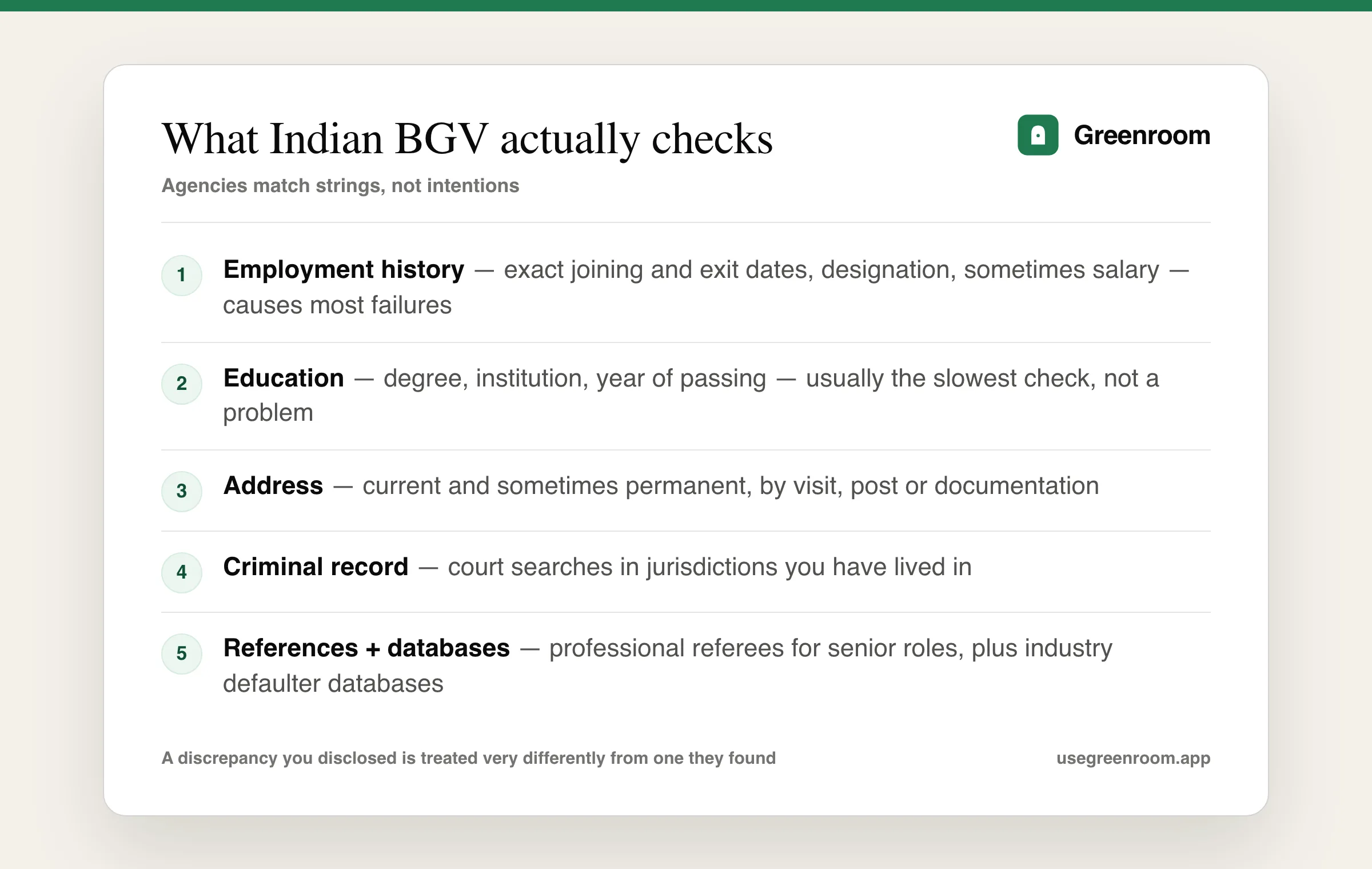
The five standard BGV components in Indian IT — employment history causes the most failures by a wide margin.
## The five things that get checked
- Employment history — every company, exact joining and exit dates, designation, and sometimes last drawn salary. Verified against previous employers' HR or payroll records. This causes the overwhelming majority of failures.
- Education — degree, institution, year of passing, and often roll number. Verified with the university or through a records database. Delays here are common and usually mean a slow university, not a problem.
- Address — current and sometimes permanent, either by a physical visit, a postal check or documentation.
- Criminal record — court record searches in jurisdictions you have lived in.
- References and databases — professional references for senior roles, plus checks against defaulter and industry databases such as NASSCOM's NSR where applicable.
Some employers add credit checks for finance-adjacent roles, drug testing for certain multinationals, and social media screening — the last being far less systematic than people assume.
## What actually causes a BGV failure
The distinction that matters: a discrepancy is not automatically a failure. What determines the outcome is whether the discrepancy suggests you were being dishonest. In rough order of severity:
- Fabricated employment — a company you did not work for, or a fake experience letter bought from an agency. This ends the offer and can get you blacklisted with the verification agency, affecting future jobs. The Indian market has a real fake-experience problem, so employers treat this harshly.
- Inflated designation or salary — claiming Senior Engineer when payroll says Engineer. Treated as deliberate misrepresentation.
- Undisclosed employment — hiding a short stint, usually one that ended badly. Ironically this is often what sinks people, because a three-month job you omitted looks far worse than a three-month job you explained.
- Date mismatches of a month or two — the story in the intro. Almost always resolved once explained, but it delays onboarding and creates avoidable anxiety.
- Unverifiable employment — a startup that shut down, so nobody answers the verification request. Not your fault, and there are standard workarounds.
- Absconding from a previous employer — flagged by the previous company, and taken seriously because it predicts the same behaviour.
Being laid off, being terminated for performance, or having a gap in your career are not BGV failures. Concealing them can be. Our career gap guide covers how to disclose those cleanly.
## How to prevent the problem entirely
Almost all BGV pain is preventable with an hour of preparation before you fill the form:
- Use exact dates from your documents, not memory. Pull your offer letters, relieving letters and payslips and copy the dates literally. Never write a year range where a month is asked for.
- List every job, including short ones. A two-month stint you disclose is a non-event; the same stint discovered is a credibility problem.
- Use the designation on your relieving letter, not the one you were promised or the one your team used informally.
- Keep a document folder permanently — offer letter, relieving letter, experience letter, last three payslips, Form 16 and degree certificates for every job. Collect these when you leave, because chasing a company you left three years ago is genuinely hard.
- Flag known problems yourself, in advance. If a previous employer has shut down or you had a disputed exit, tell the recruiter before verification starts. Proactive disclosure is treated completely differently from a discovered discrepancy.
That last point is the highest-leverage advice in this guide. Employers are far more tolerant of a problem you raised than of the identical problem their agency found.
## If a discrepancy is already raised
Do not panic, and do not go quiet — the second one is what turns a fixable issue into a withdrawn offer.
- Respond fast and in writing. Ask exactly what the discrepancy is; agencies are often vague in the first email.
- Produce documents, not explanations. A relieving letter with the correct dates settles a date mismatch instantly. Payslips, Form 16, PF passbook entries and bank statements showing salary credits are all accepted evidence.
- Use your PF and UAN record for employment gaps in documentation — the EPFO passbook shows employer contributions with dates and is hard to dispute.
- For a shut-down employer, offer alternatives: a former manager's contact, appointment and relieving letters, payslips, Form 16, or the company's ROC/MCA record showing it existed and when it closed.
- Be honest if you got it wrong. "I wrote the year rather than the month, here is the letter with the exact date" resolves cleanly. An elaborate story does not.
If an offer is withdrawn over something genuinely inaccurate, that is painful but survivable — our handling rejection guide and staying motivated guide cover the recovery.
## The questions people are afraid to ask
Asked constantly and rarely answered plainly:
- Will they contact my current employer before I resign? Standard practice is not to, and most forms let you mark your current employer as "do not contact until joining." Confirm this explicitly with the recruiter rather than hoping.
- Does a gap fail BGV? No. Gaps are verified as gaps. Only a false claim about the gap is a problem.
- Does a termination fail BGV? Not by itself — employers usually confirm dates and designation, and many will not disclose the reason. Concealing it is riskier than the fact.
- Do they check my social media? Some do, superficially. Assume anything public is visible; it rarely decides outcomes.
- How long does it take? Typically one to three weeks, with education checks the usual bottleneck. Silence normally means slow, not bad.
- Can I be blacklisted? Verification agencies do maintain internal records of confirmed falsification, and their clients overlap heavily across Indian IT. This is the concrete reason not to use fake experience letters.
## Consultants, forums, ChatGPT — where each fits
- Your own document folder — the single most useful thing on this list, and the one that takes an hour to build.
- The EPFO / UAN passbook — an authoritative, self-service employment record most candidates forget they have.
- Your new employer's recruiter — genuinely on your side here, because they want you to join. Tell them about problems early.
- Company forums and AmbitionBox — useful for how a specific employer handles BGV timelines; treat specifics as dated.
- "Experience letter" providers — avoid entirely. Buying fake experience is the one item on this page that can end a career rather than an offer.
- ChatGPT — fine for drafting a clarification email. It cannot verify your dates, and it will confidently reassure you when the honest answer is "go and read your relieving letter."
- Greenroom — the spoken layer. Ari, the AI interviewer, rehearses the awkward disclosures — a gap, a short stint, a termination — so you can say them calmly in an interview rather than freezing. Fair tradeoff: Ari does not run verifications.
> The core truth: BGV agencies match strings, not intentions, and employers judge disclosure rather than imperfection. Copy your dates from documents, disclose every job including the short ones, and raise known problems before the agency finds them.
## Your BGV checklist
- Now, before any job search: build the document folder — offer, relieving and experience letters, payslips, Form 16, degree certificates — for every employer.
- When filling the form: copy exact month-and-year dates and designations from documents, list every job, and mark your current employer do-not-contact if applicable.
- Before verification starts: proactively flag a shut-down employer, a disputed exit or anything you know looks odd.
- If a discrepancy is raised: reply within 24 hours, attach documents rather than narrative, and use your EPFO passbook where paperwork is missing.
Also useful: our notice period negotiation guide covers the exit that produces these documents, the career gap guide covers disclosure, and the after a layoff guide covers a situation candidates wrongly assume is a BGV risk.
## Frequently asked questions
### What is checked in background verification in India?
Standard Indian IT background verification covers employment history including exact joining and exit dates and designation, education with degree, institution and year of passing, current and sometimes permanent address, and criminal record searches. Senior roles may add professional references, and some employers include credit checks for finance-adjacent positions or checks against industry databases. Employment history is by far the most common source of discrepancies.
### What causes background verification to fail in India?
Genuine failures come from fabricated employment or fake experience letters, inflated designations or salary claims, and undisclosed jobs — particularly short stints that ended badly. Absconding from a previous employer is also flagged seriously. Minor date mismatches of a month or two are extremely common, almost always resolved with documents, and delay onboarding rather than ending it. Career gaps, layoffs and terminations are not failures unless concealed.
### Does a career gap fail background verification?
No. Gaps are simply verified as gaps, because the agency is confirming the dates you actually worked rather than judging continuity. What creates a problem is a false claim about the gap, such as stretching a previous job's end date to cover it. Report exact dates from your relieving letter and explain the gap honestly in the interview instead of hiding it in the paperwork.
### Will the company contact my current employer during BGV?
Standard practice is not to contact your current employer before you have resigned and joined, and most verification forms include an option to mark your present employer as do-not-contact until after joining. Do not assume this happens automatically — confirm it explicitly in writing with the recruiter when you submit the form, since an unexpected verification call can create serious problems at your existing job.
### How do I prove employment if my previous company has shut down?
Offer documentary alternatives rather than waiting for a response that will never come. Appointment and relieving letters, payslips, Form 16, and bank statements showing salary credits are all accepted. Your EPFO passbook against your UAN is particularly strong because it shows dated employer contributions independently. You can also provide a former manager's contact, or the company's MCA registration record showing it existed and when it closed.
### How long does background verification take in India?
Typically one to three weeks, though it can run longer. Education verification is usually the bottleneck because universities respond slowly, especially around examination periods. Employment checks depend on how quickly previous employers' HR teams reply. Silence generally means the process is slow rather than that something is wrong, but it is reasonable to ask your recruiter for a status update after two weeks.
The hardest part of BGV is saying the awkward thing out loud, early. Greenroom runs mock interviews with Ari that rehearse gaps, short stints and difficult exits so they land calmly. Free to start. Curious how it works? See how AI mock interviews work.