There's a specific kind of confidence that walks into an American Express interview thinking it's just another bank. Then the interviewer skips right past your resume's "worked with credit card data" line and asks: "Walk me through how you'd detect a fraudulent transaction in real time, and what happens to a legitimate customer whose card gets wrongly declined at a wedding buffet." Suddenly it's clear this isn't "a bank": it's a company whose entire business model is trust, decided in milliseconds, at global scale, and they want to know if you understand that before they hand you a laptop.
American Express interview questions span a wider range than most people expect going in, because "Amex" hires everything from backend engineers and data scientists in its Gurugram and Bengaluru tech centers to credit/risk analysts and customer experience roles. And the interview loop reflects that spread. This guide covers the rounds you'll actually go through, real questions for tech and analyst tracks, and how to prepare for the round most candidates underrate: the behavioral one.
The Amex India interview process
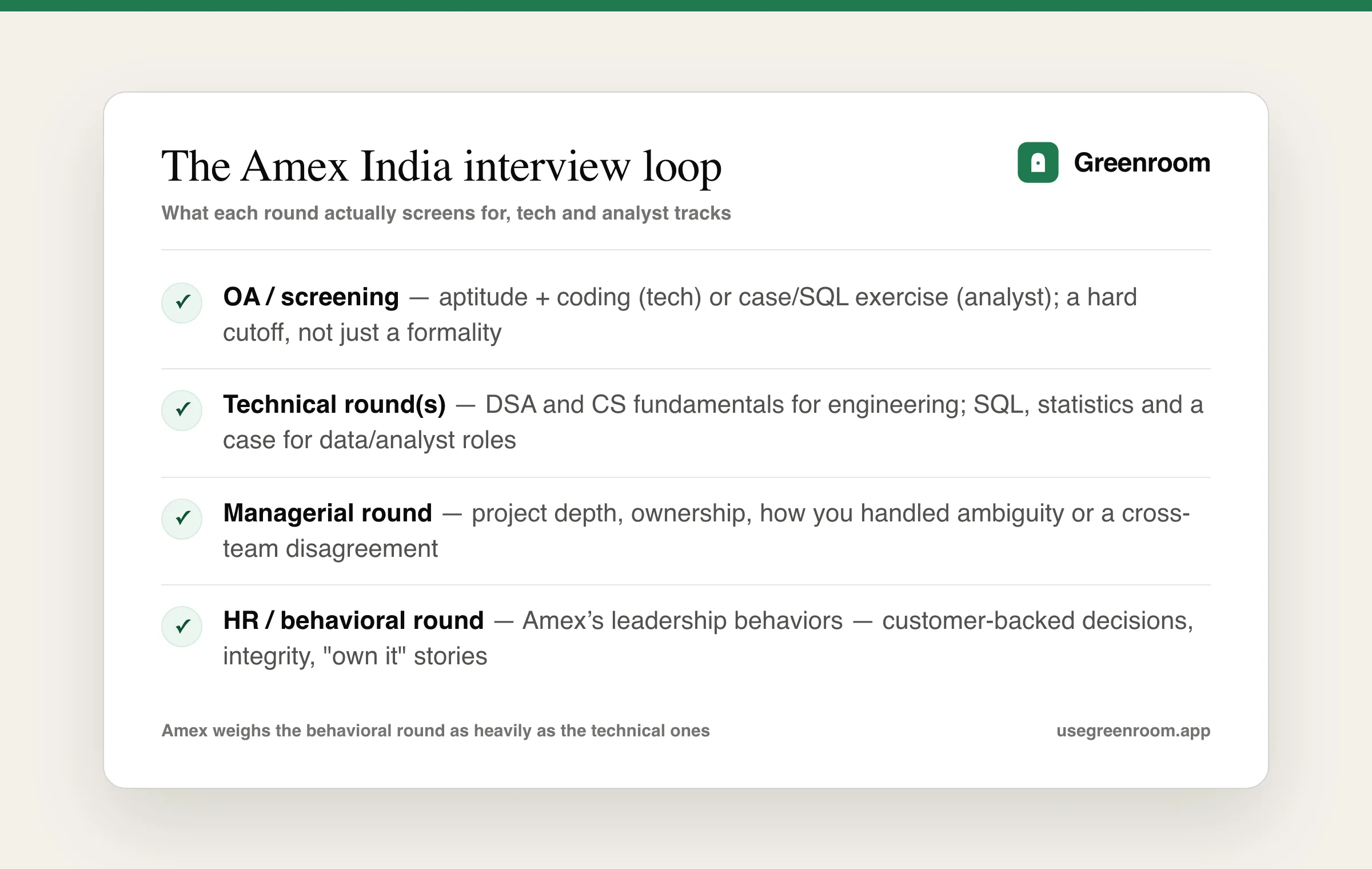
Most tech and analyst roles at American Express India run through four stages, though the exact count varies by team and seniority:
- Online assessment (OA) — for engineering roles, this is aptitude plus coding (data structures, SQL); for analyst/data roles, expect a case-style business problem or a SQL/stats exercise. Treat this as a real cutoff, not a formality, a meaningful share of applicants don't clear it.
- Technical round(s), one or two rounds depending on level. Engineering leans on data structures/algorithms, system design for senior candidates, and questions specific to your stated tech stack. Data/analyst roles get SQL, statistics, and often a live case ("how would you measure whether a new offer is cannibalizing an existing one").
- Managerial round — less about raw technical depth, more about project ownership: what you built, why you made specific tradeoffs, and how you handled ambiguity or disagreement with a teammate or stakeholder.
- HR / behavioral round: Amex explicitly evaluates against its own leadership behaviors (customer-backed decision making, integrity, setting a bold and courageous direction). This round is scored, not a formality, and candidates who treat it as an afterthought are a common way strong technical candidates still get rejected.
Technical interview questions (engineering roles)
How would you design a system to detect fraudulent transactions in real time?
The core tension is latency vs. accuracy: a fraud check has to return a decision in milliseconds without blocking the legitimate 99%+ of transactions. A strong answer covers a layered approach: fast rule-based checks first (velocity limits, geographic impossibility, blocklists) to catch obvious cases cheaply, then a machine-learned risk score for the rest, with a clear plan for what happens on a borderline score (step-up authentication, a hold, or a follow-up call) rather than a hard block that burns customer trust. Interviewers are listening for whether you've thought about the cost of false positives, not just detection rate.
Explain indexing in SQL and when it can hurt performance instead of helping.
An index lets the database find rows without scanning the full table, at the cost of extra storage and slower writes (every insert/update has to update the index too). It hurts performance when a table is write-heavy and rarely read by that column, or when the index isn't selective enough (e.g., indexing a boolean column with only two possible values), the database may ignore it and scan anyway. Amex interviewers, given the transaction-heavy domain, often follow up with "how would you index a table of a billion transactions" — the real answer is composite indexes matched to actual query patterns, not indexing every column defensively.
What's the difference between a hash map and a balanced binary search tree, and when would you choose each?
A hash map gives average O(1) lookup/insert but no ordering guarantee and worst-case O(n) on hash collisions; a balanced BST (or a language's TreeMap) gives guaranteed O(log n) operations and maintains sorted order, which matters if you need range queries ("all transactions between ₹500 and ₹5,000") or ordered iteration. Choose the hash map when you only need point lookups and want the fastest average case; choose the tree when order matters or you need predictable worst-case behavior.
How would you design the backend for Amex's rewards/points system?
A good answer treats points as a ledger, not a mutable balance field: every earn and redeem event is an immutable, append-only record, and the "balance" is a computed sum (or a cached aggregate reconciled against the ledger periodically). This makes the system auditable (a hard requirement in fintech), makes concurrent redemptions safe without exotic locking, and makes it possible to replay history if a bug is ever found. Mentioning idempotency keys for redemption requests (so a retried network call doesn't double-redeem points) is a strong signal.
SQL, data and analyst-track questions
Write a query to find the second-highest transaction amount per customer.
SELECT customer_id, amount
FROM (
  SELECT customer_id, amount,
         DENSE_RANK() OVER (
           PARTITION BY customer_id ORDER BY amount DESC
         ) AS rnk
  FROM transactions
) ranked
WHERE rnk = 2;
DENSE_RANK (rather than ROW_NUMBER) is the detail interviewers listen for. It handles ties correctly, so two transactions of the identical second-highest amount don't accidentally get split across ranks 2 and 3.
How would you measure whether a new cashback offer is actually driving incremental spend, not just rewarding spend that would have happened anyway?
This is a causal inference question dressed up as a business question. The naive approach (compare spend before vs. after the offer) is confounded by seasonality and organic growth. A stronger answer proposes a control group (either a randomized holdout of eligible customers who don't receive the offer, or a matched comparison group with similar spend history) and measures the difference in differences between treatment and control, not just the treatment group's raw change.
What's the difference between Type I and Type II error, and which matters more for a fraud model?
Type I is a false positive (flagging a legitimate transaction as fraud); Type II is a false negative (missing actual fraud). Neither is universally "worse". It depends on cost: too many Type I errors erode customer trust and generate support-call volume; too many Type II errors mean direct financial loss and regulatory exposure. The answer interviewers want is a discussion of where you'd set the decision threshold given the actual cost asymmetry of the specific business, not a memorized definition.
Behavioral and HR round
Amex's behavioral round is explicitly scored against its leadership behaviors, so generic STAR answers ("I worked hard and we shipped on time") tend to underperform against answers that specifically demonstrate customer-backed decisions and ownership. Common prompts:
- "Tell me about a time you made a decision based on what was right for the customer, even when it wasn't the easiest internal option."
- "Describe a time you disagreed with your manager or a senior stakeholder. What did you do?"
- "Tell me about a project that failed. What did you learn, and what would you do differently?"
- "Why American Express, specifically, not just 'a fintech' or 'a bank'?"
How Amex interviews differ from other BFSI and fintech interviews
If you're also interviewing at Mastercard, PayPal, or Razorpay, the technical content overlaps heavily: fraud detection, payment systems, SQL at scale are common threads across the whole payments industry. What's distinctly Amex is the weight placed on the behavioral round and its explicit leadership-behavior rubric; candidates coming from a pure product-company background sometimes under-prepare for it, treating it as a formality after a strong technical round, and that's a real way to lose an otherwise-won interview.
How to practice for the round most people underrate
Most candidates drill LeetCode and SQL exercises for weeks and then wing the behavioral round the night before, reading through a list of "top 10 Amex interview questions" and mentally rehearsing answers in their head: which is a different skill from producing a clear, structured answer out loud, live, with a follow-up question landing halfway through your story. Greenroom runs spoken mock interviews that ask real follow-ups on your actual project stories, not a fixed script, and gives feedback on structure and clarity — useful for both the technical rounds (explaining a system design decision out loud) and the behavioral round (telling a real story without rambling). It's a genuinely different exercise from reading a Glassdoor question thread or asking ChatGPT to "give me 10 Amex interview answers," since neither of those interrupts you mid-answer with "okay, but what did your manager say when you disagreed?"
Frequently asked questions
What is the American Express interview process like?
Typically four stages: an online assessment (aptitude/coding for tech roles, a case or SQL exercise for analyst roles), one or two technical rounds, a managerial round focused on project ownership and tradeoffs, and a behavioral/HR round scored against Amex's leadership behaviors.
What technical topics does American Express test for engineering roles?
Data structures and algorithms, SQL and database indexing, system design for senior roles, and domain-specific questions around payments, fraud detection, and transaction-processing systems given Amex's business.
Does American Express ask SQL questions in interviews?
Yes, heavily for data and analyst-track roles and often for engineering roles too, given how transaction- and data-heavy the business is: expect window functions, joins at scale, and query performance/indexing questions rather than only basic SELECT syntax.
How important is the behavioral round at American Express?
Very: it's explicitly scored against Amex's own leadership behaviors (customer-backed decisions, integrity, ownership), not treated as a formality after the technical rounds. Candidates who prepare specific, structured stories for it perform noticeably better than those who wing it.
What should I say when asked "why American Express"?
Avoid a generic "it's a great fintech/bank" answer. A stronger answer names something specific (the scale of the payments network, a particular product or initiative, or the trust/customer-service reputation) and connects it to what you actually want from your next role, showing you've thought about Amex specifically rather than any large financial company.
How is American Express different from Mastercard or Visa interviews?
The technical content (payments, fraud, transaction systems) overlaps substantially across the industry, but Amex places unusually strong, explicit weight on its behavioral round and named leadership behaviors — candidates coming from pure product companies should specifically prepare structured stories for that round rather than assuming a strong technical round will carry the interview.