It's 11:47pm. Your interview is in nine hours. Your preparation so far has been staring at a LeetCode tab, reading one Glassdoor review that said "the process was fine," and rehearsing "tell me about yourself" to a bathroom mirror until the mirror looked bored. No human on Earth wants to mock-interview you at this hour. This is the exact moment an AI mock interview tool earns its keep.
An AI mock interview tool is software that plays the interviewer: it asks questions out loud, listens to your spoken answers, follows up when you're vague, and grades you afterward. The better the AI mock interview platform, the more it behaves like a real voice conversation instead of a chatbot text box. This guide covers what these AI tools for mock interview practice actually do, how to run a session that helps, the AI tools for interview free options worth your time, and where mock interview AI still can't replace a human.
What an AI mock interview tool actually does
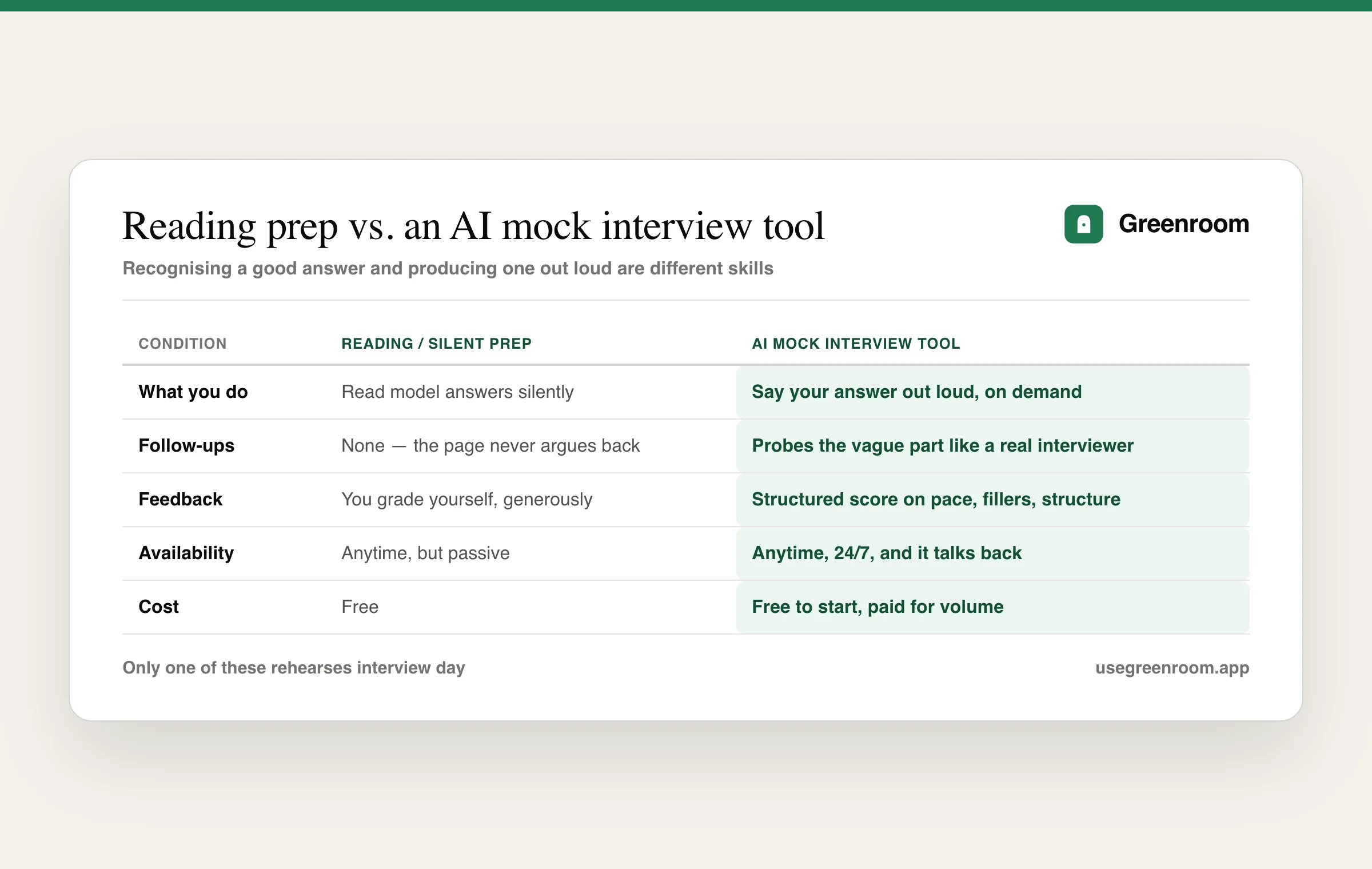
Strip away the marketing and a good AI mock interview tool does four things in order. It asks a role-appropriate question by voice. It listens to your spoken answer and transcribes it. It follows up — the part most people underestimate — probing the hand-wavy bit of your answer the way a real interviewer would. And it scores you afterward on substance and delivery: pace, filler words, structure, whether you actually answered the question.
That follow-up loop is the whole point. Reading a model answer on GeeksforGeeks teaches you to recognize a good answer. An interview mock AI forces you to produce one, out loud, when something interrupts your rehearsed script. Those are different skills, and only the second one shows up on interview day.
AI mock interview tool vs. the alternatives
Be honest about what you're choosing between. Most people prepping for interviews cycle through four options, and a mock interview AI sits in a specific slot among them — not a replacement for everything, but the only one available at midnight.
Question dumps (LeetCode, GeeksforGeeks, a friend's WhatsApp PDF). Great for coverage, useless for delivery. You can grind 300 questions and still freeze when one is asked aloud, because reading silently never rehearsed the talking. They're a content library, not a practice partner.
Generic ChatGPT prompting. Surprisingly decent as a free AI tool for interview prep — it'll role-play an interviewer if you prompt it well (here's how). But you have to script the whole thing yourself, it usually stays in a text box rather than voice, and it's far too generous with praise. It rarely interrupts you, which is exactly the pressure you need to rehearse.
A human mock interview — a peer or a paid engineer — is the gold standard for depth and judgment. It's also slow, hard to schedule, and a real engineer's time can run $100–$200 a session. You get a handful of dress rehearsals, not the dozens of reps that build fluency.
The AI mock interview tool fills the gap the other three leave: unlimited spoken reps, on demand, with follow-ups and a structured score, for a fraction of a human session's cost. The right move isn't "AI instead of humans" — it's AI for volume, a human or two for the final polish. We wrote a longer, fairer breakdown in AI mock vs a real engineer mock.
How to use an AI mock interview tool well
A session is only as useful as how you run it. The tool can't help if you treat it like a quiz you skim.
- Set the real role. Point the AI mock interview platform at the exact role and seniority you're interviewing for — "backend, senior" produces different questions than "new-grad frontend." A generic session gives generic practice.
- Treat it as live. Camera on if it has one, no notes, answer out loud in full sentences. The entire value is rehearsing the conditions, not just the content. Reading bullet points to yourself is not practice.
- Take the follow-ups. When it probes, don't escape to a new question — sit in the follow-up. The second and third question on the same topic is where the actual learning lives.
- Read the feedback past the score. A "7/10" tells you nothing. The useful part is the specifics: you said "basically" eleven times, you buried the answer, you never gave a concrete example. Fix one of those.
- Redo it. Pick a single weakness, run the session again targeting only that. Three to five focused reps and the answer stops feeling like a performance.
For a deeper walkthrough, see how to use an AI mock interview tool and how to prepare for a mock interview before your first session.
Are there free AI tools for interview practice?
Yes — and "free" is one of the most-searched qualifiers for a reason. Most serious platforms, including Greenroom, are AI tools for interview free to start, with a paid tier only when you want high volume. Google's Interview Warmup is genuinely free but read-only — it won't follow up or score you. ChatGPT's free tier works if you bring your own structure. The thing to watch for: a "free" tool that's really a 90-second demo dressed as a product. We ranked the honest options in free AI mock interview tools, ranked.
Where mock interview AI still falls short
No honest guide skips this part. A mock interview AI can't read the room the way a senior engineer can — it won't notice that your "I led the migration" story is quietly taking credit for a teammate's work, and it can't vouch for you to a hiring manager. It's a flight simulator, not a flight. The point of a simulator is that you've logged so many hours that the real thing feels familiar — which is exactly what an AI interviewer is good for, and exactly why you still want one human session before the real one.
Frequently asked questions
What is an AI mock interview tool?
An AI mock interview tool is software that simulates a real interview: it asks questions by voice, listens to your spoken answers, asks follow-up questions when you're vague, and gives you a structured score and feedback afterward on both your substance and your delivery. The best ones run as a real voice conversation rather than a text chatbot.
Are AI mock interview tools free?
Many are free to start, including Greenroom, with paid tiers only for high-volume use. Google Interview Warmup is fully free but won't follow up or score you, and ChatGPT's free tier can role-play an interviewer if you write the prompts yourself. Watch out for "free" tools that are really a short demo rather than a usable product.
Is an AI mock interview as good as a real one?
For volume of realistic spoken practice, yes — an AI tool gives you unlimited reps on demand for a fraction of the cost of a human session. For deep, role-specific judgment on a hard round, a real engineer is still better. The strongest prep uses AI for the dozens of reps and one or two human mocks for the final polish.
Can ChatGPT be used as an AI mock interview tool?
It can, as a free option. ChatGPT will role-play an interviewer if you prompt it carefully, but you have to script the structure yourself, it usually stays in text rather than voice, and it tends to be too generous with praise and rarely interrupts you. A purpose-built voice tool handles the role-play, follow-ups, and grading for you.
How many AI mock interviews should I do before a real interview?
Most candidates need three to five focused sessions per interview type to stop sounding rehearsed and start sounding fluent. Quality beats quantity — redo a session targeting one specific weakness rather than running ten unfocused ones.
What's the best AI mock interview platform in 2026?
The best platform for you is the one that practices the way you'll actually be interviewed: by voice, with real follow-up questions, and with feedback specific enough to act on. Greenroom focuses on spoken practice with GitHub-aware questions and per-answer feedback. Compare a few honestly against your own role before committing.