Karthik had three tabs open before his Zensar technical round: one for OOPs definitions, one for DBMS normal forms, one for his own resume, because he genuinely couldn't remember which line item the interviewer would land on first. She landed on all three, in order, in under fifteen minutes, then spent the next twenty asking "why" after almost every answer. "Why composition over inheritance here? Why third normal form and not second? Why did you pick that library for your project?" Karthik passed. But only because he'd rehearsed saying his answers out loud beforehand, not just reading them silently off a revision doc.
That "why" pattern is the real shape of Zensar interview questions: the fundamentals asked are genuinely basic, but the round is scored on how clearly and confidently you can defend your own answer under a follow-up, not on reciting a definition. I built Greenroom after freezing in exactly that kind of live, follow-up-driven interview: so this guide covers the real rounds, the technical and HR questions, and a prep plan built around speaking, not just revising.
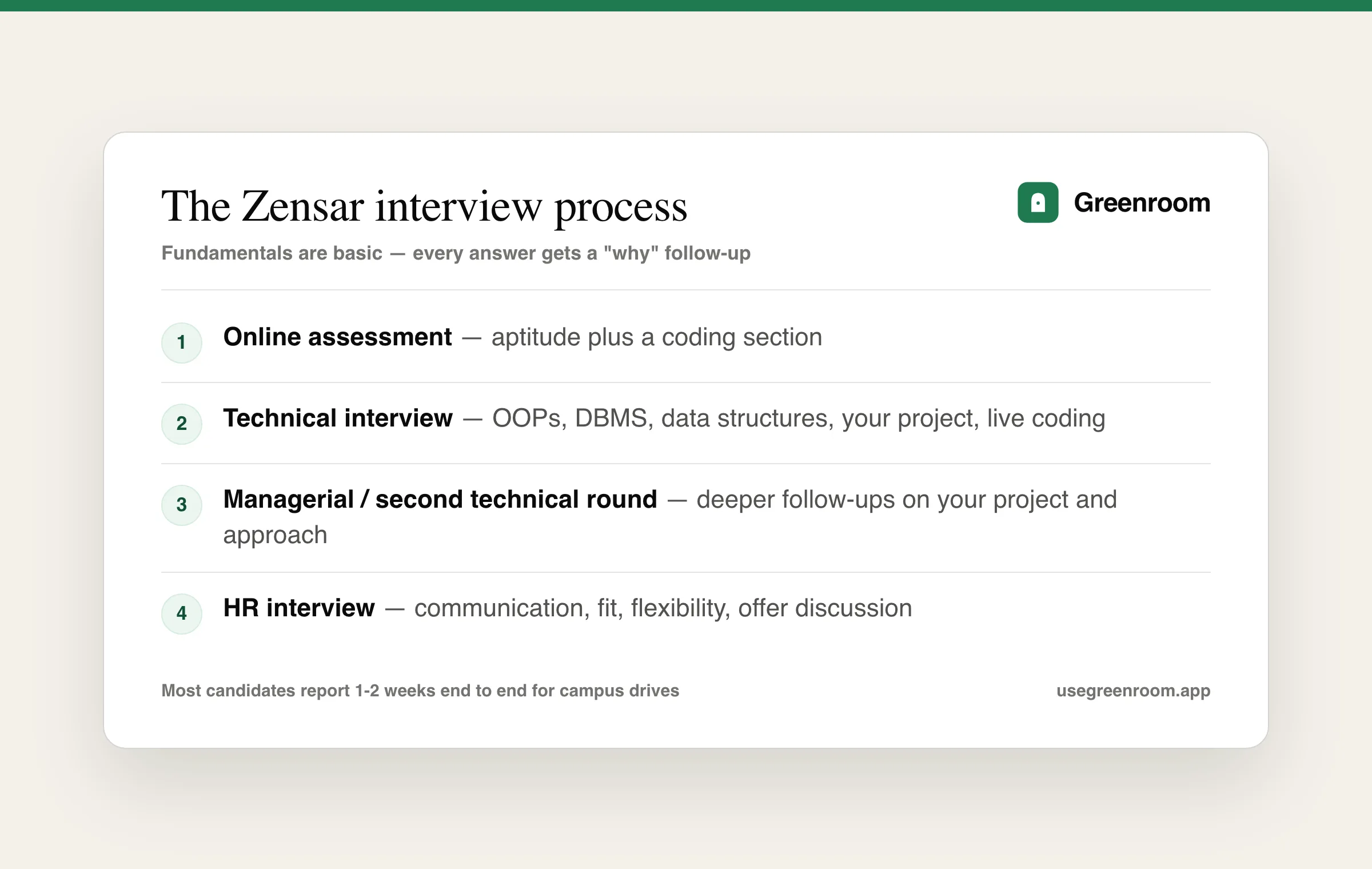
The Zensar interview process
Zensar Technologies, a Pune-headquartered IT services and product-engineering company, runs a fairly standard four-stage process for campus and off-campus hiring:
- Online assessment: aptitude (quant, logical reasoning, verbal) plus a coding section, usually on a platform like AMCAT or HackerRank.
- Technical interview: core CS fundamentals (OOPs, DBMS, data structures), your resume and academic or internship project, sometimes a live coding problem.
- Managerial or second technical round — deeper follow-ups on your project and problem-solving approach, occasionally a short design discussion for stronger candidates.
- HR interview: communication, fit, flexibility on location and shifts, and the offer discussion.
Most candidates report 1–2 weeks end to end for campus drives, with off-campus and lateral hiring sometimes stretching slightly longer.
Zensar technical interview questions
The technical round leans on fundamentals, asked with real follow-ups rather than as standalone trivia:
- OOPs concepts with examples: encapsulation, inheritance, polymorphism, and be ready for "why would you choose this over that" follow-ups. Our OOPs interview guide covers the core patterns.
- DBMS basics: keys, normalization up to 3NF, and SQL joins, explained with a concrete example table, not just definitions. Our SQL interview questions guide has the query patterns.
- Data structures: arrays, linked lists, stacks, queues, and when you'd pick one over another for a real scenario.
- A live coding problem: usually a string or array manipulation problem (palindrome, anagram check, pattern printing), narrated out loud while you write it.
- Explain your project end to end: your specific contribution, one technical decision you made, and one thing you'd do differently now.
Zensar HR and managerial questions
- Tell me about yourself; why Zensar? Know that Zensar works across digital, cloud and product engineering for enterprise clients, not just "it's an IT company."
- Walk me through your project again, what would you change if you rebuilt it today?
- Are you comfortable with relocation and rotational shifts?
- Describe a time you disagreed with a teammate's technical approach. What happened?
- Where do you see yourself in five years? Our answer breakdown covers how to structure this without sounding rehearsed.
How Zensar prep compares to other resources
An honest map of where each resource fits for this specific interview:
- GeeksforGeeks / campus interview-experience threads (solid for calibrating the fundamentals asked, but they read like transcripts, not rehearsal) they won't push back when your explanation is vague.
- LeetCode — useful for the live coding problem, though Zensar's coding bar is closer to "clean and correct" than "algorithmically clever."
- A senior's revision notes — good for scope, risky if you stop at reading them silently instead of saying answers out loud.
- ChatGPT — fine for generating extra OOPs/DBMS practice questions or reviewing a written project summary; it won't ask "why" the way a real interviewer does the moment your answer sounds memorized.
- Greenroom, the spoken layer. Ari, the AI interviewer, runs a live mock covering OOPs, DBMS, your project, and HR questions, then pushes "why" follow-ups the way a real Zensar interviewer would — scoring clarity and confidence, not just correctness.
How to prepare for the Zensar interview
- Revise OOPs, DBMS and data structures fundamentals, then say each answer out loud with a "why I'd choose this" justification.
- Rehearse your project explanation until you can give it in 90 seconds and defend one technical decision under a follow-up.
- Practice one or two live coding problems (string/array manipulation) while narrating your approach, not coding in silence.
- Prepare your "why Zensar" and five-year answers out loud, and decide your stance on relocation and shifts in advance.
- Do at least one full spoken mock covering all four rounds before the real interview.
If you're also interviewing at other Indian IT-services companies, the rounds rhyme but the depth of follow-ups differs, our Wipro interview guide and LTIMindtree interview guide cover where each diverges.
Frequently asked questions
What is the Zensar interview process for freshers?
An online assessment (aptitude plus coding), a technical interview covering OOPs, DBMS, data structures and your project, a managerial or second technical round with deeper follow-ups, and an HR interview. Most candidates report 1–2 weeks end to end for campus drives.
What technical questions does Zensar ask?
OOPs concepts with examples, DBMS basics including keys, normalization and SQL joins, data structures like arrays and linked lists, a live coding problem such as a string or array manipulation task, and a full walkthrough of your project.
Does Zensar ask coding questions?
Yes — expect at least one live coding problem, usually string or array manipulation, narrated out loud. The bar is clean, correct code explained clearly rather than algorithmically advanced solutions.
What makes the Zensar technical round hard?
Not the fundamentals themselves, which are genuinely basic, but the follow-up "why" questions after almost every answer. Candidates who can only recite a definition, without defending the choice behind it, lose points here.
How do I prepare for the Zensar interview?
Revise OOPs, DBMS and data structures fundamentals and say your answers out loud with justification, rehearse your project explanation, practice a live coding problem while narrating your approach, and do a full spoken mock covering all four rounds before the real interview.