The offer letter says "LTIMindtree" and your uncle still calls it "L&T Infotech," which is at least half right and entirely unhelpful when you are trying to work out what they actually ask. The merger closed in 2022; the fresher hiring process that came out of it is a fairly standard three-stage IT-services loop. Here are the LTIMindtree interview questions with real answers, not a list of topics to feel vaguely worried about.
The good news about a predictable process is that preparation converts almost directly into outcome. The bad news is that everyone else in the queue knows that too, so the differentiator is not what you know — it is whether you can say it cleanly in the ninety seconds you get.
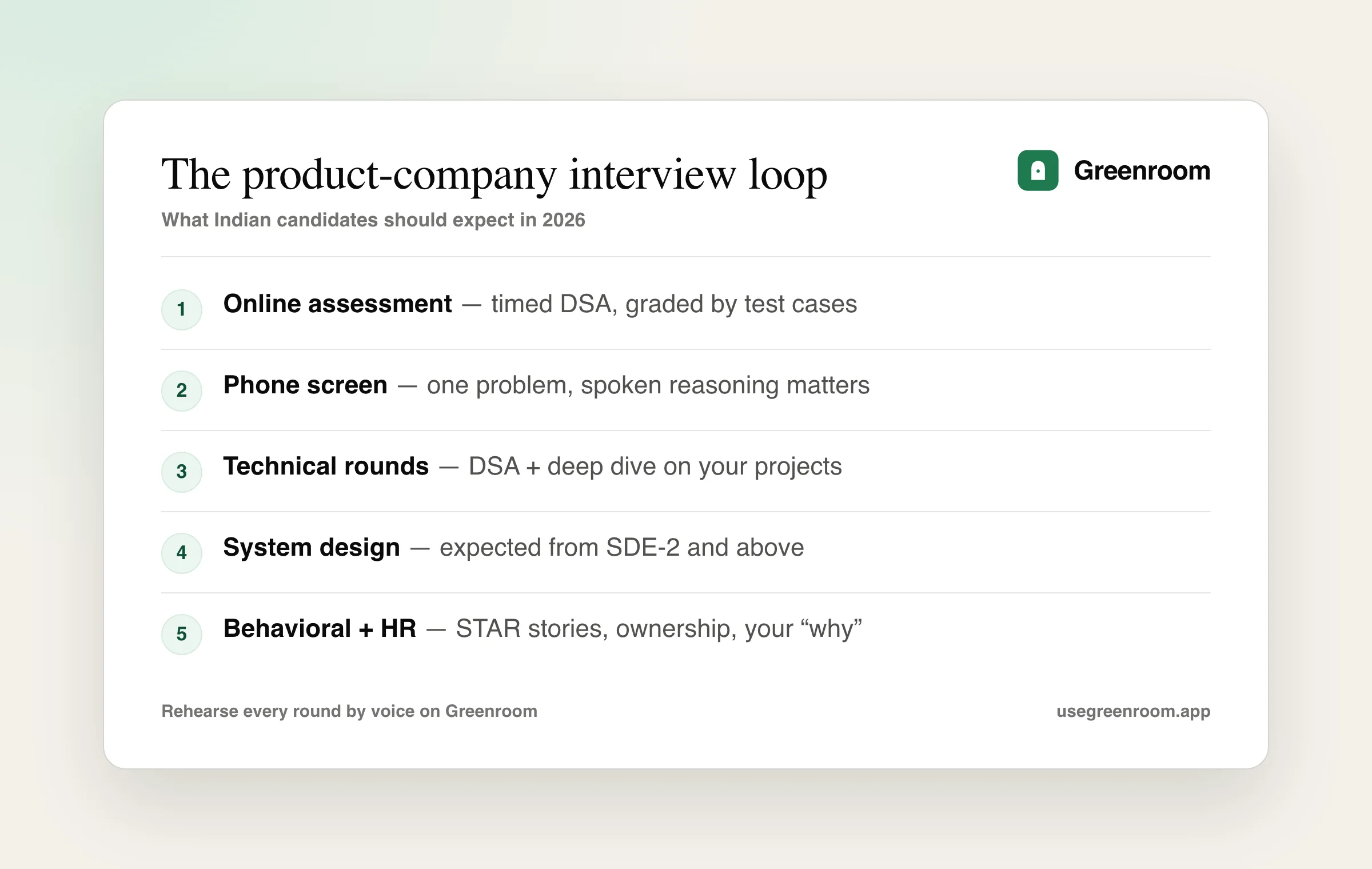
The LTIMindtree interview process
Three stages for most fresher tracks. Formats shift year to year and by campus, so treat the structure as dependable and the specifics — section timings, cut-offs, whether rounds are merged — as something to confirm with your placement cell rather than trust from any blog, this one included.
Round 1 — the online assessment
Aptitude, logical reasoning, verbal ability and coding. The verbal section carries more weight here than candidates expect; LTIMindtree places freshers on client-facing delivery teams, so written and spoken English is a screening criterion rather than a formality. Practise under a timer, because the pressure is the difficulty.
Round 2 — the technical interview
Core CS, one language you nominate, and your project. Typically 20-30 minutes for freshers. Nominate the language you are genuinely strongest in, not the one that sounds most impressive — being asked a follow-up in a language you listed for prestige is a bad way to spend a Tuesday.
Round 3 — the HR interview
Fit, communication, flexibility on location and technology, and the agreement. Short, and rarely the round that fails a prepared candidate — unless you sound unsure about joining.
LTIMindtree technical questions, with answers
Explain the four OOP pillars with an example
Lead with the example and let the definition follow. Encapsulation: a class where the field is private and only its methods mutate it. Inheritance: a subclass reusing behaviour. Polymorphism: one method name behaving differently by type — method overriding at runtime, overloading at compile time, and knowing which is which is a common follow-up. Abstraction: exposing what, hiding how. Our OOPs interview questions guide covers the follow-ups in depth.
What is the difference between DELETE, TRUNCATE and DROP?
DELETE removes rows and can be filtered with WHERE; it is logged row by row and can be rolled back. TRUNCATE removes all rows, is not filterable, and is typically much faster because it deallocates pages rather than logging each row. DROP removes the table structure itself. This exact trio is one of the most reliably asked SQL questions across Indian IT-services interviews — see our SQL interview questions guide for the joins that follow.
What is the difference between a stack and a queue?
LIFO versus FIFO, and then give each a real use: a stack for undo history or call frames or expression evaluation, a queue for scheduling or a print buffer or BFS traversal. Naming the use case is what separates a memorised answer from an understood one. Our data structures guide has the rest.
Write a program to reverse a string without a library function
Two pointers swapping inward, in place, O(n) time and O(1) extra space. Say the complexity aloud without being asked. If they extend it to reversing the words in a sentence rather than the characters, the trick is reversing the whole string and then reversing each word — mention it if you see it coming.
Walk me through your project
Four parts, in order: the problem, what you specifically built, one decision you made and the reason, and one thing that broke and what you did. Candidates lose this question by listing technologies. "We used React, Node and MongoDB" describes a stack, not a contribution. "I wrote the sync logic, and I chose to retry with backoff because the third-party API rate-limited us at peak" describes an engineer. Our guide on explaining your project has the full structure.
LTIMindtree HR questions, with answers
Tell me about yourself
Sixty to ninety seconds, forward-looking: your branch, your strongest technical area, one project or internship that shaped your direction, and what you want next. Not a chronological recital of your schooling. Our self-introduction guide for freshers has worked examples.
Why LTIMindtree?
Have one specific reason. The scale of the fresher training programme, a service line you actually want exposure to, or the delivery centre you would be posted to are all real answers. Generic praise is not, and it is transparently generic to someone who has heard it forty times that week. See how to answer "why do you want to work here".
Are you flexible on location, technology and the agreement?
This is the round's real question, and hesitation costs more than an imperfect answer. If you are flexible, say so plainly. If you have a genuine constraint, state it now rather than after signing. "Flexible on technology" also means being willing to be placed on a legacy stack rather than the thing you wanted — decide how you feel about that before someone asks.
What are your strengths and weaknesses?
One strength with evidence attached, one real weakness with the correction in progress. Evidence means a sentence about a time it mattered, not an adjective. Avoid the perfectionist answer; it reads as an unwillingness to answer the question.
How this compares to the other ways you could prepare
A question bank — PrepInsta, GeeksforGeeks, a shared drive of last year's questions — is worth using and you should use one. For a predictable process, coverage is genuinely most of the job. Its limit is that it cannot tell you whether the answer in your head survives being spoken to a stranger who does not nod encouragingly.
Practising with a friend is better, and the constraint is that a friend rescues you. They fill your silence, accept your first answer, and laugh when you lose your thread. An interviewer does none of that, and the silence is the part people are unprepared for.
Greenroom runs the round out loud and Ari, the AI interviewer, asks the follow-up instead of moving on. The honest limit: nobody outside the process knows this year's cut-off for your campus, and any page claiming otherwise is guessing. What rehearsal fixes is narrower and more useful — that the first time you explain your project is not in the room. Pair it with our campus placement guide and aptitude prep guide. Interviewing across IT services? See our Wipro, TCS NQT and Infosys guides.
A three-day preparation plan
Day 1 — fundamentals. OOP with one example each, SQL including the DELETE/TRUNCATE/DROP trio and joins, four data structures with a use case apiece. One page of notes, handwritten.
Day 2 — your own material. The project in the four-part structure. Your self-introduction. The two HR answers you least want to be asked. Out loud, standing, twice each — and record one, which is uncomfortable and is the point.
Day 3 — full rehearsal. A timed aptitude and verbal set, then one unbroken technical-plus-HR mock so you rehearse switching registers mid-conversation. Stop by evening; nobody has ever been saved by the eleventh hour of cramming.
Frequently asked questions
What is the LTIMindtree interview process for freshers?
LTIMindtree's fresher process has three stages: an online assessment covering aptitude, logical reasoning, verbal ability and coding; a technical interview on core CS, one nominated language and your project; and an HR round on fit, communication and flexibility. Formats vary by campus and year, so confirm the specifics with your placement cell.
What technical questions does LTIMindtree ask?
Expect the four OOP pillars with examples, SQL fundamentals including the difference between DELETE, TRUNCATE and DROP, data structures such as stack versus queue with real use cases, one basic coding question like reversing a string in place, and a full walkthrough of your project. Clear fundamentals matter more than advanced algorithms.
Is LTIMindtree the same as L&T Infotech?
LTIMindtree was formed from the merger of Larsen & Toubro Infotech and Mindtree, completed in 2022. Older preparation material and question banks still circulate under the L&T Infotech name, and the fresher interview shape is broadly similar, but check the year on anything you revise from.
How difficult is the LTIMindtree interview for freshers?
It is a fundamentals interview rather than a hard algorithmic one. Candidates who know OOP, SQL and basic data structures and can explain a project clearly generally clear the technical round. The most common failure is not weak knowledge but unclear delivery, particularly in the verbal section of the assessment and the project walkthrough.
Does LTIMindtree ask about flexibility and a service agreement?
Yes. The HR round covers willingness to relocate, flexibility on which technology or stack you are placed on, and the terms of the agreement. Read the duration and terms before the round so you can answer without hesitating, since uncertainty here reads as flight risk.
How do I prepare for an LTIMindtree interview in three days?
Day one, revise OOP, SQL and data structures with a worked example each. Day two, rehearse your project story, self-introduction and least comfortable HR answers out loud rather than silently. Day three, do timed aptitude and verbal practice plus one unbroken technical-and-HR mock, then stop by the evening.