There's a specific kind of silence that falls over a placement WhatsApp group at 9pm the night before the Wipro NLTH (National Level Talent Hunt) results drop. Someone posts "results out?" every four minutes. Someone else posts a screenshot of their portal still loading, captioned "bro is this normal." Nobody actually knows anything, and everyone is refreshing the same broken college portal at the same time, somehow making it slower for everybody.
If you're reading this because you've cleared the NLTH and have an interview coming up — or you're about to sit the test and want to know what's actually on the other side of it — this is the no-screenshot version. Wipro NLTH is Wipro's national hiring drive for the Project Engineer role, run through an online test followed by a technical interview and an HR round. It's one of the highest-volume entry points into Wipro for engineering graduates in India, and like most large-scale campus drives, the actual interview content is fairly predictable once you've seen it laid out properly — which, going by the chaos in every placement group, almost nobody has.
What Wipro NLTH actually is
NLTH stands for National Level Talent Hunt — Wipro's centralized hiring test for entry-level engineering roles, typically open to final-year students and recent graduates across branches (not just CS/IT, though coding-heavy roles favor CS/IT background). It's run online, usually has a defined eligibility cut-off on your academic percentage (commonly around 60% throughout, though this varies by year and drive), and functions as the single qualifying gate before any interview happens.
The NLTH online test typically covers:
- Verbal ability — reading comprehension, grammar, vocabulary.
- Quantitative aptitude — number systems, percentages, time-speed-distance, probability, data interpretation.
- Logical reasoning — pattern recognition, coding-decoding, seating arrangements, syllogisms.
- Coding/essay-writing — a programming section (one or two problems, usually basic-to-moderate difficulty) and sometimes a short essay-writing component testing written communication.
Clearing NLTH gets you to the interview stage, not the offer — and the interview is where most candidates either consolidate their result or lose it. The honest framing for what follows: Wipro's technical bar at NLTH/Project Engineer level tests fundamentals and clear communication, not competitive-programming-level difficulty. Don't burn your last week before the interview grinding hard algorithm problems when the actual gate is "can you explain a sorting algorithm and your own final-year project clearly."
If you haven't sat the test yet and want a broader campus-season view first, our campus placement interview guide and aptitude test preparation guide cover the online-test stage across companies, including NLTH-style formats.
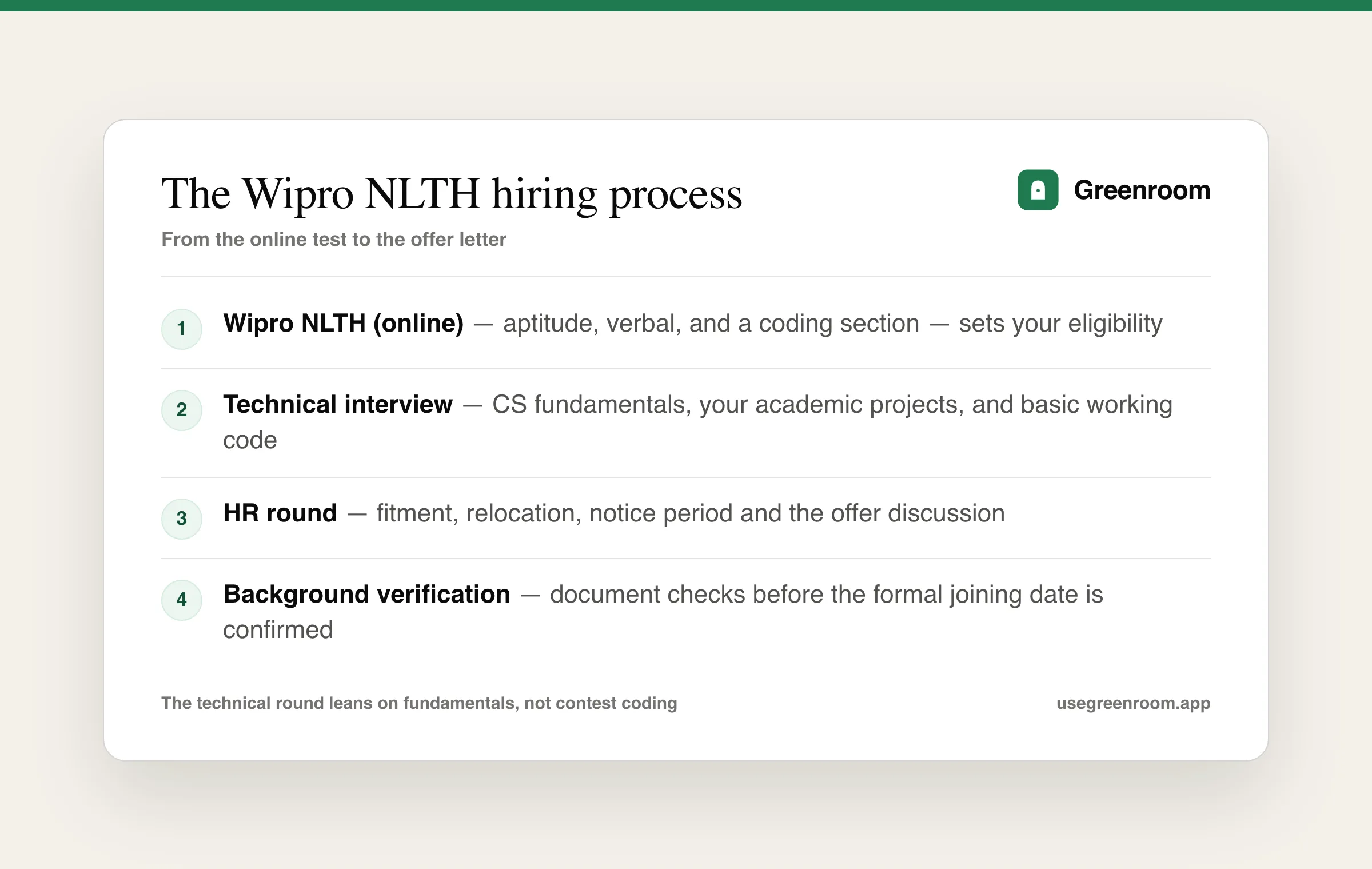
The Wipro NLTH hiring process, step by step
- Wipro NLTH (online) — verbal, quantitative aptitude, logical reasoning, and a coding/essay section. This sets your eligibility for the interview stage; some drives also use your test score to gauge interview difficulty.
- Technical interview — CS fundamentals, your academic projects, and basic working code, conducted either in person or over a video call depending on the drive.
- HR round — fitment, relocation willingness, notice period (for those with existing offers), and the formal offer discussion. Sometimes combined with the technical round into a single longer interview.
- Background verification — document checks (degree certificates, ID proof, prior employment records if any) before the final joining date is confirmed. Not an interview round, but worth knowing it's coming so you're not caught off guard gathering documents at the last minute.
Some drives run the technical and HR rounds back-to-back on the same day; others schedule them separately, sometimes days apart. Prepare for both regardless of format, since you often won't know which it'll be until you're in the room.
Technical interview questions Wipro NLTH actually asks
The technical round at the Project Engineer level draws from core CS fundamentals, basic coding ability, and your own academic project work — not deep specialization in any one area.
Tell me about yourself.
The technical-round version should lean toward your branch, the languages/tools you've used, and one project you can discuss in depth — not your hobbies and family background, which belongs in the HR round. Keep it under a minute; it's a door-opener, not the main event.
What is the difference between a compiler and an interpreter?
A compiler translates the entire source code into machine code (or an intermediate form) before execution, producing a standalone executable; an interpreter executes code line-by-line at runtime without producing a separate executable. Compiled programs typically run faster since translation happens once upfront; interpreted programs are easier to debug interactively since errors surface as execution reaches them, not all at once. Languages like Java sit in between, compiling to bytecode that a virtual machine then interprets (or JIT-compiles).
Explain the difference between stack and heap memory.
The stack stores function call frames and local variables, grows and shrinks automatically as functions are called and return, and is fast but limited in size — a runaway recursive call causes a "stack overflow." The heap stores dynamically allocated memory (objects, anything created with new or malloc) that persists until explicitly freed or garbage-collected, is larger but slower to allocate from, and is where memory leaks live if you forget to free what you allocated (in languages without garbage collection).
What are the four pillars of OOP? Give an example of each.
Encapsulation, abstraction, inheritance, and polymorphism. Tie each to a concrete example from your own project rather than reciting textbook definitions — "I used polymorphism in my hostel management system, where a base Payment class was overridden by CashPayment and OnlinePayment classes, each implementing processPayment() differently" is a stronger answer than the dictionary version. Our OOPs interview questions guide has worked examples for each pillar if you want to prep this properly.
Write a program to check if a number is prime.
A genuinely common ask at this level — interviewers want a short, correct loop, not an elegant one:
function isPrime(n) {
  if (n < 2) return false;
  for (let i = 2; i * i <= n; i++) {
    if (n % i === 0) return false;
  }
  return true;
}
Write it in whichever language you're strongest in — C, Java, Python, or JavaScript are all fine at this level. The interviewer is checking that you can write a correct loop with the right boundary condition (i * i <= n, not i <= n, for efficiency), not that you've memorized a specific syntax.
What is normalization in DBMS?
Normalization organizes database tables to minimize redundancy and avoid update anomalies, typically explained through 1NF (atomic column values, no repeating groups), 2NF (no partial dependency on a composite key), and 3NF (no transitive dependency on non-key attributes). A good interview answer explains why it matters in plain language — "without normalization, the same customer address might be duplicated across many rows, and updating it in only some of them leaves your data inconsistent" — rather than just naming the normal forms. See our DBMS interview questions guide for worked examples.
What is the difference between TCP and UDP?
TCP is connection-oriented, guarantees ordered and reliable delivery via acknowledgments and retransmission, and is used where correctness matters more than speed (web pages, file transfers, email). UDP is connectionless, doesn't guarantee delivery or order, but has lower overhead and latency, making it the right choice for real-time use cases where occasional loss is acceptable (video calls, live streaming, online gaming).
What is exception handling, and why does it matter?
Exception handling lets a program detect and respond to runtime errors (a null reference, a failed file read, invalid user input) without crashing outright. Most languages use a try/catch (or try/except) structure: code that might fail goes in try, and the response to failure goes in catch. The interview signal isn't just knowing the syntax — it's understanding that exceptions should be caught at the level where you can actually do something useful about the failure, not swallowed silently everywhere "just in case."
Explain the SDLC (Software Development Life Cycle).
Requirements gathering, design, implementation, testing, deployment, and maintenance. Wipro, like most large IT services companies, structures a significant share of entry-level work around formal SDLC processes for client engagements, so being able to name the phases and briefly describe what happens in each is directly relevant, not just textbook trivia.
Walk me through your final-year project.
Almost always asked, and almost always under-prepared. Interviewers are checking whether you genuinely built what's on your resume or whether a teammate carried the technical weight while you contributed peripherally. Structure your answer: what the project does, your specific contribution (not "we built an app" but "I built the backend API and the database schema"), what was technically hard about it, and what you'd improve with what you know now. If your real contribution was smaller than the project's overall scope, say so honestly — owning a small, well-understood piece beats vaguely claiming a big one you can't defend under a follow-up question.
HR round questions and how to answer them
The HR round at Wipro NLTH confirms fitment and the practical logistics of the offer — it's lower-stakes than the technical round but not a guaranteed pass.
Tell me about yourself (HR version).
Broader than the technical version: education, a brief personal interest or two, and why you're a strong fit for the role — under 90 seconds. Our self-introduction for freshers guide has a tighter structure with a worked example.
Why do you want to join Wipro?
Be specific rather than generic. A credible answer names something real about Wipro — its scale, its structured entry-level training, the breadth of client industries you'd be exposed to — rather than a copy-paste line that could apply to any company. If you're also interviewing elsewhere, it's fine to be honest about keeping options open, as long as your stated reason for Wipro specifically is genuine.
Are you willing to relocate?
Wipro hires across many locations, and NLTH candidates are sometimes placed in a city different from where they interviewed. Answer honestly — if you have a genuine constraint, name it clearly now rather than risk declining an offer later after the process has run its course, which wastes everyone's time including yours.
What are your strengths and weaknesses?
Pick a strength relevant to the role and back it with a one-line example. For weaknesses, name something real and show active effort to improve it — vague non-answers like "I'm a perfectionist" read as rehearsed and add nothing.
Do you have any other offers or ongoing interviews?
Answer truthfully. Recruiters ask this constantly and aren't looking for a flat "no" — a calm "I'm exploring a couple of other options, but Wipro is a strong choice for me because of X" works fine.
Do you have any questions for us?
Always have one ready. A strong question for an NLTH candidate: "What does the initial training and project allocation process typically look like for someone joining as a Project Engineer?" — specific, shows genuine interest in what happens after the offer. See our questions to ask at the end of an interview guide for more options.
Wipro Project Engineer role and salary — set expectations honestly
Worth being direct about this, since it shapes how you should prep: the Project Engineer role's starting package is on the lower end of entry-level IT-services compensation, and initial project allocation often leans toward support, maintenance, or foundational-skills work rather than greenfield development. That's not a knock on the role — Wipro's structured initial training is a genuinely useful way to build fundamentals, especially coming from a college with limited industry exposure, and plenty of engineers who later land strong product-company roles started in a comparable entry-level service-company position. If a future service-to-product transition is part of your plan, our service-to-product company switch guide lays out a practical roadmap.
How Wipro NLTH compares to other service-company drives — and to generic prep
If you're sitting multiple service-company drives this season, the comparison is useful: Wipro NLTH's technical bar sits close to what TCS Ninja, Cognizant GenC, and Capgemini's entry-level rounds expect — fundamentals, basic coding, clear project explanation — rather than the deeper DSA grind that product companies or higher hiring bands (like TCS Digital) require. See our TCS Ninja interview questions, Cognizant interview questions, and Capgemini interview questions guides for the specific format differences across drives, since the prep largely transfers between them.
It's also worth being honest about how most candidates actually prepare for NLTH, because it affects how useful that prep really is: a GeeksforGeeks-style "Wipro NLTH questions 2026" list, a senior's forwarded PDF, or the same list pasted into ChatGPT and read silently. All three give you the content. None of them simulate the actual interview moment that decides the interview — an interviewer asking a live follow-up about your own project, watching you think it through in real time. Practicing that moment out loud, not just reading about it, is the gap that decides outcomes more than most candidates expect.
Practice the part that actually decides the interview
Fundamentals are learnable from any guide. What's harder to fix the night before is freezing when an interviewer asks an unexpected follow-up about your own project. Greenroom runs voice-first mock interviews that put you through exactly that — explaining your real work out loud, with realistic follow-ups — so the Wipro NLTH interview isn't the first time you've had to do it under pressure.
If NLTH is one of several drives on your calendar, pair this with our TCS NQT interview questions, campus placement interview guide, and fresher interview Q&A guides.
Frequently asked questions
What is Wipro NLTH?
NLTH (National Level Talent Hunt) is Wipro's centralized online hiring test for the entry-level Project Engineer role, open mainly to final-year engineering students and recent graduates across India. Clearing it qualifies you for the technical and HR interview rounds.
What does the Wipro NLTH online test cover?
Verbal ability, quantitative aptitude, logical reasoning, and a coding or essay-writing section. The coding section is usually one or two problems at a basic-to-moderate difficulty level, not contest-level algorithmic challenges.
Is the Wipro NLTH technical interview hard?
Not in the contest-coding sense. Expect CS fundamentals (OOP, DBMS, networking basics), simple working code (a prime-number check, a basic loop), and detailed questions about your own academic projects — the bar is clear reasoning and correct basic code, not advanced algorithms.
What is the Wipro Project Engineer salary and is it worth accepting?
The Project Engineer package sits on the lower end of entry-level IT-services compensation, reflecting the role's foundational nature. It's still a reasonable entry point with structured initial training, and many engineers use it as a stepping stone toward stronger roles, including a later move to product companies.
How many rounds are there in the Wipro NLTH process?
Typically three interview-relevant stages: the NLTH online test (qualifying), a technical interview, and an HR round — sometimes combined into one longer interview — followed by background verification before joining, which isn't an interview but is part of the overall process.
What should I focus on most when preparing for Wipro NLTH?
Beyond aptitude and basic CS fundamentals, the highest-leverage prep is being able to explain your own academic project clearly and specifically under follow-up questions — this is where most candidates lose ground, more often than on the technical questions themselves.