The interviewer has your resume open on their second monitor. They glance at it, then at you, and say: "Walk me through your resume." You freeze — not because you don't know your own career, but because you don't know which version of it they want. The elevator pitch you rehearsed for "tell me about yourself"? That one skips the internship at the company you'd rather forget. The chronological one? You've never actually said it out loud, and now you're deciding whether 2021 was the year you joined or the year you left, live, on camera.
Here's the good news: this question has a shape. It's a different shape from "tell me about yourself," and once you see it, you stop stalling at "so... where do I start."
Why "walk me through your resume" is not "tell me about yourself"
They sound like the same warm-up question. They are not, and treating them as interchangeable is the first mistake.
"Tell me about yourself" is an open pitch. You choose the frame — present, then past, then future — and you're free to skip anything not on the page. It's a 90-second commercial for your candidacy. We cover that formula in how to answer "tell me about yourself" as a software engineer; read that one if the question you got was the open version.
"Walk me through your resume" is document-anchored. The interviewer is literally following along on the page in front of them, line by line, and they expect your narrative to track it — usually chronologically, oldest role to newest. You don't get to skip the confusing 8-month stint in the middle just because it's awkward; they can see it. The question is really asking: "Can you turn this list of dates and titles into a coherent story, in front of me, without notes?"
That distinction changes everything about how you prepare. An open pitch can be memorized in isolation. A resume walkthrough has to survive someone pointing at a specific line and asking "wait, what happened here?" — which is exactly what interviewers do.
What the interviewer is actually testing
Three things, none of which is "did they format their resume well."
Coherence. Do your moves connect, or does each job look like a random restart? A recruiter or hiring manager listening to five jobs in a row is building a mental model of why you make career decisions — and an unexplained jump reads as either bad luck or bad judgment until you supply the reason.
Self-awareness. Can you describe your own trajectory honestly, including the parts that didn't go as planned? Candidates who narrate every job as a triumphant step up sound rehearsed in a way that erodes trust. The ones who say "I took that role for the title bump and it turned out to be the wrong call, here's what I learned" sound like people who reflect.
A map for follow-ups. This is the real reason interviewers open with it. Whatever you emphasize in the walkthrough becomes the menu they order from next. Mention a migration project in one sentence, and there's a decent chance the next question is "tell me more about that migration." The resume walkthrough sets the agenda for the next 20 minutes — most candidates don't realize they're doing this in real time.
The chronological structure that works
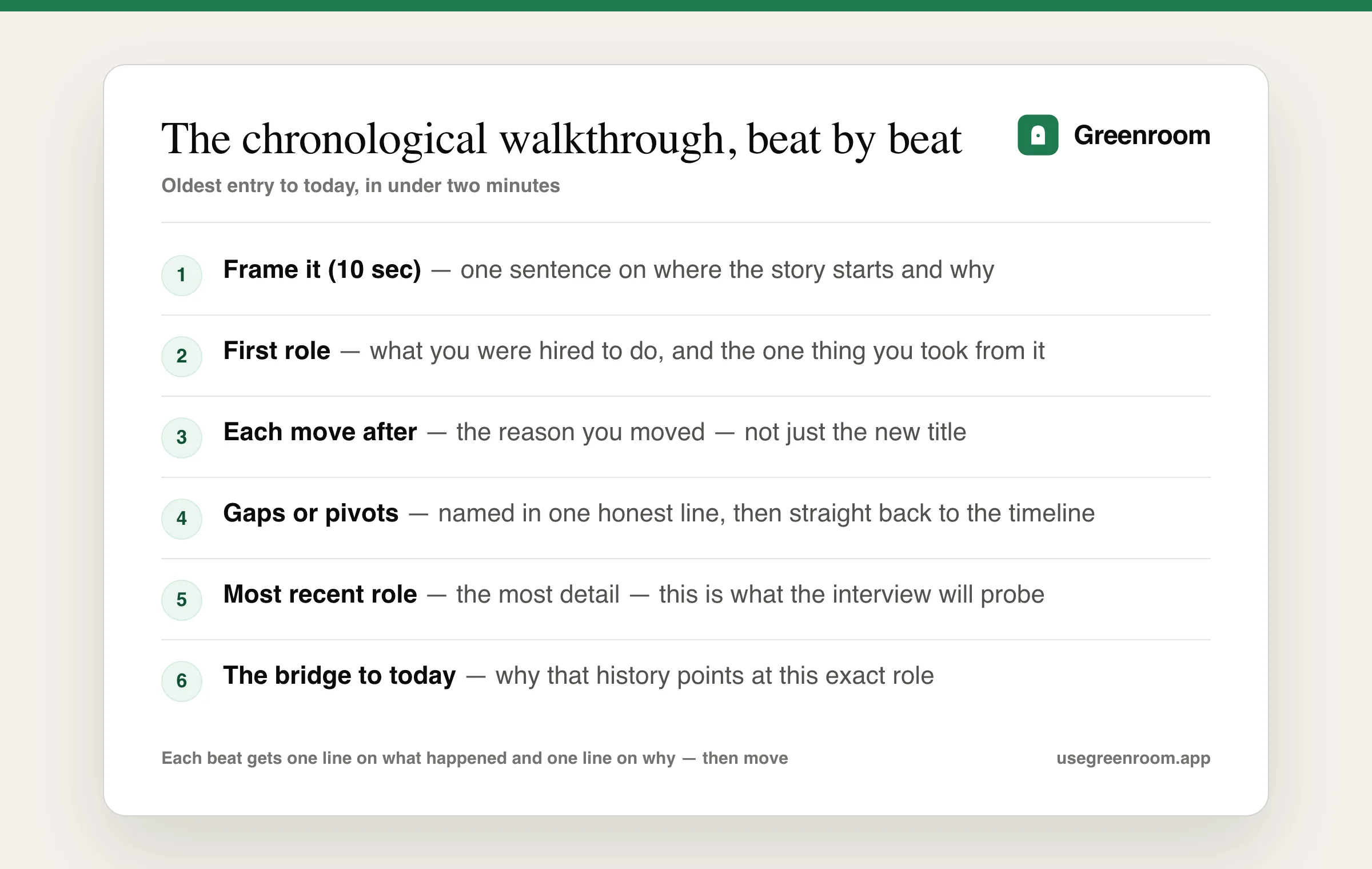
Four moves, in order, oldest to newest. This isn't a script to memorize word-for-word — it's a shape to fill in with your own history.
1. Frame it in one sentence. Before you start listing jobs, tell them where the story begins and why: "I'll walk through it chronologically — I studied X, and my first role was Y, which is where I picked up Z." This single sentence stops the interviewer from having to guess your organizing logic.
2. One line of "what," one line of "why," per role. For each job: what you were hired to do (the "what"), and — critically — why you moved to the next one (the "why"). The "why" is what most candidates skip, and it's the part that actually answers the question. "I joined as a backend engineer working on checkout" is a fact from your resume. "I moved to the payments team after eighteen months because I wanted deeper ownership of a system that couldn't fail silently" is a narrative.
3. Weight your time by recency, not evenly. Spend 10-15 seconds on a role from six years ago and 60-90 seconds on your current one. Interviewers care most about what you're doing now and why you're looking — an evenly-weighted walkthrough of five jobs at 20 seconds each buries the part they actually care about.
4. End with a bridge, not a trail-off. The last sentence should connect your most recent role to why you're in this interview — "...which is what made this role interesting: it's the same problem space, but at a scale I haven't operated at yet." A walkthrough that just stops after the last job title feels unfinished, because it is.
Handling gaps, pivots and short stints inside the walkthrough
This is the part that's specific to the resume walkthrough — because unlike "tell me about yourself," you can't quietly omit the line the interviewer is staring at.
A career gap. Name it in one clause, state the reason plainly, and move straight back into the timeline: "...then there's a seven-month gap in 2023 — I was caring for a family member — and I came back into a contract role at [Company] to get current again." Don't apologize twice, don't over-explain, and don't let the gap eat more airtime than any of your actual jobs. For the longer version of this, see how to explain a career gap in an interview.
A pivot (different stack, different domain, different function entirely). Frame it as a decision, not a drift: "I spent three years in QA automation, then moved into backend engineering because I wanted to own the systems I'd been testing, not just verify them." The resume shows the pivot as a fact; your job in the walkthrough is to supply the reason, which is the one thing the document can't show.
A short stint (under a year). Don't skip past it hoping they won't notice — they're looking at it right now. One honest sentence closes it: "That one was eight months — the team was restructured two months after I joined, and I decided to move rather than wait it out." Short stints read far worse when they're glossed over than when they're named directly. If job hopping is a recurring pattern on your resume rather than a single stint, how to explain job hopping in an interview goes deeper on the framing.
A demotion or lateral move. Same rule: name the "why" honestly. "I moved from senior to mid-level titling when I switched industries — I wanted the domain experience more than the title, and I made that trade knowingly." Said plainly, this reads as judgment. Left unexplained, it reads as a mystery the interviewer will keep turning over.
Five mistakes that sink this answer
Reciting resume bullet points. "I was responsible for developing and maintaining RESTful APIs using Node.js and Express" is a bullet point, not a story — and you're reading the interviewer's own document back to them, which they can already see. Say what you decided and why, not what your job description said.
Going too long. A full walkthrough of a 10-year, six-job career should land in 2-3 minutes. Interviewers who wanted 15 minutes would have asked for a presentation. If you find yourself narrating every project inside every job, you've confused this question with a full work history — pull back to the headline of each role and save project depth for follow-ups.
Skipping context for a jump. The single most common failure: moving from job to job with zero explanation of why, forcing the interviewer to ask "and why did you leave that one?" after every entry. If they have to ask, you've made them do your job for you — and it reads as either evasiveness or a lack of self-reflection, even when neither is true.
Starting from your GPA or college clubs. Unless you're a fresher with no work history yet, don't open the walkthrough with a paragraph on your degree. Get to the first real role fast; the resume itself already lists your education, and dwelling on it before your first job signals you don't have much professional narrative to offer.
Ending on the weakest note. Some candidates instinctively downplay their current role ("and now I'm just doing some backend stuff") right before the bridge sentence that's supposed to sell the interviewer on why they should keep listening. Your most recent role should get your most confident, most specific description — it's the one they'll ask about next.
A full worked script
Here's what this sounds like assembled, for a mid-level backend engineer with one gap and one pivot — adapt the beats, not the exact words:
"Sure — I'll go chronologically. I started as a QA automation engineer at [Company A] right out of college, building test frameworks for a Selenium-based suite. After about two years I wanted to own systems, not just verify them, so I moved into a backend role at [Company B], where I spent three years on their order-management service — mostly reliability work, on-call, that kind of thing.
There's a five-month gap after that — I was dealing with a family health issue and stepped back fully. I came back in through a six-month contract at [Company C] to get current again, working on a payments integration, and that turned into a full-time offer, which I took because the domain was genuinely interesting and the team was small enough that I'd own real scope fast.
I've been there just over a year now, and I recently led the migration of our webhook delivery system off a legacy queue, which is the project I'm proudest of from a systems-design standpoint. That's actually part of why this role caught my eye — it's the same class of problem, distributed reliability, at meaningfully bigger scale than I've operated at."
Notice what that script does: one line per early role, an honest gap explanation with no over-apologizing, real weight on the current role, and a bridge sentence that connects straight to why the interview is happening at all.
What Greenroom does differently here
You can write this script and still fumble it live, because the real interview doesn't let you deliver it uninterrupted — it interrupts you mid-walkthrough with "wait, why did you leave that one?" or "what exactly did the migration involve?" and the answer has to hold up in real time, not just on paper. A written script and a WhatsApp-forwarded PDF of "common interview questions" both fail the same way: they prepare you for the version of the question where nobody talks back.
Ari, the AI interviewer behind Greenroom, runs your resume walkthrough out loud and interrupts it the way a real interviewer would — asking why you left a role, pushing on a gap, or digging into the project you glossed over in one sentence — then tells you plainly where the narrative lost coherence. That's different from reading this structure silently or rehearsing it alone in a mirror: you find out whether your "why" for each move actually survives being questioned, before it's the real interview finding that out for you.
Frequently asked questions
How is "walk me through your resume" different from "tell me about yourself"?
"Tell me about yourself" is an open pitch — you choose what to include and can use a present-past-future frame that skips anything not relevant. "Walk me through your resume" is document-anchored: the interviewer is following your actual resume line by line and expects a chronological narrative that accounts for every entry, including gaps and short stints, because they can see them on the page.
Should I go chronological or start with my most recent job?
Chronological, oldest to newest, is the default and what most interviewers expect when they say "walk me through your resume" — it matches how they're reading the document in front of them. Reverse-chronological works if the interviewer explicitly asks to "start with your current role," but absent that instruction, oldest-to-newest is safer and easier to follow.
How long should my resume walkthrough be?
Two to three minutes for most careers, regardless of how many jobs are on the resume. Spend more time on recent, relevant roles and less on early ones — a few seconds each for jobs from many years ago, and 60-90 seconds on your current or most recent role, since that's what the interviewer will likely ask follow-ups about.
What do I say about a job I left after a few months?
Name it directly in one sentence with the real reason, then move on: "that one was eight months — the team was restructured shortly after I joined, so I moved." Don't skip it hoping they won't notice, since they're looking at your resume while you talk, and don't spend more time explaining it than you spend on any actual role.
Do I need to mention every single job on my resume?
Cover every job that appears on the version of the resume the interviewer has in front of them — skipping one they can see creates an obvious gap in your own narrative and invites the exact question you were avoiding. If your resume is very long, it's fine to summarize older, less relevant early-career roles in a single sentence rather than giving each one equal treatment.
What if my career doesn't have a clean, logical story?
Most careers don't, and interviewers know that — the goal isn't to manufacture a perfect narrative arc, it's to show you can explain your own decisions honestly. A pivot, a lateral move, or a job taken purely for the money are all fine to state plainly as what they were; what reads badly is dressing up an ordinary decision as a grand strategic plan, since interviewers can usually tell.