---
title: How to Survive a Full-Day Onsite Interview
description: Most candidates do not fail the hardest round, they fail the fourth one. How to manage energy, repeat your story freshly and stay sharp across a full interview loop.
url: https://usegreenroom.app/blog/how-to-survive-a-full-day-onsite-interview
last_updated: 2026-07-31
---
← Back to blog
Interview Skills
# How to survive a full-day onsite interview
July 31, 2026 · 12 min read
Spain won the World Cup this month by scoring in the 106th minute — deep into extra time, in a final that had refused to break for an hour and three quarters. The player who scored, Ferran Torres, had not started the match. He came on fresh into a game where everyone else was running on fumes, which is a fairly precise description of what it feels like to be the fifth interviewer in someone's onsite loop.
Because here is the pattern nobody warns candidates about: people rarely fail the hardest round. They fail the fourth one. The system design round they had genuinely prepared for, arriving at 3:40pm after four hours of talking, on half a sandwich. This guide is about the part of interviewing that is physical rather than technical — managing energy across a full loop, and staying as sharp in round five as you were in round one.
## Why the late rounds go badly
A full onsite is typically four to six rounds of 45 to 60 minutes, sometimes across a single day, sometimes spread over a week. The failure mode is predictable and it is not about knowledge:
- Cognitive fatigue is real and it hits the exact faculties you are scored on — working memory, verbal fluency, and the self-monitoring that stops you rambling. You do not become less intelligent; you become less articulate, which reads the same from the other side of the table.
- Your story degrades through repetition. By the fourth telling, "tell me about yourself" comes out flat and over-rehearsed, and the interviewer hearing it for the first time reads that flatness as disinterest.
- Blood sugar and hydration are not a joke. Four hours of concentrated talking with no proper break produces exactly the fog you cannot afford.
- Emotional carryover. One round that went badly leaks into the next two, and candidates spend round four mentally re-litigating round three instead of listening to the question.
None of this is a character flaw. It is physiology plus an interview format that was not designed around it, and it is manageable once you plan for it deliberately.
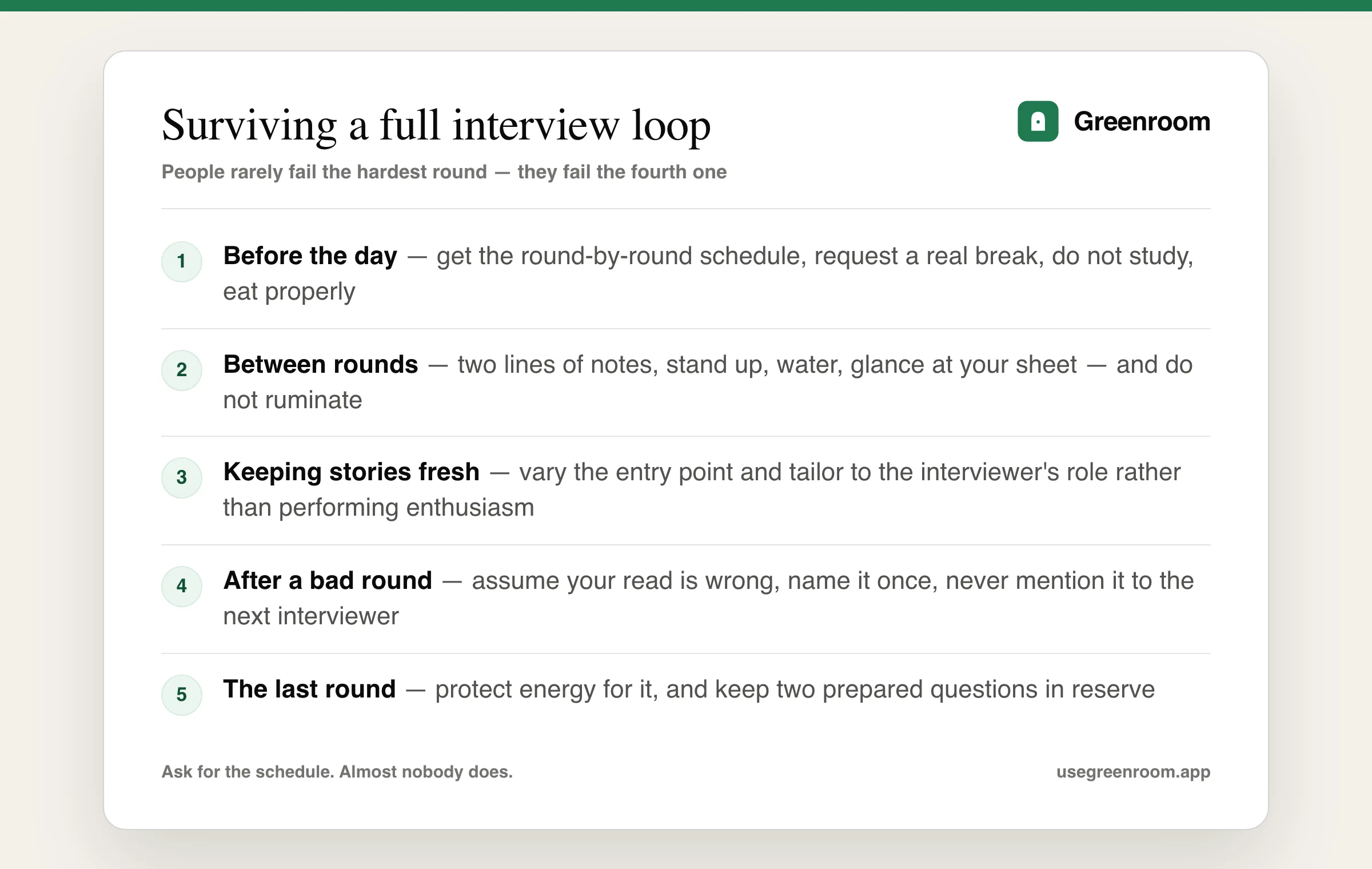
Managing a full interview loop: the plan matters most in the ninety seconds between rounds.
## Before the day
- Ask for the schedule in advance. How many rounds, what each covers, how long, and where the breaks are. Recruiters answer this readily and almost nobody asks. Knowing round four is system design changes how you pace rounds one to three.
- Request a real break if the schedule has none. "Would it be possible to have fifteen minutes around midday?" is a completely normal request and is never held against you. A loop with no gap is an oversight, not a test.
- Do not study the night before. Sleep is worth more than any last-minute revision, and new material learned the night before is unconsolidated anyway. Our week before the interview checklist covers the run-up.
- Eat properly and bring food. Something with protein rather than a sugar spike that collapses at 2pm. Bring water and actually drink it.
- Prepare a one-page cheat sheet for yourself: your two-minute intro, five stories, and the questions you want to ask. Not to read from — to glance at in the gaps so you are not retrieving cold.
## Between rounds: the ninety seconds that matter most
The gaps are short and most people spend them replaying the round that just ended. That is the worst available use of the time. A simple protocol:
- Write two lines about what just happened — what you were asked, and anything you promised to follow up on. This closes the round mentally and gives you material for the thank-you note.
- Then physically reset. Stand up, walk, look at something more than two metres away, drink water. Thirty seconds of this does more than five minutes of rumination.
- Glance at your sheet for the next round's shape, not its content.
- Do not debrief with yourself. There is no useful analysis available mid-loop, and the analysis you will produce while tired is uniformly too harsh.
If it is a remote loop, the same rules apply with more discipline, because there is no walk between rooms to force the reset. Stand up between calls. Do not check email.
## Keeping your story fresh on the fourth telling
You will repeat your background, your main project and your motivation several times. The interviewer in round four has not heard it, and it is your job to sound like it is the first time — which is genuinely hard when you are tired of your own voice.
What works:
- Vary the entry point deliberately. Start one telling from the problem, another from the team, another from what surprised you. The content is the same; the freshness comes from the angle.
- Tailor to the interviewer's role. Your project explained to a hiring manager should foreground impact and tradeoffs; the same project to a senior engineer should foreground the technical decision. This is easier than performing enthusiasm, and it lands better.
- Watch the compression instinct. Fatigue makes people abbreviate — dropping the context that made the story make sense. If you catch yourself starting mid-story, slow down and reset the frame.
- Ask a question back. "Have you worked on that part of the system?" turns a monologue into a conversation, which is less tiring for you and more engaging for them.
Our how to explain your project and tell me about yourself guides cover the underlying structures.
## Recovering from a round that went badly
This is the single highest-leverage skill in a full loop, because one weak round is survivable and three are not — and rounds two and three usually go badly for emotional reasons rather than technical ones.
- Assume your read is wrong. Candidates are famously poor at judging their own rounds; interviewers routinely score highly a round the candidate thought was a disaster. Your assessment while tired and adrenalised is not evidence.
- Remember that panels usually average. At most companies each interviewer submits independently and a committee or hiring manager weighs them together. One weak signal among four strong ones frequently still passes.
- Name it once and drop it. Say to yourself, "that one was weak, the next one is separate," and then genuinely move on. Written on your notepad, it stops circling.
- Do not apologise for it in the next round. Referencing an earlier round to a new interviewer imports a problem they did not have.
Our recovering from blanking and staying calm guides cover the in-the-moment version.
## The last round, and the questions you ask
The final round is usually the one you are least equipped for and it is often the most senior person. Two things help disproportionately.
First, front-load your energy management so you have something left — this is the whole reason for the breaks, the water and the protocol above. Treat the last round as the one you are protecting the others for.
Second, have real questions prepared, because "do you have questions for me?" arrives when you are least able to invent one, and a limp answer is the last impression the interviewer carries into the debrief. Prepare six, so that when four get answered during the day you still have two. Ask about the actual work, the team's current problem, or how success is measured in the first year. Our questions to ask at the end of an interview guide has options worth stealing.
Then send a short thank-you note the same day or the next morning, referencing something specific from a conversation — which is why you wrote two lines after each round. Our thank-you email guide covers the format.
## Coffee, breathing apps, ChatGPT — where each fits
- Sleep the night before — the highest-leverage intervention available and the one most often sacrificed.
- Caffeine, used deliberately — helpful, and easy to overdo into jitter that reads as nervousness. Whatever your normal amount is, that is the amount.
- Food with protein and water — unglamorous and genuinely the difference in round four.
- Physiological sighs or box breathing — a real, fast way to drop arousal between rounds; our breathing techniques guide covers what works.
- Your recruiter — an underused ally for schedule and break requests, because they want you to perform well.
- ChatGPT — fine for generating practice questions. It cannot simulate being the fourth conversation of your day, which is precisely the variable that breaks people.
- Greenroom — the spoken layer. Ari, the AI interviewer, lets you run several rounds back to back so you find out where your fade starts before a real loop does. Fair tradeoff: Ari cannot make you sleep.
> The core truth: full-day loops are decided by stamina at least as much as by knowledge. Ask for the schedule, take real breaks, reset physically between rounds, and protect enough energy for the last one — because that is usually the round that decides it.
## A checklist for the day
- Week before: ask for the round-by-round schedule and request a midday break if there is none.
- Night before: no new material, one-page sheet ready, sleep.
- On the day: eat properly, bring water and food, arrive early enough to not be rushed.
- Between rounds: two lines of notes, stand up, water, glance at the sheet, do not ruminate.
- After a bad round: name it once, assume your read is wrong, do not mention it to the next interviewer.
- Last round: two questions still in reserve, then a specific thank-you note the same day.
Also useful: our how long is a technical interview guide covers formats, and the signs an interview went well or badly guide covers why your own read is unreliable.
## Frequently asked questions
### Why do candidates perform worse in later interview rounds?
Cognitive fatigue degrades exactly the abilities interviews score — working memory, verbal fluency and the self-monitoring that prevents rambling. You do not become less capable, you become less articulate, which reads identically from the interviewer's side. Repetition also flattens your prepared answers, low blood sugar and dehydration compound it, and a round that went badly tends to leak into the next two as candidates re-litigate it instead of listening.
### Can you ask for a break during an onsite interview?
Yes, and it is completely normal. Ask the recruiter in advance for the round-by-round schedule and request a fifteen-minute gap around midday if the loop has none. A schedule with no break is usually an oversight rather than a deliberate test, and requesting one is not held against you. You can also ask for a short pause between rounds on the day if you need it.
### How do you keep answers fresh when repeating them to several interviewers?
Vary the entry point deliberately — start one telling from the problem, another from the team, another from what surprised you — so the content stays consistent while the delivery stays alive. Tailor emphasis to the interviewer's role, foregrounding impact for a hiring manager and technical tradeoffs for a senior engineer. Watch for the fatigue instinct to compress, which drops the context that made the story coherent.
### What should you do between interview rounds?
Spend the first thirty seconds writing two lines about what you were asked and anything you promised to follow up on, which closes the round mentally and gives you material for the thank-you note. Then reset physically: stand up, walk, look into the distance, drink water. Glance at your prepared sheet for the next round's shape. Avoid replaying the round that just ended, since mid-loop self-assessment while tired is uniformly too harsh.
### How do you recover after one bad interview round?
Assume your read is wrong, because candidates judge their own rounds poorly and interviewers frequently score well a round the candidate thought was a disaster. Remember that panels usually average independent scores, so one weak signal among several strong ones often still passes. Name the round as weak once, write it down so it stops circling, and never reference it to a later interviewer, which only imports a problem they did not have.
### How many questions should you prepare to ask interviewers?
Prepare about six, because several will be answered naturally during the day and you still want two in reserve for the final round. The question arrives when you are most tired and least able to invent one, and a limp answer becomes the last impression carried into the debrief. Good options cover the actual day-to-day work, the team's current hardest problem, and how success is measured in the first year.
You can rehearse the fade. Greenroom lets you run several mock rounds back to back with Ari, so you find out where your energy drops before a real loop does. Free to start. Curious how it works? See how AI mock interviews work.