"How do you handle stress and pressure?" is really asking: when things go wrong, do you fall apart or do you have a system? Every job has pressure, and the interviewer wants evidence you stay effective under it. The weak answer is a claim — "I work well under pressure." The strong answer is a method plus a real example that proves it. Here's how.
The formula
- 1. Show you have a system — how you actually manage pressure (prioritize, break work down, communicate early).
- 2. Give a specific example — a genuinely high-pressure situation you handled.
- 3. Show the outcome — you stayed composed and delivered.
Don't claim pressure doesn't affect you — that reads as either dishonest or oblivious. Show that it does, and that you have a way through it.
Example answer
"When pressure spikes, my first move is to stop and prioritize instead of reacting. Last quarter a major client demo broke the night before, and three things were on fire at once. I listed every issue, ranked them by impact on the demo, fixed the two blockers that actually mattered, and communicated early to the team so no one duplicated work. We shipped a working demo on time. Staying calm and triaging beats panicking and touching everything — that's been true every time."
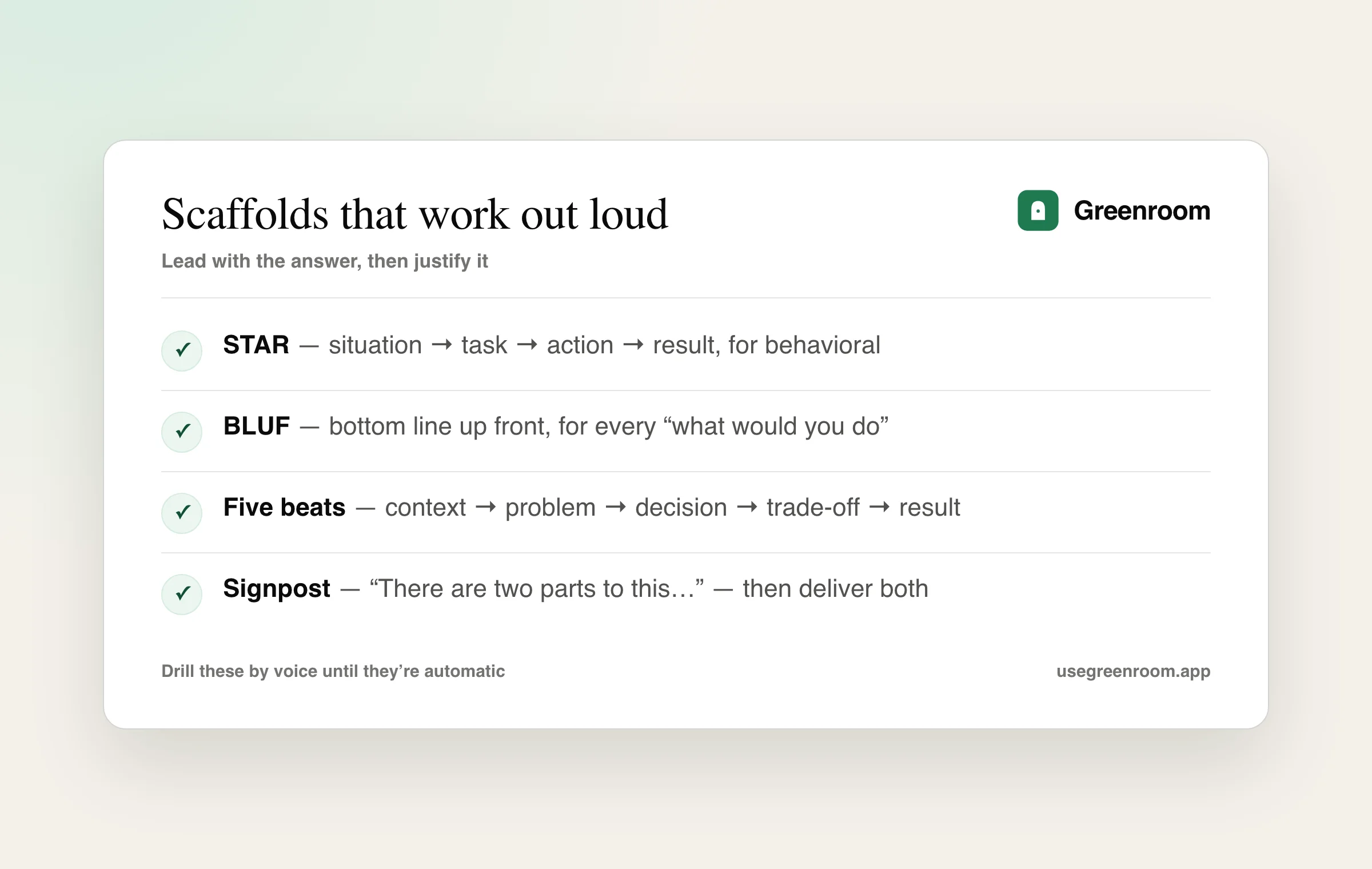
What your system can include
- Prioritization — separate urgent-and-important from noise.
- Breaking it down — turn a scary problem into small steps.
- Communication — flag risk early instead of going silent.
- Composure habits — a short pause, a breath, a quick plan before acting.
Answers that raise red flags
- "I don't really feel stress." — Unbelievable, and it suggests low self-awareness.
- "I just push through and work longer hours." — Signals burnout, not skill.
- A vague claim with no example.
- An example where you actually didn't handle it well.
How to deliver it
Ironically, this question is itself a pressure test — how you answer signals how you cope. Rehearsing a calm, structured answer out loud trains exactly the composure it's probing. Greenroom asks this in a real voice interview and tells you whether you sounded composed and structured. Pair it with our guides on interview anxiety and staying calm under pressure.
Frequently asked questions
How do I answer 'how do you handle stress and pressure?'
Show you have a system — how you prioritize, break work down and communicate early — then give a specific example of a high-pressure situation you handled, and end with the outcome where you stayed composed and delivered. A method plus proof beats the empty claim 'I work well under pressure.'
Should I say pressure doesn't affect me?
No. Claiming pressure doesn't affect you reads as either dishonest or low on self-awareness. Acknowledge that high-pressure situations are real and demanding, then show that you have a reliable way through them — prioritizing, triaging and communicating — proven by a concrete example.
What example should I use for the pressure question?
Use a genuine high-pressure moment where you stayed effective — a tight deadline, a production incident, or competing priorities. Walk through how you triaged and prioritized, how you communicated, and the successful outcome. Avoid examples where you actually didn't cope well or where you just worked longer hours.
How do I practise answering this question?
Rehearse a calm, structured answer out loud, since how you deliver it signals how you actually handle pressure. A voice-based mock interview that asks the question and gives feedback on whether you sounded composed and organized trains the exact composure the question is probing.