You're forty minutes into a final-round interview for a business analyst role at a mid-size fintech, and it's going well — suspiciously well. You've defined a BRD, you've name-dropped MoSCoW twice, you've said "stakeholder alignment" with the easy confidence of someone who has clearly Googled "business analyst interview questions" at least once. Then the hiring manager leans back and says, "Okay, real scenario. Engineering just told me the feature marketing promised in yesterday's all-hands can't ship for eight weeks. Marketing already told a client it's launching Friday. Walk me through what you do in the next two hours."
Your easy confidence packs its bags and leaves the room without you. You start with "well, I'd schedule a meeting" — which is true, and also the single most boring sentence available to you in this moment, and the interviewer knows it, because every BA candidate says some version of "I'd schedule a meeting" right before the actual interview begins. You haven't yet said who's in the meeting, what you'd bring to it, what you'd tell the client in the meantime, or what happens to the eight other things on engineering's plate if you negotiate this one up the queue. The silence that follows is the specific silence of someone realizing that "communication skills" was always going to mean more than being a generally pleasant person who nods a lot in standups.
This is, almost word for word, the moment that separates business analysts who can talk about the job from business analysts who can actually do it under a clock. The BA role is sometimes dismissed — unfairly — as the "softer" seat in the room, the one between the people who decide what to build and the people who build it. In practice it's one of the harder interviews to prepare for precisely because it isn't a single skill. You're being tested on structured thinking (can you turn a vague ask into a requirement someone can actually build), enough technical fluency to not get steamrolled by engineering (SQL, basic data literacy, knowing what a sprint actually is), and a genuine diplomatic skill that most technical interviews don't test at all — the ability to sit between two people who are both a little frustrated with each other and get them to a decision instead of a standoff.
This guide covers the business analyst interview questions that actually come up in 2026 — requirements gathering and documentation, Agile vs Waterfall and your role in each, stakeholder management and conflict scenarios, the SQL and data-literacy bar interviewers actually check for, a worked case-study question close to the one above, how candidates typically prepare and where each method falls short, and a realistic prep plan — organized by area, with a real answer and the reasoning behind it for each one.
What a business analyst interview is actually testing
Before the question list, it's worth naming the three things every BA interview is quietly grading underneath whatever specific question is being asked, because it reframes how you should answer almost everything below.
Structured thinking. Can you take an ambiguous business problem ("sales wants a dashboard") and break it into a defined scope, clear requirements, and acceptance criteria — without either over-engineering a simple ask or under-specifying a complex one. Interviewers watch for whether you ask clarifying questions before proposing a solution, or jump straight to "here's what I'd build," which usually means you're solving the problem you assumed rather than the one that was actually described.
Translation fluency. Can you take what a stakeholder said in business language ("the report takes too long to run") and turn it into something an engineer can act on ("the nightly batch job exceeds its SLA window when the customer table crosses 2M rows — we need either an indexed query or a pre-aggregated summary table"), and then translate the engineering answer back into something the stakeholder understands without either side feeling talked down to.
Diplomatic judgment under real disagreement. This is the one most candidates under-prepare for, because it's genuinely uncomfortable to rehearse. BA interviews almost always include a scenario where two sides want incompatible things and you're the person in the middle — the actual skill being tested is whether you have a repeatable process for getting to a decision (not just "I'd be a good listener"), and whether you can describe a real time you used it.
Requirements gathering and documentation
How do you gather requirements from stakeholders?
There's no single "right" technique — the skill is picking the right one for the situation, and saying so out loud is itself part of a strong answer. Interviews and workshops work best early, to surface what stakeholders think they want before anything is documented. Job shadowing / process observation catches the gap between what people say they do and what they actually do — genuinely common, and a strong example to have ready ("the stated process said approvals went through a manager; shadowing showed half the team was bypassing it via Slack because the form took too long"). Document analysis (existing SOPs, old tickets, support logs) gives you historical context without burning a stakeholder's time. Surveys scale when you need input from a large, dispersed group rather than a handful of decision-makers. Prototyping — sketching a rough wireframe or mock report and reacting to it together — surfaces requirements people couldn't articulate in the abstract but instantly recognize when they see something close to wrong. A strong answer names two or three of these, picks based on the situation, and gives a real example rather than reciting the full list as if it's a vocabulary test.
What's the difference between functional and non-functional requirements?
A functional requirement describes what the system must do — "the system shall let a user reset their password via email link," "the report shall be exportable to CSV." A non-functional requirement describes how the system must behave while doing it — performance ("the search must return results in under 2 seconds at 95th percentile"), security ("passwords must be stored hashed, never plaintext"), availability, scalability, usability. The common interview trap: candidates list non-functional requirements as an afterthought, or skip them entirely, and then get asked "what if 10,000 people use this feature on day one" — a question that's trivial if you'd already thought about load as a requirement, and awkward if functional behavior was the only thing you specified.
What documents does a business analyst actually produce, and when do you use each?
A BRD (Business Requirements Document) captures the why and the what at a business level — the problem, the goals, the scope, success metrics — written for stakeholders and sponsors, before any solution design starts. An FRD (Functional Requirements Document) or FSD (Functional Specification Document) gets more solution-specific — the actual system behavior, screens, fields, business rules — written for the technical team to build against. User stories ("As a [user], I want [goal], so that [benefit]") are the Agile-flavored, lighter-weight alternative to a full FRD, broken into small, independently shippable increments rather than one large spec. Acceptance criteria attach to each user story or requirement and define exactly what "done" means — specific, testable conditions, not a vague "it should work well." The interview signal: knowing when you'd write a heavyweight BRD/FRD (a regulated, multi-team, waterfall-shaped project) versus lightweight user stories (a fast-moving Agile team that ships weekly) shows judgment, not just vocabulary.
What is a use case, and how is it different from a user story?
A use case describes a complete interaction between an actor and a system to achieve a goal, including the main success path and alternate/exception flows — "User attempts to reset password" → main flow (email sent, link clicked, password reset) plus exception flows (email not on file, link expired, password fails complexity rules). A user story is a much smaller, single-sentence unit of value, usually without explicitly enumerating every alternate flow inline — those typically live in the attached acceptance criteria instead. Use cases tend to show up in heavier, traditional environments (insurance, banking, government systems where every exception path needs to be documented for compliance); user stories dominate in Agile teams that prefer many small, frequently-delivered increments. Knowing both, and being able to say which fits a given team's working style, is the actual skill — not picking a "correct" one, since both are correct in different contexts.
How do you handle changing or conflicting requirements mid-project?
Changing requirements aren't a failure of the process — they're the default state of any real project, and the interview is checking whether you have a repeatable way to absorb change without quietly breaking scope, budget, or trust. The mechanism is change control: any new or modified requirement gets logged, its impact on timeline/cost/other requirements gets assessed (often with the technical lead), and it goes through a lightweight approval step with whoever owns the budget or roadmap before it's silently folded into the current sprint or release. For conflicting requirements — two stakeholders who each genuinely believe their version is correct — the fix isn't picking a side; it's getting both in the same room (or thread) and tracing each requirement back to the underlying business goal it's supposed to serve, because conflicts often dissolve once you discover both stakeholders actually want the same outcome and just described it differently. A strong answer narrates a real instance of this, including what the underlying shared goal turned out to be.
Stakeholder management and methodology
How do you manage difficult or conflicting stakeholders?
Interviewers are listening for a process, not a personality trait like "I'm a people person." A workable framework: identify each stakeholder's actual interest (not just their stated position — a stakeholder who insists on a specific UI layout might really care about reducing support tickets, which opens other solutions), find the overlap between competing asks before declaring a winner, bring data rather than opinion when a decision needs to be made ("usage logs show feature X is used by 2% of users; feature Y is used by 40%" beats "I think Y matters more"), and escalate transparently rather than letting a disagreement quietly stall a project — looping in a sponsor or product owner with a clear recommendation, not just dumping the conflict on someone more senior. The weakest answers here describe pure conflict-avoidance ("I just try to keep everyone happy"); the strongest describe a real disagreement, the actual mechanism used to resolve it, and the outcome.
Agile vs Waterfall — what's actually different about your role in each?
In Waterfall, requirements are gathered comprehensively up front, frozen into a BRD/FRD, and handed to engineering for a long build phase with formal sign-off gates between stages — the BA's role concentrates heavily at the start (deep requirements work) and at acceptance testing near the end, with comparatively less day-to-day involvement during the build. In Agile, requirements are gathered continuously and broken into small, independently valuable increments (user stories) that get refined, built, and reviewed every sprint — the BA's role is constant and embedded: writing and refining stories, running or supporting backlog grooming, clarifying edge cases with developers mid-sprint, and validating each increment as it ships rather than waiting for one big acceptance test at the end. Most real organizations in 2026 run some hybrid — Agile delivery cadence with a Waterfall-shaped governance layer on top for budget and compliance — and a candidate who can describe working comfortably in that hybrid reality reads as more useful than one who insists on a pure version of either methodology.
What is stakeholder analysis, and how do you prioritize requirements?
Stakeholder analysis maps who's affected by or has influence over a project, typically along two axes — power/influence and interest/impact — so you know who needs deep, frequent engagement (high power, high interest) versus who just needs to be kept informed (low power, low interest) versus who needs careful, proactive management because their interest is high but doesn't match their formal authority. For prioritizing the requirements themselves, MoSCoW (Must have, Should have, Could have, Won't have this time) is the most commonly cited framework — the part interviewers actually probe is whether you can defend a "Must" versus a "Should" with a reason ("this is a Must because it's a regulatory requirement, not a preference") rather than letting the loudest stakeholder's requirement default to "Must" by social pressure. Other frameworks worth knowing exist (weighted scoring, Kano model for delight-vs-expected features) but MoSCoW is the one you should be fluent enough to apply live to a sample backlog if asked.
What's gap analysis and process mapping, and when do you use them?
Gap analysis compares the current state ("as-is") of a process or system to a desired future state ("to-be") and names the specific differences that need to be closed — it's the structured version of "what's actually broken and what would 'fixed' look like," and it's the right tool when a stakeholder says something vague like "our onboarding is too slow" and you need to find out where, specifically, time is being lost. Process mapping (a flowchart of the actual current process, swimlane diagrams showing handoffs between teams/roles) is often the input to a gap analysis — you can't define the gap until you've mapped what's actually happening, which is frequently different from what the official process documentation claims happens. A strong interview answer connects the two: map the as-is process first (often revealing the real, undocumented bottleneck), then do the gap analysis against the desired future state, rather than skipping straight to a fix based on a stakeholder's hunch.
Data and tools — the bar interviewers actually check
What SQL should a business analyst actually know?
You're not expected to write complex stored procedures, but you are expected to pull and reason about your own data rather than waiting on an analyst or engineer for every question — and interviewers test this with a quick, practical query rather than a whiteboard algorithm. Know SELECT/WHERE/ORDER BY cold, GROUP BY with aggregate functions (COUNT, SUM, AVG) for summarizing data ("how many tickets per category last month"), JOINs (especially INNER vs LEFT JOIN — and why a left join can return more rows than you expect when matching tables aren't 1:1), and basic filtering with HAVING versus WHERE (the distinction interviewers like to check: WHERE filters rows before aggregation, HAVING filters groups after aggregation). A representative query you should be able to read and explain:
SELECT department, COUNT(*) AS open_tickets
FROM support_tickets
WHERE status = 'open'
GROUP BY department
HAVING COUNT(*) > 10
ORDER BY open_tickets DESC;
If asked to write this live, talk through it out loud — "I'm filtering to open tickets first, grouping by department, then keeping only departments with more than 10 open tickets" — because the interviewer is checking whether you understand the order of operations (filter, then group, then filter groups), not just whether the syntax compiles. For deeper SQL prep beyond this baseline, see our SQL interview guide.
What about Excel and visualization tools?
Excel fluency is still assumed baseline — pivot tables, VLOOKUP/XLOOKUP, conditional formatting for quick visual flags, and basic formula auditing when a stakeholder's spreadsheet "stopped working." Visualization tools (Power BI, Tableau, Looker) come up more at the data-analyst-adjacent end of BA roles, and the interview question is less "can you build a dashboard" and more "can you choose the right chart for the question" — a line chart for a trend over time, a bar chart for comparing categories, never a pie chart with nine slices nobody can read. See our Power BI interview guide if visualization tooling is a stated part of the role you're interviewing for.
How do you present findings to leadership?
The interview is checking whether you can compress a detailed analysis into something a busy executive can act on in under a minute, not whether you can produce the most thorough slide deck. The pattern that tends to land well: lead with the recommendation or the headline number, not the methodology ("we should deprioritize Feature X — usage data shows 2% adoption after three months" before "here's how I gathered the data"), keep supporting detail available but secondary (an appendix slide, a linked doc), and always close with a clear ask — a decision you need from them, not just information for its own sake. Leadership presentations that open with "so first I looked at..." and build up to a conclusion test patience that most executives don't have in a 15-minute slot; reversing that order is a small change that interviewers notice immediately if you mention it.
How candidates actually prepare for BA interviews — and where each method falls short
Most BA candidates lean on one of four preparation habits, and each one trains a different slice of the actual interview — over-relying on just one is exactly how you end up fluent on vocabulary and shaky on the live scenario question.
Reading a "business analyst interview questions" list (like this one, or a GeeksforGeeks/Indeed-style dump) and memorizing definitions. This genuinely works for the vocabulary layer — BRD vs FRD, MoSCoW, gap analysis — and you should do it. The limitation is that interviews rarely just ask "what is MoSCoW"; they ask you to apply it live to a messy scenario with incomplete information, which a memorized definition doesn't prepare you for on its own.
A friend's "my BA interview experience" post or a Glassdoor thread. Useful for calibration — knowing that a particular company's loop includes a live SQL screen-share, or that their case study was about a failed feature launch, helps you mentally prepare for the shape of the day. The limitation is the same as with any single data point: one candidate's experience at one company in one cycle isn't a syllabus, and over-indexing on "they'll probably ask X" can leave you flat-footed when they ask Y instead.
LinkedIn Learning or course-based BA certification prep (CBAP, PMI-PBA style material). Strong for structured, comprehensive coverage of every technique and framework by name — genuinely more rigorous than most blog posts, this one included. The gap: certification prep is built to test recognition and recall on a multiple-choice exam, not verbal reasoning under a live follow-up question, so it's common to ace the practice exam and still freeze the first time an interviewer interrupts your answer with "okay, but what if the client says no to that timeline."
Generic ChatGPT mock-interview prompting. Better than nothing, and good for drilling factual recall and getting comfortable with the phrasing of common questions. The honest limitation: it's a text-based, turn-taking exercise with no real conversational pressure, and the follow-ups are only ever as sharp as the prompt you wrote yourself — which makes it easy to accidentally prompt yourself into an easier interview than the real one. It doesn't replicate the specific discomfort of being interrupted mid-answer by someone testing whether you actually have a process, or just a vocabulary.
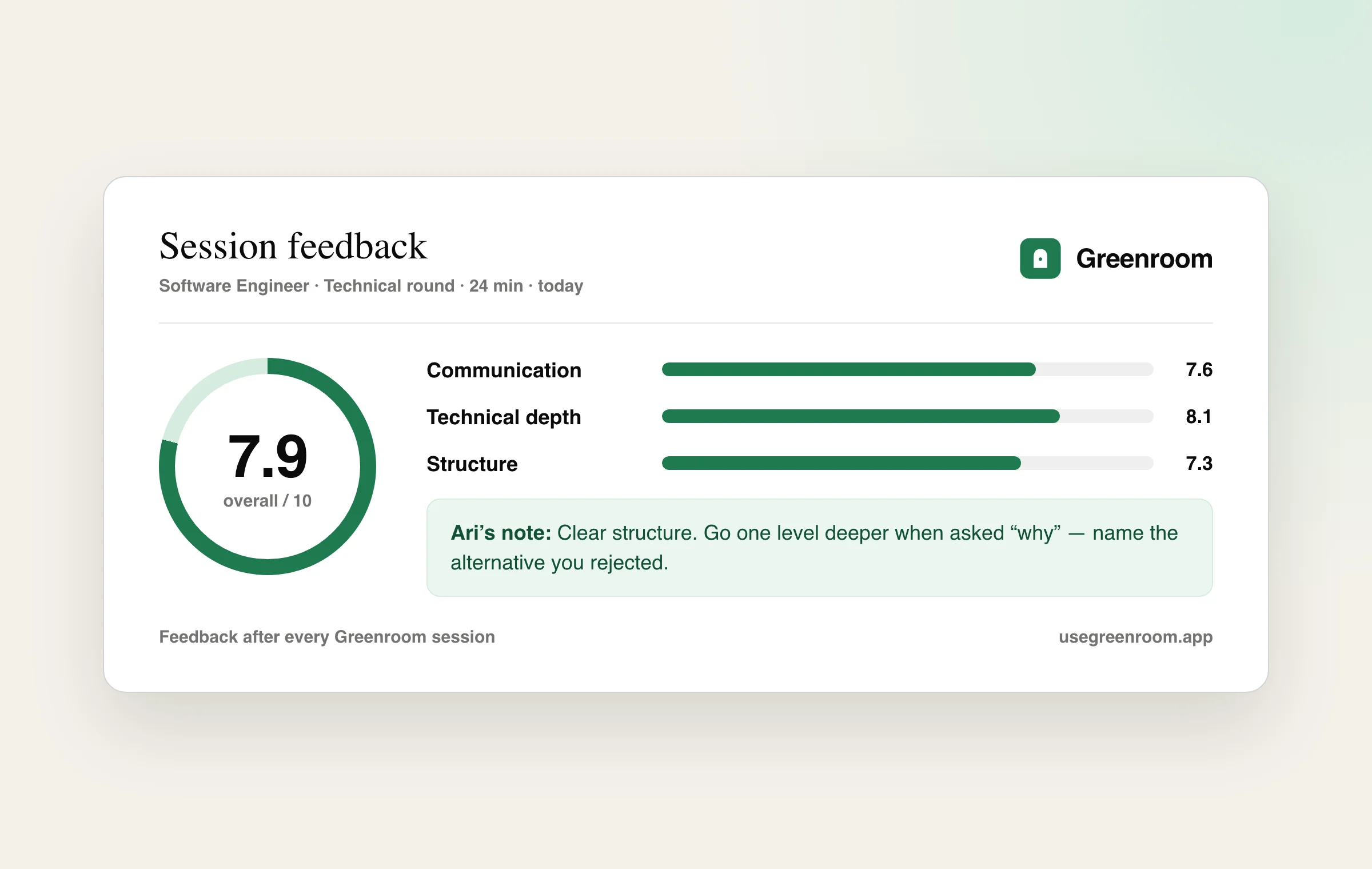
The honest throughline: BA interviews grade structured reasoning and diplomatic judgment delivered out loud, under a real scenario, often with a follow-up that changes the constraint — not whether you can eventually produce a correct written definition with no time pressure. That's the specific gap Greenroom's spoken mock-interview format is built to close: you talk through a requirements-gathering or stakeholder-conflict scenario out loud, the AI interviewer asks real follow-ups the way a hiring manager would (a stakeholder pushing back, a timeline tightening mid-conversation), and you get feedback on the clarity and structure of your reasoning, not just whether you used the right buzzword. It's not a substitute for actually knowing the frameworks — you still need the BRD/FRD vocabulary and the SQL basics — but it's the one method on this list that rehearses the verbal, interrupted, think-on-your-feet format the real interview actually is.
Worked case-study scenario: the deadline collision
This is close to the exact scenario from the opening story, and it's worth working through step by step because most candidates' answers fall apart specifically in the order they address things, not in the content of any single point.
The setup, as an interviewer would actually frame it: "Marketing told a client a feature ships Friday. Engineering just told you it needs eight more weeks. You're the BA in the middle. Walk me through what you do, starting right now."
- Get the facts straight before doing anything else, out loud. What specifically is blocking the eight-week estimate — is it a hard technical dependency, an underestimated original scope, or a resourcing conflict with another project? You can't mediate a disagreement you don't actually understand yet, and jumping straight to "let's schedule a meeting" without this step is the exact trap from the opening story.
- Identify what's actually negotiable. Is the whole feature blocked, or is there a smaller slice that genuinely could ship Friday — even a limited version — that would let marketing keep its commitment partially true rather than entirely broken? This is the step that separates a BA who mediates from one who just relays bad news in both directions.
- Quantify the actual cost of each option, even roughly: shipping late costs X (a specific client relationship, a renewal conversation), cutting scope to hit Friday costs Y (a worse first impression, more support load), pulling resources from another project to compress the timeline costs Z (a different deadline slips instead). Naming real trade-offs, even approximate ones, is what makes the next conversation a decision instead of a vibe.
- Bring options, not just the problem, to whoever needs to decide. Escalating "engineering says no" to a sponsor or product owner with zero proposed paths forward reads as a BA who relays messages rather than adds value. Escalating with "here are two realistic options and the trade-off of each" is the actual job.
- Communicate to both sides honestly and in their language, and close the loop. Tell engineering what was decided and why (so they don't feel steamrolled by a business decision they weren't part of), and tell marketing the real, specific new commitment — not a vague "we're working on it" that just relocates the same collision two weeks later.
The interviewer isn't grading whether you "solved" the deadline collision — there often isn't a clean solution available in two hours. They're grading whether you have a repeatable process for getting from chaos to a decision, and whether you can narrate that process clearly under pressure, which is precisely the skill the rest of this guide has been building toward.
A second worked scenario: the stakeholder who wants everything
A second case-study pattern interviewers reach for almost as often as the deadline collision: a senior stakeholder — often someone with real organizational power but limited day-to-day visibility into delivery capacity — keeps adding "just one more thing" to a project that was already scoped and approved.
The setup: "You're three weeks into a four-week project. The VP sponsoring it asks for two new features in the same meeting, says they're both 'quick adds,' and clearly expects you to just say yes." How do you handle it in the room, live?
The weak instinct is to either cave immediately (protecting the relationship at the cost of the timeline) or push back too hard in the moment (protecting the timeline at the cost of looking inflexible in front of a VP). Neither is the actual skill being tested. A stronger sequence: acknowledge the request without committing to it on the spot ("let me understand both asks, then I'll come back with what they'd actually cost"), get just enough detail to estimate impact honestly rather than guessing, and then come back — ideally within the same conversation, not days later — with the real trade-off stated plainly: "Both are doable. Here's what each one costs against the current deadline, and here's what I'd recommend cutting or pushing if we add them." This converts an emotionally loaded "no" into a structured choice the VP gets to make with real information, which is almost always better received than either an instant yes or an instant no. The follow-up interviewers like to add: "what if they say 'just figure it out, I don't care about the trade-off'?" — the honest answer is that someone still has to own that trade-off even if the VP won't engage with it explicitly, and silently absorbing scope without flagging the cost anywhere is how a BA ends up taking the blame for a deadline that was never realistic once the asks were added.
The throughline across both worked scenarios in this guide: every BA case study is really asking the same underlying question in a different costume — do you have a repeatable process for converting an emotionally charged moment into a structured decision, and can you narrate that process clearly while the pressure is still live, not after you've had a day to think about it calmly.
BABOK, certifications, and how much theory you actually need
Candidates sometimes ask whether they need to study the BABOK (Business Analysis Body of Knowledge, the IIBA's reference guide) cover to cover, or pursue a certification like CBAP or CCBA, before interviewing. The honest answer: it depends on the company, but it's rarely the bottleneck candidates assume it is.
The BABOK organizes business analysis into knowledge areas — business analysis planning and monitoring, elicitation and collaboration, requirements life cycle management, strategy analysis, requirements analysis and design definition, and solution evaluation — and it's genuinely useful as a map of the full discipline, especially if your experience so far has been narrow (e.g., you've only ever worked requirements-gathering and never touched solution evaluation or benefits realization after launch). Larger, more process-mature organizations — banks, insurers, consulting firms — are more likely to expect BABOK-aligned vocabulary and may explicitly value a certification on a resume as a filtering signal. Smaller, faster-moving companies and most startups care far less about the formal taxonomy and far more about whether you can demonstrably do the job in a live scenario — which is exactly the gap a memorized BABOK glossary doesn't close on its own.
The practical takeaway: skim the BABOK's knowledge-area structure once, so you recognize the names if an interviewer uses them, but don't mistake reading the standard for being ready to apply it. The interview tests application under a live scenario far more than it tests whether you can recite a body of knowledge — which is exactly why this guide spends more words on the deadline-collision and stakeholder-overload scenarios than on glossary definitions.
What a strong requirement actually looks like on paper
A surprising number of candidates can define "functional requirement" correctly and still write a weak one when asked to produce a real example live — usually because the example is vague enough to mean three different things to three different engineers. Compare these two for the same feature:
Weak: "The system should let users reset their password easily."
Strong: "Given a registered user on the login page, when they select 'Forgot password' and enter their registered email, the system shall send a reset link valid for 30 minutes to that email address. If the link is expired when clicked, the system shall display an error and offer to resend a new link. Acceptance criteria: (1) reset email arrives within 60 seconds in 95% of cases, (2) expired-link error message is shown rather than a generic failure, (3) the new password must meet the existing complexity policy before submission is accepted."
The difference isn't length for its own sake — it's that the strong version is testable. An engineer can build against it without guessing, and a QA tester can write a test case directly from the acceptance criteria without asking you what "easily" was supposed to mean. Interviewers who ask you to "write a sample requirement" live are checking exactly this: whether your default writing style produces something buildable, or something that sounds reasonable in a meeting and then causes three rounds of clarifying Slack messages once development actually starts.
Why otherwise-strong BA candidates get rejected anyway
A consistent pattern shows up across BA hiring loops, and most of it isn't about knowing fewer frameworks than the candidate who got the offer.
Vocabulary without application. Defining MoSCoW, BRD vs FRD, and gap analysis correctly but being unable to apply any of them when handed a live, messy scenario is the single most common gap. Interviewers explicitly design the case-study portion of the loop to catch this, because it's exactly the gap between studying for the interview and being able to do the job.
Conflict-avoidance dressed up as diplomacy. Answers like "I just try to keep everyone happy" or "I make sure everyone feels heard" sound pleasant and reveal no actual process. Strong stakeholder-management answers name a real disagreement, a specific mechanism used to resolve it (tracing back to underlying business goals, bringing data instead of opinion, escalating with options rather than just the problem), and a concrete outcome — vagueness here reads as untested diplomacy, not real skill.
Requirements that aren't testable. As shown above, a requirement that can't be verified against a clear pass/fail condition isn't really a requirement yet — it's a wish. Candidates who write or speak in this vague register throughout the interview signal that ambiguity downstream (rework, scope disputes, "that's not what I meant") is likely to follow them into the role.
No data fluency at all. A BA who can't read a basic SQL query, sanity-check a dashboard number, or explain why a metric might be misleading (small sample size, a denominator that changed, survivorship bias in churned-user data) increasingly struggles against candidates who can, even at companies that don't formally require SQL in the job description — because the role has drifted measurably more data-adjacent over the past several hiring cycles.
Talking about the team instead of your own decisions. Just as in a technical managerial round, BA interviewers specifically listen for what you personally decided, drafted, or pushed back on, versus what "the team" or "the project" accomplished around you. A candidate who describes outcomes fluently but goes vague the moment the question turns to "what did you specifically do" reads as someone who was present for the project rather than someone who drove a meaningful part of it.
A quick note on titles, levels, and how the bar shifts
"Business analyst" covers a wider range of actual day-to-day work than most single-track engineering titles, and interviewers calibrate the bar accordingly — it's worth knowing roughly where a given role sits before you walk in. A junior/associate BA at a large organization is usually heavily process- and documentation-focused: writing and refining requirements under a senior BA's direction, running smaller stakeholder interviews, owning a slice of a larger project rather than its full scope — interviews at this level lean harder on vocabulary, basic SQL, and whether you can follow a structured process, and lighter on independent judgment calls. A senior BA or BA lead, by contrast, is expected to own stakeholder relationships directly, make prioritization calls without constant sign-off, mentor junior BAs, and increasingly blur into product-manager territory at smaller companies — interviews here weight the case-study and conflict-management questions far more heavily, often with two or three scenario rounds back to back rather than one. A technical/data-leaning BA role (common at fintechs, healthtech, and analytics-heavy teams) raises the SQL and tooling bar significantly — expect a live query exercise, not just a verbal description of what you'd query — while keeping the stakeholder and requirements content largely the same. Knowing which flavor of the role you're interviewing for changes how you should weight your prep time across this guide's sections, and it's a fair, normal question to ask your recruiter directly before the loop starts.
A realistic prep plan
Give yourself one to two focused weeks rather than a weekend skim, since the scenario and stakeholder-management questions reward rehearsal more than last-minute cramming.
Days 1–3 — Vocabulary and frameworks, cold. Drill BRD vs FRD, functional vs non-functional requirements, use case vs user story, MoSCoW, gap analysis, and change control until you can define each in one clean sentence and immediately attach a real example from a project you've worked on (even an academic or internship project counts, if you're early-career). If you genuinely have no project to draw from yet, build one mentally from a process you've personally experienced as messy — registering for a course, returning a product, a clunky internal tool at a part-time job — and practice analyzing it as if a stakeholder handed it to you.
Days 4–7 — Data fluency and methodology. Get comfortable writing and reading basic SQL (SELECT/GROUP BY/JOIN/HAVING) without looking up syntax mid-sentence, and rehearse explaining Agile vs Waterfall and where your own experience sits on that spectrum. If SQL is genuinely new to you, our SQL interview guide and data analyst interview guide cover the adjacent technical bar in more depth.
Week 2 — Scenario rehearsal, out loud. Pick three or four realistic conflict scenarios (a deadline collision, two stakeholders wanting incompatible features, a requirement that changes after development has started) and talk through your process for each one out loud, ideally to another person or a recorder — not just in your head, since the gap between thinking through a scenario silently and narrating it clearly to someone watching you is exactly the gap this entire guide has been describing. This is also the week to do a full mock interview under realistic time pressure, since the scenario question specifically rewards composure and a visible process more than a "correct" final answer. Pair this with our communication skills guide and STAR-format behavioral answers guide for structuring your project stories.
A quick gut check for readiness: can you describe, in under ninety seconds and out loud, a real time you resolved a stakeholder conflict — naming the actual disagreement, your actual process, and the actual outcome — without saying the word "communication" even once? If that's hard to do cleanly, you're not behind on frameworks; you're behind on the specific verbal-delivery skill the interview is actually testing.
Practise the conversation, not just the vocabulary
You can define BRD, FRD, and MoSCoW perfectly on a flashcard and still go quiet the moment an interviewer hands you a live, messy scenario with two annoyed stakeholders and a clock running. The BA interview is a conversation under mild pressure, so the practice has to be a conversation too — reading a model answer is a different skill from producing one live, in real time, while someone watches you think. Greenroom runs spoken business analyst mock interviews, asks realistic follow-up questions on requirements and stakeholder scenarios, and gives feedback on the clarity and structure of how you reasoned through it — not just whether you used the right framework name. Pair it with our communication skills guide, SQL interview guide, and STAR-format behavioral answers guide for the project-story side of the loop.
Frequently asked questions
What questions are asked in a business analyst interview?
Business analyst interviews cover requirements-gathering techniques, functional vs non-functional requirements, documentation (BRD, FRD, use cases, user stories, acceptance criteria), handling changing or conflicting requirements, stakeholder management and conflict resolution, Agile vs Waterfall and your role in each, prioritization frameworks like MoSCoW, gap analysis and process mapping, basic SQL and Excel, presenting findings to leadership, and a scenario or case-study question that tests how you mediate between business and technical sides under a real deadline conflict.
How do you gather requirements as a business analyst?
Use a mix of techniques chosen for the situation rather than one default method: stakeholder interviews and workshops to surface what people think they want, process observation or job shadowing to catch the gap between stated process and actual behavior, document analysis for historical context, surveys when you need input at scale, and prototyping to surface requirements people can react to but couldn't articulate in the abstract. Capture what you find in a BRD or user stories with clear acceptance criteria, validate it back with stakeholders before development starts, and prioritize using a framework like MoSCoW.
What SQL should I know for a business analyst interview?
You're expected to read and write practical queries, not complex stored procedures: SELECT/WHERE/ORDER BY, GROUP BY with aggregate functions like COUNT, SUM, and AVG for summarizing data, JOINs (especially the difference between INNER and LEFT JOIN), and the distinction between WHERE (filters rows before aggregation) and HAVING (filters groups after aggregation). Interviewers usually test this with a short live query rather than a whiteboard algorithm, and they're listening for whether you can explain your query's logic out loud, not just whether the syntax is correct.
What soft skills do business analysts need?
Strong communication and active listening, stakeholder management and diplomacy under genuine disagreement, the ability to translate fluently between business language and technical language in both directions, and structured judgment for turning an ambiguous ask into a clear, testable requirement. Because the role mediates between business needs and engineering constraints, conflict resolution and clear, leadership-ready presentation of findings matter as much as technical tools like SQL and Excel — most BA interviews test all of this through a live scenario question, not a checklist of definitions.
How is Agile different from Waterfall for a business analyst's day-to-day work?
In Waterfall, a BA does deep requirements work up front, documents it comprehensively in a BRD/FRD, and is less involved day-to-day during the build until formal acceptance testing near the end. In Agile, a BA is embedded continuously — writing and refining user stories, supporting backlog grooming, clarifying edge cases with developers mid-sprint, and validating each increment as it ships rather than waiting for one big acceptance test. Most real organizations run a hybrid of the two, and being able to describe working comfortably in that hybrid reality is a stronger answer than insisting on a pure version of either methodology.
How should I prepare for a business analyst interview?
Drill the core vocabulary and frameworks (BRD vs FRD, functional vs non-functional requirements, MoSCoW, gap analysis, change control) until you can attach a real example to each one, get comfortable with basic SQL and Excel, and then spend the most time rehearsing scenario answers about mediating conflicting stakeholders out loud — since that live, interrupted, think-on-your-feet conversation is what most BA interviews are actually built around. Practising with a voice-based mock interview that gives feedback on clarity and structure closes the specific gap between knowing a framework and being able to apply it fluently under pressure.