The night before the interview, you grind 40 Java questions, two React projects, and a "why do you want to join an IT services company" answer polished to a shine. You walk in. The panel is two mechanical engineers from the Chakan plant, and the first question is about four-stroke engine cycles. You prepared for the wrong Mahindra.
It happens every single placement season, so let's fix it in the first hundred words: this guide covers Mahindra & Mahindra interview questions — the automotive, farm-equipment and mobility giant — not Tech Mahindra, the IT services company. Same Mahindra Group, same logo family, completely different interview. Here's the process candidates report, the technical and HR questions that actually come up, and how to prepare for the GET route.
Mahindra & Mahindra vs Tech Mahindra: not the same interview
Mahindra & Mahindra (M&M) builds SUVs (Scorpio, XUV700, Thar), tractors (the world's largest tractor maker by volume), and an aggressive electric-vehicle line — it hires mechanical, electrical, automotive, mechatronics and embedded engineers into plants and R&D centres (Chakan, Kandivali, Nashik, Zaheerabad, Mahindra Research Valley in Chennai), plus digital and IT roles in its tech teams. Tech Mahindra is the group's IT services arm — mass campus hiring, coding-plus-aptitude tests, English assessments. If your offer letter dreams involve CAN bus and crankshafts, you're in the right place; if they involve Java services for overseas clients, read the Tech Mahindra guide instead.
The Mahindra & Mahindra interview process
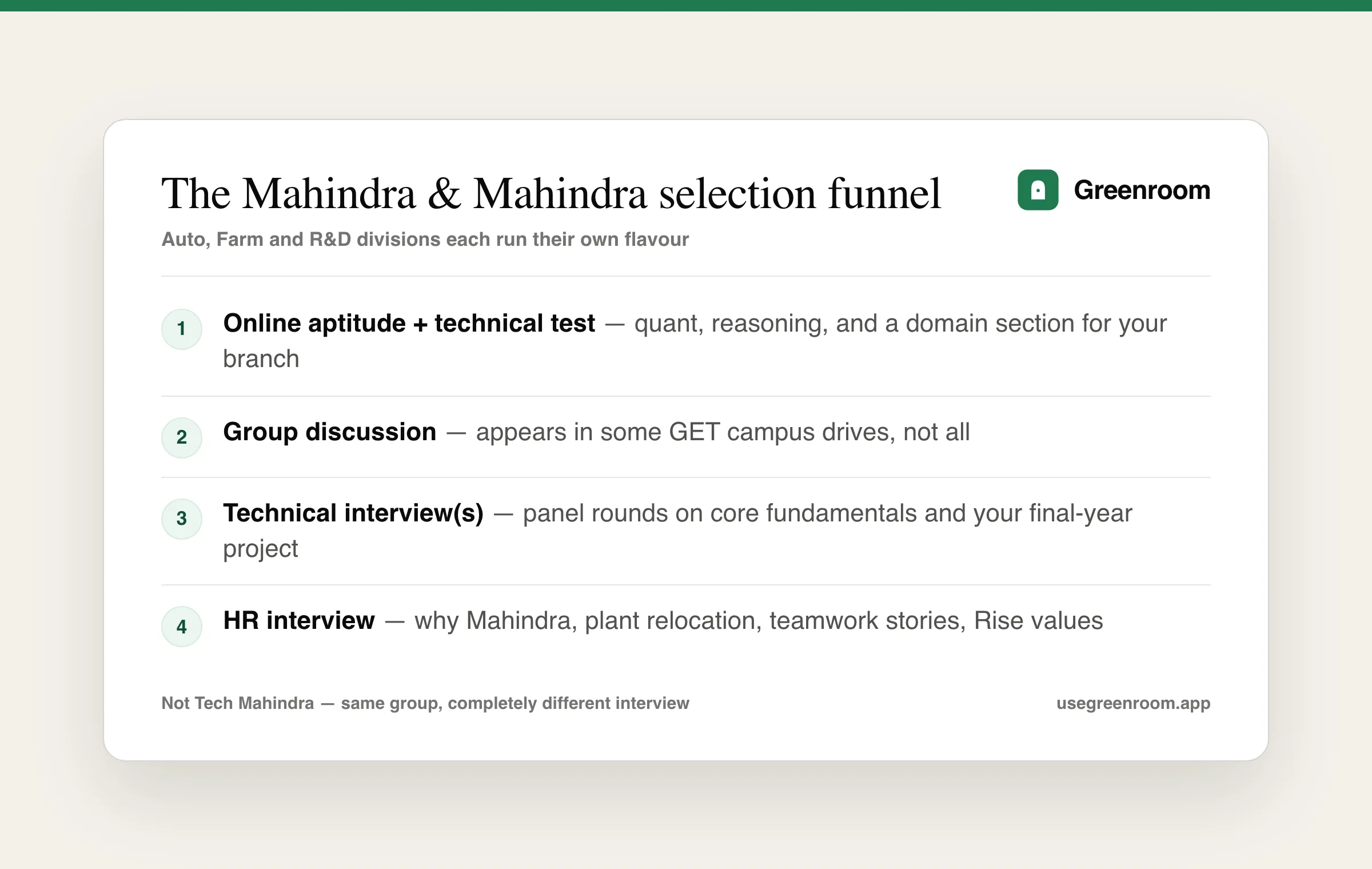
Based on what candidates consistently report (AmbitionBox, Glassdoor and campus threads), the typical selection funnel runs:
- Online aptitude + technical test — quant, logical reasoning and a domain-specific technical section (thermodynamics and SOM for mechanical; circuits and machines for electrical). Campus drives sometimes add a psychometric inventory.
- Group discussion — appears in some GET campus drives, not all.
- Technical interview (one or two rounds) — often a panel; core-subject fundamentals plus a deep dive into your final-year project or internship.
- HR interview — motivation, mobility, and fit with the group's "Rise" values.
Lateral hires usually get a domain-heavy technical round with the hiring team, then a managerial and HR discussion. Rounds vary by division — Auto, Farm Equipment, Mahindra Research Valley and the digital teams each run their own flavour.
Technical questions for mechanical and automotive roles
- Explain the four-stroke engine cycle. Why do diesel engines have higher compression ratios than petrol?
- Otto cycle vs Diesel cycle — draw and compare efficiencies.
- What is the function of a differential? What happens in a vehicle without one?
- EV powertrain basics — why do EVs not need a multi-speed gearbox? What does a BMS do? (With M&M's Born Electric push, EV fundamentals now show up even for "pure" mechanical candidates.)
- Strength of materials — stress-strain curve for ductile vs brittle materials, factor of safety.
- Manufacturing — casting vs forging vs machining: when and why; what is GD&T and why does an assembly line care?
- Your project — expect 15–20 minutes on it. Every design choice will get a "why?"
Electrical, embedded and software roles
- Motor fundamentals — induction vs BLDC vs PMSM; why do EVs prefer PMSM?
- What is CAN bus and why does a car need it? How does arbitration work?
- Battery basics — cell chemistry trade-offs, thermal management, what a battery management system monitors.
- Embedded — microcontroller vs microprocessor, interrupts vs polling, reading a simple C snippet aloud (our embedded systems questions guide covers this round in depth).
- Digital/IT roles — OOP concepts, SQL joins, Python basics, and increasingly data questions for connected-vehicle and analytics teams.
HR round questions at Mahindra
- "Why Mahindra & Mahindra, and why this division?" — have a real answer involving their products; "you're a big brand" dies on contact.
- "Are you willing to relocate to a plant location?" — say yes only if you mean it; postings at Chakan, Nashik, Zaheerabad or Igatpuri are real.
- "Tell me about a time you worked in a team under pressure" — standard HR fare; prepare two STAR stories.
- Values fit — the group talks about its "Rise" philosophy (driving positive change, alternative thinking); you don't need to recite it, but knowing it exists signals homework.
- Salary and bond expectations for GETs — know the market range before you anchor yourself.
How to prepare (for the GET interview especially)
The pattern in every candidate report is the same: fundamentals over breadth, and your project over everything. A GET panel would rather hear you derive why a diesel engine knocks than watch you name-drop ANSYS modules you opened twice. Revise your core subjects like it's the university exam that finally matters, follow the campus recruitment playbook for the OA and GD stages, and prepare your project story to survive five consecutive whys.
Then practise saying it all out loud. AmbitionBox threads give you the questions; they can't interrupt you mid-answer with "but why does the compression ratio matter?" — and that follow-up is where campus candidates crumble. Ari, the AI interviewer behind Greenroom, runs spoken mock technical and HR rounds with exactly those follow-ups, in a browser, the night before the drive if that's what it takes. I built it after walking out of an interview where I knew every answer and delivered none of them.
Frequently asked questions
What questions are asked in a Mahindra & Mahindra interview?
For engineering roles: core fundamentals (four-stroke cycles, Otto vs Diesel cycle, differentials, stress-strain behaviour, casting vs forging), EV basics (powertrains, BMS, motor types), and a deep 15–20 minute dive into your final-year project. For electrical/embedded roles: motors, CAN bus, battery systems and microcontrollers. HR rounds ask why Mahindra, relocation willingness and teamwork stories.
Is Mahindra & Mahindra the same as Tech Mahindra?
No. Mahindra & Mahindra is the group's automotive and farm-equipment company — SUVs, tractors and EVs — hiring mechanical, electrical, automotive, embedded and some digital/IT engineers. Tech Mahindra is the group's separate IT services company with mass campus hiring and coding-plus-aptitude assessments. The interviews are completely different; prepare for the right one.
What is the interview process at Mahindra & Mahindra?
Candidates typically report: an online aptitude plus domain-technical test, sometimes a group discussion in campus drives, one or two technical interviews (often panel-based, heavy on fundamentals and your project), and an HR round covering motivation, relocation and values fit. Lateral hires get a domain-focused technical round followed by managerial and HR discussions. Rounds vary by division and location.
What is asked in the Mahindra GET interview?
The Graduate Engineer Trainee interview focuses on core engineering subjects relevant to your branch — thermodynamics, strength of materials and manufacturing for mechanical; machines, circuits and control for electrical — plus a detailed grilling on your final-year project, internship learnings, and HR questions about relocating to plant locations like Chakan, Nashik or Zaheerabad.
Does Mahindra & Mahindra ask coding questions?
For core engineering (mechanical/automotive) roles, coding is rarely central — at most basic C or Python familiarity for automation-adjacent work. For embedded roles expect C, microcontrollers and CAN; for digital/IT and analytics roles expect OOP, SQL and Python questions. The aptitude test's technical section matters more than competitive coding for most M&M roles.
How should freshers prepare for a Mahindra & Mahindra interview?
Revise branch fundamentals to exam depth, prepare your final-year project to survive repeated 'why' follow-ups, learn EV basics (Mahindra's Born Electric line makes them fair game for everyone), and rehearse spoken answers for both technical and HR rounds out loud. Reading interview experiences gives you the questions; speaking practice with follow-ups is what keeps you from freezing at the panel.