The rejection email arrived at 4:58pm on a Friday — that very specific time slot companies seem to reserve for news nobody wants to deliver in person. It was polite, generic, and exactly four sentences long, the third of which was the only one that mattered: "we've decided to move forward with other candidates." No reason. No "here's what would've tipped it." Just a clean, friendly wall. The instinct, every time, is to either fire back an angry reply demanding to know why, or to say nothing and quietly assume the worst about every round you just sat through. Neither gets you anything useful. There's a third option that actually works more often than people expect, and it starts with asking in a way that makes it easy for the other person to say yes.
Why most feedback requests get ignored
Recruiters and hiring managers aren't withholding feedback to be cruel — most of the time it's a mix of legal caution (companies increasingly avoid specific feedback that could be read as evidence in a discrimination claim, even when none occurred) and sheer time pressure: they're often closing one req and opening three more the same week. A vague request — "can you give me some feedback on why I didn't get the job?" — is easy to skip because answering it well takes real effort. A narrow, specific request is easy to answer in two sentences, which is exactly why it gets answered more often.
The email script that actually gets replies
Send it within a day or two of the rejection, while the interview is still fresh for them. Keep it short — three sentences, one specific ask:
Subject: Thank you, and a quick question

Hi [Name],

Thanks for letting me know, and for the time the team spent with me
through the process — I enjoyed [specific round, e.g. the system
design conversation with Priya].

If you have a moment, I'd really appreciate one piece of feedback
on where I could improve for next time — even a single sentence
would help. No worries at all if that's not something you're able
to share.

Best,
[Your name]
Notice what's doing the work here: gratitude first (not bitterness), a specific positive memory (proves you were actually engaged, not just going through motions), a narrow ask ("one piece," "even a single sentence" — lowers the effort bar dramatically), and an explicit, genuine opt-out ("no worries if not") that removes any pressure and, counterintuitively, makes people more likely to respond.
What to do with whatever you get back
Three realistic outcomes, and what to do with each:
- Specific, useful feedback ("your system design answers lacked depth on scaling tradeoffs") — write it down verbatim somewhere you'll actually look at again, and treat it as a real, free data point. This is gold; most candidates never get it.
- Vague, generic feedback ("we found other candidates whose experience more closely matched") — don't over-read this. It's often boilerplate, not a coded message. Politely thank them and move on; don't reply asking them to clarify further, which reads as pressure.
- Silence — most common outcome by far. Don't send a second follow-up specifically chasing feedback; you asked once, cleanly, with an opt-out built in. A second nudge erodes the goodwill the first message earned. (If you're separately waiting on a different, earlier-stage decision rather than feedback after a rejection, that's a different situation — see our guide on following up after no response for that cadence.)
How this differs from coping with the rejection itself
Asking for feedback is a tactical, after-the-fact move — it's about gathering information for next time. It's a different skill from processing the rejection emotionally in the moment, which our guide on handling interview rejection covers in depth. Do the emotional processing first, even briefly; an angry or desperate-sounding feedback request reads exactly as it is, and tends to close the door rather than open it.
Why a generic "tips for handling rejection" article isn't enough here
Most rejection-coping advice (and there's a lot of it — a quick search turns up dozens of nearly identical "5 ways to bounce back" listicles) stops at the emotional layer and never gets to the concrete next action: what do you actually type into the reply box. The gap between "feeling better about the rejection" and "having a specific, actionable piece of feedback in hand for your next round" is exactly the gap this script is built to close.
Turn feedback into the next round's prep
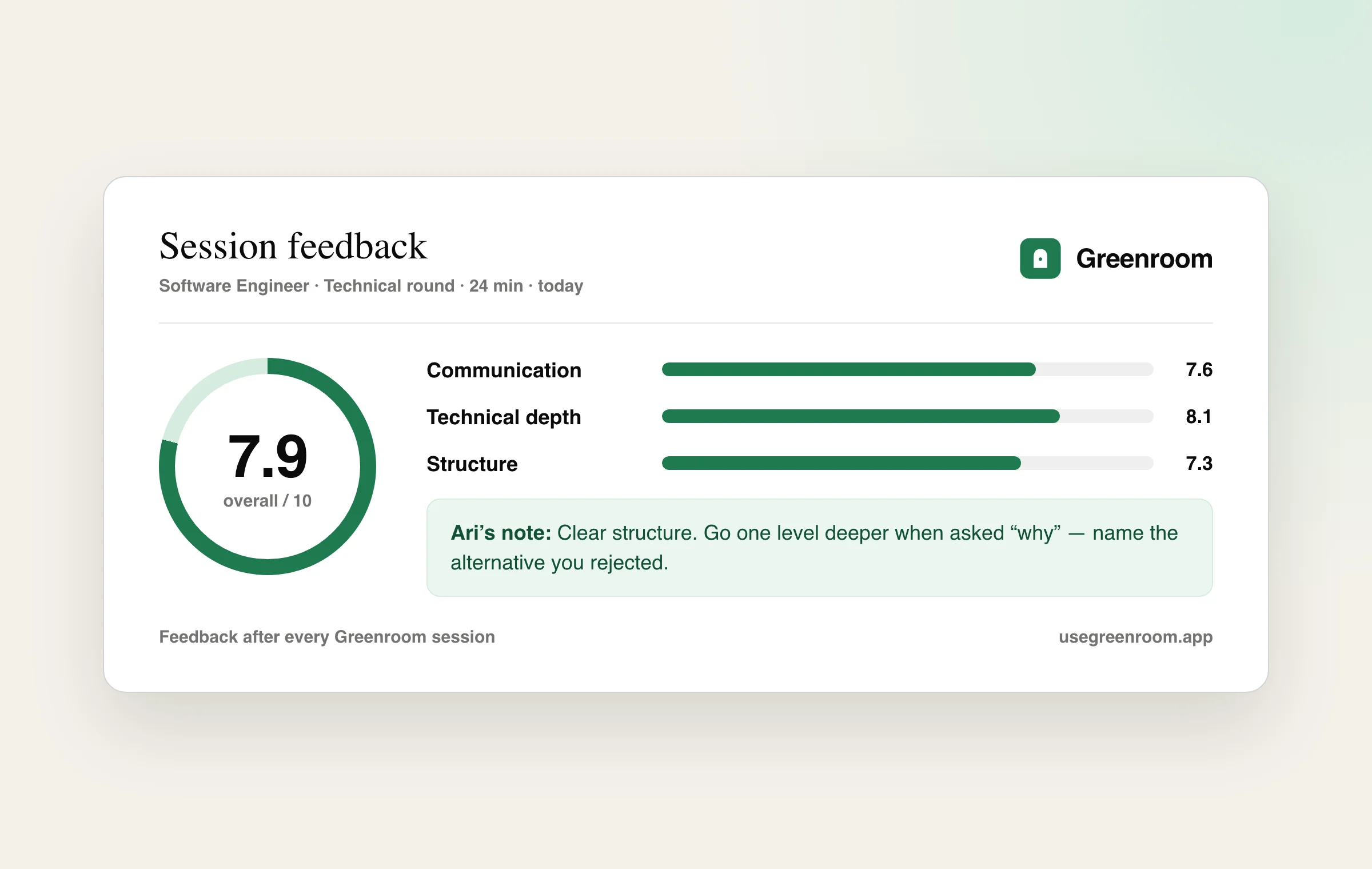
If you do get something specific — say, "system design depth" or "your answers ran long and lost structure" — that's a direct, free prompt for what to drill next. Pair it with a targeted mock round on exactly that weak spot rather than a generic full run-through; our guide on preparing for a mock interview covers how to structure a focused practice session around one specific gap instead of starting from zero every time.
Frequently asked questions
Is it appropriate to ask for feedback after an interview rejection?
Yes — it's a normal, professional thing to ask, and many recruiters are willing to share at least something if you make it easy to answer. The key is asking narrowly (one specific piece of feedback) and including an explicit opt-out, which removes pressure and makes a reply far more likely than an open-ended request.
What should I write in an email asking for interview feedback?
Keep it to three short parts: genuine thanks (ideally referencing a specific round or person), a narrow request for one piece of feedback, and an explicit 'no worries if you're not able to share' opt-out. Avoid sounding bitter, demanding, or vague about what you're asking for.
Why don't most companies give detailed interview feedback?
Mainly a mix of legal caution (specific feedback can be read as evidence in a discrimination claim even when none occurred) and time pressure, since recruiters are usually moving on to several other open roles. A short, low-effort, specific request is more likely to get answered than a broad one.
What should I do if I get vague feedback like 'other candidates were a better match'?
Don't over-interpret it or push for clarification, which can read as pressure — this kind of response is often boilerplate rather than a coded message. Thank them politely and move on; if you want a real signal, you're more likely to get one by asking narrowly the first time.
Should I follow up again if a recruiter doesn't respond to my feedback request?
No — send the feedback request once, with a built-in opt-out, and leave it there. A second follow-up specifically chasing feedback tends to erode the goodwill the first message earned. This is different from following up on a pending decision, which has its own appropriate cadence.