Ananya walked into her Genpact interview expecting a coding round, because that's what every campus WhatsApp group had prepped her for. Instead, the interviewer opened with "walk me through how you'd explain a 12% drop in a client's month-over-month revenue to someone who isn't technical." She had SQL joins memorized cold and nothing rehearsed for "explain this like I'm a client, not an engineer." That gap, technical fluency versus client-ready communication, is the actual Genpact interview, and almost nobody preps for it on purpose.
Genpact interview questions span aptitude, core technical or analytics fundamentals, and a genuinely conversational round that tests whether you can explain a number, a process, or a decision to a non-technical stakeholder without losing them. I built Greenroom after freezing in exactly that kind of spoken, follow-up-heavy interview: so this guide covers the real rounds, the questions, and how to rehearse the communication half that most candidates skip.
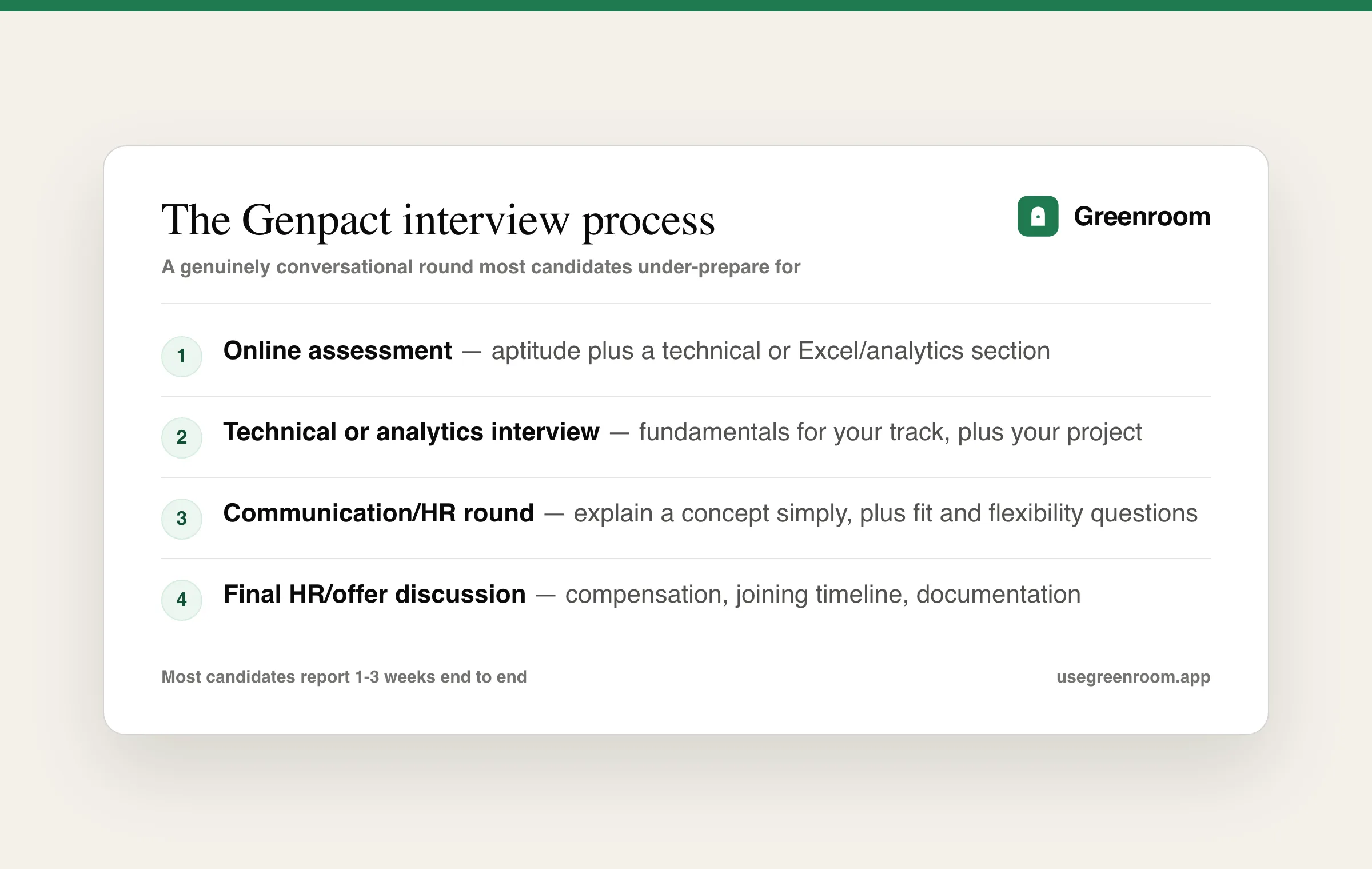
The Genpact interview process
Genpact hires at scale across two tracks, process/analytics roles and technology roles, and the process differs slightly by track, but the shape is consistent:
- Online assessment: aptitude (quant, logical reasoning, verbal), plus a technical/coding or Excel-and-analytics section depending on the role.
- Technical or analytics interview: core fundamentals for your track (SQL, programming basics, or process/analytics case questions), your resume and any internship or academic project.
- Communication/HR round — a genuinely conversational round: explain a concept simply, discuss a scenario, and standard fit and flexibility questions (shifts, relocation).
- Final HR/offer discussion: compensation, joining timeline, documentation.
Most candidates report 1–3 weeks end to end for campus and off-campus drives, sometimes compressed into a single day for walk-in drives.
Genpact technical and analytics questions
The technical bar depends on the role you're hired for, but these show up consistently:
- SQL basics and joins — write a query to find duplicate records, or aggregate revenue by region. Our SQL interview questions guide covers the core patterns.
- Excel and data-analysis fundamentals: pivot tables, VLOOKUP/XLOOKUP, and how you'd spot an anomaly in a dataset without any tooling beyond a spreadsheet.
- OOP concepts with examples if you're on a technology track: classes, inheritance, polymorphism explained in plain language, not just definitions.
- A process-improvement scenario — "a client's invoice-processing time doubled last quarter; how would you investigate?" These are graded on structure: clarify, hypothesize, narrow down, recommend.
- Explain your project end to end: what you built, your specific contribution, and one real challenge you hit.
Genpact communication and HR questions
This round is where Genpact differentiates itself from a typical coding-only tech interview:
- Explain a technical concept to someone non-technical: pick something you know cold (an API, a database, a formula) and practice explaining it in one minute with zero jargon.
- Tell me about yourself; why Genpact? Know what Genpact actually does (process transformation, analytics and AI-led operations for large enterprise clients) not just "it's a big company."
- Describe a time you had to simplify something complex for someone else.
- Are you comfortable with rotational shifts, and is your location flexible?
- Where do you see yourself in five years? Our answer breakdown covers how to structure this without sounding rehearsed.
How Genpact compares to other prep resources
An honest map of where each resource fits for this specific interview:
- GeeksforGeeks / campus WhatsApp question banks: useful for the technical MCQ shape, but they skip the communication round entirely, which is often where offers are actually won or lost.
- LeetCode — helpful only if you're on a heavier coding track; most Genpact technical rounds lean fundamentals and SQL over algorithm-heavy problems.
- A senior's notes from last year's drive — good for calibrating difficulty, risky for assuming the format hasn't changed.
- ChatGPT — fine for drafting a clean project explanation or generating practice scenarios; it won't interrupt you mid-explanation the way a real interviewer will when your answer gets too technical.
- Greenroom, the spoken layer. Ari, the AI interviewer, runs a live mock covering technical fundamentals, a client-communication scenario, and HR questions, then scores whether your explanation actually lands for a non-technical listener, the exact thing this interview grades.
How to prepare for the Genpact interview
- Revise SQL joins, Excel fundamentals, and OOP basics if you're on a technology track — explain each concept out loud, not just on paper.
- Prepare one clean, jargon-free explanation of your best project, rehearsed until a non-technical friend can follow it.
- Practice a process-improvement scenario using a simple structure: clarify the problem, form a hypothesis, narrow down with data, recommend a fix.
- Rehearse your "tell me about yourself" and "why Genpact" answers out loud until they sound natural, not memorized.
- Confirm your stance on shift flexibility and relocation before the HR round so you're not deciding live.
If you're also interviewing at other Indian IT-services or BPO-analytics companies, the rounds rhyme but the emphasis shifts, our Wipro interview guide and Cognizant interview guide cover where each diverges.
Frequently asked questions
What is the Genpact interview process for freshers?
An online assessment (aptitude plus a technical or Excel/analytics section), a technical or analytics interview covering fundamentals and your project, a communication-focused round where you explain a concept simply, and a final HR/offer discussion. Most candidates report 1–3 weeks end to end.
What technical questions does Genpact ask?
SQL basics and joins, Excel and data-analysis fundamentals like pivot tables and lookups, OOP concepts for technology-track roles, a process-improvement scenario question, and a walkthrough of your project and your specific contribution to it.
Does Genpact ask coding questions?
Depends on the role: technology-track roles include coding and OOP fundamentals, while process/analytics-track roles focus more on SQL, Excel and case-style analytical questions rather than algorithm-heavy coding.
What makes the Genpact interview different from a typical tech interview?
A genuinely conversational communication round where you're asked to explain a technical or analytical concept to a non-technical listener. It's graded as heavily as the technical round, and most candidates don't rehearse it on purpose.
How do I prepare for the Genpact interview?
Prepare SQL, Excel and OOP fundamentals plus your project explanation, then practice explaining one technical concept in plain language until a non-technical friend can follow it. Rehearse HR answers out loud, and decide your stance on shifts and relocation in advance.