---
title: Signs an Interview Went Well (Or Badly) — 2026 Guide
description: The reliable signals that predict an offer, the myths that lie to you (like "it ran long, so it went well"), and exactly what to do next either way.
url: https://usegreenroom.app/blog/signs-an-interview-went-well-or-badly
last_updated: 2026-07-22
---
← Back to blog
Career
# Signs an interview went well (or badly)
July 22, 2026 · 15 min read
You're in the elevator, forty seconds after the call ended, and your brain has already convened an emergency tribunal. Exhibit A: the interviewer smiled at minute 12. Exhibit B: they said "great" four times, but was it a *genuine* great or a *filler-word* great. Exhibit C: they ran eight minutes over, which either means they loved you or means their calendar was just badly built. By the time you reach the lobby you've built an entire Bayesian model out of one raised eyebrow and a slightly-too-fast "we'll be in touch." This is the most universal post-interview ritual there is, and almost none of it is reliable evidence. This guide covers the **signs an interview went well** (and the real **signs an interview went badly**) that actually correlate with outcomes, debunks the ones that don't, and tells you what to actually do in the hour after — regardless of which tribunal your brain convenes.
## The real positive signals
### The interview ran long, and they didn't seem to be watching the clock
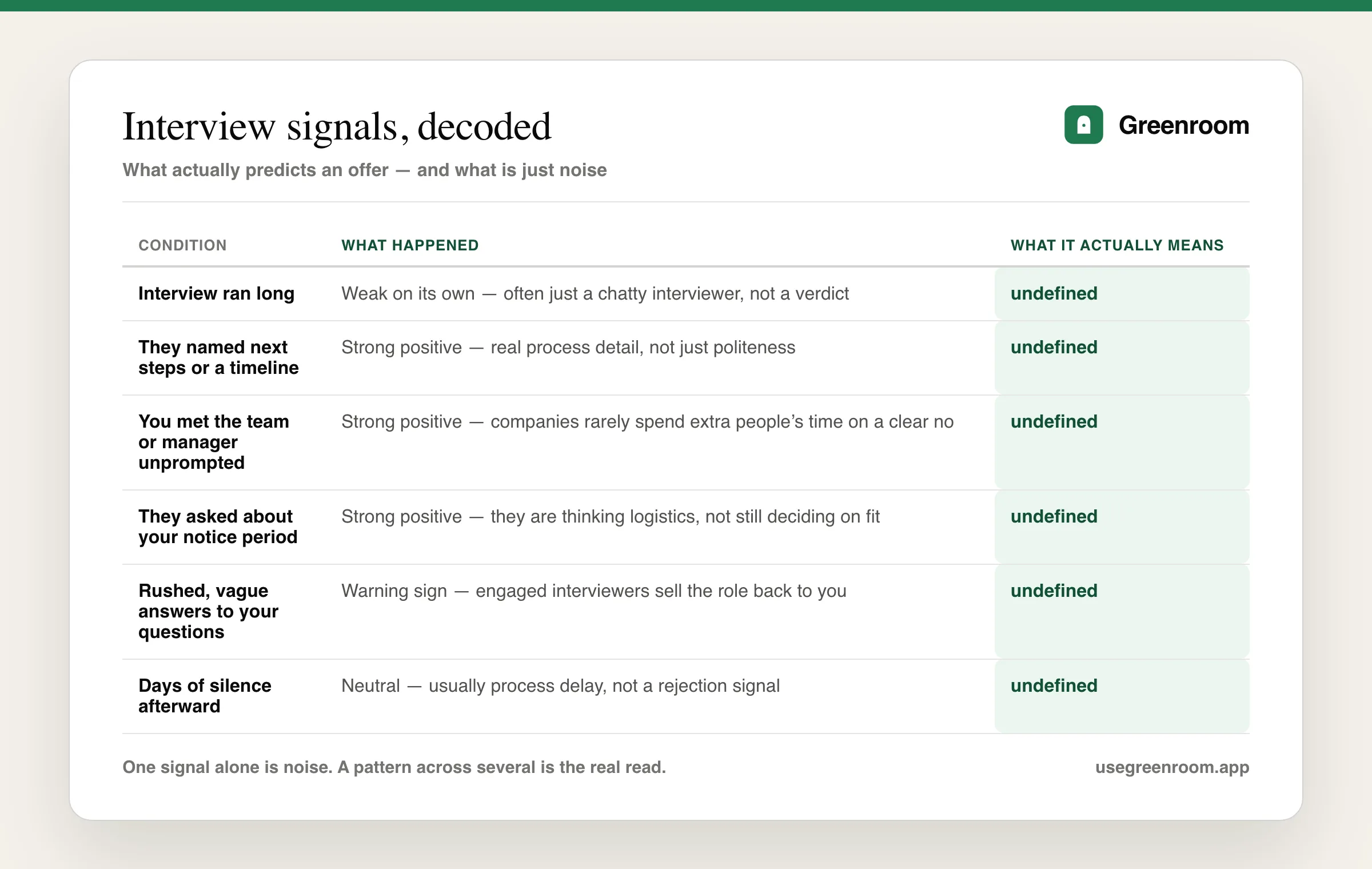
Length alone is weak evidence (more on that in the myths section below), but length *combined with visible engagement* — leaning in, asking unscripted follow-ups, not glancing at a second monitor — is a real signal. Interviewers with a full calendar and a "no" already forming in their head tend to keep things brisk and on-script; interviewers who are genuinely evaluating you as a serious option let the conversation wander because they're gathering more data, not performing a formality.
### They talked concretely about next steps or a timeline
"We'll be in touch" is boilerplate. "You'll hear from our recruiter by Friday, and if it goes well the next round is with our engineering director" is **process information a company has no incentive to share with a candidate they've already ruled out.** Concrete timelines, named next-round formats, or "I'll flag this to the hiring manager today" are strong positive signals precisely because they cost the interviewer nothing to withhold if you weren't a fit.
### You met someone unplanned — the manager, a future teammate, someone from another team
Interview loops are expensive in people-hours. If a hiring manager or senior engineer gets pulled in for an unscheduled 10-minute chat at the end of your call, that's someone's calendar getting rearranged on your behalf — companies don't spend that on candidates they're about to reject. This is one of the single strongest real-time signals you can get, because it's a resource commitment, not just a word choice.
### They asked about logistics — notice period, salary expectations, availability to start
Questions about your notice period, current compensation, or start-date flexibility are forward-looking questions. An interviewer still deciding whether you're a fit asks *evaluative* questions ("tell me about a time..."); an interviewer starting to picture you in the seat asks *operational* ones. This shift — from "are you right for this" to "when could you start" — is one of the more reliable tells in the entire interview.
### The tone shifted from formal to conversational
A noticeable loosening — fewer scripted questions, more "honestly, here's what the team's actually like right now" — usually means the interviewer has mentally moved from *screening* mode to *selling* mode. People sell things they want. If the second half of your interview felt more like two colleagues talking than a Q&A, that shift itself is meaningful.
One signal alone is noise. A pattern across several is the real read.
## The real negative signals
### Your questions got rushed or vague answers
At the end of most interviews, you get a chance to ask questions. Watch how they're handled: a genuinely interested interviewer treats your questions as a chance to sell you on the role and gives specific, energized answers. A rushed "yeah, it's a good culture, lots of learning opportunities" with one eye on the clock, or a visible pivot to wrapping up the call quickly, is a real (if soft) negative signal — engaged people don't rush the part where they get to convince you to join them.
### The interview ended noticeably early with no clear reason
If a scheduled 45-minute interview wraps at minute 18 with no natural stopping point ("I think that covers everything I needed"), that's frequently — not always, but frequently — a sign the interviewer reached a "no" partway through and saw no value in continuing. Compare this to running over, which (as covered above) usually signals the opposite.
### They never circle back to something you flagged as important
If you mention a specific interest — "I'd love to know more about how the team handles on-call" — and a genuinely engaged interviewer will usually try to address it, even briefly, because they want you to leave with a good impression. If it's visibly ignored or brushed past, especially more than once, that's a small but real signal the interviewer's attention wasn't fully on building rapport with you.
### Body language and tone that don't match the words
"Great, thanks so much" said flatly, without eye contact (or without engagement on video), while already closing their notebook, communicates something different from the same words said warmly. This one's the least reliable in isolation — some people are just naturally low-energy or having an off day unrelated to you — but combined with other signals above, a mismatch between polite words and disengaged delivery is worth noting.
## The myths that lie to you
This is the section worth reading twice, because these are the signals candidates obsess over that turn out to be close to meaningless on their own.
### Myth: "It ran long, so it went well"
Sometimes true, as covered above — but interviews also run long because the interviewer is chatty by nature, because the previous meeting bled into this one and nobody adjusted, or because they're padding time to be polite while internally they've already decided against you. Length only becomes meaningful *combined* with genuine engagement (leaning in, unscripted questions, energy) — length alone, with a flat tone, tells you almost nothing.
### Myth: "They smiled a lot, so I'm in"
Politeness is a professional default, not a verdict. Most interviewers are trained (or just naturally inclined) to keep candidates comfortable regardless of how the evaluation is actually going, partly because companies care about candidate experience and employer brand even for rejected candidates. A warm demeanor is a hygiene factor, not a signal — the absence of warmth is a bad sign, but the presence of it isn't proof of anything.
### Myth: "No response for a week means I'm rejected"
Hiring is slow and bureaucratic almost everywhere — interviewer calendars, panel debrief scheduling, HR approval chains, budget sign-off, and simple inbox backlog routinely stretch "we'll follow up soon" into two or three weeks, especially at larger companies or around holidays. Silence is neutral, not negative, until it passes the timeline the recruiter actually gave you — and even then, a short follow-up email is the right move, not a mental verdict (see [how to follow up after no response](/blog/how-to-follow-up-after-no-response)).
### Myth: "They gave me homework / a take-home, so it must have gone well"
A take-home assignment or case study is frequently just the *next scheduled step in the process for everyone*, decided before your interview even started — not a reward you personally unlocked. Don't read it as a signal either way; read it as "the process continues," full stop.
### Myth: "I felt terrible, so it must have gone terribly"
Anxiety distorts self-assessment more than almost anything else in an interview — candidates who feel like they bombed frequently get offers, and candidates who feel great frequently don't, because your internal experience of stumbling over one sentence is not remotely correlated with how much that sentence actually cost you in the interviewer's mental scorecard. This is worth sitting with: your gut read of "how it went" is one of the least reliable instruments available to you, which is exactly why external signals (next steps, timeline, who you met) matter more than the vibe in your stomach.
## What to actually do next, regardless of how it felt
Don't spiral into forensic replay. Re-watching the call in your head for signals is a natural instinct, but past a first pass it stops being useful analysis and starts being anxiety with extra steps — [ruminating rarely changes an outcome that's already out of your hands](/blog/how-to-stop-panicking-during-interviews), it just extends the discomfort. Send a [thank-you email](/blog/thank-you-email-after-interview) within 24 hours regardless of how you think it went — it costs you five minutes, reinforces genuine interest, and occasionally surfaces information (a hiring delay, a role change) you wouldn't have known otherwise. Keep applying and interviewing elsewhere in parallel — treating any single interview as the only outcome that matters puts irrational pressure on it and, ironically, tends to make the *next* interview go worse. If you don't hear back by the timeline you were given, [follow up once, politely](/blog/how-to-follow-up-after-no-response) — it's a normal, expected professional move, not a desperate one. And if the answer is genuinely no, [ask for feedback](/blog/how-to-ask-for-interview-feedback) — most rejections come with zero signal about what to actually fix next time unless you ask directly.
The core truth: No single moment in an interview tells you the outcome — not the length, not the smile, not the silence afterward. What predicts an offer is a pattern across several concrete signals (next steps named, people pulled in, logistics discussed), and what predicts nothing is the vibe in your gut on the elevator ride down.
## Why "reading the room" is the wrong skill to grind
Most advice on this topic amounts to teaching you to become a better forensic analyst of your own past interview — parse the pauses, decode the tone, rank the smiles. That's a real skill, but it's backwards-looking: it helps you interpret an interview that already happened, not perform better in the next one. A [GeeksforGeeks-style article](/blog/how-to-prepare-for-an-interview) or a friend's "here's how I read my last interview" WhatsApp message can sharpen your instincts a little, but neither one puts you back in the room to actually fix the thing that made you unsure in the first place — a rambly answer, a weak "tell me about yourself," an answer to "why this company" that you're privately not confident in.
That's the gap I built [Greenroom](/) to close. I used to leave interviews running exactly this kind of forensic replay in my head — parsing every pause for meaning — because I'd never once rehearsed the actual answer out loud before it mattered. Ari, Greenroom's AI interviewer, runs a full spoken mock interview and gives you direct feedback on the parts you can actually control before the real thing — structure, clarity, whether your "why this role" answer lands — so there's less to obsessively decode afterward, because you walked in prepared instead of hoping the vibes worked out. It's free to start.
Pair the mindset work here with [how to handle interview rejection](/blog/how-to-handle-interview-rejection) if the news does turn out to be a no, or [how to stay calm in interviews](/blog/how-to-stay-calm-in-interviews) if the anxiety in this post sounds familiar from before the interview, not just after it.
## Frequently asked questions
### How do I know if my interview went well?
Look for concrete signals, not vibes: the interviewer named specific next steps or a timeline, you met someone unplanned (a manager or teammate), they asked logistics questions like notice period or availability, and the tone shifted from formal screening to a more open, conversational sell. One signal alone is weak; several together are a genuinely good sign.
### What are the signs an interview went badly?
The strongest negative signals are a rushed or vague response to your own questions, the interview ending noticeably earlier than scheduled with no clear stopping point, the interviewer not circling back to something you flagged as important, and body language or tone that feels disengaged despite polite words. None of these alone are certain, but a pattern of several is a real warning sign.
### Does a long interview mean it went well?
Not reliably on its own. An interview running long combined with genuine engagement — leaning in, unscripted follow-up questions, energy — is a good sign. But interviews also run long simply because the interviewer is naturally chatty or the schedule slipped, so length without engagement tells you very little.
### If I don't hear back for a week, does that mean I was rejected?
No — hiring processes are frequently slow due to panel scheduling, internal approvals, and inbox backlog, especially at larger companies. Silence is neutral until it passes the timeline you were actually given. If that timeline passes, a single polite follow-up is the right next step, not a rejection you should assume on your own.
### Should I ask the interviewer directly how I did?
Generally no — most interviewers won't give an honest real-time answer regardless of how it actually went, since final decisions are usually made by a panel afterward, not by any one interviewer in the room. It's more useful to ask for feedback afterward if you do get a rejection, since that's the point companies are more likely to share something concrete.
### Why did I feel like I bombed an interview I actually got the offer for?
Anxiety distorts self-assessment during interviews more than almost any other factor — a stumbled sentence feels enormous to you in the moment but often barely registers on the interviewer's mental scorecard. Your gut feeling right after an interview is one of the least reliable predictors of the actual outcome, which is why external signals (next steps, who you met, timeline) matter more than how you felt walking out.
Stop decoding the interview that already happened — prepare for the next one instead. Greenroom runs spoken mock interviews with real follow-up questions and feedback on the parts you can actually control. Free to start.