It's 8:40 a.m. in a college seminar hall in Nagpur, and a final-year student I'll call Sneha is reading the same WhatsApp-forwarded PDF as the two hundred students around her — "Top 50 Persistent Systems interview questions, guaranteed." By 2 p.m. she's cleared the online test, and by 2:45 she's in front of an interviewer who opens with: "Forget the resume for a second. Your project uses a database — walk me through what happens when two users update the same row at the same time." The PDF did not cover that. The PDF never covers that.
Persistent Systems, the Pune-headquartered product engineering and IT services company, runs one of the more fundamentals-honest fresher loops in Indian campus hiring. The test filters hard, but the technical interview is where offers are actually decided, and it's decided on whether you can explain OOP, DBMS, and your own project out loud, not whether you memorized definitions. I built Greenroom after bombing interviews I was "prepared" for in exactly this way — knew it on paper, froze when asked to say it. This guide covers the real Persistent Systems interview process, the coding and technical questions that repeat across drives, and how to prepare for each round.
The Persistent Systems interview process
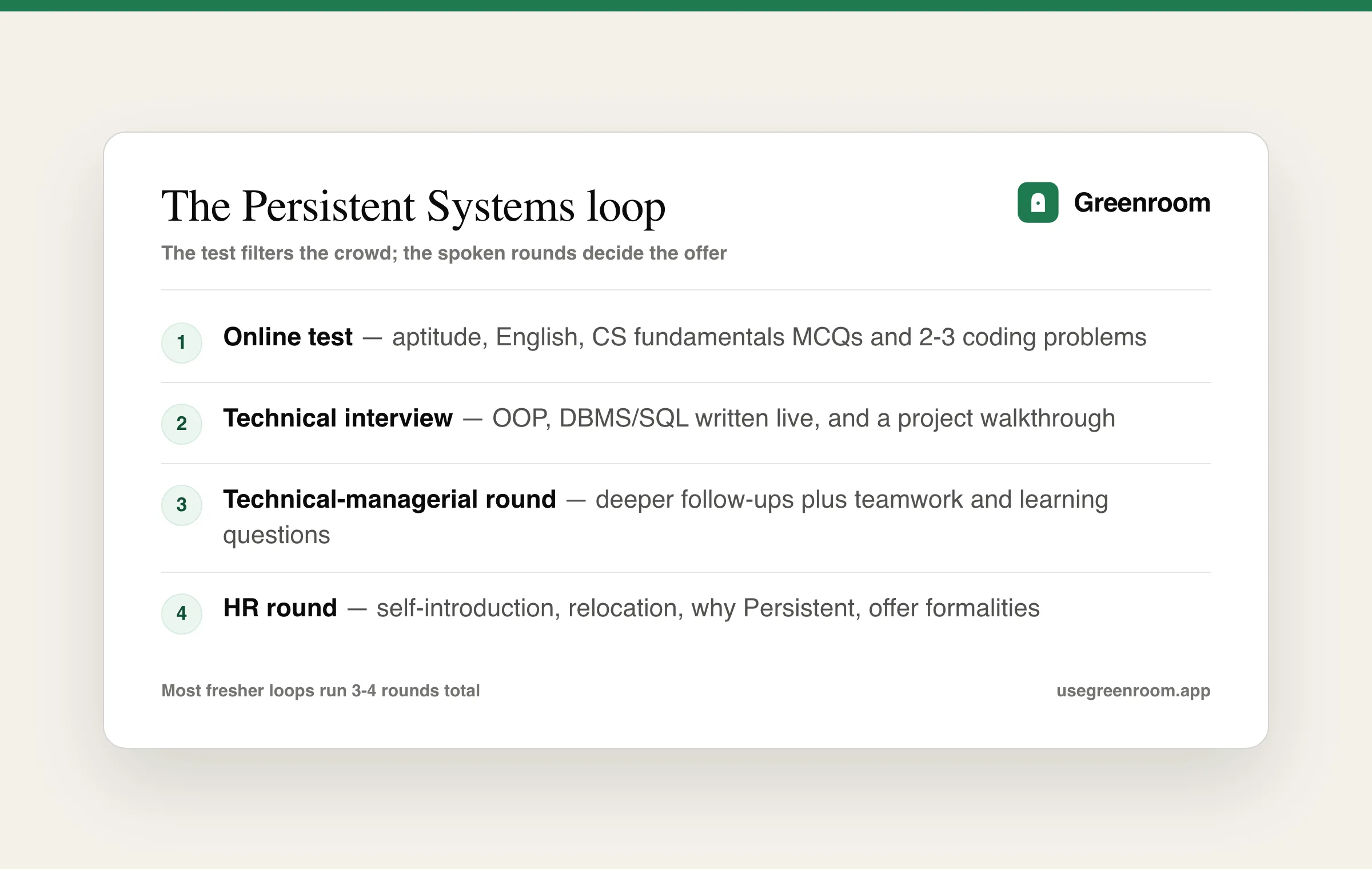
Reported campus and off-campus drives follow this shape:
- Online test: aptitude and logical reasoning, English, CS fundamentals MCQs (data structures, OOP, DBMS, OS, networks), and 2–3 coding problems, typically easy-to-medium.
- Technical interview: programming fundamentals in C/C++/Java or Python, OOP concepts, DBMS and SQL queries written live, and a detailed walkthrough of your final-year project.
- Technical-managerial round — some loops add a second, deeper round mixing technical follow-ups with questions about teamwork and learning.
- HR round: self-introduction, relocation and shift flexibility, why Persistent, and offer formalities.
That's 3–4 rounds total for most freshers. The pattern candidates consistently report: the online test eliminates the majority, so people over-prepare for it and walk into the technical interview under-rehearsed — which is backwards, because the interview is where the real selection happens.
Persistent Systems coding questions
The coding section and the live-coding moments in the technical round stick to fundamentals. Frequently reported problems:
- String manipulation: reverse words in a sentence, check for palindromes and anagrams, find the first non-repeating character.
- Arrays: second-largest element, move zeroes to the end, two-sum style pair finding, simple matrix traversals.
- Recursion and patterns: Fibonacci, factorial, star/number pattern printing (yes, still, in 2026).
- SQL, written live: joins across two tables, second-highest salary, GROUP BY with HAVING.
Technical interview questions for freshers
This round is a conversation, not a quiz, and it circles four territories:
- OOP — the four pillars with your own examples; the difference between abstraction and encapsulation; method overloading vs overriding; why composition over inheritance.
- DBMS and SQL: normalization up to 3NF in plain words, ACID properties with a story for each, DELETE vs TRUNCATE, what an index actually does.
- OS and networks basics: process vs thread, deadlock conditions, what happens when you type a URL and press Enter.
- Your project, the deepest section. Why this tech stack? What was the hardest bug? What would you change now? If a teammate wrote a module, expect the interviewer to detect it in one question.
Our guide on how to explain your project in an interview covers the structure that survives this grilling. The one-line summary: rehearse your project as a story with decisions in it, not a list of technologies.
HR interview questions at Persistent Systems
The HR round is genuinely evaluative for communication, not a rubber stamp:
- Tell me about yourself — 60–90 seconds, structured; our self-introduction guide for freshers has the template.
- Why Persistent Systems? — know that it's a product engineering services company (it builds software for product companies), so "I want to work on real products end to end" lands better than generic IT-services lines.
- Are you open to relocation and flexible shifts? — Pune, Nagpur, Goa, Bengaluru, Hyderabad are common bases; a hedged answer here has sunk otherwise-cleared candidates.
- Where do you see yourself in five years? and a stress-check question or two.
GeeksforGeeks PDFs, YouTube, ChatGPT: where each fits
The honest map of the standard fresher prep stack against this loop:
- GeeksforGeeks interview experiences — the best free source for recent Persistent drive patterns and actual asked questions; read five experiences and the shape becomes obvious.
- The WhatsApp PDF: fine as a checklist of topics, useless as preparation, because Persistent's interviewers ask the follow-up behind each question and the PDF only has the front.
- YouTube placement-prep channels, good for aptitude section tricks and test-pattern walkthroughs before the online test.
- ChatGPT —genuinely useful for generating follow-up questions on your own project ("ask me five hard questions about a students attendance app built with Flask")— but you'll type answers, and this interview is spoken.
- Greenroom, the spoken layer. Ari, the AI interviewer, runs the technical and HR rounds out loud, asks the "why" follow-ups behind OOP and DBMS answers, and grills your project the way a Persistent panel does. So the first time you explain normalization aloud isn't in the real interview.
How to prepare for the Persistent Systems interview
- Days 1–4: online test prep: aptitude speed drills (our aptitude test preparation guide covers the section pattern), plus 20–30 easy coding problems in your strongest language.
- Days 5–8: fundamentals out loud: explain OOP pillars, ACID, normalization, and process-vs-thread to a wall, a friend, or Ari, until the words come without loading time.
- Days 9–11: project deep-dive — write down every decision in your project and the reason for it; rehearse the two-minute walkthrough and the ten-minute grilling.
- Days 12–14: full spoken mocks: one technical, one HR, treating the campus placement interview guide as the master checklist.
If you're running a multi-company placement season, the fundamentals overlap heavily: our Infosys interview questions guide and TCS NQT guide cover the neighboring mass-recruiter loops, and the differences are mostly in test pattern, not syllabus.
Frequently asked questions
What questions are asked in a Persistent Systems interview?
The online test covers aptitude, English, CS fundamentals MCQs, and 2–3 coding problems. The technical interview focuses on OOP concepts with your own examples, DBMS and SQL written live, OS and networking basics, and a detailed walkthrough of your final-year project. HR asks about self-introduction, relocation, and why Persistent.
How many rounds are there in the Persistent Systems interview process?
Most fresher loops run 3–4 rounds: an online test (aptitude, English, CS fundamentals, coding), a technical interview, sometimes a combined technical-managerial round, and an HR round.
Is the Persistent Systems interview easy for freshers?
The coding bar is deliberately reachable, easy-to-medium problems and fundamentals rather than trick questions. The real filter is the spoken technical round: candidates who can only recognize correct answers, rather than explain OOP, SQL, and their own project out loud, are the ones who don't convert the interview.
What coding questions does Persistent Systems ask?
Frequently reported problems include string reversal and palindromes, anagram checks, first non-repeating character, second-largest element in an array, pattern printing, Fibonacci with recursion, and SQL queries like second-highest salary and joins with GROUP BY.
What is asked in the Persistent Systems HR round?
A structured self-introduction, why Persistent Systems, openness to relocation across its India offices and flexible shifts, five-year plans, and a communication check: it's genuinely evaluative, not a formality, so rehearse it as seriously as the technical round.
How should I prepare for the Persistent Systems interview in two weeks?
Spend the first four days on aptitude and easy coding problems for the online test, the next four explaining OOP, DBMS, and OS fundamentals out loud, three days deep-diving your project and the decisions behind it, and the final days on full spoken mock interviews — one technical, one HR.