---
title: How to Prepare for a Mock Interview (2026): The Complete Prep Guide
description: How to prepare for a mock interview so it actually transfers to the real one — what to practice, the mistakes that waste a session, and how to use feedback like data instead of a verdict.
url: https://usegreenroom.app/blog/how-to-prepare-for-a-mock-interview
last_updated: 2026-06-21
---
← Back to blog
Interview prep
# How to prepare for a mock interview
June 21, 2026 · 27 min read
You booked the mock interview three days ago, fully intending to "prep a little" before it. It is now 11:47pm the night before, you have seventeen browser tabs open — a LeetCode problem, a Glassdoor thread from 2019, a YouTube video titled "I CRACKED GOOGLE IN 3 DAYS," and a Notion doc with the heading "STAR METHOD???" and nothing underneath it — and you have learned precisely nothing except that your laptop fan can, in fact, get louder than you thought. You close the tabs. You tell yourself you'll "just wing it" and let the mock interview itself be the practice. Then the mock interviewer asks "tell me about a time you disagreed with a teammate," and you produce forty-five seconds of the verbal equivalent of a buffering icon.
Here's the part nobody tells you: that's not a personality flaw. That's what happens to **everyone** who shows up to a mock interview with zero prep and treats it as a pop quiz instead of a rehearsal. A mock interview is the one form of interview practice that gives you a second chance immediately — but only if you walk in with something to test, and walk out knowing what to fix. Most people skip both halves. They show up unprepared, get understandably mediocre feedback, and conclude "I'm just bad at interviews," when the real lesson was "I didn't prepare for the practice."
This guide is about **how to prepare for a mock interview** the right way — not just how to survive one, but how to set it up so the 30-45 minutes you spend actually move the needle on the real thing. We'll cover what to decide before you book the session, what to bring into it, the specific mistakes that turn a mock interview into a wasted hour, how to actually use the feedback you get afterward, and a realistic week-by-week plan for layering mocks into your prep instead of doing one in a panic the night before.
## What a mock interview is actually testing (it's not what you think)
Most candidates think a mock interview is testing whether they "know the answer." It mostly isn't. If you've studied the material, you probably *do* know the answer — somewhere in your head, in fragments, in the right general shape. What a mock interview actually tests is whether you can **retrieve and structure that answer out loud, in real time, while someone is watching you think and occasionally interrupting with a follow-up you didn't expect.**
That's a completely different skill from knowing the material, and it's the skill that real interviews score you on. An interviewer never asks "do you understand closures?" as a yes/no question — they ask you to *explain* closures, watch how you organize the explanation, and then poke at the edges with "okay, but what if the outer function ran twice?" The first time you discover you can't actually produce a clean explanation of something you "know," should be in a mock interview that doesn't count — not in the actual interview that does.
This is also why **reading** about interview prep — blog posts (yes, including parts of this one), flashcards, a friend's notes — caps out fast. Reading builds recognition. Recognition feels like competence right up until someone asks you to produce the thing live, and you realize recognizing an answer and generating one from scratch under mild social pressure are not the same muscle. Mock interviews are the only widely available way to train the actual muscle being graded.
## Decide what you're testing before you book the session
The single biggest preparation step happens *before* the mock interview even starts, and almost everyone skips it: deciding what this specific session is for. A 30-45 minute mock interview is not long enough to test "everything." If you walk in with a vague goal like "get better at interviewing," you'll get a vague, unfocused session and vague, unfocused feedback. If you walk in with a specific goal, you get specific, actionable feedback — and that's the entire value of the exercise.
Pick one focus per mock session from a list like this:
- **A weak question type.** Behavioral questions still rattle you. Or you freeze on "walk me through a project." Or system design questions make you panic and start drawing boxes with no plan.
- **A specific round format.** You have a system design round next week and have never done one out loud. Book a mock that simulates exactly that round, not a generic technical chat.
- **A communication habit.** You know you ramble, or you go silent while thinking, or you never signpost ("there are three approaches here..."). Ask your mock interviewer (or set your AI mock interviewer) to specifically flag this.
- **A specific project or resume line.** You have one bullet point on your resume you've never actually had to defend out loud, and you're nervous about it. Use the mock to stress-test exactly that bullet.
- **Timing and pacing.** You consistently run long on the first question and rush the last two. A mock interview is the cheapest way to discover this before it costs you a real offer.
If you can't articulate the goal in one sentence before you start, you're not ready to start. Spend five minutes writing that sentence down — "this session is about whether I can explain my recommendation-system project to someone who's never seen the code" — and the whole session gets sharper, including the part where you grade your own performance afterward.
## What to actually bring into a mock interview
"Prep" for a mock interview doesn't mean cramming new material — it means showing up with the *raw material* you'll need to perform well, organized enough that you're not improvising from scratch live. Here's the actual checklist, in priority order.
### 1. Your two or three flagship stories, pre-shaped
You don't need fifty STAR stories memorized. You need two or three real situations from your work or projects that you can reshape to answer most behavioral prompts — a hard bug, a disagreement, a deadline crunch, a time you were wrong. Know the shape of each one (situation, your specific action, the measurable result) well enough that you're not *inventing* the story live, only *adapting* its framing to whatever the question actually asked. If this is your weak spot specifically, our [guide to behavioral interview questions and answers](/blog/behavioral-interview-questions-answers-software-engineer) has a deeper breakdown of which stories map to which prompts.
### 2. A clean two-minute summary of your most defensible project
Pick the project you can talk about longest without running out of true things to say, and rehearse a two-minute version: what it did, why it existed, the one decision you'd defend, and the thing you'd change with more time. Mock interviewers — and real ones — almost always ask about a project from your resume, and "walk me through it" is a far worse question to improvise live than it looks. See [how to explain your project without rambling](/blog/how-to-explain-your-project-in-an-interview) if this is where you tend to lose the thread.
### 3. The actual job description or round format you're targeting
A generic mock interview is better than nothing, but a mock interview *targeted* at the actual role and round you're prepping for is dramatically more useful. If round two is a system design round, tell your mock interviewer that. If you're prepping for a specific company's loop, mention it — many AI mock interview tools, including Greenroom, let you specify the company and role so the questions and follow-ups resemble the real thing instead of a generic technical-question grab bag.
### 4. A notebook or notes app open, ready for feedback — not during, after
Don't try to take notes mid-answer; it breaks your flow and looks (and feels) exactly as distracted as it is. Keep a notes app open and jot a one-line flag the moment something feels off — "rambled on Q2," "forgot the result/impact part of that story" — then expand on it properly once the session ends, while it's still fresh.
### 5. A quiet space and your camera on, even if it's "just practice"
If your actual interview will be on video, your mock should be too. Practicing audio-only when the real thing is on camera means you never rehearse the part where your hands fidget, your eye contact drifts to your notes, or your face does something unflattering when you're thinking hard. The mock interview is supposed to surface exactly these gaps while they're still cheap to fix.
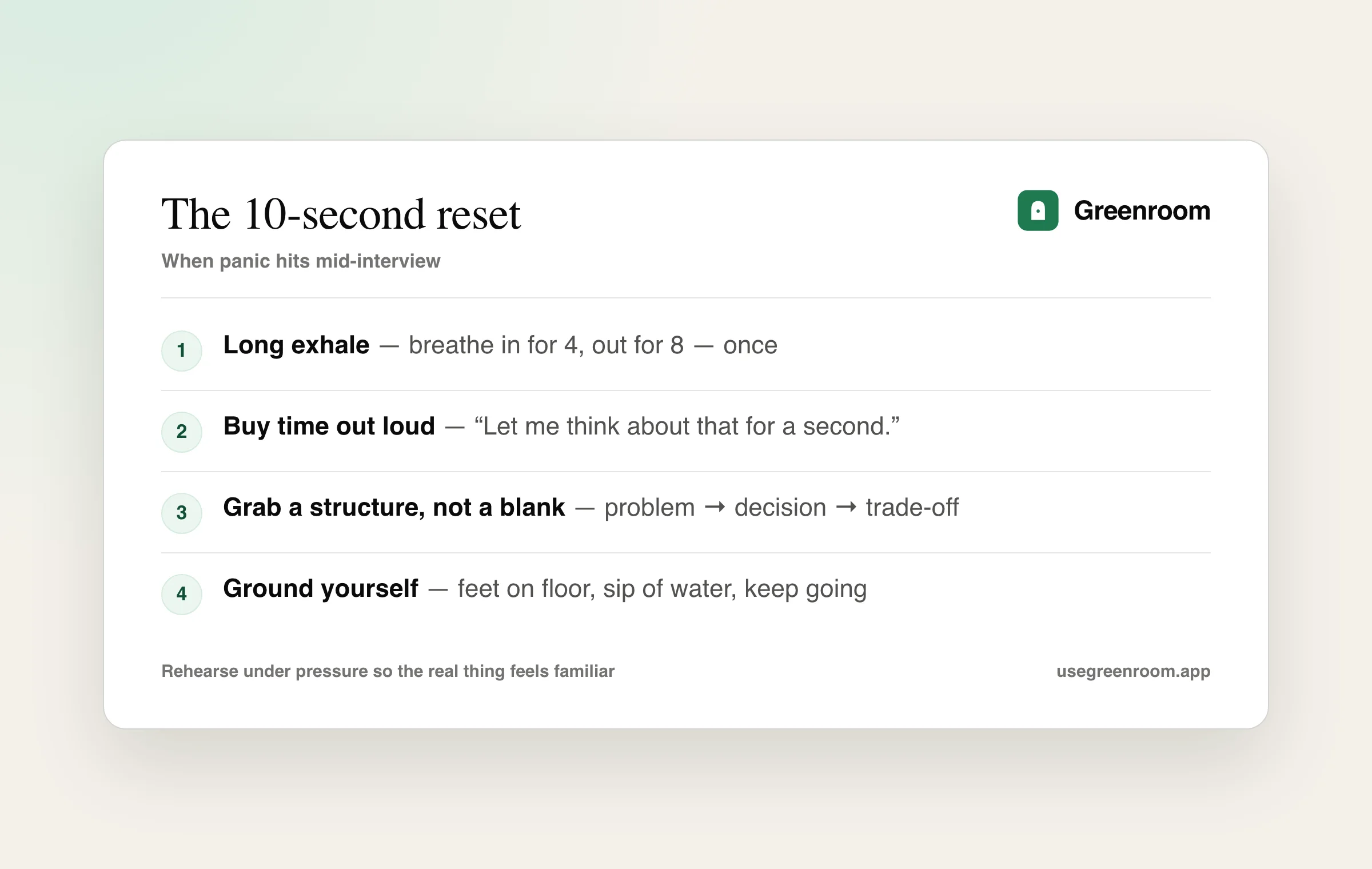
A five-minute checklist before you start beats an hour of vague "prep" the night before.
## The mistakes that quietly waste a mock interview
Most of the value lost in mock interview prep doesn't come from skipping it — it comes from doing it in a way that *feels* productive but isn't. Here are the specific mistakes worth checking yourself against.
### Treating the mock as a performance instead of a rehearsal
If your only goal walking in is "do well," you'll unconsciously steer toward questions and topics you're already comfortable with, dodge the uncomfortable follow-up, and walk away with a confidence boost and zero new information. The goal of a mock interview is the opposite of a real interview's goal: in a real interview you want to look good; in a mock interview you want to **find the cracks** while there's no cost to finding them. If a mock interview feels easy and validating the whole way through, you probably picked the wrong difficulty or the wrong interviewer, not because you're actually ready.
### Skipping mocks until you "feel ready"
This is the most common mistake by far, and it's backwards. You don't do mock interviews *after* you feel ready — you do them specifically *because* you don't feel ready, to find out which parts of "not ready" are real gaps and which are just nerves. Waiting until you feel prepared means you only ever rehearse material you've already mastered, which is the least useful thing a mock interview can do. The candidates who improve fastest run their first mock interview embarrassingly early, while they're still bad at it, because that's when the data is most valuable.
### Doing only one mock and extrapolating
One mock interview tells you about one performance, on one day, against one set of questions, possibly while you had a cold or didn't sleep well. It does not tell you "I'm ready" or "I'm hopeless" — it tells you what happened in those 30 minutes. Patterns only show up across **multiple** sessions: if you ramble on behavioral questions in mock one, mock three, and mock five, that's a real pattern worth fixing. If you rambled once and were crisp the other four times, that one off session was noise, not signal.
### Picking a mock partner (or tool) who's too nice
A friend who knows you and likes you will, almost without exception, soften feedback. "That was pretty good, maybe just a bit more detail" is friendlier and far less useful than "I lost track of your point around the 90-second mark and don't think I could repeat your conclusion back to you." If you're practicing with a friend, explicitly ask them to be harsh and specific, and tell them you won't take it personally — most people need that permission stated out loud before they'll actually give honest feedback. This is one reason a [structured AI mock interview](/blog/can-chatgpt-do-mock-interviews) can outperform a well-meaning friend: it has no social cost to being blunt.
### Memorizing scripts word-for-word
A memorized script sounds memorized — flat delivery, no natural pauses, and it shatters completely the moment a follow-up question doesn't match the script you rehearsed. What you actually want to rehearse is the **shape** of an answer (situation → action → result, or problem → approach → trade-off) loosely enough that you can re-fill it live with whatever the real question actually asked. Mock interviews are where you discover the difference between "I have a script" and "I have a structure I can adapt" — and only the second one survives a real interviewer's curveball.
### Ignoring the warm-up question
Candidates routinely treat the first, easiest question — "tell me about yourself," "walk me through your background" — as a throwaway, and wing it badly, then lock in and perform well on the harder questions after. This is exactly backwards: the warm-up question sets the interviewer's first impression and is one of the most heavily over-indexed-on moments of the whole interview, precisely because it's the one part every candidate assumes doesn't matter. If "tell me about yourself" is shaky for you, that's worth fixing before any harder material — we cover the structure in [how to answer "tell me about yourself"](/blog/how-to-answer-tell-me-about-yourself-software-engineer).
## How to actually use mock interview feedback
This is the part most prep advice skips entirely, and it's the part that actually determines whether mock interviews help you. Getting feedback and *using* feedback are different skills, and the gap between them is where most of the value of mock interviewing quietly leaks away.
### Separate "what happened" from "how it felt"
Right after a mock interview, your emotional read ("that was a disaster," "I think that went great") is almost always less accurate than the actual transcript or recording. Nerves distort self-assessment in both directions — some people feel terrible after a perfectly fine answer because they remember the one stumble, and some people feel great after a vague, padded answer because it *felt* fluent while they were saying it. Don't trust the vibe. Watch the recording, or read the transcript and any structured feedback, before you decide how it actually went.
### Look for patterns across sessions, not verdicts within one
A single piece of feedback — "you went a bit long on that answer" — is a data point, not a verdict. The useful move is to keep a running list across every mock interview you do: a simple doc with one line per session, noting the one or two things flagged each time. After three or four sessions, you'll see real patterns: "I get flagged for rambling specifically on technical explanations, not behavioral ones" is a far more useful and fixable insight than "I ramble," and you'd never see it from a single session.
### Fix one thing per round, not five
Feedback from a thorough mock interview can list five things to improve, and the instinct is to try to fix all five in the next session. In practice this produces a stiff, overthought performance where you're juggling five mental notes instead of actually answering the question. Pick the single highest-impact item — usually the one that came up across multiple sessions, not the one that just happened to get mentioned — and drill only that for your next round. Once it's fixed, move to the next item on the list.
### Re-test the same weak spot, don't just move on
If a mock interview reveals you ramble on system-design trade-off questions specifically, the next useful session is **another system-design mock**, not a different topic entirely. It's tempting to move on to a "fresh" area because revisiting your weak spot feels repetitive and a little demoralizing. But the entire point of identifying a specific gap is to close it, and closing it requires testing the same gap again until the feedback changes. Variety feels productive; repetition on the actual weak spot is what produces improvement.
### Distinguish content gaps from delivery gaps
When a mock interview goes poorly, ask which kind of problem it was: a **content** gap (you genuinely didn't know the technical answer) or a **delivery** gap (you knew it, but couldn't organize or articulate it cleanly under pressure). These need completely different fixes. A content gap means go study the material — read the doc, work the problem, watch the official explainer. A delivery gap means do another mock interview on the same topic, because more reading won't fix a retrieval-and-structure problem; only more retrieval practice will. Most candidates default to "go study more" for everything, which is the right fix for maybe half of what actually goes wrong in a mock interview.
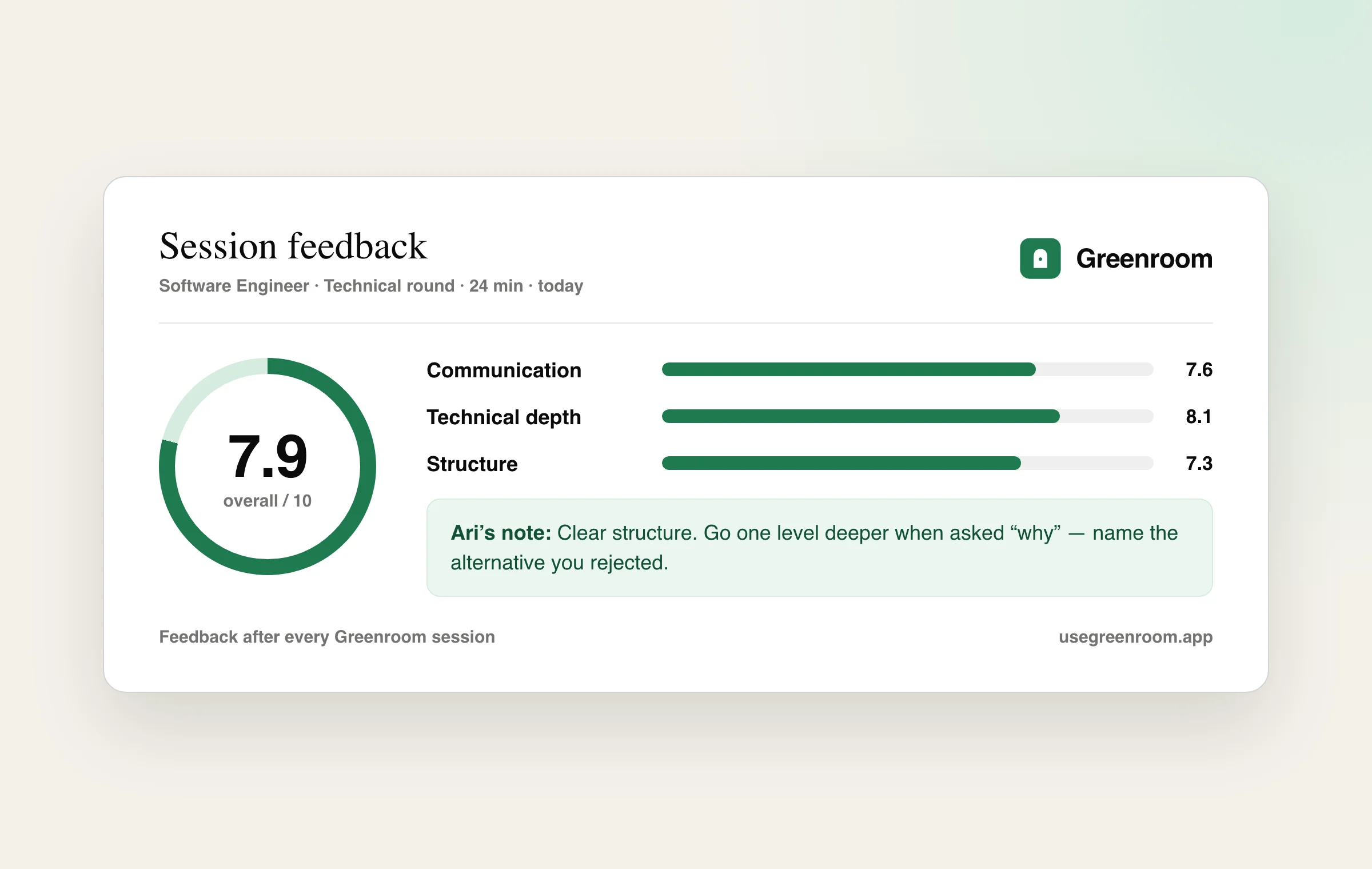
Specific, written feedback you can revisit beats a vague verbal "that was good, keep going."
## Mock interviews vs. the alternatives — an honest comparison
There's no shortage of ways to "prepare" for an interview that *aren't* a mock interview, and most candidates use a mix of all of them. Here's an honest look at where each one actually helps, and where it quietly doesn't.
**Reading question dumps (GeeksforGeeks-style lists, a friend's WhatsApp-forwarded PDF of "Top 50 Questions"):** These are genuinely useful for one thing — building awareness of *what topics exist*. They're close to useless for the skill that actually gets scored, because reading a question and its answer trains recognition, not live retrieval and delivery. If your only prep is a question dump, you'll recognize every question in the real interview and still struggle to produce a clean answer to half of them, because you've never had to generate one out loud under any pressure at all.
**LeetCode / pure coding-problem grinding:** Excellent, close to mandatory, for the specific skill of solving algorithmic problems under time pressure — and a genuinely different skill from interview communication. The well-known failure mode, which interviewers see constantly, is the candidate who solves the problem correctly in total silence and then can't explain their own approach when asked. LeetCode trains the "solve" half; a mock interview is what trains the "narrate your thinking out loud while solving" half, which is the half that's actually being graded in a live interview.
**Peer mock platforms (Pramp, interviewing.io):** Genuinely valuable — a real human, often another candidate or working engineer, giving real-time reactions and follow-ups. The tradeoffs: scheduling two calendars is real friction, session quality varies a lot by partner (a generous partner teaches you less than a sharp one), and peer platforms are mostly oriented around coding-interview practice specifically, less so behavioral or domain-specific rounds. They're a strong complement to other prep, not a complete replacement.
**ChatGPT / generic AI prompting:** Works better than most people expect for generating practice questions and explaining concepts, and we've written a [full breakdown of what ChatGPT can and can't do as a mock interviewer](/blog/can-chatgpt-do-mock-interviews). Where it tends to fall short for live mock practice specifically: it's text-first (so you're typing, not speaking, unless you set up voice mode deliberately), it doesn't naturally interrupt with the kind of unpredictable, slightly adversarial follow-up a real interviewer throws in, and it has no memory of how your *delivery* — pacing, filler words, structure — is trending across sessions unless you ask it to track that yourself.
**A friend or mentor doing a mock interview with you:** Real human reactions and real follow-ups, for free, which is genuinely valuable. The honest tradeoff: as mentioned above, social dynamics make most friends soften feedback, scheduling is real friction, and most friends aren't trained interviewers, so the follow-up questions may not resemble what an actual interview loop would ask.
**Paid mock interview services (Exponent, a coach):** Real, experienced interviewers, often from the exact company or domain you're targeting, which buys you authenticity a generic mock can't. The tradeoff is straightforwardly cost and scheduling — a single session can run $100-300+, which makes "do five of these to find a pattern" expensive in a way it isn't with cheaper or unlimited alternatives.
**AI voice mock interviewers (Greenroom and similar tools):** The pitch is the middle ground — unlimited, scheduled-on-your-own-time, **spoken** (not typed) practice with realistic follow-up questions and structured feedback you can track across sessions, without the cost of a human coach or the social softness of a friend. [Greenroom](/) specifically runs spoken mock interviews tailored to a target role or company, asks real follow-ups on your actual project and GitHub history, and gives you feedback you can compare session to session — which is exactly the "find the pattern across multiple mocks" workflow this guide keeps coming back to. The honest tradeoff versus a real human: it can't replicate the exact unpredictable personality quirks of one specific interviewer at one specific company the way a coach who's interviewed there can — but it's far cheaper, available at 2am, and doesn't get tired of running your tenth session this week.
The realistic answer for most candidates isn't "pick one" — it's layering them: question dumps and reading for topic awareness, LeetCode for raw problem-solving reps, and mock interviews (AI, peer, or human) for the live retrieval-and-delivery practice that nothing else trains. The mistake is substituting the first two for the third and assuming reading is the same as rehearsing.
## A realistic plan for layering mocks into your prep
Mock interviews work best as a recurring rhythm, not a one-off the night before. Here's a realistic structure for the weeks leading up to a real interview, assuming you have at least three to four weeks of runway.
### Weeks 1-2: low-stakes, broad mocks
Run one or two mock interviews per week, deliberately easier than what you expect the real interview to be, covering a broad mix of question types rather than one narrow focus. The goal here isn't performance — it's discovery. You're trying to surface which areas are shaky before you've committed to a specific narrow drilling plan. Expect these to feel rough. That's the data working as intended, not a bad sign.
### Weeks 2-3: targeted mocks on your two or three weakest areas
Once you have a pattern from the broad mocks (say: behavioral answers run long, and system design trade-offs feel unstructured), shift to mocks specifically targeting those two things, ideally back to back across multiple sessions so you can watch the same weak spot improve session over session. This is the highest-leverage phase — it's where the "fix one thing, re-test the same thing" loop from the feedback section above actually compounds.
### Week before: format-matching mocks, full dress rehearsal
In the final week, shift the mocks to match the *exact* format of the real interview as closely as possible — same round types, same rough time limits, camera on if the real thing is on camera, same level of difficulty you expect to face. This is also when to do at least one full back-to-back simulation of the entire loop if it's a multi-round process, since stamina and pacing across multiple rounds back-to-back is its own skill that a single isolated mock never tests. Our [week-before-the-interview checklist](/blog/week-before-interview-checklist) covers the rest of this window beyond just the mocks themselves.
### The 48 hours before: one light confidence-building mock, then stop
Do one final, lighter mock interview — something closer to a warm-up than a stress test — at most two days before the real thing, then stop drilling new material entirely. The 24 hours immediately before a real interview should be about rest, logistics, and light review of your own flagship stories, not cramming new content or running an exhausting mock that leaves you mentally fried for the interview that actually counts.
The core truth: A mock interview doesn't prepare you by existing — it prepares you by the specific gap it reveals and what you do with that gap afterward. Walking in with a clear goal and walking out with one concrete fix, repeated across several sessions, beats a dozen unfocused mocks done "just to practice."
## Mindset: what to actually feel going into a mock interview
The nerves before a mock interview are real, even though "it doesn't count." That's not irrational — your brain treats being evaluated, even in a low-stakes practice setting, with some of the same physiological response as the real thing, which is part of why mock interviews are useful: they train your nervous system to perform under a milder version of the same pressure. A few reframes that help:
**You're not being graded — you're collecting data.** The outcome of a mock interview isn't pass/fail; it's information you didn't have before. A "bad" mock interview that surfaces a real, fixable gap two weeks before the actual interview is a far better outcome than a flawless mock interview that taught you nothing, because flawless usually means you picked questions you'd already mastered.
**Discomfort during the mock is the point, not a sign you're doing it wrong.** If a mock interview never feels uncomfortable, you're probably not pushing into your actual weak spots. The mild dread of "I don't fully know how I'm going to answer this" is exactly the state real interviews put you in — better to feel it for the first time here than in the room that counts.
**One bad mock interview is not a referendum on whether you'll get the job.** It's tempting to spiral from "that mock went badly" to "I'm not going to get an offer," but a single session, on a single day, says very little. If you find yourself spiraling after a rough mock, that's worth naming directly — our guide on [dealing with interview anxiety](/blog/how-to-deal-with-interview-anxiety) covers the broader version of this, and it applies just as much to practice sessions as real ones.
**If you blank mid-mock, that's the best place to learn how to recover.** Going blank for a few seconds happens to almost everyone eventually, in practice or for real, and the actual skill being tested is the recovery, not the avoidance. A mock interview is the cheapest possible place to practice the recovery — see [the blank-mid-interview recovery playbook](/blog/recover-from-blanking-in-interview) for the specific moves.
## Building a feedback log that actually compounds
Almost everyone who does multiple mock interviews intends to "remember the patterns," and almost no one actually does, because human memory of "how that session felt" decays within days and gets overwritten by the next session's feelings. The fix is mechanical, not motivational: keep one running document — a spreadsheet, a Notion page, even a single long note — and add exactly one entry after every mock interview, no exceptions, before you let yourself close the tab.
A useful entry is short and structured the same way every time:
- **Date and focus.** What this session was specifically testing.
- **What actually happened.** One or two sentences, written from the recording or transcript, not from memory or vibes.
- **Content gap or delivery gap?** Which bucket the main issue fell into, per the distinction above.
- **The one fix.** A single, concrete next action — "reread consistent hashing," "practice ending answers with a one-line summary instead of trailing off."
- **Carried over from last time?** Whether this is a new issue or a repeat of something flagged in an earlier session.
That last field is the one that actually matters most. The first time "rambles on technical explanations" shows up, it's a hypothesis. The third time it shows up, it's confirmed, and the fact that it kept recurring despite you "knowing about it" tells you the fix needs to be more deliberate than just being aware of it — maybe a hard rule like "every technical answer ends with one summary sentence," rehearsed enough times that it becomes automatic rather than something you have to consciously remember mid-answer under pressure.
This log is also the single best thing to skim in the 48 hours before a real interview. Instead of re-cramming content, you're reviewing a short, concrete list of your own specific failure patterns and their fixes — which is a far more efficient use of pre-interview anxiety-driven energy than rereading a textbook chapter you already understand.
## Common excuses for skipping mock interview prep (and why they don't hold up)
**"I'll just be more careful in the real interview."** Being "more careful" isn't a skill you can deploy on demand under pressure if you've never practiced it; it's a sentence that sounds like a plan but isn't one. The candidates who stay calm and structured in real interviews are almost always the ones who got uncomfortable enough times in low-stakes mock interviews that the discomfort stopped being novel.
**"Mock interviews feel artificial, so they won't transfer."** Some artificiality is unavoidable — a mock interviewer usually isn't deciding your actual employment — but the skill being trained (retrieving and structuring an answer out loud, live, under mild evaluation) transfers almost completely, because that skill doesn't actually care whether the stakes are real. Athletes run drills against no real opponent for the same reason: the specific movement pattern being trained doesn't require game conditions to improve.
**"I don't have time for mock interviews on top of studying the material."** This usually reflects a miscalibration of where the actual gap is. If you've already studied the material reasonably well, additional reading has diminishing returns, while the same 30 minutes spent on a mock interview targets the retrieval-and-delivery gap directly — which, for most candidates past a baseline level of preparation, is the larger remaining gap, not the content itself.
**"I'll do mock interviews once I'm closer to the actual interview date."** This is the "wait until I feel ready" mistake in a different costume. Mock interviews are most valuable early, specifically because they're cheap to run when you're still rough — the earlier you find a gap, the more runway you have to actually close it before it matters.
**"One mock interview should be enough to tell me where I stand."** As covered above, a single session is one noisy data point. Treating it as a verdict — in either direction — is the single fastest way to either overestimate your readiness off one lucky session, or spiral after one unlucky one that doesn't represent your actual baseline.
## How mock interview prep differs by interview type
The core loop — define a goal, bring the right raw material, run the session, separate content from delivery gaps, log the one pattern, re-test it — stays the same across interview types, but what you actually bring into the mock changes.
**Behavioral interviews:** Bring two or three real stories, loosely shaped (situation, your specific action, the measurable result), not memorized word for word. The thing mock interviews surface fastest here is *length* — most people's first instinct is to ramble for three or four minutes on a story that should take ninety seconds, and you genuinely cannot feel this happening from the inside without hearing it back.
**Technical / coding interviews:** Bring your problem-solving process, not pre-solved problems — the value of the mock is practicing narrating your thinking *while* you work through something you haven't fully solved yet, since that's exactly the condition the real interview puts you in. If you walk in having already solved the exact problem beforehand, you're rehearsing presentation of a known answer, not the harder skill of live problem-solving narration.
**System design interviews:** Bring the framework (clarify requirements, then data flow, storage, scaling, trade-offs), not a memorized design for a specific system, since the real question will almost never match a design you prepared in advance. The mock interview's job here is testing whether you can *drive* the conversation with that framework when the actual prompt is unfamiliar, which is the part static studying can't simulate.
**"Tell me about yourself" / intro questions:** Bring the present → past → future structure and rehearse it enough times that it stops sounding rehearsed — this is the question most candidates under-prepare specifically because it feels too easy to need practice, which is exactly why it's worth at least one full mock cycle of its own.
**Take-home or project-defense interviews:** Bring the actual project or code you'll be asked to defend, and use the mock specifically to rehearse explaining *decisions*, not just describing what the code does — interviewers in this format almost always probe "why this approach and not that one," and that's the question worth stress-testing live before the real defense.
## A worked example: prepping for one specific mock interview
To make this concrete, here's what "prepping for a mock interview" looks like end to end for someone with a system design round coming up in two weeks.
1. **Define the goal.** "This mock is specifically to test whether I can drive a system design conversation for 30 minutes without the interviewer having to rescue me with hints." One sentence, written down.
2. **Bring the right raw material.** Review the five-step framework once (clarify requirements, then work through data flow, storage, scaling, trade-offs) so it's fresh, but don't memorize a script — the mock is exactly where you test whether you can apply the framework live, not whether you can recite it.
3. **Pick the right difficulty and format.** Set the mock interviewer's prompt to a system design question roughly matching the seniority and domain of the real interview — not an easier warm-up version, since this specific session's goal is to stress-test the real skill.
4. **Run it with the camera on, in the actual room you'll likely interview from**, to also surface any environment problems (bad lighting, a whiteboard tool you've never used) while they're still cheap to fix.
5. **Immediately after, separate the content gaps from the delivery gaps.** Maybe the trade-off discussion was thin (content — go reread one specific topic) but the opening clarifying-questions phase was actually strong (delivery — no action needed there).
6. **Log one line in the running feedback doc.** "Mock 3: clarifying questions strong, trade-off depth on database choice weak — reread sharding patterns."
7. **Book the next mock to specifically re-test the trade-off depth**, not a fresh random topic.
That's the entire loop. It looks almost boringly procedural written out — and that's exactly why it works better than "do a mock interview and see how it goes," which has no goal, no structured comparison point, and nothing concrete to carry into the next session.
## Frequently asked questions
### How many mock interviews should I do before a real interview?
There's no universal number, but a useful floor is three to five spread across two to three weeks, since a single mock only shows you one performance on one day, and real patterns only emerge across multiple sessions. If you have a multi-round loop coming up (technical, system design, behavioral), aim for at least one or two mocks specifically targeting each round type rather than spreading generic mocks evenly.
### What should I do in the first five minutes of preparing for a mock interview?
Write one sentence stating exactly what this specific mock session is meant to test — a weak question type, a specific round format, a communication habit, or a particular project you're nervous about defending. A mock interview with a clear, narrow goal produces far more useful feedback than one approached as generic "practice."
### Is it better to do a mock interview with a friend, a paid coach, or an AI tool?
Each has real tradeoffs: a friend is free but tends to soften feedback and has scheduling friction; a paid coach or service like Exponent gives authentic, experienced human feedback but costs $100-300+ per session, which makes running several expensive; an AI mock interview tool like Greenroom is available on your schedule, lets you run enough sessions to spot real patterns, and gives consistent structured feedback, though it can't replicate one specific human interviewer's exact personality quirks. Most candidates get the most value layering more than one — for example, several AI mocks to build the underlying skill and pattern-track progress, plus one or two human mocks closer to the real interview for authenticity.
### What's the biggest mistake people make when preparing for a mock interview?
Treating the mock as a performance to pass rather than a rehearsal to find gaps in. This shows up as picking an easy difficulty, avoiding the topics you're actually nervous about, and walking away with a confidence boost instead of new information. The second most common mistake is doing only one mock interview and treating its outcome as a verdict on overall readiness, when a single session is one data point, not a pattern.
### How do I prepare for a mock interview if I only have one day?
Spend the limited time on the highest-leverage prep, not broad review: write the one-sentence goal for the session, rehearse the structure (not the script) of your one or two strongest stories, and skim the actual job description or round format you're targeting so the mock can mirror it as closely as possible. Skip trying to "study everything" — a focused, slightly underprepared mock interview that surfaces one real gap is more useful than a frantic cram session that leaves you exhausted going in.
### Should I take notes during a mock interview or wait until after?
Wait until after, or limit yourself to one-line flags in the moment ("rambled on Q2") rather than detailed notes. Taking real notes while you're supposed to be answering breaks your flow and trains a habit you don't want in the real interview, where stopping to write isn't an option. Do the full debrief — watching the recording or reading feedback closely — immediately after the session ends, while it's still fresh.
## What to do right after this mock interview ends
The mock interview itself is half the exercise. The other half — watching it back, separating content gaps from delivery gaps, logging the one pattern that matters, and booking the next session to specifically re-test it — is the part that actually compounds into being ready for the real thing. [Greenroom](/) runs spoken mock interviews tailored to your target role and company, with real follow-up questions on your actual projects and structured feedback you can track across sessions, so the pattern is visible instead of guessed at. Pair it with [how to practice mock interviews alone](/blog/how-to-practice-mock-interviews-alone) for the weeks when you don't have a session booked, and [coding-interview communication tips](/blog/coding-interview-communication-tips) if delivery, not content, is your actual gap.